
Erections change as men get older — that part is well established. What’s less clear to most men is where normal aging stops and erectile dysfunction starts. Research on this question spans decades of population studies, and the pattern it shows is consistent: erectile difficulty becomes more common with every passing decade, but “more common” isn’t the same thing as “normal” or “untreatable.” This guide walks through what the research actually shows, what changes naturally with age, and where the line sits between the two and is erectile dysfunction normal with age.
Does Erectile Dysfunction Get More Common With Age?
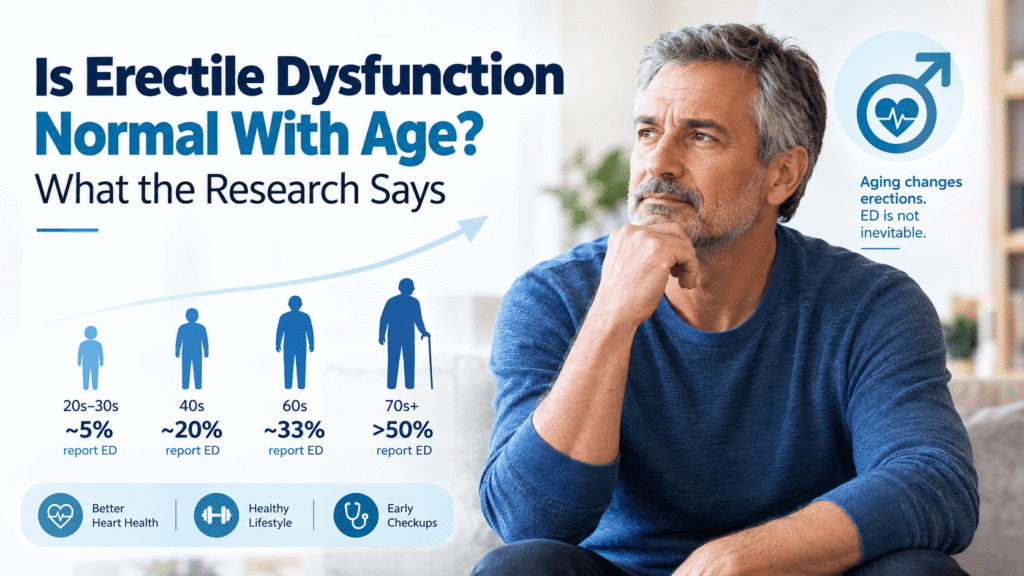
Yes, and the research on this is remarkably consistent across different studies and populations. Roughly 5% of men in their 20s and 30s report some degree of erectile difficulty. That number climbs to somewhere around 1 in 5 men by their 40s, closer to 1 in 3 by their 60s, and more than half of men by their 70s. Some of the largest long-term studies, which followed the same groups of men for years at a time, found that both the likelihood and severity of erectile difficulty rise steadily with age rather than appearing suddenly at any one cutoff point.
What this data doesn’t show is a single age where erectile dysfunction “starts.” Age is a strong statistical predictor of ED, but it’s not a direct cause on its own — it’s a stand-in for the physical changes and health conditions that tend to accumulate over time.
What Changes Naturally as Men Age
Some degree of change in erectile function is a normal part of getting older, separate from a diagnosable case of ED. With age, it’s common for erections to take longer to develop, to feel less firm than they did at 25, to require more direct physical stimulation, and to lose firmness more quickly after ejaculation. Refractory periods — the recovery time needed between erections — also tend to lengthen.
These changes happen gradually and don’t necessarily interfere with a satisfying sex life. They’re the result of normal shifts in blood flow, nerve sensitivity, and hormone levels that come with age, not a malfunction.
Where the Line Is: Normal Aging vs. Erectile Dysfunction
This is the distinction that gets lost most often. Slower, less rigid erections that still allow for satisfying intercourse are a normal aging change. The persistent inability to get or keep an erection firm enough for intercourse, happening consistently over weeks or months, is erectile dysfunction — regardless of the man’s age.
In other words, aging can make erections less automatic and less intense, but it doesn’t make satisfying sex impossible, and it doesn’t mean ED should be written off as something to just live with. A 70-year-old with persistent ED has just as much reason to get evaluated as a 40-year-old with the same symptoms.
What Causes ED to Increase With Age
Erectile dysfunction becomes more common with age largely because the underlying causes of ED become more common with age. A handful of overlapping factors are responsible for most of the increase.
Vascular and Heart-Related Changes
An erection depends on healthy blood flow into the penis. As men age, arteries naturally lose some elasticity and are more likely to develop plaque buildup, both of which restrict that blood flow. Because this is the same vascular system that supplies the heart, erectile difficulty often shows up before a cardiovascular diagnosis does.
Hormonal Changes
Testosterone levels decline gradually starting around age 30, typically by about 1% per year. Lower testosterone can reduce sexual desire and make erections harder to achieve, though hormonal decline alone rarely explains ED on its own — it usually compounds with vascular or lifestyle factors.
Nerve and Muscle Changes
Nerve signaling that triggers an erection can slow with age, and the muscles involved in achieving and maintaining an erection lose some responsiveness over time. This is part of why direct stimulation often becomes more necessary later in life.
Chronic Conditions Become More Common
Diabetes, high blood pressure, high cholesterol, and obesity all become more prevalent with age, and all of them are independently linked to higher rates of ED. Men managing more than one of these conditions tend to see a compounding effect on erectile function.
Medications Prescribed More Often With Age
Blood pressure medications, antidepressants, and other drugs more commonly prescribed to older adults can list erectile dysfunction as a side effect. This is worth raising with a doctor rather than assuming it’s unavoidable — alternative medications or dosing adjustments are sometimes an option.
ED by Age: What to Expect in Your 40s, 50s, 60s, and 70s
- 40s: Occasional erectile difficulty becomes noticeably more common, often linked to early cardiovascular risk factors, stress, or the first signs of declining testosterone.
- 50s: Erectile changes become more consistent for a meaningful share of men, frequently overlapping with new diagnoses like high blood pressure or prediabetes.
- 60s: A significant percentage of men experience at least moderate erectile difficulty, often tied to accumulated vascular changes and more medications in daily use.
- 70s and beyond: Erectile difficulty becomes the statistical norm rather than the exception, though many men in this age group remain sexually active and can still respond well to treatment.
Can Erectile Dysfunction Be Prevented or Slowed as You Age?
To a meaningful degree, yes. Because so much of age-related ED traces back to vascular health, the same habits that protect the heart tend to protect erectile function. Regular exercise, not smoking, maintaining a healthy weight, managing blood pressure and cholesterol, limiting alcohol, and getting consistent sleep are all linked to better erectile function later in life. None of these guarantee ED won’t develop, but they measurably shift the odds and often improve response to treatment when ED does occur.
When ED at Any Age Needs a Doctor’s Visit
Erectile difficulty is worth discussing with a doctor whenever it becomes persistent, regardless of age. It’s a good idea to schedule a visit if erections are consistently difficult to achieve or maintain over several weeks, if ED appears suddenly rather than gradually, or if it’s accompanied by low libido, fatigue, or other signs of a hormone imbalance. Because ED can be an early signal of cardiovascular disease, a new diagnosis is also a reasonable prompt to get blood pressure, cholesterol, and blood sugar checked.
An erection lasting longer than four hours without stopping is a medical emergency and needs immediate attention at an emergency room, not a routine appointment.
Frequently Asked Questions
Is erectile dysfunction normal at 60?
Occasional erectile difficulty is common at 60, but persistent ED still isn’t something to dismiss as inevitable. Treatment options are just as effective at 60 as they are at 40.
Is erectile dysfunction normal at 70?
It’s statistically common at 70 — more than half of men in this age group report some degree of erectile difficulty — but common doesn’t mean untreatable. Many men in their 70s respond well to standard ED treatments.
Does declining testosterone cause ED?
Low testosterone can contribute to ED, particularly by reducing sexual desire, but it’s rarely the sole cause. Vascular health, nerve function, and psychological factors usually play a role alongside hormone levels.
Does erectile dysfunction get worse with age if it’s left untreated?
It can, especially when an underlying cause like high blood pressure or diabetes is also going unmanaged. Addressing ED early, rather than assuming it will resolve on its own, tends to lead to better long-term outcomes.
Key Takeaways
- Erectile difficulty becomes statistically more common with every decade of life, but there’s no single age when ED “starts”
- Slower, less firm erections are a normal aging change; persistent inability to get or keep an erection is erectile dysfunction at any age
- Vascular changes, declining testosterone, nerve changes, and age-related health conditions are the main drivers behind rising ED rates
- Lifestyle habits that protect the heart also protect erectile function and can improve treatment outcomes
- Persistent ED at any age is worth a doctor’s visit — and an erection lasting over four hours needs emergency care

One thought on “Is Erectile Dysfunction Normal With Age? What the Research Says”