
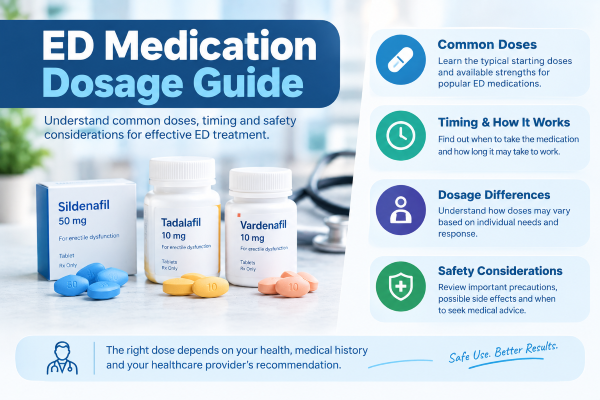
Every ED medication on the market has its own starting dose, its own ceiling, and its own set of rules for who needs to start lower. This ED medication dosage guide pulls the FDA-labeled starting doses, maximum doses, and dose-adjustment triggers for all four PDE5 inhibitors — sildenafil, tadalafil, vardenafil, and avanafil — into one place, so you know not just what your first dose should be, but exactly which factors would change it and why.
The Short Answer
Most ED medications start at a middle-of-the-range dose and get adjusted up or down based on how well they work and how they’re tolerated. Sildenafil (Viagra) typically starts at 50mg, tadalafil (Cialis) as-needed starts at 10mg, vardenafil (Levitra) starts at 10mg, and avanafil (Stendra) starts at 100mg. Four specific situations change that starting point before you’ve even taken a first dose: being 65 or older, having reduced kidney function, having liver impairment, or taking certain other medications, especially alpha-blockers. Beyond the starting dose, increases and decreases should go through a doctor rather than trial and error.
Starting Doses for All Four ED Medications
Here’s how the standard starting dose, maximum dose, and timing compare across all four PDE5 inhibitors when taken as-needed:
| Medication | Starting Dose | Max Dose | Taken Before Sex | Duration |
| Sildenafil (Viagra) | 50mg | 100mg | 30-60 min | ~4 hours |
| Tadalafil (Cialis) | 10mg | 20mg | 30-60 min | Up to 36 hours |
| Vardenafil (Levitra) | 10mg | 20mg | ~60 min | ~4-5 hours |
| Avanafil (Stendra) | 100mg | 200mg | ~15-30 min | ~6 hours |
Tadalafil is also available as a separate daily low-dose regimen (2.5mg to 5mg, taken every day rather than before sex) — a different enough approach that it deserves its own comparison rather than a single table row.
When Your Dose Gets Adjusted Downward
Four factors routinely move a starting dose lower before a first prescription is even filled. They don’t apply equally across medications, which is where a lot of the confusion comes from.
Age 65 and Older
- Sildenafil: starting dose is often lowered to 25mg due to higher drug exposure in older adults
- Vardenafil: starting dose is lowered to 5mg for the same reason
- Tadalafil and avanafil: no age-specific starting-dose change is built into the prescribing guidance, though prescribers often start conservatively anyway
Reduced Kidney Function
- Sildenafil: severe impairment (creatinine clearance under 30 mL/min) calls for a 25mg starting dose
- Tadalafil: moderate impairment caps as-needed dosing at 10mg every 48 hours and daily dosing at 5mg; severe impairment caps as-needed dosing at 5mg every 72 hours, and daily use isn’t recommended at all
- Vardenafil: no adjustment needed for mild-to-moderate impairment; avoided in severe impairment or dialysis
- Avanafil: no adjustment needed for mild-to-moderate impairment; not recommended in severe impairment
Liver Impairment
- Sildenafil: any degree of liver dysfunction calls for a 25mg starting dose
- Tadalafil: mild-to-moderate impairment is permitted with caution; severe impairment is not recommended
- Vardenafil: moderate impairment caps the dose at 5mg to start and 10mg maximum; severe impairment is avoided entirely
- Avanafil: no adjustment needed for mild-to-moderate impairment; not recommended in severe impairment
Alpha-Blockers and Other Interacting Medications
- Vardenafil: starting dose drops to 5mg for anyone also taking an alpha-blocker
- Avanafil: starting dose drops to 50mg on alpha-blocker therapy
- Tadalafil: strong CYP3A4 inhibitor medications cap as-needed dosing at 10mg every 72 hours and daily dosing at 2.5mg
- Sildenafil: certain interacting medications call for a lower starting dose, and nitrate medications remain an absolute contraindication regardless of dose
ED Medication Dosage Guide: When to Increase Your Dose
A starting dose isn’t always the dose that ends up working best, and that’s expected rather than a sign something is wrong. The usual process: give a dose several attempts under reasonable conditions — not immediately after a heavy meal for sildenafil, for instance, since food slows its absorption — before concluding it isn’t effective enough. If a starting dose consistently underperforms after a fair trial, a doctor will typically move to the next labeled step: sildenafil from 50mg to 100mg, vardenafil or tadalafil from 10mg to 20mg, or avanafil from 100mg to 200mg. None of these medications should be increased past their labeled maximum, since higher-than-approved doses haven’t been shown to add meaningful benefit and do add meaningful risk.
When to Decrease Your Dose or Stop Altogether
Dose reductions usually come down to tolerability rather than effectiveness. Flushing, headache, nasal congestion, and visual changes are the most common reasons a doctor steps a dose down rather than up. A new prescription for nitrates, a decline in kidney or liver function, or starting a new interacting medication can all trigger a lower dose even if the current one has been working fine. Some situations call for stopping rather than adjusting: chest pain during sexual activity, sudden vision loss or hearing loss, or an erection lasting more than four hours all need emergency medical attention rather than a wait-and-see approach.
Why You Shouldn’t “Double Up” on a Dose
Taking an extra pill because the first one didn’t seem to work, or combining two medications to try to boost the effect, is one of the more common and more risky habits around ED medication. PDE5 inhibitors have a ceiling effect — once you’re at the labeled maximum, taking more doesn’t meaningfully improve results, but it does meaningfully increase the risk of low blood pressure, flushing, and priapism. If a dose genuinely isn’t working, the right move is a conversation with a doctor about adjusting the prescribed dose or trying a different medication, not self-adjusting around the label.
Switching Between ED Medications: Does Dosing Carry Over?
No. Each PDE5 inhibitor has its own independent dosing scale based on its own chemistry, so there’s no proportional conversion between them. Someone taking sildenafil 100mg who switches to tadalafil doesn’t start at tadalafil’s maximum — they start at tadalafil’s own standard starting dose, typically 10mg, and adjust from there the same way a first-time user would. The dose that worked for one medication says very little about where you’ll land on a different one.
When to Talk to a Doctor
Any new ED medication, and any change to an existing dose, should go through a doctor rather than being adjusted independently. This matters even more for anyone with heart disease, kidney or liver conditions, or a medication list that includes nitrates or alpha-blockers, since these are exactly the situations where the standard starting dose doesn’t apply. It’s also worth a conversation any time a medication that used to work stops working as well — that’s often a dose or health-status change rather than a reason to simply take more.
Frequently Asked Questions
What is the standard starting dose for most ED medications?
It depends on the medication: sildenafil typically starts at 50mg, tadalafil and vardenafil at 10mg, and avanafil at 100mg. All four have lower starting doses for specific situations like age 65 and older, reduced kidney or liver function, or certain interacting medications.
How long do I need to try a dose before concluding it doesn’t work?
Most prescribers recommend several attempts under favorable conditions — not right after a heavy meal, not with excessive alcohol — before deciding a dose isn’t effective. A single disappointing attempt isn’t usually enough information to judge a dose by.
Can I increase my ED medication dose without talking to my doctor?
No. Doses should only go up through a doctor, both because exceeding the labeled maximum doesn’t add benefit and because the right next step depends on factors like kidney function, liver function, and other medications that a doctor needs to check first.
Why do seniors get a lower starting dose of ED medication?
Older adults tend to clear these medications from the body more slowly, which means the same dose produces higher drug levels than it would in a younger adult. Starting lower accounts for that difference before increasing if needed.
Key Takeaways
- This ED medication dosage guide covers starting doses of 50mg (sildenafil), 10mg (tadalafil and vardenafil), and 100mg (avanafil), each with its own labeled maximum
- Age 65+, reduced kidney function, liver impairment, and alpha-blocker use are the four main reasons a starting dose gets lowered
- Dose increases should follow a fair trial of the starting dose, not a single attempt, and should go through a doctor
- Doubling up on a dose doesn’t improve results once you’re at the labeled maximum — it only adds risk
- Switching medications means starting at the new medication’s own standard dose, not a dose based on what worked before
