
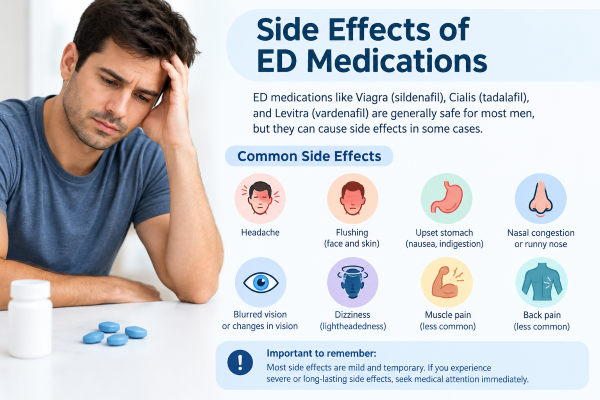
Most men who take an ED pill get through it with nothing worse than a mild headache or a flushed face. A small number run into something more serious, and the hard part is knowing which is which when it’s happening to you. The side effects of ED medications fall into three clear groups: the common ones you can ignore, the ones worth adjusting with your doctor, and a short list that means stop and get help right away. This guide sorts them using the numbers the FDA labels actually report, not vague “may cause” language.
The Short Answer
Headache, flushing, indigestion, a stuffy nose, and back or muscle aches are the usual side effects of sildenafil, tadalafil, vardenafil, and avanafil. They show up in roughly 2% to 16% of men depending on the drug and dose, they tend to be mild, and they fade as the medication wears off.
What’s not normal: an erection lasting four hours or more, sudden vision loss in one or both eyes, sudden hearing loss, chest pain, fainting, or swelling of the face or throat. Any of those means stop the medication and get medical help immediately.
Why ED Medications Cause Side Effects
ED pills work by relaxing and widening blood vessels so more blood reaches the penis. The trouble is that they don’t only act there. The same effect reaches blood vessels in the head, face, nose, and stomach lining, which is why the classic complaints are headache, a warm flushed face, nasal stuffiness, and heartburn.
Most of these are really a sign the medication is working in the body the way it was designed to, just somewhere you didn’t want it to. That’s also why side effects tend to be dose-related: a higher dose widens vessels more, everywhere.
Side Effects of ED Medications: What the FDA Labels Actually Report
Here’s how often the most common side effects showed up in the clinical trials behind each drug’s FDA label, at as-needed doses. The numbers are the share of men who reported each effect while taking the drug.
| Side Effect | Sildenafil | Tadalafil (10mg / 20mg) | Vardenafil | Avanafil (100mg / 200mg) |
| Headache | 16% | 11% / 15% | 15% | 6.9% / 10.5% |
| Flushing | 10% | 3% / 3% | 11% | 4.3% / 4.0% |
| Indigestion | 7% | 8% / 10% | 4% | Under 2% |
| Stuffy nose | 4% | 3% / 3% | 9% | 2.9% / 2.0% |
| Back pain | 2% | 5% / 6% | 2% | 2.0% / 1.1% |
| Headache on placebo | 4% | 5% | 4% | 1.7% |
A few things stand out. Headache is the most common complaint across all four drugs, but it also shows up in a few percent of men taking a sugar pill, so not every headache is the medication’s fault. Flushing is much more common with sildenafil and vardenafil than with tadalafil. Back pain and muscle aches are more of a tadalafil story. Sildenafil’s label also lists temporary vision changes, mainly a bluish tint or extra sensitivity to light, reported in about 3% of men.
The dose effect is easy to see in the tadalafil column. Going from 10mg to 20mg pushed headache from 11% to 15% and indigestion from 8% to 10%. The same pattern holds for avanafil, where headache rose from 6.9% at 100mg to 10.5% at 200mg. More medication means more of the effect everywhere in the body, which is why starting at the lowest effective dose is standard practice.
One caution about reading the table: these figures come from separate trials with different groups of men, so they show what each label reports rather than a head-to-head ranking. A drug with a lower number isn’t automatically the gentler choice for you.
Daily low-dose tadalafil looks different. At 5mg, headache was reported by 6% of men compared with 5% on placebo, and at 2.5mg by 3%. Indigestion ran 4% to 5%, and flushing 1% to 3%. For men who find the as-needed dose rough, the daily option can be a quieter fit.
A Three-Tier Way to Judge Any Side Effect
Rather than memorizing lists, it helps to sort whatever you’re feeling into one of three tiers.
Tier 1: Common and Usually Harmless
These are the effects you can expect, shrug off, and wait out:
- Mild to moderate headache
- Flushing or a warm face and neck
- Heartburn or indigestion
- Stuffy or runny nose
- Back pain, muscle aches, or sore limbs
- A mild bluish tint to vision or extra light sensitivity that clears up
None of these need a call to the doctor on their own. If they keep happening or bother you, mention them at your next visit, since that’s useful information for adjusting a prescription.
Tier 2: Worth Adjusting With Your Doctor
A side effect crosses into this tier when it repeats every time, ruins the experience, or doesn’t ease off. Severe or ongoing headaches fall here, as do dizziness, ongoing stomach upset, or aches that last well beyond the day you took the pill. This is the group where a small change often fixes it: a lower dose, a different timing routine, or switching to another medication. Don’t stop on your own and then quietly give up on treatment. A short conversation usually solves it.
The fix usually depends on the specific complaint:
- Headaches every time: a lower dose, or a switch to a different medication, is the usual first move
- Flushing that bothers you: the labels report lower flushing rates for tadalafil than for sildenafil or vardenafil, which is worth raising with your doctor
- Back or muscle aches after tadalafil: a lower dose often helps, and so can trying a different medication
- Indigestion: taking the pill away from a heavy meal sometimes settles it, and your doctor can suggest what’s safe to take for heartburn
- Dizziness when standing up: this deserves a call, especially if you take blood pressure medication
Tier 3: Stop and Get Help Now
These are rare, but they’re the reason every ED medication label carries warnings. Stop taking the medication and seek emergency care for any of the following:
- An erection that lasts four hours or longer, or one that’s painful
- Sudden loss of vision, or sudden vision problems, in one or both eyes
- Sudden decrease or loss of hearing, with or without ringing or dizziness
- Chest pain, a racing or irregular heartbeat, or fainting
- Swelling of the face, lips, tongue, or throat, or trouble breathing
Here’s a quick reference you can keep handy:
| What You Notice | Tier | What to Do |
| Mild headache or flushing | Tier 1 | Normal; wait it out |
| Stuffy nose, indigestion, back ache | Tier 1 | Normal; mention it at your next visit if it recurs |
| Mild blue tint to vision that fades | Tier 1 | Usually temporary; mention it to your doctor |
| Severe or ongoing headache, dizziness | Tier 2 | Call your doctor about a dose or medication change |
| Erection lasting 4 hours or more | Tier 3 | Emergency care immediately |
| Sudden vision loss in one or both eyes | Tier 3 | Stop the medication; emergency care |
| Sudden hearing loss or ringing | Tier 3 | Stop the medication; seek prompt medical care |
| Chest pain, fainting, face or throat swelling | Tier 3 | Emergency care immediately |
How Long Side Effects Usually Last
Most side effects stick around only while the medication is active in your system and fade as it wears off. Sildenafil and vardenafil work for a few hours, so a headache or flushed face usually passes within that window. Tadalafil stays active for much longer, up to around 36 hours, so its side effects, back aches in particular, can linger into the next day.
Some men also find side effects ease with repeated use as the body adjusts. If a side effect is getting worse rather than better, or it continues long after the dose should have worn off, that’s the cue to call your doctor.
Timing can also trip people up. Because tadalafil’s window is so long, a headache that shows up the next morning may still be linked to last night’s dose. Keeping a quick note of what you took and when makes patterns much easier to spot, for you and for your doctor.
Practical Ways to Reduce Side Effects
A few small habits make a real difference:
- Take sildenafil on a lighter stomach. A heavy, fatty meal slows absorption, which can delay the effect and tempts people to take more
- Go easy on alcohol. It adds to dizziness and lowers blood pressure, and it can make headaches and flushing worse
- Ask about a lower dose. Side effects are dose-related, so stepping down often helps without losing the benefit
- Consider daily low-dose tadalafil if as-needed doses cause aches or headaches. The label rates at 2.5mg and 5mg are noticeably lower
- Ask your doctor which pain reliever is safe for headaches rather than guessing
- Never take a second dose to make up for a slow start. Doubling up raises side effects without adding benefit
Who Is at Higher Risk
Side effects hit some men harder, and a few combinations are dangerous. Tell your doctor if any of these apply:
- Nitrates for chest pain or heart disease. This combination is contraindicated because blood pressure can fall dangerously low
- Alpha-blockers for blood pressure or prostate symptoms. Together they can cause dizziness and fainting, and a lower starting dose is usually advised
- A past episode of sudden vision loss from NAION, or a naturally crowded optic disc
- Conditions linked to prolonged erections, such as sickle cell disease, multiple myeloma, or leukemia
- Certain heart-rhythm medications or a known heart-rhythm condition, which matters for vardenafil in particular
- Strong interacting medications such as some HIV treatments, which raise drug levels and call for lower doses
The Rare Serious Ones, Explained
Four warnings appear on every ED medication label, and they’re worth understanding rather than just fearing.
A prolonged erection, called priapism, is an erection that lasts four hours or longer. It’s rare, but waiting it out can permanently damage erectile tissue, so it’s treated as an emergency.
Sudden vision loss in one eye or both can signal a condition called NAION, where blood flow to the optic nerve drops. It’s rare, and the labels note a direct cause hasn’t been established, but the advice is to stop the medication and get care straight away.
Sudden hearing loss, sometimes with ringing or dizziness, has also been reported. Again it’s rare and a direct cause hasn’t been proven, yet the guidance is the same: stop and see a doctor promptly.
Low blood pressure and heart strain matter most for men with existing heart conditions or anyone mixing the medication with nitrates. Sex itself is physical exertion, so a doctor will often check whether your heart is healthy enough for it before prescribing.
When to Talk to a Doctor
Call your doctor if side effects keep recurring, if they’re strong enough that you’re skipping doses, or if a new symptom shows up after starting or changing a dose. It’s also worth a conversation any time you add a new medication, since interactions change the picture. Side effects are common reasons men give up on treatment that would otherwise work, and in most cases a small adjustment is all it takes.
It helps to bring a few details so the conversation is useful:
- Which medication and dose you took, and about when
- What you felt, how strong it was, and how long it lasted
- Whether it happens every time or only sometimes
- Everything else you take, including supplements and anything bought over the counter
That short list is usually enough for a doctor to decide whether to change the dose, change the timing, or switch medications.
Frequently Asked Questions
What is the most common side effect of ED medication?
Headache. It’s reported by roughly 6% to 16% of men depending on the drug and dose, compared with about 2% to 5% on placebo. Flushing and indigestion come next.
How long do ED pill side effects last?
Usually only while the drug is active. For sildenafil and vardenafil that’s a few hours. For tadalafil, which lasts up to around 36 hours, effects such as back aches can run into the next day.
Is it normal for vision to look blue-tinted after Viagra?
A mild, temporary blue tint or extra light sensitivity is a known sildenafil effect, reported in about 3% of men, and it usually clears up. Sudden vision loss is different and needs emergency care.
When should I stop taking ED medication and see a doctor?
Stop and get help right away for an erection lasting four hours or more, sudden vision or hearing loss, chest pain, fainting, or swelling of the face or throat. For milder problems that keep recurring, call your doctor about adjusting the dose rather than quitting on your own.
Key Takeaways
- The side effects of ED medications are usually mild: headache, flushing, indigestion, stuffy nose, and aches, reported by roughly 2% to 16% of men depending on the drug and dose
- Headache happens even on placebo, so not every headache is the medication’s fault
- Sort any side effect into three tiers: harmless, worth adjusting with a doctor, or stop and get help now
- An erection lasting four hours or more, sudden vision loss, and sudden hearing loss are emergencies
- Lower doses, lighter meals, less alcohol, or daily low-dose tadalafil can cut most common side effects
