
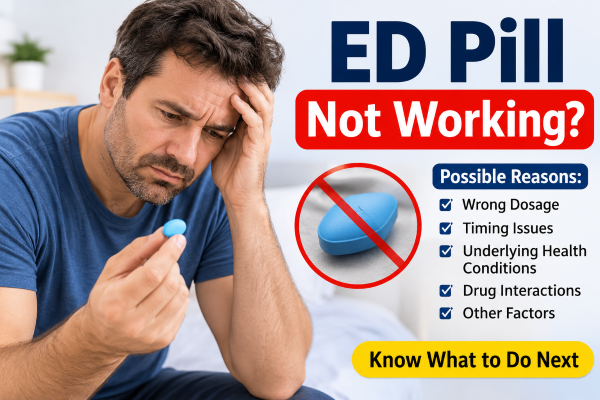
You took the pill, waited, and nothing happened. If you’re dealing with an ED pill not working, the first reaction is usually frustration, followed by the worry that nothing will help. That’s rarely the case. In most men, a failed first attempt comes down to timing, food, dose, or nerves, and all of those can be fixed. This guide walks through the seven most common reasons, in the order they’re easiest to sort out, and what to try next if the pill still isn’t doing its job.
The Short Answer
ED pills work for most men, but not for every man and not on every try. In the trials behind the FDA label for Viagra, about 74% of men on the usual 50 mg dose reported better erections, compared with 24% on a placebo. At 100 mg, the figure was 82%.
That’s a strong result, and it also means roughly one man in five or six doesn’t respond even at the top dose. For everyone else who’s disappointed, the pill usually isn’t the problem. How it was taken, what’s going on in the body, or how many times it was tried is.
The sections below start with the simple fixes. Work through them in order before deciding the medication has failed.
ED Pill Not Working? 7 Reasons and Fixes
1. The Timing Is Off
Many men take the pill too close to sex and expect an instant result. These medicines need time to be absorbed.
Sildenafil is taken about an hour before sexual activity, and it can be taken anywhere from 30 minutes to four hours before. Tadalafil also needs advance planning, but it stays active for much longer, up to 36 hours in clinical trials, so the exact minute matters less.
Fix: plan around the pill instead of the other way around. If you’re using sildenafil, take it an hour ahead and give it time to work.
2. Food or Alcohol Is Getting in the Way
A large, high-fat meal slows sildenafil down. The FDA label shows it delays peak levels by about 60 minutes and lowers the peak by roughly 29%. That’s enough to turn a dependable dose into a weak one.
Tadalafil is different. Food doesn’t change how it’s absorbed, which is one reason some men switch to it.
Alcohol is a separate problem. A drink or two may not interfere with the pill itself, but heavy drinking blunts erections on its own, whatever medication you take.
Fix: take sildenafil on a fairly empty stomach, keep dinner lighter, and go easy on alcohol on the nights that matter.
3. There’s Not Enough Arousal, or There’s Too Much Pressure
This is the one men don’t expect. ED pills don’t create desire. The FDA label for sildenafil says plainly that it has no effect without sexual stimulation, and the same applies to tadalafil.
The pills help blood flow respond to arousal. If you’re anxious, distracted, tired, or watching the clock for the pill to kick in, arousal may never arrive. Performance anxiety is one of the most common reasons a perfectly good dose fails.
Fix: give yourself time, set aside the pressure, and let intimacy build the way it normally would. If anxiety is a repeat problem, a counselor can help, and pairing therapy with medication often works better than either alone.
4. The Dose Is Too Low
Many men start at a low dose to play it safe and stay there. Starting low is sensible, but the dose is meant to be adjusted.
The sildenafil label lists 25 mg, 50 mg, and 100 mg, with 50 mg as the usual starting dose. In the same trials, the share of men who improved climbed with each step: 63% at 25 mg, 74% at 50 mg, and 82% at 100 mg. Tadalafil is taken as needed at 10 mg to start and can go to 20 mg, or down to 5 mg.
Fix: if the dose has been right in every other way and still isn’t enough, ask your doctor about stepping up within the label limits. Never exceed the maximum on your own. Once a day is the limit for both drugs.
5. You Haven’t Tried It Enough Times
One failed attempt tells you very little. The first time is often the worst, because nerves are high and you’re watching for results. Many men find it goes better once they know what to expect.
A fair trial means the right dose, taken at the right time, without a heavy meal or alcohol, with proper stimulation, and repeated several times. A reasonable rule of thumb is about five well-planned attempts before deciding the drug isn’t working for you.
Fix: keep a short note of each attempt. Write down the dose, the time, what you ate, and what happened. That record is also very useful when you speak to your doctor.
6. An Underlying Condition Is the Real Problem
Sometimes the pill is doing its job, but there’s too much damage for it to overcome. Pills depend on healthy blood vessels and working nerves. When either is badly affected, the response can be weak.
The usual suspects are:
- Diabetes, which can damage both blood vessels and nerves over time
- Atherosclerosis and other blood vessel disease, which limit blood flow
- Nerve injury, including after prostate surgery or radiation, or from conditions like multiple sclerosis
- Low testosterone, which affects desire as well as erections
- Chronic kidney disease
Fix: ask for a check-up. Blood sugar, blood pressure, cholesterol, and testosterone tests can reveal what’s behind the weak response, and treating those conditions often improves how well the pill works. It’s also worth knowing that ED itself can be a warning sign of heart disease or diabetes.
7. A Medication or Habit Is Interfering
Some everyday medicines can work against erections, including certain antidepressants, blood pressure tablets, and prostate medicines. Smoking, heavy drinking, and extra weight also reduce the response to ED medication.
Fix: don’t stop any prescribed medicine on your own. Instead, ask your doctor or pharmacist whether anything you take could be part of the problem. In many cases an alternative is available.
How Sildenafil and Tadalafil Compare
If one pill isn’t working, the other may suit your body or your routine better. This table summarizes the key differences from the FDA labels.
| Sildenafil (Viagra) | Tadalafil (Cialis) | |
| Usual starting dose | 50 mg as needed | 10 mg as needed (or 2.5 mg daily) |
| Dose range | 25 mg to 100 mg | 5 mg to 20 mg as needed |
| When to take it | About 1 hour before sex; anywhere from 30 minutes to 4 hours before | Before sexual activity; effect can last up to 36 hours |
| Effect of food | A high-fat meal delays and lowers the peak | Not affected by food |
| Needs arousal? | Yes | Yes |
| Maximum frequency | Once a day | Once a day |
Switching from one to the other is common and is a decision for you and your doctor. Never take both on the same day.
Your Checklist for a Proper Trial
Before you decide a pill has failed, make sure you’ve covered each of these:
- Take it at the right dose, as prescribed
- Take it at the right time, about an hour ahead for sildenafil
- Take sildenafil without a heavy or fatty meal
- Keep alcohol low
- Allow time for proper arousal and stimulation
- Try it several times, ideally five or so, before judging it
- Keep notes so you and your doctor can see what happened
If you can tick every box and the result is still poor, that’s useful information. It points to a physical cause worth investigating, not a personal failing.
What to Try Next If the Pill Still Doesn’t Work
There’s a clear order for what comes next, and it moves from simple to more involved.
- Adjust the dose or switch to another pill: a different drug can work better for you, even when the first didn’t
- Check for causes: blood tests for sugar, cholesterol, and testosterone, plus a blood pressure and heart check
- Treat the cause: managing diabetes, blood pressure, or low testosterone can improve the response to pills
- Add counseling: especially if anxiety or relationship stress is part of the picture
- Vacuum erection device: a drug-free option that draws blood into the penis, and works for many men whose pills have failed
- Penile injections: medicine such as alprostadil placed directly into the penis, usually working in 5 to 20 minutes
- Shockwave therapy: promoted widely, but the evidence is limited and low in certainty, so ask for proof before you pay
- Penile implant: a surgical option, usually reserved for when other treatments have failed
Lifestyle changes matter at every stage. Regular exercise, a healthy weight, no smoking, and moderate alcohol improve how well ED treatments work, and they protect your heart at the same time.
Safety Rules You Shouldn’t Skip
When a pill isn’t working, it’s tempting to take more. Don’t.
- Never go above the maximum dose on the label, or take more than one dose in a day
- Never combine two ED pills, or add a supplement, to boost the effect
- Never take ED pills with nitrate medicines, often used for chest pain, because the combination can drop blood pressure dangerously
- Seek emergency care for an erection lasting more than four hours
- Seek urgent help for sudden vision or hearing loss, or for chest pain
Be wary of products sold as natural or herbal ED boosters. The FDA has warned about many so-called male enhancement products, some of which have been found to contain hidden drugs. If a pill from a reputable pharmacy isn’t working, a product of unknown origin won’t fix it.
Common Mistakes That Make a Failed Attempt More Likely
A few habits quietly undermine the pill before it has a chance. Watch for these:
- Taking it with a big dinner and a few drinks, then wondering why nothing happened
- Testing it alone or in a rush, with no real arousal to build on
- Giving up after one try, particularly after a stressful first attempt
- Cutting tablets or taking half doses to save money or avoid side effects, without medical advice
- Doubling up on the same day because the first dose “didn’t kick in”
- Mixing in supplements or leftover pills from a friend
Most of these come from the same source: pressure. The more riding on one night, the less likely it is to go well. Treating the first few attempts as practice takes a lot of that weight off.
What to Tell Your Doctor
A good appointment starts with good information. Bring the following, and the conversation will go much faster:
- The exact pill, dose, and timing you’ve used
- How many times you’ve tried it, and what happened each time
- What you ate and drank beforehand
- Every medicine and supplement you take, including over-the-counter ones
- Whether you get morning erections or erections during self-stimulation, since this helps separate physical from psychological causes
- Any other symptoms, such as low desire, tiredness, chest discomfort, or numbness
Be direct about it. Doctors hear this question every day, and the more specific you are, the easier it is to find the right next step.
When to See a Doctor
See a doctor if you’ve followed the checklist and tried several times without success, if the pill used to work and has stopped, or if you notice other symptoms such as chest discomfort, fatigue, or low desire.
If you’re facing an ED pill not working again and again, that deserves attention in its own right. A doctor can look for the cause, adjust your treatment, and move you on to the next option without guesswork. Waiting too long only delays the answer.
Frequently Asked Questions
Why is my ED medication not working all of a sudden?
A change in health is the most common reason. Weight gain, new medication, rising blood sugar, stress, and poor sleep can all reduce the response. A check-up can find out what’s changed.
Can you build a tolerance to ED pills?
It’s debated, and the research is limited. Often what looks like tolerance is the underlying condition progressing, or changes in habits, timing, or health. Talk to your doctor before assuming the pill has stopped working for good.
What if Viagra doesn’t work at 100 mg?
Don’t increase the dose. At this point it’s worth checking for underlying causes, trying a different pill, or discussing other treatments such as injections or a vacuum device.
How many times should I try an ED pill before giving up?
About five well-planned attempts is a reasonable guide, with the right dose, timing, no heavy meal or alcohol, and proper stimulation. After that, speak to your doctor.
Key Takeaways
- Most failures come down to timing, food, alcohol, dose, nerves, or too few attempts, and all can be fixed
- In FDA trials, 63% to 82% of men improved on sildenafil, so a first failure is far from the last word
- ED pills need sexual stimulation to work, so anxiety and pressure can cancel out a good dose
- Underlying conditions like diabetes, vascular disease, nerve damage, and low testosterone can weaken the response
- Switch pills, treat the cause, or move to devices, injections, or an implant when pills fail
- Never exceed the dose or combine ED pills, and avoid products of unknown origin
