
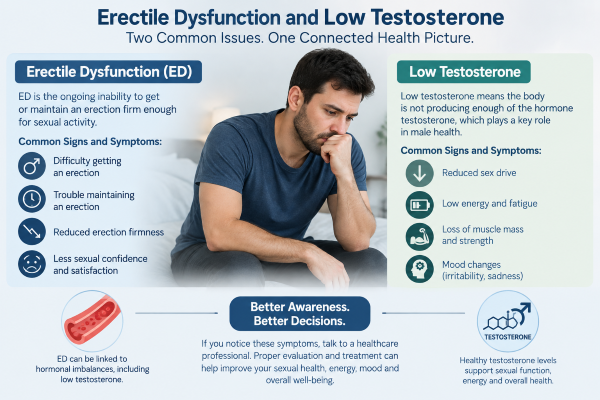
Erectile dysfunction and low testosterone show up together often enough that it’s easy to assume one simply causes the other. The real relationship is more complicated than that. Low T can contribute to ED, but plenty of men with rock-bottom testosterone still get erections just fine, and plenty of men with completely normal testosterone struggle with ED anyway.
Untangling which one is actually driving the problem — or whether something else entirely is behind both — is the difference between treatment that works and months spent chasing the wrong fix.
The Short Answer : Erectile dysfunction and Low testosterone
Low testosterone can contribute to erectile dysfunction, mainly by reducing libido and interfering with some of the hormonal signals involved in arousal, but it’s not a direct one-to-one cause the way blood flow problems or nerve damage are.
Studies estimate that somewhere between 20% and 40% of men with ED also have low testosterone, but that means a majority of ED cases happen with normal testosterone levels. The two conditions overlap, share some risk factors, and are worth testing for together — but treating low T alone doesn’t reliably fix ED, and treating ED alone doesn’t fix low T.
What Counts as Low Testosterone?
Total testosterone is generally considered low below 300 ng/dL, though some labs and specialists use slightly different cutoffs. Normal adult testosterone typically falls somewhere between 300 and 1,000 ng/dL, and levels naturally decline by roughly 1% to 2% per year starting in a man’s late twenties or early thirties — a slow drift that becomes clinically meaningful for some men by their 40s, 50s, or 60s. A single low reading isn’t enough for a diagnosis; guidelines call for two separate morning blood tests, since testosterone is highest earlier in the day and fluctuates from one reading to the next.
Low Testosterone Symptoms
Low T rarely announces itself with one obvious sign. It usually shows up as a cluster of symptoms that overlap with normal aging, stress, or poor sleep, which is part of why it often goes undiagnosed for years:
- Reduced sex drive
- Persistent fatigue or low energy
- Loss of muscle mass or strength
- Increased body fat, especially around the abdomen
- Reduced facial or body hair growth
- Low mood, irritability, or difficulty concentrating
- Poor sleep quality
- Reduced bone density over time
Having one or two of these symptoms doesn’t necessarily mean testosterone is low — several overlap heavily with normal fatigue, stress, or aging. The pattern matters more than any single symptom, which is exactly why a blood test, not a symptom checklist, is what actually confirms a diagnosis.
How Low Testosterone Can Contribute to ED
Testosterone doesn’t directly create an erection — that process is driven mainly by blood flow and nerve signals. But testosterone plays a supporting role in several ways that can make erections harder to achieve or maintain:
- Lower libido means less sexual interest and arousal to begin with, which can indirectly affect erectile response
- Low T is linked to lower energy and mood changes, which can reduce interest in and confidence around sex
- Testosterone supports nitric oxide production in penile tissue, one of the chemical signals involved in achieving an erection
- Low T often coexists with conditions that independently cause ED, including obesity, diabetes, and high cholesterol
That layered relationship is why low T is better described as a contributing factor for some men rather than a direct cause for most.
Does Low Testosterone Actually Cause ED?
This is where a lot of content oversimplifies. The honest answer, based on the research: sometimes, but not reliably, and not as a one-to-one relationship. Multiple studies looking at men with ED have found that anywhere from 20% to 40% also have low testosterone — the range varies because different studies use different age groups and different testosterone cutoffs. That leaves 60% to 80% of ED cases in men with perfectly normal testosterone, which means low T is neither necessary nor sufficient to cause ED on its own. A urologist evaluating a man with both conditions is typically looking for which one is actually driving symptoms, rather than assuming low T explains everything.
Which Came First? A Practical Self-Check
For men dealing with both low libido and erectile difficulty, a few patterns can help suggest which condition is playing the bigger role, though only bloodwork and a doctor’s evaluation can confirm it:
| Pattern | More Likely Explanation |
| Low interest in sex plus weak erections, even with adequate stimulation | Leans toward low testosterone as a contributing factor |
| Normal sex drive, but erections that fail despite clear arousal | Leans toward a vascular, nerve, or psychological cause unrelated to testosterone |
| Morning erections still occur normally | Suggests the physical hardware works; testosterone or psychological factors are more likely than blood flow |
| Morning erections have also disappeared | Suggests a broader hormonal or vascular issue worth a fuller workup |
| Fatigue, mood changes, or reduced muscle mass alongside ED | Raises suspicion for low testosterone specifically, not just ED alone |
None of these patterns are a diagnosis on their own — they’re a way to have a more informed conversation with a doctor, not a substitute for testing.
How Low Testosterone Is Tested
Testing is straightforward but has to be done correctly to be meaningful:
- A total testosterone blood test, drawn in the morning when levels are highest
- A second morning test on a different day to confirm a low result before diagnosing
- Additional tests, such as luteinizing hormone (LH) and prolactin, to help identify whether the issue originates in the testes or the pituitary gland
- Sometimes a free testosterone test, which measures the hormone not bound to proteins and available for the body to use
A single low result on a same-day, afternoon draw is a common reason for a false low-T impression — it’s one of the more frequent testing mistakes, and it’s worth confirming with a proper morning test before assuming a diagnosis.
Treatment Options
Because low T and ED don’t always share the same root cause, treatment often needs to address both separately rather than assuming fixing one automatically fixes the other.
Treating Low Testosterone
- Testosterone replacement therapy (TRT), available as gels, skin patches, injections, or long-acting pellets
- Clomiphene, a non-testosterone medication that can raise natural testosterone production, sometimes preferred for men who want to preserve fertility
- Addressing underlying causes, such as obesity or pituitary issues, when identified during testing
Treating ED Directly
- PDE5 inhibitors, including sildenafil, tadalafil, vardenafil, and avanafil, which work by improving blood flow regardless of testosterone levels
- Daily low-dose options for men who prefer not to time medication around sexual activity
- Addressing vascular risk factors like high blood pressure, high cholesterol, and blood sugar, which affect erectile blood flow independent of hormones
Lifestyle Changes That Help Both
- Regular exercise, particularly resistance training, which supports natural testosterone production and cardiovascular health
- Maintaining a healthy weight, since excess body fat is linked to lower testosterone
- Getting 7 to 9 hours of sleep, since poor sleep independently lowers testosterone
- Limiting alcohol and avoiding smoking, both of which affect testosterone and erectile blood flow
- Managing chronic stress, which elevates cortisol in ways that can suppress testosterone production
When to See a Doctor
It’s worth getting evaluated if low libido, fatigue, or erectile difficulty has been persistent for several weeks or longer, if ED shows up alongside other possible low-T symptoms like reduced muscle mass or mood changes, or if ED developed suddenly rather than gradually, since a sudden change is more often tied to a specific triggering factor than a slow hormonal decline. A doctor can order the right combination of tests rather than guessing which condition is responsible based on symptoms alone.
Frequently Asked Questions
Can normal testosterone still cause erectile dysfunction?
Yes. Most men with ED actually have normal testosterone levels — blood flow, nerve function, psychological factors, and other health conditions cause the majority of ED cases, independent of hormone levels.
Will testosterone replacement therapy fix erectile dysfunction?
Sometimes, particularly when low libido was the main driver of erectile difficulty, but TRT doesn’t reliably resolve ED on its own, especially when blood flow or vascular issues are the primary cause. Many men need both TRT and an ED-specific treatment.
What testosterone level is considered too low?
Total testosterone below 300 ng/dL, confirmed on two separate morning blood tests alongside symptoms, is generally considered low. A single low reading isn’t sufficient for diagnosis on its own.
Does low testosterone affect morning erections?
It can, but morning erections are driven more by nerve activity during sleep than by testosterone directly. Their presence is often a useful sign that the physical mechanics of an erection are intact, regardless of hormone levels.
Key Takeaways
- Low testosterone contributes to ED for some men, but it’s not a direct one-to-one cause — 60% to 80% of ED cases occur with normal testosterone
- Low T is diagnosed below 300 ng/dL, confirmed on two separate morning blood tests, not a single reading
- Reduced libido plus weak erections leans toward low T; normal desire with erections that still fail points more toward blood flow, nerve, or psychological causes
- Treating low T alone doesn’t reliably fix ED, and vice versa — many men need both TRT and a PDE5 inhibitor
- Exercise, healthy weight, sleep, and reduced alcohol and stress support both testosterone and erectile function at the same time
