
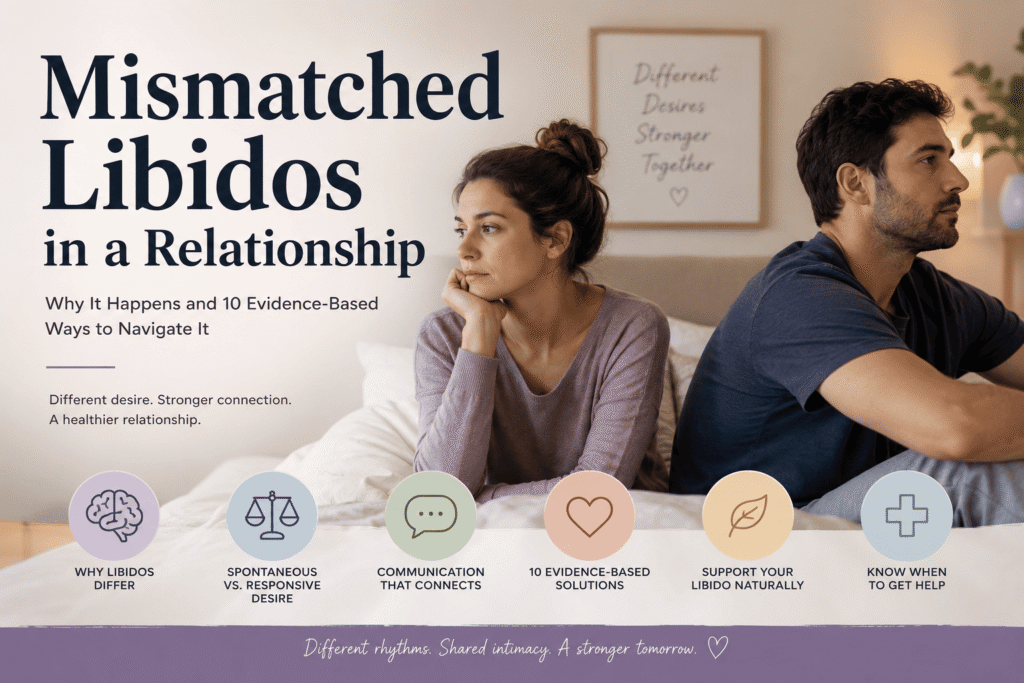
Mismatched libidos are one of the most common — and most quietly distressing — challenges in long-term relationships. Research shows that approximately 80% of couples experience mismatched libidos at some point. The gap in sexual desire can make one partner feel rejected and unwanted while the other feels pressured and guilty, and if it goes unaddressed, the cycle erodes intimacy on both sides. The important reassurance is that a mismatch in sexual desire does not signal incompatibility, a lack of love, or a relationship in trouble. It signals a difference in two people’s libido patterns — which, like most things in a relationship, can be navigated with the right tools. This article explains why mismatched libidos happen, the single most important concept most couples in this situation have never heard of (responsive vs. spontaneous desire), and 10 evidence-based strategies for navigating the difference — from communication techniques to medical considerations and lifestyle approaches.
Research shows that 80% of couples experience mismatched libidos at some point in their relationship. A 2017 study found that approximately 34% of women and 15% of men report little to no interest in sex. Yet studies also show that the key difference between couples who struggle and those who succeed with desire discrepancy is not the size of the gap — it’s how partners respond to it and whether they communicate openly about it.
Mismatched Libidos Are Normal — But Here Are the Numbers
Sexual desire discrepancy — the clinical term for mismatched libidos — is defined as a persistent difference between partners in the desired frequency, type, or intensity of sexual activity that causes distress for one or both. It is one of the most frequently reported issues in couples’ therapy, and it affects couples of all sexual orientations and relationship structures.
As sex therapist Chris Donaghue notes, ‘In every relationship, there will always be a higher-desire partner and a lower-desire partner for sex, just like there will be for any topic.’ The implication is important: some degree of desire discrepancy is expected in virtually every long-term relationship. The question is not whether it exists but how couples navigate it.
Desire discrepancy research shows these differences are normal and often distressing, but couples who address them openly report better outcomes. Differences in sexual desire predict lower relationship satisfaction specifically when couples struggle to communicate about it — not simply because the desire gap exists.
Why Libidos Differ: The Real Causes
Understanding the real causes of desire discrepancy is the starting point for addressing it effectively. Libido is not fixed — it is a dynamic output of biological, psychological, relational, and lifestyle factors.
Hormonal factors
- Testosterone: Linked to sexual desire in all genders, not just men. People with higher testosterone levels tend to experience more frequent spontaneous sexual desire. Levels fluctuate with age, stress, sleep, and health conditions.
- Oestrogen and progesterone: Women’s sexual desire often fluctuates across the menstrual cycle — typically peaking around ovulation and dropping in the premenstrual phase. Perimenopause and menopause involve significant hormonal shifts that commonly reduce libido.
- Prolactin: Elevated prolactin (from a pituitary adenoma, some medications, or postpartum breastfeeding) reduces sexual desire in both men and women. All hyperprolactinaemic men typically report reduced sexual desire.
- Thyroid hormones: Both hypothyroidism (underactive) and hyperthyroidism (overactive) affect libido. Thyroid dysfunction is a treatable cause of reduced sexual desire that is often missed.
Psychological factors
- Stress, anxiety, and work pressure — among the most common suppressors of libido in otherwise healthy people
- Depression — reduces sexual desire and interest in intimacy; some antidepressants also affect libido as a side effect
- Body image and self-esteem — negative body image reduces both desire and the willingness to be intimate
- Past trauma or sexual anxiety — can suppress desire or create avoidance patterns
Relationship and situational factors
- Relationship conflict, unresolved resentment, or emotional distance — often reduce sexual desire, particularly in women
- New parenthood — sleep deprivation, physical recovery, identity shifts, and hormonal changes all commonly reduce libido in both partners
- Life stress — financial pressure, family difficulties, or health worries redirect mental energy away from intimacy
Medications
- SSRIs and SNRIs (antidepressants) — one of the most common medication causes of reduced libido and delayed or absent orgasm
- Hormonal contraceptives — can reduce libido in some women, particularly progestin-dominant formulations
- Beta-blockers and some antihypertensives — associated with reduced sexual desire
- Opioids — suppress testosterone production over time
The Concept That Changes Everything: Spontaneous vs. Responsive Desire
This is the single most important concept for couples with mismatched libidos — and most couples have never heard of it. Understanding this distinction often reframes the entire dynamic.
- Spontaneous desire: Desire that arises on its own, seemingly out of nowhere, before any sexual activity begins. Someone with spontaneous desire thinks about sex, feels aroused, and wants it without needing any particular stimulus. This is often portrayed in media as the ‘normal’ or ‘healthy’ pattern.
- Responsive desire: Desire that emerges in response to stimulation, context, or intimacy — not before it. Someone with responsive desire may not think about sex during their daily life and may not ‘feel like it’ until they are already engaged in intimate activity. Once they are, desire follows. Think of it as needing to see the menu before you know whether you’re hungry.
Both patterns are completely normal. Neither is broken, deficient, or a sign of low libido. Research suggests responsive desire is actually more common than spontaneous desire, particularly in women and in long-term relationships — yet the partner with spontaneous desire often interprets the responsive partner’s ‘I don’t feel like it’ as rejection, when it actually means ‘I would feel like it once we start.’
This concept changes the practical conversation entirely. The lower-desire partner in many couples does not lack sexual desire — they lack spontaneous desire, and their desire responds to invitation and warmth rather than arising independently. Knowing this allows the higher-desire partner to stop taking the ‘not right now’ personally, and allows the responsive-desire partner to understand their own pattern rather than feeling broken.
Practical tip: If you are in a couple where one person ‘never seems to want sex,’ ask whether that person still enjoys sex once it starts, or finds it worthwhile looking back. If yes — that is responsive desire, not low libido. The solution is creating a context that allows desire to emerge (warmth, connection, low pressure, extended foreplay) rather than waiting for the desire to appear spontaneously first.
The Rejection-Pressure Cycle — and How to Break It
One of the most destructive patterns in couples with mismatched libidos is the rejection-pressure cycle, which research confirms actively worsens the desire gap over time.
It works like this: the higher-libido partner initiates and is turned down. They feel rejected, unwanted, and sometimes question their attractiveness or the health of the relationship. This causes them to initiate more frequently or more urgently, adding pressure. The lower-libido partner, now feeling watched, monitored, and pressured, finds that the pressure itself reduces their desire further. They begin to feel guilty and may eventually comply without genuine desire — which research shows leads to worse sexual experiences for both and further reduces the lower-desire partner’s interest over time.
Research confirms this: obligated sex is associated with reduced sexual satisfaction and reduced relationship satisfaction for both partners. Breaking this cycle requires the higher-desire partner to deliberately step back from pressure and initiation for a period, and for both partners to focus on non-sexual intimacy while communication about desire expectations is rebuilt.
10 Ways to Navigate Mismatched Libidos
1. Have the honest conversation — and keep having it
A one-time conversation will not resolve a persistent desire discrepancy. Communication about sexual desire needs to be ongoing, not a single difficult talk followed by silence. Choose a time when both partners feel relaxed and unthreatened — not in the bedroom, not immediately after a rejected initiation. Share desires, feelings, and the reasons for lower desire without blame. Research consistently shows that couples who communicate about desire discrepancies report better outcomes than those who avoid the conversation.
2. Understand your desire styles
Use the spontaneous vs. responsive desire framework (above) to understand which pattern each partner primarily follows. This single piece of knowledge reduces shame, reduces the interpretation of ‘not right now’ as personal rejection, and opens up practical solutions that work with each person’s genuine pattern rather than against it.
3. Separate initiation from pressure
There is a significant difference between expressing desire (‘I would love to be close with you tonight’) and creating pressure (‘We haven’t had sex in two weeks and that’s not okay’). Expressing desire without pressure is more likely to generate a positive response from a responsive-desire partner. The goal of initiation is to offer an invitation, not to create an obligation.
4. Expand the definition of intimacy
Sexual intimacy is not limited to penetrative sex. Sensate focus exercises, extended foreplay, massage, oral intimacy, and non-sexual physical touch all build closeness and may allow a responsive-desire partner to discover desire in the process. Research shows that ‘sexual success’ defined by orgasm and intercourse alone leads to less satisfaction than sexual success defined by connection, pleasure, and mutual engagement. Couples who expand their definition of satisfying intimacy often find more common ground than those who only count intercourse.
5. Schedule intimacy — counterintuitively, it works
Scheduling sex feels unromantic, but for couples with different libidos — particularly when one partner has responsive desire — it can reduce the anxiety of constant readiness and allow both partners to mentally prepare. A responsive-desire partner who knows intimacy is planned for Saturday evening can spend the preceding hours thinking about it, which generates desire before the encounter begins. The ‘Cialis approach’ (anytime in a given window, like ‘anytime this weekend’) is less pressured than a specific time.
6. Reduce the initiation burden on one partner
If the higher-desire partner always initiates and is always the one risking rejection, resentment builds. Establishing a system where both partners take turns initiating — even when one partner initiates less frequently or with different energy — distributes the emotional labour of desire management more equitably and reduces the dynamic of one person always pursuing and the other always retreating.
7. Spend quality time together outside the bedroom
Emotional connection is one of the strongest predictors of sexual desire — particularly for people with responsive or context-dependent desire. Studies have found that spending meaningful time together, travelling, shared experiences, and activities that promote laughing and positive emotion all increase intimacy and sexual desire. Desire does not exist in isolation from the relationship; improving the relationship outside the bedroom frequently improves desire inside it.
8. Address lifestyle factors that suppress desire
- Improve sleep — testosterone is produced during deep sleep, and chronic sleep deprivation reduces both libido and emotional resilience
- Reduce chronic stress — cortisol suppresses testosterone; exercise, mindfulness, and rest all reduce cortisol
- Reduce alcohol — moderate amounts may reduce inhibition short-term, but chronic or heavy drinking reduces testosterone and sexual function in both sexes
- Exercise regularly — improves body image, testosterone, mood, and energy, all of which support libido
- Eat a balanced diet — particularly one supporting Nitric Oxide (leafy greens, healthy fats) and testosterone (zinc-rich foods, healthy fats, adequate protein)
9. Review medications with a doctor
If libido changed following the start of a new medication, that medication may be the cause. SSRIs, hormonal contraceptives, beta-blockers, and opioids are among the most common medication causes of reduced sexual desire. Never stop a prescribed medicine without medical advice — but discuss the side effect with the prescribing doctor, who may be able to adjust the dose, switch to a different medication within the same class, or suggest a management strategy.
10. Seek sex therapy or couples counselling
When desire discrepancy is persistent, creating significant distress, or accompanied by resentment, avoidance, or relationship difficulty, professional support is one of the most effective interventions available. A sex therapist can provide structured exercises (including sensate focus, communication frameworks, and desire mapping), help both partners understand their desire styles, and address any psychological barriers to intimacy that self-help approaches do not reach. The International Society for Sexual Medicine (ISSM) recommends couples therapy as a first-line approach when desire discrepancy is causing significant relationship distress.
Natural Foods and Supplements That May Support Libido
Certain foods and supplements have evidence supporting libido and sexual function, though none produce effects comparable to addressing the relationship, psychological, and lifestyle factors above. These are supportive additions, not primary solutions.
- Dark chocolate (70%+ cocoa): Contains phenylethylamine (associated with feelings of attraction and excitement) and tryptophan (a serotonin precursor). Also contains flavanols that support Nitric Oxide and blood flow. Evidence for direct libido increase is limited, but its vascular and mood-supporting properties are real.
- Avocado: Rich in monounsaturated fats (essential for steroid hormone production, including testosterone), zinc, Vitamin B6, and omega-3 fatty acids. Supports hormonal and vascular health. A nutrient-dense food that contributes to the dietary foundation of healthy sexual function.
- L-arginine: An amino acid the body converts to Nitric Oxide, supporting blood flow to the genitals. At clinical doses (3–5 g/day), some studies show modest improvement in sexual arousal and erectile function. Best food sources: poultry, nuts, watermelon.
- Ginkgo biloba: Studied for its effects on blood flow and Nitric Oxide production. Some research suggests it may support sexual arousal, particularly in women, through improved vascular flow to the genitals. Evidence is preliminary and mixed. Note: ‘Ginkgo biloba,’ not ‘Ginkgo libola’ as sometimes misspelled.
- Ashwagandha (KSM-66): A well-standardised adaptogen with multiple RCTs showing improvements in sexual function, libido, and arousal in both men and women — particularly when stress and fatigue are contributing factors. Most studies used 300 mg twice daily for 8 weeks.
- Maca root: Some studies show modest improvements in sexual desire in healthy adults. Evidence is limited but consistent in direction. Most studied at 1,500 to 3,000 mg/day.
Always disclose supplements to your doctor, as some interact with prescription medicines (particularly anticoagulants, antidepressants, and blood pressure medicines).
When Low Libido Is a Medical Issue
Low libido in one partner is sometimes a medical symptom rather than a relationship or lifestyle issue. Medical evaluation is appropriate when:
- Libido has declined significantly and rapidly without an obvious lifestyle or relationship explanation
- Low libido is accompanied by other symptoms — fatigue, weight change, mood changes, hair loss, or irregular periods
- Libido loss began with a new medication
- The lower-desire partner has no interest in sex even in contexts where they previously did
- Low libido is causing personal distress independent of relationship pressure
Medical causes to investigate include: thyroid dysfunction (both directions), low testosterone (in men and women), elevated prolactin, Diabetes, anaemia, Depression, and medication side effects. Many of these are treatable, and addressing the medical cause often restores libido significantly.
Important: If low libido is significantly affecting your quality of life or your relationship, a GP consultation is a reasonable first step. A simple blood test can check thyroid function, testosterone, and prolactin. Do not assume the cause is solely psychological or relationship-based without ruling out a medical contribution — and do not begin taking supplements or herbal products to boost libido without first ruling out a treatable medical cause.
When to See a Sex Therapist or Counsellor
- Desire discrepancy has been present for more than 3 to 6 months and shows no sign of improvement
- The mismatch is creating resentment, avoidance, or emotional distance in the relationship
- Either partner feels significantly distressed by the desire gap
- There is a history of sexual trauma that may be contributing to avoidance
- Communication about desire feels impossible, charged, or consistently leads to conflict
A sex therapist can be seen individually or as a couple. Look for a therapist with accreditation from a recognised body such as the American Association of Sexuality Educators, Counselors, and Therapists (AASECT) in the US, or the College of Sexual and Relationship Therapists (COSRT) in the UK.
Conclusion
Mismatched libidos are among the most common challenges in long-term relationships — affecting the majority of couples at some point. They are also among the most navigable, when couples understand the real causes, stop interpreting the desire gap as a sign of incompatibility or lack of love, and use evidence-based strategies to address it.
The single most transformative insight is the spontaneous vs. responsive desire distinction, which reframes ‘I never want sex’ as ‘I don’t experience spontaneous desire, but I can experience responsive desire when the context is right.’ From there, practical strategies — honest communication, expanded intimacy, scheduling, lifestyle changes, and where appropriate medical evaluation — can meaningfully close the gap or allow couples to find a mutually satisfying rhythm.
If the desire discrepancy is persistent, distressing, or accompanied by significant relationship difficulty, sex therapy is one of the most effective evidence-based resources available. Most couples who address mismatched libidos proactively and openly report both improved sexual and relationship satisfaction.
Frequently Asked Questions
-
Is it normal to have mismatched libidos in a relationship?
Yes — it is extremely common. Research shows that 80% of couples experience mismatched libidos at some point, and studies consistently find that in virtually every relationship, one partner has higher desire than the other for most periods. Desire naturally fluctuates with stress, health, life stage, hormones, and relationship dynamics. Mismatched libidos do not mean incompatibility — they mean two people with different desire rhythms need strategies to find common ground.
-
How do mismatched libidos affect a relationship?
Unaddressed libido discrepancy can create a painful cycle where the higher-desire partner feels rejected and the lower-desire partner feels pressured and guilty. Over time this can reduce emotional intimacy, create resentment, and lead to avoidance of physical closeness entirely. However, research also shows that couples who communicate openly about desire discrepancy and use deliberate strategies to navigate it report positive outcomes — better communication, closer emotional connection, and satisfying intimacy that may look different from what they expected.
-
Can a relationship survive with completely different sex drives?
Yes — many relationships thrive despite significant desire discrepancy. The key factors are open communication about desire, willingness to understand each other’s desire style (spontaneous vs. responsive), expanding the definition of satisfying intimacy beyond intercourse, and mutual respect for each other’s needs. When couples stop measuring success by whether both partners want sex at the same frequency and start measuring it by whether both partners feel seen, respected, and satisfied, most find workable solutions.
-
What foods can naturally boost libido?
Foods that support the vascular and hormonal foundations of libido include dark leafy greens (Nitric Oxide precursors), avocado and healthy fats (testosterone support), oysters and pumpkin seeds (zinc for testosterone), watermelon (L-citrulline for blood flow), dark chocolate 70%+ (flavanols and mood support), and fatty fish (omega-3s for endothelial health). These foods work best as part of a consistently balanced diet rather than as one-off libido boosters. Ashwagandha (KSM-66) has the strongest supplement evidence specifically for libido, particularly when stress is a contributing factor.
-
When should we see a sex therapist for mismatched libidos?
Seek sex therapy if the desire discrepancy has been present for more than 3 to 6 months without improvement, if it is causing significant distress for either partner, if resentment or avoidance is developing, if sexual trauma may be contributing, or if attempts to communicate about it consistently lead to conflict. A certified sex therapist can provide structured frameworks for both partners and address psychological or relational barriers that self-help strategies do not reach. Either partner can attend individually; couples therapy is not the only option.
Citations
- Mallory AB, Stanton AM, Handy AB. Couples’ sexual communication and dimensions of sexual function: A meta-analysis. Journal of Sex Research, 2019. https://pubmed.ncbi.nlm.nih.gov/31304817/
- Mark KP. Sexual desire discrepancy. Current Sexual Health Reports, 2015; 7:198–202. https://link.springer.com/article/10.1007/s11930-015-0054-4
- Basson R. Women’s sexual dysfunction: Revised and expanded definitions. CMAJ, 2005. https://pubmed.ncbi.nlm.nih.gov/15911862/ [Responsive desire model]
- International Society for Sexual Medicine (ISSM). How Can Couples Address Mismatched Libidos? https://www.issm.info/sexual-health-qa/how-can-couples-address-mismatched-libidos
- Psychology Today. When Libidos Clash: I Love You, but I’m Not in the Mood (March 2025). https://www.psychologytoday.com/us/blog/hidden-desires/202503/when-libidos-clash-i-love-you-but-im-not-in-the-mood
- Medical News Today. Mismatched sex drives: Relationships and coping. https://www.medicalnewstoday.com/articles/mismatched-sex-drives
- Therapy Group DC. Mismatched Sex Drives: What Causes Them and How to Navigate the Difference. https://therapygroupdc.com/therapist-dc-blog/mismatched-sex-drives-what-causes-them-and-how-to-navigate-the-difference/
This article is for general informational purposes only and does not constitute medical or therapeutic advice. If you are experiencing persistent low libido or relationship difficulty, consult a qualified healthcare provider or licensed therapist.
