
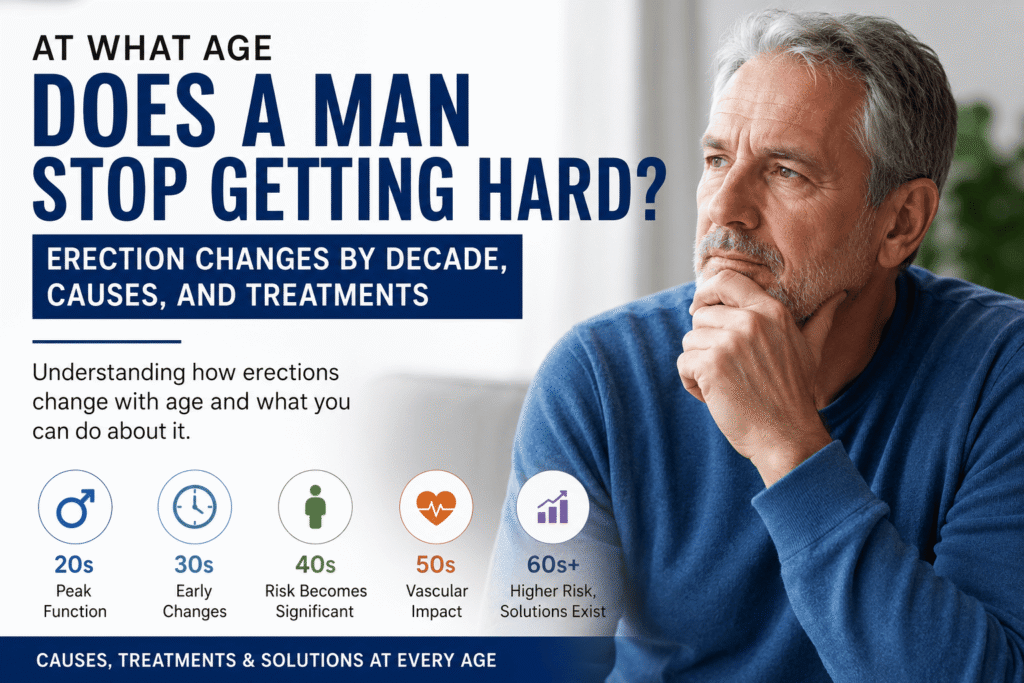
At what age does a man stop getting hard? The direct answer is: there is no fixed age. Erection quality changes gradually with decades, but Erectile Dysfunction is not an inevitable outcome of ageing — it is an outcome of the accumulation of modifiable risk factors that tends to increase with age. Research shows that approximately 40% of men in their 40s experience some degree of ED, and this prevalence increases by approximately 10% with each decade. Yet men in their 70s and 80s can and do have satisfying sexual function with proper health management. This article explains how erections change decade by decade, why older men are more likely to experience difficulty, when the change becomes a medical concern, and what treatments work — at every age.
Research shows that about 40% of men experience some degree of ED by age 40, and this prevalence increases by approximately 10% per decade — around 50% by 50, 60% by 60. However, this includes all degrees of severity, from mild to complete ED. Many men with mild or moderate age-related changes maintain satisfying sexual function with lifestyle management, medication, or both. Complete ED is three times more common in men aged 70 than those aged 40.
At What Age Does a Man Stop Getting Hard? The Honest Answer
There is no age at which a man universally stops getting hard. Erectile function is not switched off by a biological clock — it declines gradually due to specific, largely modifiable physiological changes that accumulate over decades. These include reduced arterial blood flow, declining Nitric Oxide production, gradual testosterone reduction (approximately 1 to 2% per year from the 30s), slower nerve signalling, and the increasing likelihood of conditions like Hypertension, Diabetes, and cardiovascular disease that impair vascular and neurological function.
The important reassurance: Erectile Dysfunction is not a normal or inevitable part of ageing. It is a symptom of underlying conditions — most of which are identifiable and treatable. Men who maintain cardiovascular health, avoid smoking, exercise regularly, manage chronic conditions, and seek medical advice when problems arise can maintain satisfying erectile function well into their 70s and beyond.
How Erections Change by Decade
20s — Peak erectile function
In their 20s, most men experience robust erectile function. Erections are triggered readily by visual, psychological, or physical stimulation, often without prolonged foreplay. Spontaneous erections (including frequent nocturnal and morning erections) are common. The refractory period — the recovery time between erections — is at its shortest, often measured in minutes.
Erection difficulties in this decade are most commonly psychological — performance anxiety, stress, relationship issues, or the psychological effects of pornography — rather than physical. New-onset ED in a young man without obvious physical cause warrants evaluation but is typically highly responsive to psychosexual therapy and lifestyle improvement.
30s — Early gradual changes
Erection quality generally remains strong in the 30s, but subtle changes begin. Spontaneous erections become less frequent. The refractory period begins to lengthen. Testosterone starts its gradual annual decline of 1 to 2%. Arousal may require slightly more direct stimulation than in the 20s.
Lifestyle choices made in the 30s significantly influence erection quality in later decades. Men who develop Obesity, high blood pressure, or high cholesterol in their 30s begin accumulating vascular damage that will affect erectile function in their 40s and 50s. Conversely, men who build and maintain exercise habits, healthy diets, and cardiovascular health in their 30s protect their long-term erectile function.
40s — The decade when ED risk becomes clinically significant
The 40s are when erectile changes become more noticeable and when the statistical risk of Erectile Dysfunction increases meaningfully. Erections may take longer to develop, feel less consistently firm, and require more direct stimulation. The refractory period lengthens further.
The 40% statistic — approximately 40% of men in their 40s experience some degree of ED — includes mild and moderate cases. Most men in this decade who experience erection changes have identifiable contributing factors: cardiovascular risk (hypertension, high cholesterol), prediabetes or Diabetes, stress, reduced physical activity, or medication side effects. Many respond well to lifestyle changes and oral PDE5 inhibitors.
50s — Accumulation of vascular risk factors
By the 50s, the vascular component of ED risk becomes more pronounced. Atherosclerosis — the narrowing and stiffening of arteries from fatty plaque build-up — is more established, and the penile arteries, being among the smallest in the body, are significantly affected. The same process that causes heart attacks and strokes at this age impairs penile blood flow.
Testosterone continues declining. Nocturnal erections become less frequent and less firm than in younger decades. Prostate conditions become more common; prostate cancer treatment (surgery or radiation) can significantly affect erectile function. Despite all this, many men in their 50s maintain satisfying sexual function — often with the help of PDE5 inhibitors, lifestyle management, and treating underlying conditions.
60s and 70s — ED is common but not universal
ED becomes significantly more prevalent in the 60s and 70s. Reduced blood flow, diminished nerve sensitivity, lower testosterone, increased medication burden, and the accumulation of chronic health conditions all contribute. Complete ED — the inability to achieve any erection — is three times more common in men aged 70 than in men aged 40.
Yet a meaningful proportion of men in their 70s and even 80s maintain erections sufficient for satisfying sexual activity. The key variables are cardiovascular health, medication management, and whether chronic conditions like Diabetes are well-controlled. PDE5 inhibitors remain effective in older men, though starting doses may need adjustment due to slower drug clearance and greater sensitivity to blood pressure effects.
A healthy man typically has 3 to 5 erections during sleep each night (Nocturnal Penile Tumescence), each lasting 20 to 35 minutes. These nocturnal erections are maintained in ageing men much longer than waking erections, because they do not depend on arousal but on the normal physiological cycling of REM sleep. Their absence — in a man who also has waking ED — is a clinically useful indicator of organic (physical) rather than psychological ED.
Why Older Men Are More Likely to Struggle with Erections
- Reduced arterial blood flow: Atherosclerosis narrows penile arteries (1 to 2 mm diameter). These are the smallest arteries in the body and are affected by vascular disease earlier than larger vessels. Reduced inflow means less blood fills the corpus cavernosum during arousal.
- Declining Nitric Oxide (NO) production: Nitric Oxide is the chemical signal that initiates erection by relaxing penile smooth muscle. Ageing reduces the ability of the endothelial lining of blood vessels to produce NO. Smoking, Diabetes, and atherosclerosis accelerate this decline.
- Reduced nerve sensitivity: Penile nerve sensitivity gradually declines with age, slowing arousal response and requiring more direct stimulation to initiate an erection.
- Testosterone decline: Testosterone falls approximately 1 to 2% per year from the mid-30s. While testosterone is not the primary driver of the erection mechanism, it supports libido, arousal threshold, and the conditions in which erections occur. Confirmed hypogonadism warrants evaluation for TRT.
- Longer refractory period: The time between erections lengthens significantly with age. A young man may require minutes; a man in his 60s may require 24 hours or longer. This is a normal physiological change related to declining prolactin clearance and neural recovery, not a sign of ED.
- Increased medication burden: Older men are more likely to be taking multiple medications. Antihypertensives, antidepressants, opioids, and other medicines commonly affect erectile function.
- Chronic health conditions: Diabetes, cardiovascular disease, Obesity, and Obstructive Sleep Apnoea all impair erectile function through overlapping vascular, neurological, and hormonal mechanisms.
Psychogenic vs Vascular ED: How the Balance Shifts with Age
This section is clinically useful and absent from the original article. Understanding the typical shift in ED cause by age helps men and their doctors choose the right treatment approach.
- Under 40: The majority of ED in younger men is primarily psychogenic (anxiety, performance anxiety, depression, stress). Physical factors can contribute but are less common. Nocturnal erections are usually preserved. Psychosexual therapy and lifestyle changes are often first-line.
- 40s to 50s: A mixed picture. Both psychological and vascular factors are common, often coexisting. A man who develops vascular ED may then develop performance anxiety about it, creating a mixed-cause condition. Both components need to be addressed.
- Over 60: Vascular and neurological causes dominate. The majority of ED in older men has a primary organic cause. However, psychological components — particularly depression, anxiety, or relationship changes — often coexist and should not be ignored.
A useful clinical distinction: men whose ED is primarily psychological typically still have morning erections (because nocturnal erections occur independently of arousal), but lose erections during partnered activity. Men with organic ED tend to find erection quality declining across all contexts — including solo activity and on waking.
Nocturnal Erections: A Useful Health Barometer
Morning erections — the most visible evidence of nocturnal penile tumescence — are not just a quirk of male physiology. They are a clinically useful health indicator.
Nocturnal erections occur primarily during REM (rapid eye movement) sleep, when the parasympathetic nervous system dominates and testosterone peaks. They serve a physiological function: repeatedly cycling oxygenated blood through the corpus cavernosum prevents fibrosis (scarring) of the erectile tissue over time. Their presence confirms that the vascular and neurological systems required for erection are broadly intact.
A man who experiences consistent morning erections but has difficulty during partnered activity most likely has a significant psychological component to his ED. A man who rarely or never experiences morning erections is more likely to have an organic (physical) cause — and this pattern warrants cardiovascular and hormonal evaluation alongside ED assessment.
Why New-Onset ED at Any Age Warrants Cardiovascular Screening
This connection is one of the most clinically important aspects of Erectile Dysfunction and is absent from the original article.
The penile arteries (1 to 2 mm in diameter) are smaller than the coronary arteries (3 to 4 mm). Atherosclerosis and endothelial damage from the same risk factors that cause heart disease tend to show up in the smaller penile arteries first — meaning ED can precede a cardiovascular diagnosis by 3 to 5 years.
Harvard Medical School research confirms this: men with ED have a significantly higher risk of cardiovascular events in the following decade. New-onset ED — particularly in a man under 60 without a clear psychological explanation — should prompt a cardiovascular risk assessment: blood pressure, cholesterol, blood glucose, and smoking status.
Clinical recommendation: If you are seeing a doctor about erection problems for the first time and you are under 60, ask for a basic cardiovascular review in the same appointment. The penile arteries show vascular damage before the coronary arteries. Addressing cardiovascular risk at this point is more impactful than simply prescribing ED medication and moving on.
Other Factors That Cause Erection Problems at Any Age
- Smoking: Damages endothelial cells and depletes Nitric Oxide — a 51% higher risk of ED compared to non-smokers. Erection quality improves within weeks of stopping.
- Excessive alcohol: Acute heavy drinking depresses the nervous system and prevents erections. Chronic heavy drinking lowers testosterone and damages blood vessels.
- Poor diet and obesity: Atherosclerosis-promoting diets and abdominal obesity directly impair penile blood flow. A man with a 42-inch waist is 50% more likely to have ED than a man with a 32-inch waist.
- Physical inactivity: Regular exercise reduces ED risk by approximately 41%. Exercise improves endothelial function, testosterone, and cardiovascular health.
- Neurological conditions: Multiple Sclerosis, Parkinson’s Disease, spinal cord injury, and stroke can disrupt the neural signals required for erection.
- Pelvic surgery or radiation: Prostate cancer surgery (radical prostatectomy) and pelvic radiation are major causes of neurogenic ED in older men. Nerve-sparing surgical techniques and early post-operative rehabilitation with PDE5 inhibitors help preserve function.
- Psychological factors: Stress, Depression, performance anxiety, and relationship difficulties can cause or worsen ED at any age. Depression and ED share a triad relationship with cardiovascular disease — all three should be evaluated together.
- Antipsychotics and other medications: Antipsychotics reduce dopamine and elevate prolactin, suppressing both libido and erectile function. SSRIs, antihypertensives, opioids, and finasteride are also common medication causes. Always discuss new ED that begins after starting a medication with your prescriber.
How to Improve Erections at Every Age
Lifestyle changes — effective at all ages
- Regular aerobic exercise: At least 150 minutes of moderate-intensity exercise weekly. The Harvard walking study found that 30 minutes of walking daily reduced ED risk by 41%.
- Pelvic floor exercises (Kegels): Strengthen the bulbocavernosus and ischiocavernosus muscles that help trap blood in the penis during erection. Technique: contract the muscles used to stop urine flow midstream, hold 3 to 5 seconds, relax, repeat 10 to 15 times per set, 3 sets daily.
- Quit smoking: Erection quality measurably improves within 2 to 4 weeks of stopping smoking.
- Limit alcohol: Limit to 1 to 2 standard drinks on evenings when sexual activity matters.
- Mediterranean-pattern diet: Rich in leafy greens, healthy fats, fatty fish, and whole grains — directly supports vascular health and Nitric Oxide production.
- Adequate sleep: 7 to 9 hours per night. Testosterone is produced during deep sleep; chronic sleep deprivation measurably reduces testosterone.
- Manage stress: Chronic cortisol elevation suppresses testosterone and impairs the parasympathetic nervous system activation required for erection.
- Control underlying conditions: Well-managed Diabetes, blood pressure, and cholesterol preserves the vascular health that erections depend on.
ED Medications
When lifestyle changes are insufficient or when ED has a significant vascular or mixed organic cause, PDE5 inhibitors are the evidence-based first-line pharmacological treatment. They block the PDE5 enzyme that normally breaks down cGMP, extending the window during which arousal can produce an erection.
- Sildenafil (Viagra): Works within 30 to 60 minutes, lasts 4 to 6 hours. Most affordable. Affected by high-fat meals.
- Tadalafil (Cialis): Works within 30 minutes to 2 hours, lasts up to 36 hours. Available as once-daily low dose. Not significantly affected by food.
- Vardenafil (Levitra): Works within 30 to 60 minutes, lasts 4 to 5 hours.
- Avanafil (Stendra): Fastest onset — as early as 15 minutes. Lasts up to 6 hours.
All PDE5 inhibitors require a prescription and sexual stimulation to work. They are contraindicated with nitrate medicines. Starting doses for men over 65 are typically lower due to slower drug clearance.
Advanced Treatment Options
- Vacuum Erection Devices (VEDs): Create negative pressure around the penis, drawing blood in to produce an erection. A constriction ring maintains the erection. Effective regardless of ED cause and often used after prostate surgery.
- Injectable alprostadil: Prostaglandin E1 injected directly into the corpus cavernosum. Produces erections regardless of vascular or nerve status — highly effective for men who do not respond to oral PDE5 inhibitors.
- Testosterone Replacement Therapy (TRT): Indicated only where confirmed hypogonadism is present. Not a treatment for ED where testosterone is in the normal range. Note that TRT suppresses sperm production — men who wish to father children should discuss this before starting.
- Low-intensity shockwave therapy: An emerging treatment that uses sound waves to stimulate new blood vessel growth in the penile tissue. Evidence is promising for vascular ED; not yet universally guideline-endorsed but increasingly offered in men’s health clinics.
- Penile implant surgery: Third-line option for men who do not respond to other treatments. Highly effective with high long-term patient satisfaction. Involves surgical placement of an inflatable or malleable device.
When to See a Doctor
- Erection problems occur consistently across most sexual encounters over several weeks
- ED begins suddenly without an obvious trigger — this can signal cardiovascular change, hormonal shift, or medication side effect
- ED is accompanied by reduced libido, fatigue, or mood changes (possible hormonal cause)
- ED is accompanied by penile pain, curvature, or ejaculation problems
- ED begins after starting a new medicine — discuss with the prescribing doctor before stopping the medication
- You are under 60 and experiencing new-onset ED — cardiovascular screening is clinically appropriate
- ED is causing significant personal distress, anxiety, or relationship difficulty — psychosexual support is available and effective
Conclusion
At what age does a man stop getting hard? There is no single answer because age alone does not determine erectile function. The 40% at 40, 50% at 50, 60% at 60 statistical pattern reflects the accumulation of vascular risk factors and health conditions over time — not an inevitable biological limit. Men who maintain cardiovascular health, manage chronic conditions, stay physically active, avoid smoking, and seek medical advice when problems arise can maintain satisfying erectile function decades beyond the ages at which most men accept decline.
When erection problems do develop, they have identifiable causes — vascular, neurological, hormonal, psychological, or medication-related — and most causes are treatable. The right starting point is a medical evaluation that identifies the cause, screens for cardiovascular risk, and recommends an evidence-based treatment tailored to the individual.
Frequently Asked Questions
-
Can a man have ED with one woman and not another?
Yes. This pattern is a classic sign of a significant psychological component to ED. When a man can achieve erections in some contexts (masturbation, with a particular partner, on waking) but loses them in others, it indicates the issue is not primarily physical. Psychological factors — performance anxiety, emotional disconnection, unresolved relationship conflict, or stress in one context but not another — are the usual explanation. Psychosexual therapy is highly effective for this pattern.
-
Can a 70-year-old man get an erection?
Yes. While ED prevalence increases significantly in the 70s, many men of this age maintain satisfying erectile function with lifestyle management and, where needed, medical treatment. PDE5 inhibitors (at appropriately adjusted doses), vacuum erection devices, injectable alprostadil, and penile implants are all effective in older men. Complete ED in a 70-year-old is not an inevitable outcome — it is a symptom requiring evaluation, not an unavoidable consequence of age.
-
Do men in their 40s need Viagra?
Men in their 40s who experience Erectile Dysfunction may benefit from Sildenafil (Viagra) or other PDE5 inhibitors, but this depends on the cause, severity, and the doctor’s assessment. Many men in their 40s respond well to lifestyle changes — particularly exercise, quitting smoking, and managing cardiovascular risk factors — before needing medication. When ED is persistent, significantly impacting quality of life, or caused by an underlying medical condition, a PDE5 inhibitor is an appropriate and effective option with a doctor’s prescription.
-
What can I drink for a full erection?
No single drink produces a full erection, but beverages that support Nitric Oxide production and blood flow may modestly support erection quality over time: beetroot juice (rich in dietary nitrates), pomegranate juice (antioxidants that protect Nitric Oxide), and watermelon juice (contains L-citrulline). Staying well-hydrated with water supports circulating blood volume. Avoiding alcohol beyond one to two drinks and avoiding grapefruit on days you take Sildenafil are practical tips. Persistent erection problems require medical evaluation regardless of dietary interventions.
-
At what age is ED most common?
ED prevalence increases progressively with each decade. Approximately 40% of men experience some degree of ED by age 40, rising to roughly 50% by 50, 60% by 60, and beyond 70% in men aged 70 and older. However, these statistics include all severity levels from mild to complete ED. The majority of men at any age can manage their ED effectively with appropriate lifestyle changes, medical treatment, or both.
Citations
- Johannes CB, et al. Incidence of erectile dysfunction in men 40 to 69 years old: longitudinal results from the Massachusetts Male Aging Study. Journal of Urology, 2000. PMC5313305. https://pmc.ncbi.nlm.nih.gov/articles/PMC5313305/
- Harvard Health Publishing. 5 natural ways to overcome erectile dysfunction. https://www.health.harvard.edu/mens-health/5-natural-ways-to-overcome-erectile-dysfunction
- Cleveland Clinic. Erectile Dysfunction (ED): Causes, Diagnosis and Treatment. https://my.clevelandclinic.org/health/diseases/10035-erectile-dysfunction
- NHS UK. Erectile dysfunction (impotence). https://www.nhs.uk/conditions/erection-problems-erectile-dysfunction/
- Harvard Health Publishing. Some drugs may cause your erectile dysfunction. https://www.health.harvard.edu/mens-health/some-drugs-may-cause-your-erectile-dysfunction
- Dhaliwal A, Gupta M. PDE5 Inhibitors. StatPearls. NCBI Bookshelf. https://www.ncbi.nlm.nih.gov/books/NBK549843/
This article is for general informational purposes only and does not constitute medical advice. If you are experiencing Erectile Dysfunction, consult a qualified healthcare provider. Always seek cardiovascular evaluation alongside ED assessment in men under 60 with new-onset ED.
