
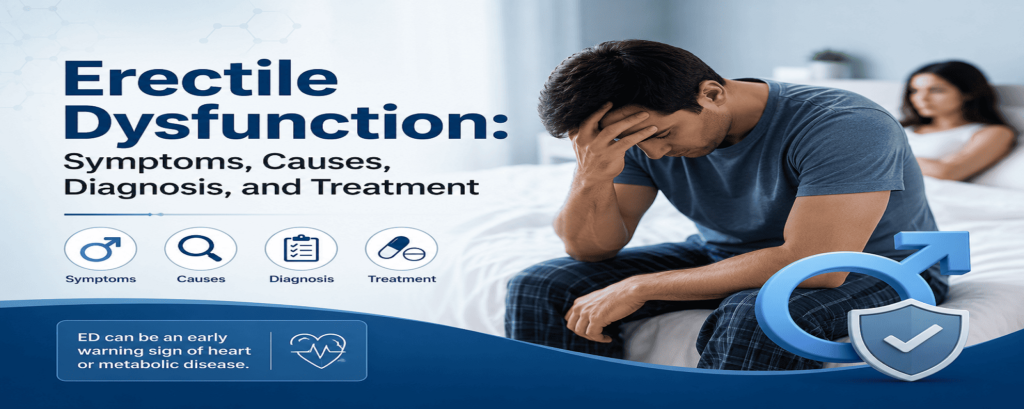
Erectile Dysfunction (ED) is the ongoing difficulty getting or keeping an erection firm enough for sexual activity, and it is one of the most common forms of sexual dysfunction among men and people Assigned Male at Birth (AMAB). It happens when something interrupts the normal chain of nerve signals, blood flow, and hormones that produce an erection, and the cause can be physical, psychological, or a mixture of both. Because ED can also be an early warning sign of heart or metabolic disease, it is worth taking seriously rather than ignoring. This article explains the symptoms, causes, diagnosis, and treatment options for Erectile Dysfunction, and when to see a doctor.
Did you know? Erectile Dysfunction is far more common than most people assume. The National Institute of Diabetes and Digestive and Kidney Diseases (NIDDK) reports that research suggests between 30 million and 50 million men in the United States experience ED, and it becomes more common with age.
Erectile Dysfunction Symptoms
Erectile Dysfunction is defined by a persistent pattern, not by an occasional off night. Most men experience an occasional difficulty with erections, and that alone is not ED. The symptoms usually include:
- Trouble achieving an erection
- Being able to achieve an erection but having trouble maintaining it
- Being able to achieve an erection alone but not during partnered sex
Additionally, ED rarely affects only the bedroom. It can affect self-esteem and contribute to stress, Anxiety, Depression, and strain within a relationship. Because the physical and emotional sides feed one another, addressing both often matters.
If you notice these symptoms persisting over several weeks or months, that is a reason to talk to your doctor.
How Erections Work
Understanding the mechanics makes the causes easier to follow. An erection begins with sensory or mental stimulation. The brain sends signals along the nerves to the penis, and those nerve messengers cause the smooth muscle in the penile tissue to relax.
As the muscle relaxes, blood flows in through the penile arteries and fills two chambers of spongy tissue. As these chambers fill, the penis becomes rigid, and the veins compress to keep the blood in place and sustain the erection. When the muscles contract again, blood flows out and the erection ends.
Because of this, Erectile Dysfunction can result from a problem at any point in that chain: the nerve signals, the blood supply, the hormones that support desire and function, or the psychological state that starts the process.
Causes of Erectile Dysfunction
ED is usually multifactorial, meaning more than one thing contributes. It is helpful to separate the causes into physical, psychological, and situational.
Physical causes
Healthy blood flow is essential to an erection, so anything that damages blood vessels can lead to ED. Common vascular contributors include:
- Diabetes
- Hypertension (High Blood Pressure)
- Atherosclerosis, the narrowing and hardening of arteries from plaque buildup
- Smoking
- Obesity and high cholesterol
- Pelvic injury or trauma
Nerve signalling can also be disrupted. Conditions and procedures that may impair the nervous system and contribute to ED include Spinal Cord Injury, prostate or bladder surgery, Multiple Sclerosis, Parkinson’s Disease, and Epilepsy.
Hormonal factors can play a role as well, particularly low testosterone, thyroid disorders, and elevated prolactin. Certain prescription medicines, including some antidepressants and blood pressure drugs, can also contribute. However, you should never stop a prescribed medicine on your own; if you suspect a medication is involved, raise it with the doctor who prescribed it.
Psychological causes
Erectile Dysfunction does not always have a physical cause. Psychological factors can be the main driver, or can develop on top of a physical one. These include:
- Anxiety, whether general or specific to sexual performance
- Fear of being inadequate during sex
- Chronic stress, whether sex-related or from other areas of life
- Guilt around sexual activity
- Depression and other mood disorders
- Relationship difficulties or poor communication with a partner
Situational causes
Sometimes there is no underlying disease at all. Temporary difficulty with erections can follow a period of heavy drinking, poor sleep, fatigue, a stressful stretch at work, or performance anxiety with a new partner. These episodes are common and often resolve on their own. Because of this, a single bad experience is usually not cause for alarm, though a persistent pattern is worth investigating.
Types of Erectile Dysfunction
Clinicians often group ED into two broad types. The symptoms look similar, but the cause, severity, and treatment can differ.
Organic ED
Organic ED stems from physical factors such as vascular disease, hormonal imbalance, neurological disorders, or penile trauma. It is often divided further into arteriogenic ED, from insufficient arterial blood supply; neurogenic ED, from impaired nerve signalling; and endocrinologic ED, from hormonal imbalance. Organic ED tends to be more persistent, and it can be an early warning sign of cardiovascular disease.
Psychogenic ED
Psychogenic ED arises from psychological factors such as Anxiety, Depression, stress, or relationship problems. It may be temporary or long-lasting, and it often varies with circumstances. A classic clue is that erections still occur during sleep or masturbation but not during partnered sex, though only a doctor can properly interpret this.
In practice, many men have a mixture of both, which is one reason self-diagnosis is unreliable.
Diagnosis of Erectile Dysfunction
Diagnosing ED usually starts with a conversation about your symptoms, medical history, medications, and relationships, followed by a physical examination. Depending on what your doctor finds, further tests may include:
- Physical examination: Examining the penis and testicles and checking nerve sensation.
- Blood tests: Screening for Diabetes, low testosterone, thyroid problems, cholesterol, and signs of heart disease.
- Urine tests: Checking for Diabetes and other underlying conditions.
- Ultrasound: Assessing blood flow to the penis, sometimes combined with a medication injected to produce an erection.
- Psychological assessment: Questions to identify Depression, Anxiety, or relationship factors.
Warning : Do not self-diagnose or self-treat Erectile Dysfunction. ED can be the first outward sign of undiagnosed heart disease, Diabetes, or high blood pressure, and skipping a medical evaluation can mean missing a serious condition. ED medicines are prescription-only for good reason: they can cause a dangerous drop in blood pressure when taken with nitrate medicines used for chest pain, and they may be unsafe for people with certain heart conditions or who take alpha-blockers. Never take an ED medicine that was not prescribed for you, never exceed the dose your doctor prescribes, and avoid products sold without a prescription or from unverified sources, as these may contain undisclosed or incorrect ingredients. Seek emergency care for an erection lasting more than four hours (priapism), sudden vision or hearing loss, or chest pain during sexual activity.
Erectile Dysfunction Treatment
Erectile Dysfunction is usually treatable. Your doctor will consider the likely cause, your other health conditions, and the medicines you take before recommending an approach. Treatment often combines more than one method.
Oral medicines (PDE5 inhibitors)
The standard first-line treatment is an oral Phosphodiesterase-5 (PDE5) inhibitor. These medicines block the PDE5 enzyme, which helps blood vessels in the penis relax and improves blood flow in response to sexual stimulation. They do not create desire or produce an erection on their own; arousal is still required.
The FDA has approved several PDE5 inhibitors, including sildenafil, tadalafil, vardenafil, and avanafil. They work through the same mechanism but differ in how quickly they take effect and how long they last, and they come in a range of strengths.
These medicines are available by prescription only. Before prescribing, a doctor reviews your medical history to check for heart disease and possible drug interactions, particularly with nitrates. Because of this, the appropriate medicine and dose is a decision for your prescriber, not something to select or adjust on your own.
Psychological treatment
When psychological factors contribute, talking therapies can help, either alone or alongside medication:
- Sex therapy: A form of counseling focused specifically on sexual difficulties, which some studies suggest may help psychogenic ED.
- Counseling: Where Anxiety, Depression, or relationship strain is involved, individual or couples counseling may help.
- Cognitive Behavioral Therapy (CBT): Works on the thought and behavior patterns that maintain performance anxiety, and may be combined with sex therapy.
Vacuum erection devices
A vacuum erection device is a mechanical option, often considered when medicines are unsuitable or ineffective. A plastic cylinder is placed over the penis and a pump creates low pressure, drawing blood into the erectile tissue. An elastic ring placed at the base then helps maintain the erection. These devices work for many men when used correctly, and a clinician should explain proper use, since the constriction ring should not be left in place for extended periods.
Other and surgical options
If oral medicines and devices do not work, a doctor may discuss injectable medicines, urethral suppositories, or testosterone therapy where a deficiency is confirmed. Surgery is generally a last resort. Options include a penile implant placed by a urologist, or, in selected younger men with specific vascular injuries, surgery to reconstruct arteries and improve blood flow.
[ PRODUCT MODULE PLACEHOLDER — for your team, remove before publishing ] Any product listings or purchase links belong here as a clearly separated module, outside the medical guidance above — not woven into the treatment text. Prescription ED medicines should not be promoted with copy that invites readers to buy without a prescription or to choose their own dose. Please have compliance review placement and wording.
Lifestyle Changes That May Help
Whether you already have ED or want to lower your risk, habits that protect your blood vessels tend to protect erectile function too. These changes support, rather than replace, medical care.
- Eat a heart-healthy diet: Diets rich in vegetables, fruit, whole grains, and healthy fats support vascular health.
- Stop smoking: Smoking damages blood vessels and is strongly linked with ED. Ask your doctor about support to quit.
- Limit alcohol: Heavy drinking can worsen erectile function, both immediately and over time.
- Stay physically active: Regular exercise improves circulation and helps manage weight, blood pressure, and blood sugar.
- Manage weight and chronic conditions: Keeping Diabetes, Hypertension, and cholesterol under control lowers ED risk.
- Address stress and sleep: Poor sleep and chronic stress affect hormones and desire. Treating Anxiety or Depression can help.
- Avoid recreational drug use: Illicit substances can impair erectile function.
Conclusion
Erectile Dysfunction is common, it is rarely anyone’s fault, and it is usually manageable. It can arise from blood vessel problems, nerve or hormone issues, psychological factors, or a combination, and it sometimes signals an underlying condition that deserves attention in its own right. Because of this, the most useful step is not searching for a quick fix but getting a proper evaluation.
With an accurate diagnosis, most men find an approach that works, whether that is lifestyle change, therapy, a prescribed medicine, a device, or some combination. Treatment should always be guided by a doctor who knows your medical history. If you are experiencing symptoms, talk to your doctor; it is a routine conversation for them, and it is the fastest route to feeling like yourself again.
Frequently Asked Questions
-
Is Erectile Dysfunction permanent?
Not usually. ED is often treatable, and in some cases it resolves on its own. In the long-running Massachusetts Male Aging Study, researchers observed a remission rate of about 29 percent over roughly five years. Whether ED can be reversed depends largely on its underlying cause, which is why a diagnosis matters.
-
How can I improve my Erectile Dysfunction?
Healthy habits help: regular physical activity, a nutritious diet, stopping smoking, limiting alcohol, and managing conditions such as Diabetes and Hypertension. Depending on the cause, your doctor may also recommend counseling, a prescribed medicine, or a device. A doctor can tell you which combination fits your situation.
-
How do I know if I have Erectile Dysfunction?
ED means persistent trouble getting or keeping an erection firm enough for sex, rather than an occasional off night. A doctor can confirm it through a history, physical examination, and tests such as blood work. Because ED can point to other health conditions, a professional assessment is worthwhile.
-
Is Erectile Dysfunction 100% curable?
It depends on the cause. When the underlying problem can be treated, such as a hormonal imbalance or a medication side effect, ED may resolve. When it cannot be fully cured, symptoms can usually still be managed effectively so that a satisfying sex life remains possible.
-
Can you get ED in your 20s?
Yes. Although ED becomes more common with age, younger men can experience it, often with a psychological or lifestyle component such as stress, anxiety, alcohol, or poor sleep. In younger men especially, ED can also flag an undiagnosed medical issue, so it is worth discussing with a doctor rather than ignoring.
Citations
- National Institute of Diabetes and Digestive and Kidney Diseases (NIDDK). Definition & Facts for Erectile Dysfunction. https://www.niddk.nih.gov/health-information/urologic-diseases/erectile-dysfunction/definition-facts
- Leslie SW, Sooriyamoorthy T. Erectile Dysfunction. StatPearls. NCBI Bookshelf, updated 2024. https://www.ncbi.nlm.nih.gov/books/NBK562253/
- Travison TG, Hall SA, Fisher WA, et al. The Natural Progression and Remission of Erectile Dysfunction: Results From the Massachusetts Male Aging Study. Journal of Urology. https://www.auajournals.org/doi/abs/10.1016/j.juro.2006.08.108
- Selvin E, Burnett AL, Platz EA. Prevalence and Risk Factors for Erectile Dysfunction in the US. The American Journal of Medicine, 2007. https://www.amjmed.com/article/S0002-9343(06)00689-9/fulltext
- Nunes KP, et al. / Cleveland Clinic. Erectile Dysfunction: mechanisms, evaluation, and management. https://www.niddk.nih.gov/health-information/urologic-diseases/erectile-dysfunction
This article is for general informational purposes only and is not a substitute for professional medical advice, diagnosis, or treatment. Medicines for Erectile Dysfunction are prescription-only. Always talk to your doctor or a qualified healthcare provider before starting, stopping, or changing any medication.
