
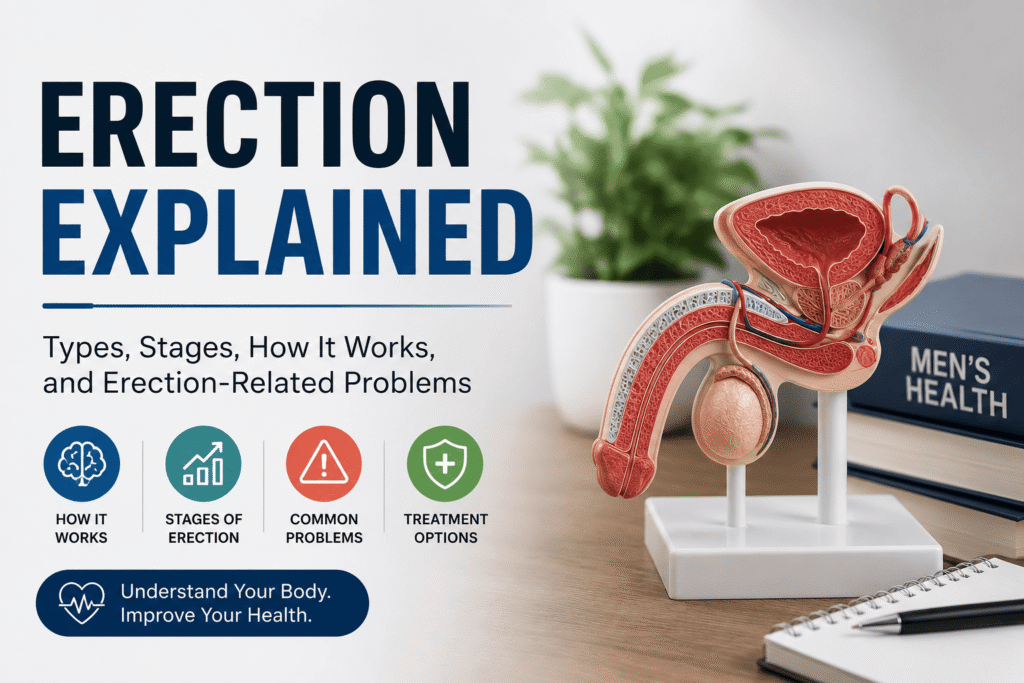
An erection is one of the most fundamental aspects of male sexual health, and yet the mechanics behind it — the anatomy, the nerve signals, the chemical cascade, the different types, and what happens when it goes wrong — are rarely explained clearly in one place. Whether you are curious about how erections work, wondering why you get random erections, trying to understand the stages of erection, or looking for information on erection problems and their treatment, this guide covers all of it. Understanding your erection is not just about sexual performance — it is also about recognising when something may need medical attention, since erection quality is one of the most sensitive early indicators of cardiovascular health.
A healthy erection is considered a reliable indicator of cardiovascular health. Because the arteries supplying the penis (1–2 mm diameter) are smaller than the coronary arteries supplying the heart (3–4 mm), they show the effects of vascular damage earlier. Erection problems in a man under 60 with no obvious psychological cause can be the first detectable sign of underlying heart or blood vessel disease — appearing years before a cardiac diagnosis.
What Is an Erection?
An erection is the physiological process by which the penis becomes firm, enlarged, and erect in response to sexual arousal, physical stimulation, sleep, or sometimes with no obvious cause at all. It occurs when increased blood flow fills the spongy erectile tissue inside the penis, causing it to expand and stiffen.
What an erection looks like varies between individuals. The shaft becomes rigid, the glans (head) may become more pronounced, and the angle, shape, and direction of the erection differ from person to person — all within the normal range. What an erection feels like also varies: most men describe warmth, sensitivity, fullness, and a pleasurable tingling sensation caused by the increased blood flow.
Erections are a normal and vital part of male sexual function — and their quality and frequency are meaningful signals about overall health.
The Anatomy Behind an Erection: Corpus Cavernosum Explained
Understanding the anatomy makes the mechanism far easier to follow. The penis contains three cylindrical chambers of erectile tissue:
- Corpus cavernosum (paired): Two parallel chambers running along the top and sides of the penis. These are the primary erectile chambers — they fill with blood during an erection and account for most of the penis’s rigidity.
- Corpus spongiosum (single): A chamber running along the underside of the penis surrounding the urethra. It contains the glans (head) and does not become as rigid as the corpus cavernosum, which allows the urethra to remain open for ejaculation.
Each corpus cavernosum contains a network of smooth muscle, connective tissue, blood spaces, and arteries. In the flaccid state, the smooth muscle is contracted, restricting blood flow. During arousal, the smooth muscle relaxes, the arteries dilate, blood rushes in, and the veins that drain the penis are compressed by the expanding tissue — trapping blood inside and producing the erection.
The tunica albuginea — a tough fibrous sheath surrounding the corpus cavernosum — plays a critical role by compressing the veins during erection, which prevents blood from draining out and maintains rigidity.
What Causes an Erection? The Full Mechanism
How an erection works is a precisely coordinated sequence involving the brain, nervous system, hormones, and blood vessels. Here is the complete chain:
- Step 1 — Arousal signal: Sexual stimulation — physical touch, visual, psychological, or during REM sleep — activates signals from the brain or spinal cord to the nerves supplying the penis.
- Step 2 — Nitric Oxide release: Nerve endings and the lining of blood vessels in the penis release Nitric Oxide (NO). This is the critical chemical messenger that starts the erection process.
- Step 3 — cGMP production: Nitric Oxide activates an enzyme called guanylate cyclase, which produces cyclic Guanosine Monophosphate (cGMP). cGMP is the signal that tells smooth muscle to relax.
- Step 4 — Smooth muscle relaxation: cGMP causes the smooth muscle inside the corpus cavernosum to relax and the penile arteries to dilate, dramatically increasing blood inflow.
- Step 5 — Blood trapping: As the corpus cavernosum fills with blood, it presses against the tunica albuginea, which compresses the draining veins — trapping blood inside and producing rigidity.
- Step 6 — Detumescence: When arousal ends, an enzyme called PDE5 breaks down cGMP, smooth muscle contracts again, the veins reopen, blood drains out, and the penis returns to its flaccid state.
This explains exactly why PDE5 inhibitors (Sildenafil/Viagra, Tadalafil/Cialis, Vardenafil/Levitra) work for Erectile Dysfunction: they block PDE5, preventing cGMP from being broken down, which extends the relaxation of smooth muscle and makes erections easier to achieve and sustain in response to arousal. The key point: they require arousal to work because they depend on Nitric Oxide being released first.
The Three Types of Erection
Not all erections are the same. There are three clinically recognised types of erection, each triggered by a different pathway and serving a different function.
1. Reflexogenic erection
A reflexogenic erection is triggered by direct physical stimulation of the penis or genitals — touch, friction, or pressure. The signal travels through the peripheral nerves and spinal cord rather than the brain, which is why reflexogenic erections can still occur in some men with spinal cord injuries above the injury level. These are the erections most commonly associated with foreplay and sexual activity. They are controlled by the autonomic nervous system and involve the release of Nitric Oxide from local nerve endings.
2. Psychogenic erection
A psychogenic erection is triggered by mental or emotional stimuli — sexual thoughts, fantasies, visual stimuli, memories, or emotional attraction — without direct physical stimulation. The signal originates in the brain’s sexual response centres (including the hypothalamus and limbic system), which send signals down the spinal cord to the penile nerves and blood vessels. Psychogenic erections are closely tied to psychological state, which is why stress, anxiety, depression, or relationship problems can suppress them — even when physical health is normal.
3. Nocturnal erection
Nocturnal erections — commonly called ‘morning wood’ or NPT (Nocturnal Penile Tumescence) — occur during sleep, typically during the Rapid Eye Movement (REM) stage of the sleep cycle. A healthy man typically experiences 3 to 5 nocturnal erections per night, each lasting 20 to 30 minutes. They are involuntary and unrelated to sexual dreams.
The purpose of nocturnal erections is not fully established, but they are thought to serve a tissue-maintenance function — the repeated cycles of oxygenated blood flow through the penile tissue during sleep help keep the erectile tissue healthy and prevent fibrosis. The testosterone surge that occurs during REM sleep is also thought to contribute to their onset.
Nocturnal erections are clinically significant: their presence indicates the vascular and neurological systems required for erection are intact. A man who reports ED during waking activity but has reliable morning erections is more likely to have a psychological cause for his ED than a vascular or nerve one. A man with no nocturnal erections at all is more likely to have an organic (physical) cause.
Stages of an Erection
An erection is not an on-off switch — it moves through identifiable stages. Research published in the Journal of Urology by Paick and Donatucci described five stages, which remain the standard clinical framework:
- Latent phase: The penis is flaccid. Blood flow is minimal — enough only to nourish penile tissue. Smooth muscle is contracted, limiting blood entry.
- Tumescence phase: Sexual stimulation triggers Nitric Oxide release. Smooth muscle begins to relax, penile arteries dilate, and blood starts flowing in. The penis becomes partially enlarged and starts to firm up. The tunica albuginea begins to stretch.
- Full erection phase: Blood continues to fill the corpus cavernosum. The expanding tissue compresses the drainage veins, trapping blood. The penis reaches full size and becomes firm enough for penetration.
- Rigidity phase: Venous outflow is almost completely stopped. The penis is fully engorged and at maximum hardness. The ischiocavernous muscles (perineal muscles) contract, further increasing pressure within the corpus cavernosum to its maximum — this is the peak of rigidity.
- Detumescence phase: After ejaculation or cessation of stimulation, PDE5 breaks down cGMP, smooth muscle contracts, the drainage veins reopen, blood flows out, and the penis gradually returns to the flaccid state.
The Erection Hardness Score (EHS)
The Erection Hardness Score (EHS) is a simple, validated clinical scale that doctors use to assess erection quality. It ranges from 0 to 4 and is worth knowing because it gives precise language to what men often describe vaguely.
- Grade 0: Penis is completely flaccid with no evidence of erection.
- Grade 1: Penis is larger than flaccid but not hard.
- Grade 2: Penis is hard but not completely rigid. It can be bent but not easily.
- Grade 3: Penis is hard and fully rigid. It can be bent only slightly with difficulty.
- Grade 4: Penis is completely hard and fully rigid, with no ability to bend.
A normal, functional erection for intercourse typically falls between Grade 3 and Grade 4. Grades 0–2 indicate insufficient rigidity for penetration and may warrant medical evaluation. The EHS is useful because it helps both patients and doctors communicate clearly about erection quality without ambiguity.
How Long Should an Erection Last?
This is one of the most searched questions about erections and is absent from the original article. The honest answer is that there is no single ‘normal’ duration — it varies significantly between individuals and situations.
Erections during sexual activity typically last a few minutes to around 30 minutes, depending on the person, the arousal level, and the activity. Erections that occur during arousal without sexual activity (spontaneous erections) may last a few minutes and then subside naturally.
- Nocturnal erections: Each episode typically lasts 20 to 30 minutes, occurring 3–5 times per night during REM sleep.
- During sexual activity: There is no medically defined ‘correct’ duration. Erections may come and go during a sexual encounter and return with continued stimulation.
- After ejaculation: The refractory period follows — the penis typically returns to flaccid within a few minutes of ejaculation. The length of the refractory period varies enormously with age and individual physiology.
An erection lasting more than 4 hours that will not subside — particularly if painful — is called Priapism. This is a medical emergency. The trapped blood becomes oxygen-depleted, causing tissue damage that can lead to permanent Erectile Dysfunction if not treated within hours. Go to an emergency room immediately. Do not wait.
Random Erections: Why They Happen and How to Manage Them
Random erections — erections that occur without any sexual arousal or stimulation — are a normal physiological phenomenon, particularly common during adolescence and young adulthood, though they can occur at any age. They are caused by normal hormonal activity, nerve signals, and the body’s mechanisms for maintaining penile tissue health through regular blood flow.
They can also be triggered by vibration (such as travelling on a bus or train), a full bladder pressing on the prostate or nerves, or simply the normal fluctuation of blood flow through penile tissue.
If random erections are causing distress or occurring in socially inconvenient situations, several strategies can help:
- Mental distraction — shifting attention to an unrelated topic reduces the psychological arousal component
- Changing position — standing, sitting differently, or tucking the penis can reduce stimulation and visibility
- Waiting calmly — most random erections subside within a few minutes without intervention
- Light exercise — a brisk walk redistributes blood flow and can help resolve the erection
- Cold water — a cold shower or splash of cold water can reduce genital blood flow quickly
Frequent random erections are normal in adolescence. If they are persistent, excessively frequent, or accompanied by pain in an adult, a doctor should be consulted to rule out underlying causes.
Nocturnal Erections (Morning Wood): Why They Happen
Morning wood — the erection present when waking from sleep — is the most commonly noticed of the 3–5 nocturnal erections that occur each night during REM sleep. Understanding why they happen removes unnecessary concern and, more importantly, makes them a useful health indicator.
- Why they happen during REM sleep: REM sleep is associated with a surge in testosterone and the activation of the parasympathetic nervous system (the ‘rest and digest’ branch), which promotes the relaxation of smooth muscle in the penis and blood vessel dilation — the same pathway activated during sexual arousal.
- Tissue maintenance function: Regular nocturnal erections are thought to oxygenate penile tissue during the night, preventing the fibrosis (scarring) that can develop in the corpus cavernosum over time when it is not regularly filled with oxygenated blood.
- Why they are visible in the morning: The final REM cycle of the night is the longest, occurring close to waking. The erection from this final REM cycle has often not had time to fully subside before waking — hence ‘morning wood.’
Occasional absence of morning erections is not a cause for concern. However, consistently absent nocturnal erections over several weeks, particularly in combination with daytime ED, can be an indicator of vascular disease, nerve damage, or low testosterone — and warrants medical evaluation.
How Age Affects Erections
Age is one of the most significant factors affecting erection quality and frequency. Understanding what is normal with age prevents unnecessary concern and also helps identify when something genuinely needs medical attention.
- Adolescence and early adulthood: Frequent spontaneous and random erections are normal due to high testosterone, hormonal fluctuation, and a highly responsive nervous system. Multiple nocturnal erections per night are typical.
- 30s and 40s: Erections may require more direct stimulation to initiate. Spontaneous erections become less frequent. Refractory period after ejaculation begins to lengthen.
- 50s and 60s: Testosterone continues to decline gradually (roughly 1–2% per year from the 30s). Erections may take longer to achieve and may be less firm without adequate stimulation. Nocturnal erections become less frequent and shorter.
- 70s and beyond: ED becomes significantly more common — estimated to affect over 50% of men over 70. However, ED is not inevitable with age and is often related to modifiable conditions (cardiovascular disease, Diabetes, medication) rather than age alone.
The key point: age-related changes in erections are gradual and manageable. A sudden change in erection quality at any age is more likely to signal an underlying condition than normal ageing, and warrants medical evaluation.
Lifestyle Factors That Affect Erection Quality
Erection quality is highly sensitive to lifestyle. The same factors that protect cardiovascular health also protect erectile function — because the underlying mechanism is identical: healthy blood vessels, adequate blood flow, and intact nerve signalling.
- Smoking: Damages endothelial cells and reduces Nitric Oxide bioavailability — the same molecule that starts the erection process. Smokers consistently experience weaker and less reliable erections than non-smokers.
- Alcohol: Acute heavy drinking depresses the nervous system and can prevent erections. Chronic heavy drinking causes vascular and nerve damage that leads to long-term ED.
- Diet: Diets high in saturated fat, refined sugar, and processed food contribute to atherosclerosis — the narrowing of blood vessels that impairs blood flow to the penis. A Mediterranean-style diet has the strongest evidence base for supporting erectile function.
- Exercise: Regular cardiovascular exercise improves endothelial function, Nitric Oxide production, and blood flow. Men who exercise regularly have significantly lower rates of ED than sedentary men.
- Obesity: Associated with low testosterone, insulin resistance, and vascular inflammation — all of which reduce erection quality. Weight loss has been shown to improve erectile function independently of medication.
- Sleep: Poor sleep reduces testosterone and elevates cortisol, both of which impair erections. Sleep apnoea, in particular, is strongly linked with ED.
- Stress and mental health: Chronic stress raises cortisol and suppresses the arousal signal required for erections. Anxiety, depression, and relationship difficulties are major causes of psychogenic ED.
Erection-Related Problems
Erectile Dysfunction (ED)
Erectile Dysfunction is the persistent inability to achieve or maintain an erection firm enough for satisfactory sexual activity. It affects an estimated 30–50 million men in the United States alone and is one of the most common male health conditions. ED is not a disease in itself but a symptom — and identifying its cause is the most important step toward effective treatment.
Psychological causes include stress, anxiety (including performance anxiety), depression, relationship difficulties, and guilt. Physical causes include cardiovascular disease, Diabetes, Hypertension, Obesity, low testosterone, neurological disorders (Parkinson’s, MS, spinal cord injury), and certain medications (antidepressants, antihypertensives, alpha-blockers).
Weak erections
Weak erections — EHS Grade 1 or 2 — occur when the vascular mechanism is partially impaired. Blood flows into the penis but either insufficient volume enters or drainage is not adequately blocked. Weak erections are often an intermediate stage of the same conditions that cause full ED and should be evaluated by a doctor.
Priapism
Priapism is a prolonged erection — typically defined as lasting more than 4 hours — that is unrelated to sexual arousal or desire and does not subside. Ischemic Priapism (the most common and dangerous type) causes oxygen deprivation in the penile tissue and is a medical emergency requiring immediate hospital treatment. If untreated, it can cause permanent Erectile Dysfunction through fibrosis of the corpus cavernosum.
Peyronie’s Disease
Peyronie’s Disease involves the development of fibrous scar tissue (plaques) inside the penis, causing curvature and sometimes significant pain during erections. It affects approximately 1 in 11 men and can cause psychological distress as well as physical discomfort. Treatment options include oral medications, injections, and surgery in more severe cases.
Caution: Do not self-medicate for erection problems. Many causes of ED — including cardiovascular disease, Diabetes, and low testosterone — require proper diagnosis and medical management. Taking ED medicines without medical screening exposes you to potentially dangerous drug interactions, particularly with nitrate medicines for chest pain. Always consult a doctor before starting any treatment for erection problems.
Treatment for Erection Problems
The treatment for erection problems depends on the underlying cause. Most cases of ED are treatable, and many men benefit significantly from one or a combination of approaches.
Oral medications (PDE5 inhibitors)
The standard first-line medical treatment for ED is an oral PDE5 inhibitor. These medicines block the enzyme that breaks down cGMP, prolonging smooth muscle relaxation and improving blood flow to the penis in response to arousal:
- Sildenafil (Viagra): Works within 30–60 minutes, lasts 4–6 hours.
- Tadalafil (Cialis): Works within 30 minutes to 2 hours, lasts up to 36 hours. Also available as a once-daily low dose.
- Vardenafil (Levitra): Works within 30–60 minutes, lasts 4–5 hours.
- Avanafil (Stendra): Fastest onset — as early as 15 minutes, lasts up to 6 hours.
All PDE5 inhibitors require a prescription and sexual stimulation to work. They are contraindicated with nitrate medicines — combining them can cause a potentially fatal blood pressure drop.
Lifestyle changes
For mild to moderate ED — particularly when lifestyle factors are involved — addressing them can produce meaningful improvement without medication. Quitting smoking, reducing alcohol, losing weight, exercising regularly, and managing stress are all evidence-based approaches with documented positive effects on erectile function.
Psychological treatment
When anxiety, depression, performance anxiety, or relationship difficulties are the primary drivers of ED, psychosexual counselling, cognitive behavioural therapy (CBT), or sex therapy can be highly effective — sometimes more so than medication alone for psychogenic ED.
Other options
For men in whom oral medications are insufficient or unsuitable, other options include vacuum erection devices, injectable alprostadil directly into the penis, urethral suppositories, penile implant surgery, or testosterone therapy where deficiency is confirmed.
Conclusion
An erection is a precisely coordinated process involving the brain, nervous system, blood vessels, and hormonal signals — and understanding how it works helps explain both why erection problems occur and how they are treated. The three types of erection (reflexogenic, psychogenic, and nocturnal) each serve different functions. The five stages progress from latency through tumescence and full erection to rigidity and detumescence. Erection quality is graded on the Erection Hardness Score and is one of the best available early indicators of cardiovascular health.
When erection problems occur — whether ED, weak erections, Priapism, or Peyronie’s Disease — the most important first step is a proper medical evaluation rather than self-treatment. Most erection problems are treatable. A doctor can identify the cause, screen for interactions, and recommend the most appropriate approach for your specific situation.
Frequently Asked Questions
-
What are the three types of erection?
The three clinically recognised types of erection are: reflexogenic (triggered by physical stimulation of the genitals), psychogenic (triggered by mental or emotional stimuli such as thoughts or visual arousal), and nocturnal (occurring involuntarily during REM sleep). All three involve the same underlying vascular mechanism but are activated by different nervous system pathways.
-
What is a normal erection for a man?
A normal erection involves the penis becoming firm, enlarged, and rigid enough for sexual activity — typically EHS Grade 3 or 4 on the Erection Hardness Score. Average erect penis length varies between individuals, with research suggesting an average of approximately 5.1 to 5.5 inches (12.95–13.97 cm). Angle, shape, and direction also vary normally between individuals.
-
How can I improve my erection?
Lifestyle factors have a significant evidence base for improving erections: quitting smoking, limiting alcohol, exercising regularly, maintaining a healthy weight, managing stress, and getting adequate sleep all support the vascular and hormonal mechanisms behind erections. For persistent erection difficulties, a doctor can assess whether an oral PDE5 inhibitor (such as Sildenafil, Tadalafil, or Vardenafil) or other treatment is appropriate.
-
How long should an erection last?
There is no single normal duration — it varies by individual, age, arousal level, and situation. Erections during sexual activity typically last a few minutes to around 30 minutes. Nocturnal erections typically last 20–30 minutes each. An erection lasting more than 4 hours that will not subside is Priapism — a medical emergency requiring immediate hospital care.
-
What erection pill works best?
All four FDA-approved PDE5 inhibitors — Sildenafil (Viagra), Tadalafil (Cialis), Vardenafil (Levitra), and Avanafil (Stendra) — are effective for most men with ED. They differ in onset, duration, and side-effect profile. Sildenafil is the most affordable and most studied. Tadalafil lasts the longest (up to 36 hours) and suits men who want spontaneity. Avanafil works fastest (15 minutes). The best choice depends on your health history — a doctor can advise which is most suitable for you.
Citations
- Paick JS, Donatucci CF, Lue TF. Physiology of penile erection. Urologic Clinics of North America, 1995. PubMed PMID 3686764. https://pubmed.ncbi.nlm.nih.gov/3686764/
- Cleveland Clinic. Penile Erection: Function, Duration & How It Works. https://my.clevelandclinic.org/health/articles/10036-erection
- Ro Health. What Is an Erection, and How Do Erections Work? https://ro.co/erectile-dysfunction/how-do-erections-work/
- Rex MD. Stages of an Erection. https://rexmd.com/learn/stages-of-an-erection
- National Institutes of Health. Physiology of erection. NCBI Bookshelf NBK513278. https://www.ncbi.nlm.nih.gov/books/NBK513278/
- Goldstein I, et al. Nitric oxide and penile erection. Biology of Reproduction, 1995. https://academic.oup.com/biolreprod/article/52/3/485/2761399
- Veale D, et al. Am I normal? A systematic review and construction of nomograms for flaccid and erect penis length and circumference in up to 15,521 men. PubMed PMID 32666897. https://pubmed.ncbi.nlm.nih.gov/32666897/
- National Institute of Diabetes and Digestive and Kidney Diseases. Erectile Dysfunction. https://www.niddk.nih.gov/health-information/urologic-diseases/erectile-dysfunction
This article is for general informational purposes only and does not constitute medical advice. If you are experiencing persistent erection problems, consult a qualified healthcare provider. Do not self-medicate with prescription medicines.
