
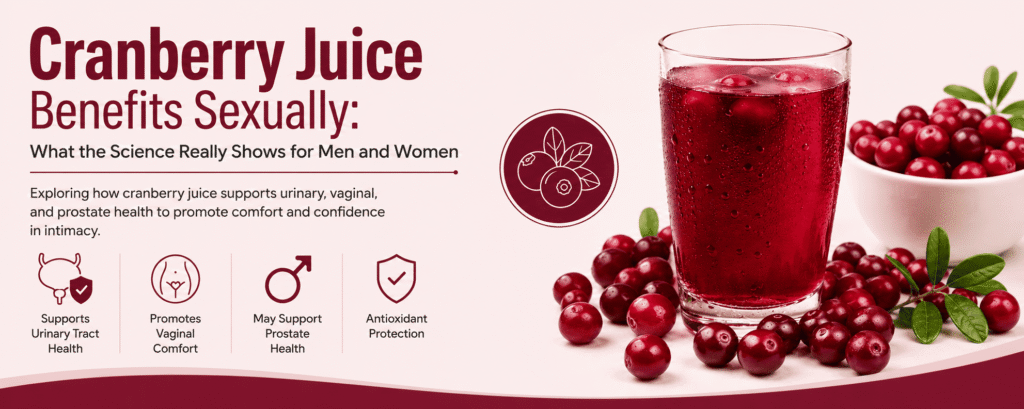
Cranberry juice is a tart, deep-red drink pressed from the small berries of the Vaccinium macrocarpon plant, and it has long carried a reputation as a wellness staple. Its best-studied benefit comes from natural plant compounds called proanthocyanidins, which appear to keep certain bacteria from sticking to the walls of the urinary tract. Because urinary comfort and intimate well-being are closely linked, many people ask whether cranberry juice benefits sexually as well. This article explains what the evidence genuinely supports for both men and women, where the popular claims outrun the science, and how to enjoy cranberry juice sensibly.
What Is in Cranberry Juice?
Before looking at intimacy, it helps to understand what a glass of cranberry juice actually offers. The nutritional profile is modest but meaningful, and it shapes every claim that follows.
- Vitamin C: One cup of unsweetened cranberry juice provides roughly 23 to 26 mg of Vitamin C, or about a quarter of the daily value for most adults. Vitamin C is an antioxidant that supports normal immune function and collagen formation.
- Vitamin E and polyphenols: Cranberries also supply some Vitamin E along with plant compounds such as proanthocyanidins, quercetin, and anthocyanins, which give the berry its color and are studied for their antioxidant activity.
- Sugar and calories: A cup of unsweetened juice contains close to 30 grams of natural sugar and around 116 calories, and many store-bought “cocktail” versions add considerably more. Because of this, moderation matters, especially for anyone watching blood sugar.
However, it is worth remembering that a food’s nutrient list tells you what it contains, not necessarily what it does inside the body. That distinction is central to the sexual-wellness question.
Did you know? A meta-analysis of seven randomized controlled trials in generally healthy women found that cranberry reduced the risk of recurrent Urinary Tract Infections by about 26 percent, though the researchers noted the studies were relatively small and called for larger, higher-quality trials to confirm the effect.
The Real Connection Between Cranberry Juice and Sexual Wellness
Most of the credible link between cranberry juice and intimacy is indirect rather than direct. Cranberry juice is not an aphrodisiac and does not appear to act on arousal, hormones, or blood flow in any meaningful way. Instead, its value lies in supporting urinary and, possibly, vaginal comfort, which can remove a common source of discomfort that interferes with intimacy.
In other words, the honest framing is not “cranberry juice improves sexual performance,” but rather “cranberry juice may help prevent a problem that can make intimacy uncomfortable.” That is a smaller claim, but it is the one the evidence actually supports.
Cranberry Juice Benefits Sexually for Women
For women, the most researched benefits relate to urinary and vaginal health, both of which can affect comfort and confidence.
Urinary Tract Infection Prevention
Urinary Tract Infections are common, and they can cause pain, urgency, and a reduced interest in intimacy while symptoms last. A large 2023 Cochrane review that pooled 50 studies with 8,857 participants concluded that cranberry products can reduce the risk of symptomatic, culture-confirmed Urinary Tract Infections in women with recurrent infections, in children, and in people who are prone to infections after certain medical procedures. The proposed mechanism is that proanthocyanidins interfere with the ability of E. coli bacteria to adhere to the urinary tract lining.
Additionally, a network meta-analysis published in 2024 found that, with moderate-to-low certainty, the available evidence supports cranberry juice for preventing Urinary Tract Infections. The certainty is not high, so cranberry juice is best seen as a possible supportive measure rather than a treatment.
Vaginal Comfort and the Microbiome
A healthy vagina is normally dominated by Lactobacillus bacteria, and an imbalance in this ecosystem is linked with conditions such as Bacterial Vaginosis. Some early research has explored whether cranberry might influence this balance. A small randomized, double-blind, placebo-controlled study of 25 postmenopausal women reported that regular cranberry juice consumption modestly modulated the vaginal microbiota over a two-week period.
This is an intriguing but preliminary finding from a very small study, and it does not establish that cranberry juice treats or prevents vaginal infections. If you have symptoms such as unusual discharge or odor, that is a reason to talk to your doctor, not to reach for juice.
Cranberry Juice Benefits Sexually for Men
For men, the picture is thinner, and it is important to separate biological plausibility from proven effect.
Erectile Function and the Vitamin C Question
Some articles argue that because Vitamin C supports the production of Nitric Oxide, a molecule involved in blood vessel relaxation, and because healthy blood flow matters for erections, cranberry juice must help with Erectile Dysfunction. This chain of reasoning is plausible in theory, but no strong clinical trials show that drinking cranberry juice improves erectile function in practice. The amount of Vitamin C in cranberry juice is similar to that of many everyday fruits, and Erectile Dysfunction usually has causes such as vascular disease, diabetes, or stress that a beverage will not resolve.
General Urinary and Antioxidant Support
The urinary benefits that apply to women can apply to men as well, since men also experience Urinary Tract Infections, though less frequently. The antioxidants in cranberries may contribute to general health as part of a balanced diet. However, general antioxidant intake is not the same as a specific effect on sexual function, and it should not be presented as one.
What Cranberry Juice Cannot Do
Being clear about the limits is part of giving you trustworthy information. Based on current evidence, cranberry juice does not:
- Directly boost libido or arousal: There is no scientific evidence that cranberry juice raises sex drive or triggers arousal in men or women.
- Cure or treat Erectile Dysfunction: It is not a substitute for medical evaluation or prescribed treatment when Erectile Dysfunction is present.
- Change the taste of bodily fluids in any proven way: This is a widely repeated belief, but it is not supported by reliable research.
- Treat or cure Sexually Transmitted Infections: STIs are caused by specific bacteria, viruses, or parasites and require appropriate medical treatment. Cranberry juice has no role here.
How to Include Cranberry Juice in Your Diet
If you enjoy cranberry juice and tolerate it well, it can be a reasonable part of a varied diet. Choosing wisely makes a difference.
- Favor unsweetened, 100% juice: Many “cocktail” blends are high in added sugar, which offsets the benefits. Reading the label helps.
- Keep portions modest: Because of the natural sugar content, a small glass is usually more sensible than large quantities, particularly if you have Diabetes or Prediabetes.
- Treat it as a supportive habit, not a cure: For an active infection or a persistent sexual health concern, cranberry juice is not a replacement for medical care.
Warning: Cranberry juice is not right for everyone. It may interact with blood-thinning medications such as Warfarin, so anyone taking anticoagulants should talk to their doctor first. People with a history of kidney stones may need caution because cranberries contain oxalates. The Cochrane evidence does not support cranberry use in pregnant women, older adults in care settings, or people with bladder-emptying problems. And cranberry juice should never be used in place of antibiotics for an active infection. When in doubt, talk to your doctor before relying on it.
Conclusion
So, does cranberry juice benefit sexually? The realistic answer is that its contribution is modest and mostly indirect. The strongest evidence supports cranberry products for helping to prevent recurrent Urinary Tract Infections in certain groups, and by easing that discomfort, cranberry juice may indirectly help some people feel more comfortable and confident during intimacy. However, it does not appear to boost libido, improve erections, or act as an aphrodisiac, and it cannot treat infections or Sexually Transmitted Infections. Enjoyed in moderation as part of a balanced diet, cranberry juice can be a pleasant, mildly beneficial drink, but for any specific sexual health concern, the best step is a conversation with your doctor.
Frequently Asked Questions
-
Does cranberry juice help with Erectile Dysfunction?
There is no strong clinical evidence that cranberry juice improves Erectile Dysfunction. While it contains Vitamin C, which is involved in blood vessel function, this does not translate into a proven effect on erections. If you are experiencing Erectile Dysfunction, it is worth speaking to a doctor, since it can signal underlying health issues.
-
Can cranberry juice increase libido?
No reliable studies show that cranberry juice raises libido in men or women. A balanced diet supports overall health, which can indirectly affect well-being, but cranberry juice has no known libido-boosting property. Persistent low desire is best discussed with a healthcare provider.
-
Does cranberry juice really change the taste of bodily fluids?
This is a popular belief, but it is not backed by scientific evidence. Diet can subtly influence body chemistry in general, yet no quality research confirms that cranberry juice produces this specific effect. It is best treated as a myth rather than a fact.
-
How much cranberry juice should I drink for urinary health?
There is no official universal dose, and studies have used a range of amounts and forms, including juice and capsules. Unsweetened juice in modest quantities is generally preferred to limit sugar intake. If you have recurrent Urinary Tract Infections, ask your doctor what approach makes sense for you.
-
Is cranberry juice safe to drink every day?
For most healthy people, moderate daily consumption of unsweetened cranberry juice is generally considered safe. However, the sugar content, possible interactions with blood thinners, and oxalate content mean it is not ideal for everyone. If you take medication or have a chronic condition, check with your doctor first.
Citations
- Williams G, Stothart CI, Hahn D, et al. Cranberries for preventing urinary tract infections. Cochrane Database of Systematic Reviews, 2023. https://www.cochrane.org/evidence/CD001321_cranberries-preventing-urinary-tract-infections
- Fu Z, et al. Cranberry Reduces the Risk of Urinary Tract Infection Recurrence in Otherwise Healthy Women: A Systematic Review and Meta-Analysis. PubMed (PMID: 29046404). https://pubmed.ncbi.nlm.nih.gov/29046404/
- Cranberry Juice, Cranberry Tablets, or Liquid Therapies for Urinary Tract Infection: A Systematic Review and Network Meta-analysis. PubMed (PMID: 39030132), 2024. https://pubmed.ncbi.nlm.nih.gov/39030132/
- Al Othaim A, et al. Impact of cranberry juice consumption on gut and vaginal microbiota in postmenopausal women. Food Frontiers, 2021. https://iadns.onlinelibrary.wiley.com/doi/10.1002/fft2.76
- U.S. Department of Agriculture, FoodData Central. Cranberry juice, unsweetened — nutrient values. https://fdc.nal.usda.gov/
This article is for general informational purposes only and is not a substitute for professional medical advice, diagnosis, or treatment. Always talk to your doctor or a qualified healthcare provider about your individual health needs.

One thought on “Cranberry Juice Benefits Sexually: What the Science Really Shows for Men and Women”