
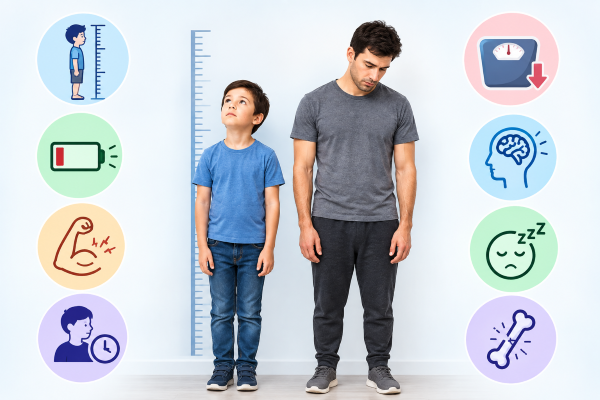
Noticing that a child isn’t growing at the same pace as their peers? Or observing unexplained fatigue and weight gain in adulthood despite a healthy lifestyle? These subtle signs may point to Growth Hormone Deficiency (GHD) — a condition in which the pituitary gland fails to produce enough growth hormone. GHD affects an estimated 1 in 4,000 to 10,000 children, Growth Hormone Deficiency symptoms but it can develop at any age. While short stature is the most obvious sign in children, symptoms look very different in adults. Recognising these warning signs early can significantly improve treatment outcomes.
1. Significantly Slower Growth Rate in Children
One of the earliest and most visible signs of GHD in children is growth failure — growing less than 2 inches (5 cm) per year. This often results in short stature, meaning the child is noticeably shorter than peers. However, some children have growth failure without appearing unusually short, which is why regular growth tracking matters. Without treatment, severely affected children may not reach an adult height above 5 feet (152 cm).
2. Facial Features and Body Proportions
Children with congenital GHD often develop characteristic facial features, including a prominent forehead, an underdeveloped nasal bridge, and an overall appearance of immaturity compared to peers. The face may look younger than the child’s actual age, sometimes described as “doll-like.” Many children also have delayed dental development and abnormal tooth eruption patterns.
Body proportions often remain childlike, with increased abdominal fat and decreased muscle mass. Hands and feet may appear small relative to overall body size.
3. Delayed Puberty and Sexual Development
Adolescents with GHD commonly experience delayed puberty. Boys may show delayed voice deepening, genital development, and facial or body hair growth. Girls might experience delayed breast development and menstruation. This delay occurs because growth hormone interacts with sex hormones and influences sexual maturation — some teens with untreated GHD may show a complete absence of pubertal development.
This delay can cause real psychological distress during adolescence, including poor self-esteem and social difficulties.
4. Increased Fat Tissue and Decreased Muscle Mass
Both children and adults with GHD tend to have altered body composition — typically increased fat around the waist and abdomen, creating a rounded appearance. They also tend to have reduced fat-free mass (muscle and bone), contributing to decreased exercise capacity and physical endurance. Adults may notice difficulty maintaining muscle tone despite regular exercise, since growth hormone plays a central role in fat metabolism and muscle development.
Untreated GHD is associated with increased cardiovascular and metabolic risk compared with the general population, including a higher likelihood of developing metabolic syndrome and insulin resistance over time. This is one of the reasons early recognition and treatment matter, beyond the more visible symptoms.
5. Low Energy Levels and Decreased Exercise Capacity
Fatigue and low energy are common complaints. Children may tire easily during physical activity, and adults often report persistent fatigue that interferes with daily life. This stems from metabolic changes and decreased muscle strength — many patients describe a general sense of reduced vitality and poor exercise tolerance. Quality-of-life assessments consistently show that energy and physical function scores improve significantly with growth hormone replacement therapy.
6. Psychological and Cognitive Effects
Growth hormone receptors are present throughout the brain, and deficiency can affect psychological wellbeing and cognitive function. Children with GHD may experience learning difficulties, poor concentration, sleep problems, and memory difficulties. Adults frequently report depression, social isolation, and reduced quality of life, along with mood swings and anxiety. These psychological symptoms often improve with appropriate growth hormone replacement therapy.
Fact: A substantial portion of daily growth hormone secretion occurs during deep sleep phases — which is why sleep disorders can sometimes mimic or worsen GHD symptoms, and why sleep quality is worth discussing as part of a GHD evaluation.
7. Cardiovascular and Metabolic Abnormalities
Adults with GHD typically show increased cardiovascular risk factors — elevated LDL (“bad”) cholesterol, decreased HDL (“good”) cholesterol, and increased triglycerides. Insulin resistance and metabolic syndrome are more frequent in people with untreated GHD, along with a higher likelihood of developing type 2 Diabetes and Hypertension compared with the general population. Long-term studies suggest untreated GHD in adults increases the risk of Cardiovascular Disease and premature mortality.
8. Bone Density Reduction and Fracture Risk
Growth hormone plays a significant role in bone metabolism and mineral density. Adults with GHD often show reduced bone mineral density, raising fracture risk — bone density is measurably lower in untreated growth-hormone-deficient adults compared with healthy peers of the same age. When administered appropriately, growth hormone replacement therapy can increase bone mineral density and potentially reduce fracture risk.
9. Skin Changes and Poor Wound Healing
Growth hormone plays a role in skin health and tissue repair. People with GHD often develop thin, dry skin that lacks elasticity and appears prematurely aged, since growth hormone stimulates collagen production that maintains skin structure and hydration. Patients frequently report delayed wound healing — minor cuts or bruises can take noticeably longer to heal, and surgical recovery times can be extended in those with untreated GHD.
When to See a Doctor
If you notice persistent growth delays in a child, or multiple symptoms described above, consult a healthcare provider. A paediatric endocrinologist specialises in hormone disorders in children and can properly evaluate growth patterns.
For adults, consider discussing GHD with a doctor if you’re experiencing fatigue, body composition changes, reduced vitality, and psychological symptoms without an apparent cause — particularly if you had childhood GHD or a pituitary disorder.
Men’s Health Guide
Understanding sexual health involves more than treating a single concern. Factors such as lifestyle, sexual performance, erectile function, premature ejaculation, exercise, and medication safety can all play a role. Below are useful resources covering common men’s sexual health questions.
Learn how alcohol may affect the effectiveness and safety of Viagra and why moderation is important.
Explore the potential connection between cranberry juice, urinary health, and aspects of sexual wellness.
Understand how dapoxetine is used for premature ejaculation and the key considerations before using it.
Find out whether Cialis is appropriate for people who do not have erectile dysfunction and what risks to consider.
Discover exercises and fitness approaches that may help improve endurance, pelvic control, and overall sexual performance.
Learn about common causes of weak erections and the lifestyle changes and treatment options that may help.
Conclusion
Spotting Growth Hormone Deficiency symptoms early can be genuinely life-changing, especially for children with growth potential still ahead of them. Whether a child is growing too slowly or an adult is dealing with unexplained fatigue and weight gain, these signs shouldn’t be ignored. From characteristic facial features and delayed puberty to increased fat tissue and psychological changes, GHD affects the whole body in ways that are easy to miss individually but add up to a recognisable pattern.
Modern treatments work well. Daily growth hormone injections can help children reach normal adult heights and help adults regain energy, improve body composition, and support mental wellbeing — but treatment success depends heavily on early diagnosis. If you recognise several of these symptoms in yourself or your child, talk to a doctor about testing. An endocrinologist can determine what’s happening and build a treatment plan to improve quality of life and reduce the risk of long-term complications.
Frequently Asked Questions
-
How do I check my growth hormone levels?
Growth hormone (GH) levels are checked through specialised blood tests ordered by an endocrinologist. A standard, single blood test is unreliable on its own, since growth hormone is released in pulses throughout the day rather than at a steady level. Instead, stimulation tests measure the body’s ability to produce growth hormone after receiving specific stimulating agents — this gives a much more reliable picture than a one-off blood draw.
-
Is Growth Hormone Deficiency hereditary?
It can be, in some cases. A meaningful proportion of children with GHD have family members with similar conditions, and several genetic mutations affecting growth hormone production or action have been identified. That said, most cases are idiopathic — meaning they occur without an identified genetic link — so a family history isn’t required for a diagnosis to be considered.
-
Can Growth Hormone Deficiency cause obesity?
Yes — GHD promotes increased visceral (abdominal) fat accumulation and reduced lean muscle mass, contributing to central obesity and metabolic syndrome if left untreated. Lifestyle interventions alongside growth hormone therapy can help mitigate this weight gain.
-
What causes isolated Growth Hormone Deficiency?
Isolated GHD — meaning GH deficiency without other pituitary hormone deficits — often results from genetic mutations in the GH1 or GHRHR genes, pituitary hypoplasia (underdevelopment), or idiopathic factors with no identifiable cause.
-
How is Growth Hormone Deficiency diagnosed?
Diagnosis relies on clinical growth data, low IGF-1 (insulin-like growth factor 1) concentrations, and an inadequate GH response to stimulation testing. Bone age assessment and pituitary MRI can help rule out other conditions. Prompt consultation with a paediatric endocrinologist (for children) or endocrinologist (for adults) is recommended, since timely diagnosis meaningfully improves treatment outcomes.
-
What treatments are available for Growth Hormone Deficiency?
Treatment primarily involves daily growth hormone injections, dosed and adjusted based on weight and individual response. Modern synthetic growth hormone is well-studied and effectively treats most symptoms. Children may need several years of therapy through the completion of growth; adults might require lifelong treatment with regular monitoring to maintain optimal results.
This article is for general informational purposes only and does not constitute medical advice. If you suspect Growth Hormone Deficiency in yourself or your child, consult a qualified healthcare provider or endocrinologist for proper evaluation and diagnosis
