
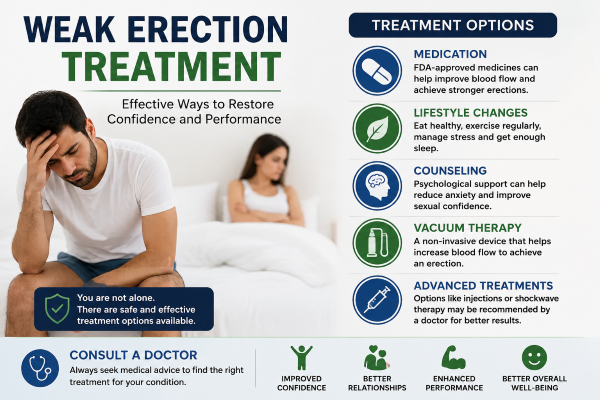
A weak erection — one that develops but lacks full firmness, weak erection treatment or that starts strong and softens during sex — is one of the most common concerns men bring up, and one of the most treatable. Occasional softness from stress, tiredness, or alcohol is normal and not a cause for concern. When it becomes frequent, it may point to an underlying vascular, hormonal, or psychological cause, and it typically responds well to treatment — often without needing to escalate straight to medication. This article covers the full range of options, from lifestyle-first approaches to medical treatment, and gives a clear framework for knowing when it’s time to see a doctor.
The Massachusetts Male Aging Study — one of the largest studies on this topic — found that approximately 52% of men aged 40 to 70 reported some degree of erectile difficulty, with prevalence rising with age. This does not mean weakness is an inevitable part of ageing: the same research and decades of follow-up studies confirm that most cases respond well to lifestyle changes, treatment of underlying conditions, or medical therapy.
Natural Approaches and Lifestyle Changes
For men experiencing occasional or mild weak erections, lifestyle changes are typically the first and most effective step — addressing the vascular, hormonal, and stress-related causes without medication.
Diet
What you eat directly affects vascular health, which determines blood flow to the penis. Research consistently shows men following a Mediterranean-style diet have fewer erection problems than those eating primarily red meat and processed food. Focus on: plenty of fruits and vegetables, whole grains over refined carbohydrates, fish and lean proteins, healthy fats from olive oil and nuts, and limited red and processed meat.
Exercise
Physical activity is one of the most effective natural interventions available. A Harvard study found that just 30 minutes of daily walking reduced the risk of erection problems by up to 41%. Exercise improves circulation, reduces stress, supports weight management, and boosts confidence — all of which contribute to stronger erections.
Pelvic floor exercises (Kegels) specifically strengthen the muscles that help maintain blood flow in the penis during erection. A UK-based clinical trial found that men who performed pelvic floor exercises with biofeedback and lifestyle advice experienced significantly greater improvement in erectile function than those receiving lifestyle advice alone.
- How to do Kegels: Squeeze the muscles you would use to stop urination midstream, hold for 3 to 5 seconds, then release fully. Repeat 10 to 15 times, twice daily. Progress to longer holds over 4 to 6 weeks.
Weight, smoking, alcohol, stress, and sleep
- Lose excess weight: Carrying extra weight, especially around the waist, significantly raises risk. A 42-inch waist carries a 50% higher risk than a 32-inch waist (Harvard research).
- Quit smoking: Tobacco damages blood vessels throughout the body, including the penis, by depleting Nitric Oxide. Vascular health measurably improves within 2 to 4 weeks of quitting.
- Limit alcohol: A drink or two may reduce anxiety, but excessive alcohol impairs erectile function directly. Staying under 14 units per week supports healthy sexual function.
- Manage stress: Chronic stress raises cortisol, which interferes with arousal and blood flow. Regular exercise, mindfulness, and adequate rest all reduce this burden.
- Sleep better: Aim for 7 to 9 hours nightly. Poor sleep disrupts testosterone production and damages vascular health over time.
Herbal Supplements — An Honest Look
Several herbal supplements are marketed for weak erections. The evidence quality varies significantly and deserves an honest assessment rather than marketing claims:
- Panax Ginseng: The best-evidenced herbal option. Multiple studies and meta-analyses show modest, consistent improvement in erectile function scores. Evidence grade: low-to-moderate.
- L-arginine: Converts to Nitric Oxide in the body, supporting blood vessel relaxation. Modest evidence at clinical doses (3 to 5 g/day), particularly for mild ED. Evidence grade: low.
- Horny Goat Weed (Icariin): A traditional remedy with a proposed PDE5-inhibiting mechanism similar to Sildenafil, but human clinical trial evidence remains very limited. Evidence grade: insufficient for a firm recommendation.
Important: Many products marketed as ‘natural’ or ‘herbal’ weak erection treatments contain unlisted pharmaceutical ingredients — sometimes undeclared Sildenafil analogues — which can be dangerous, particularly if combined with other medications such as nitrates. Always consult your doctor before trying any new supplement, and be sceptical of products that promise guaranteed or dramatic results.
Underlying Health Conditions That Cause Weak Erections
Weak erections are frequently a symptom of an underlying health condition rather than a standalone problem. Treating the underlying cause often restores erection quality naturally.
- Cardiovascular disease: The same blood vessel problems that affect the heart affect penile blood flow — often first, since the penile arteries are smaller and show damage earlier. Treating vascular health through medication, diet, and exercise often restores normal erections.
- Diabetes: High blood sugar damages both nerves and blood vessels involved in erection. Managing blood sugar levels helps preserve erectile function. ED affects 35 to 50% of men with Diabetes.
- High blood pressure: Uncontrolled hypertension damages artery walls and reduces penile blood flow. Some blood pressure medicines (notably beta-blockers and thiazide diuretics) also cause erection difficulty as a side effect — a doctor can review whether an alternative class is appropriate.
- High cholesterol: Excess cholesterol narrows arteries, restricting the blood flow needed for firm erections. Lowering cholesterol through diet, exercise, or medication improves erectile function.
- Hormonal imbalances: Low testosterone, thyroid disorders, or elevated prolactin all affect desire and erectile capability.
- Neurological conditions: Multiple Sclerosis, Parkinson’s Disease, and spinal cord injuries interfere with the nerve signals required for erection.
- Depression and anxiety: Mental health conditions affect both sexual desire and physical erectile function — disrupting hormones, reducing libido, and interfering with the brain’s arousal signals.
Regular check-ups for blood pressure, blood sugar, cholesterol, and triglycerides catch these problems early. New-onset weak erections in a man under 60 are a good prompt for cardiovascular screening specifically, since ED can precede a cardiovascular diagnosis by 3 to 5 years.
Medical Treatment Options
When lifestyle changes alone are insufficient, or when erection difficulties persist, medical treatment provides effective, well-evidenced solutions. This section summarises the main options — for a full breakdown of each tier, dosing, and evidence, see our complete Erectile Dysfunction Treatment guide.
Oral medications (PDE5 inhibitors) — usually first-line
The four FDA-approved options work by relaxing penile smooth muscle and increasing blood flow during arousal:
- Sildenafil (Viagra): Onset 30 to 60 minutes; effective window 4 to 6 hours; best on an empty stomach.
- Tadalafil (Cialis): Onset 30 minutes to 2 hours; effective window up to 36 hours; minimal food interaction; also available as a daily low dose.
- Vardenafil (Levitra): Onset 30 to 60 minutes; effective window 4 to 5 hours.
- Avanafil (Stendra): Fastest onset — as early as 15 to 30 minutes; effective window up to 6 hours.
Injectable medications
For men who don’t respond to oral medication or experience unwanted side effects, injectable alprostadil offers a reliable alternative — administered directly into the penis with a very fine needle, typically producing firmness within 10 to 30 minutes. A doctor teaches the correct technique so it can be self-administered safely at home.
Mechanical devices and surgery
- Vacuum erection devices: Create a seal around the penis, drawing blood in to produce an erection; a constriction ring maintains it during sex. Non-pharmacological, avoids medication side effects, and works for most men.
- Penile implants: Surgical devices — inflatable (pump to erect, deflate afterward) or semi-rigid (bendable but always firm). Reserved for men who have exhausted other options; carries surgical risks (infection, complications) but very high satisfaction rates among those who choose it.
Hormone Replacement Therapy
If blood tests confirm low testosterone, hormone therapy (gels, patches, or injections) can help — but requires regular monitoring through blood tests, and is only appropriate for confirmed hypogonadism, not as a general performance enhancer.
Addressing Psychological Factors
Physical treatments work best when emotional factors are also addressed. Stress, anxiety, depression, and relationship conflict commonly contribute to or worsen weak erections. Performance anxiety in particular creates a self-reinforcing cycle — worrying about not performing well makes it measurably harder to perform.
Sex therapy and relationship counselling can help with performance anxiety and confidence, communication difficulties, relationship tension affecting intimacy, and depression or anxiety affecting sexual function. Attending sessions with a partner, where relevant, often improves outcomes, since intimacy involves both people.
Combining Treatments for Better Outcomes
Combining strategies often produces better results than any single approach alone:
- Medication plus lifestyle change: Taking a prescribed PDE5 inhibitor while also improving diet, exercise, and stress management typically outperforms medication alone.
- Counselling alongside medical treatment: Addressing psychological factors alongside physical treatment is particularly valuable when performance anxiety or relationship issues are contributing.
- Gradual reduction as lifestyle changes take hold: Some men are able to reduce medication dosage or transition toward natural management as underlying vascular and hormonal health improves — always under medical guidance, never self-directed.
- Ongoing vascular monitoring: Regular checks of blood pressure, blood sugar, cholesterol, and triglycerides alongside consistent treatment help prevent future problems.
Always plan treatment with a doctor to ensure it is safe, appropriately sequenced, and personalised to your specific cause.
When You Should See a Doctor
- Difficulties persist for more than 8 to 12 weeks despite consistent lifestyle changes
- The problem is causing significant distress in your life or relationship
- You notice a sudden change in erectile function
- You experience other symptoms such as chest pain or shortness of breath — seek urgent care
- You are under 40 and having consistent difficulty — this warrants earlier evaluation, not later
Conclusion
Weak erections are common, and in the majority of cases they respond well to treatment — ranging from simple lifestyle changes to advanced medical intervention. For occasional or mild difficulty, improving diet, exercise, sleep, and stress management is often enough to restore function. When difficulty persists, a doctor can identify and treat underlying causes — cardiovascular disease, Diabetes, or hormonal imbalance — before they progress further.
Prescription PDE5 inhibitors deliver reliable results for most men, therapy and counselling support the emotional dimension where relevant, and mechanical or surgical options provide lasting solutions for men who don’t respond to other treatments. Working with a healthcare professional — rather than self-treating with unverified supplements — ensures the approach is safe, personalised, and effective.
Frequently Asked Questions
-
Can I take erection pills if I have High Blood Pressure?
Yes — many men with controlled high blood pressure can safely take PDE5 inhibitors. The important exception is nitrate medicines for chest pain (such as nitroglycerin): combining these with ED medication can cause a dangerous, sudden drop in blood pressure. Always disclose your full medication list and blood pressure status to your doctor, who will confirm whether it’s safe to prescribe and at what dose.
-
Do vacuum pumps hurt to use?
No, vacuum pumps should not hurt when used correctly. You may feel a mild pulling sensation as blood is drawn into the penis, but this shouldn’t be painful. Pain usually means too much suction is being used — start with a lower pressure setting and follow the device instructions carefully. The constriction ring should never be worn for more than 30 minutes.
-
Can relationship problems alone cause weak erections?
Yes. Relationship conflict, communication breakdowns, and intimacy issues can cause persistent erection difficulty even without any physical cause. The stress and anxiety generated by relationship tension trigger hormonal responses that interfere with arousal. Couples counselling often resolves this by addressing the underlying emotional and communication barriers directly, sometimes more effectively than medication alone.
-
Are there weak erection treatment options without side effects?
Yes. Lifestyle changes — adequate sleep, weight management, regular exercise, and a balanced diet — carry no medication side effects and can meaningfully improve erectile function. Pelvic floor exercises and vacuum pumps are safe, non-pharmaceutical options that are effective for many men over time. These are reasonable first steps before considering medication, particularly for mild or occasional difficulty.
-
Is a weak erection the same as Erectile Dysfunction?
Not necessarily. A weak erection refers to reduced firmness, which can happen occasionally to almost any man due to stress, alcohol, or fatigue. Erectile Dysfunction is the clinical diagnosis for when this becomes persistent and consistent — generally when difficulty occurs in more than 25% of sexual attempts over several weeks and causes distress. Occasional weak erections are normal; a consistent pattern is worth discussing with a doctor.
This article is for general informational purposes only and does not constitute medical advice. If you are experiencing persistent weak erections, consult a qualified healthcare provider for a proper diagnosis and treatment plan.
