
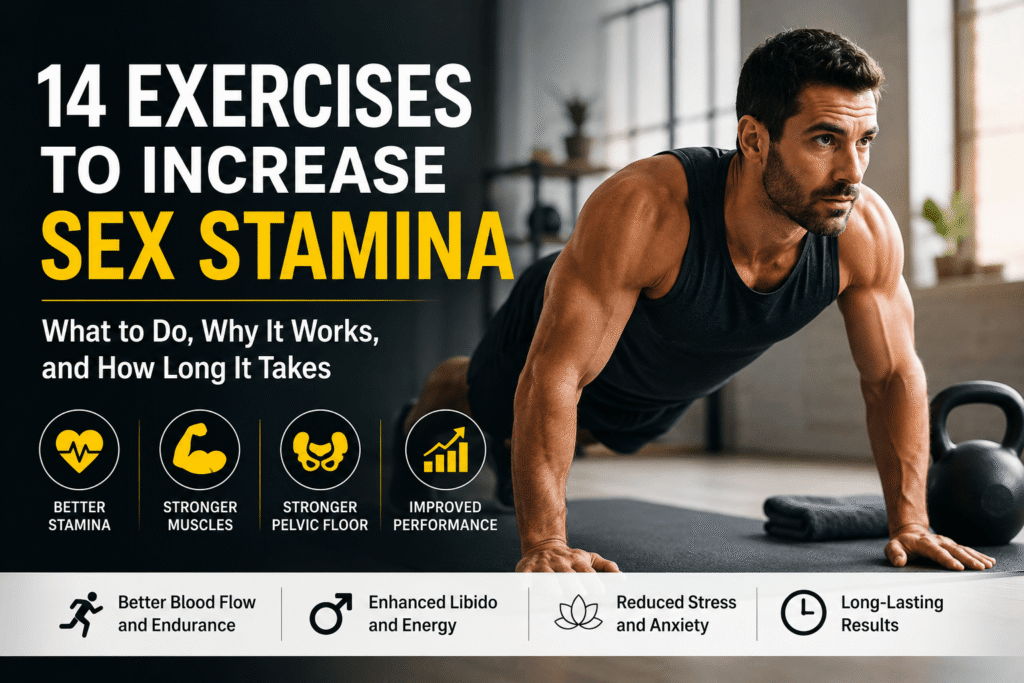
Sexual stamina is directly linked to physical fitness — specifically cardiovascular endurance, muscular strength and endurance, pelvic floor conditioning, flexibility, and hormonal health. All of these are modifiable through targeted exercise. A well-planned approach to exercise does not just improve general fitness; it directly supports the specific physiological demands of sexual activity: the cardiovascular load, the muscular endurance required for sustained positions, ejaculatory control, and the hormonal environment that governs arousal and desire. This article covers 14 evidence-supported exercises for improving sexual stamina, with clear instructions, the specific sexual benefit of each, and realistic timelines for results exercises to increase sex stamina.
A 2018 meta-analysis in Sexual Medicine Reviews (Gerbild et al.) confirmed that aerobic exercise significantly improves erectile function in men with cardiovascular-related ED, with the greatest benefit in moderate to severe ED. The effective dose was 40 minutes of moderate-to-vigorous aerobic exercise four times per week. A separate Harvard study found that men who walked 30 minutes daily had a 41% lower risk of Erectile Dysfunction — positioning regular exercise as one of the most evidence-based interventions available for sexual health.
Why exercises to increase sex stamina
Sexual activity places real physiological demands on the body: it requires cardiovascular output comparable to moderate-to-vigorous aerobic exercise, muscular endurance in multiple major muscle groups, pelvic floor strength for both erection quality and ejaculatory control, and flexibility for sustained positions. Exercise addresses all of these through four primary pathways:
- Cardiovascular and vascular function: Exercise improves the ability of the heart to sustain elevated output, improves endothelial function (the blood vessel lining that produces Nitric Oxide), and reduces arterial stiffness. Better cardiovascular fitness directly translates into better blood flow to the genitals during arousal.
- Muscular strength and endurance: The muscles most used during sex — glutes, hip flexors, core, and upper body — benefit directly from resistance training, improving power, endurance, and the ability to sustain positions without premature fatigue.
- Hormonal optimisation: Resistance exercise acutely increases testosterone. Regular physical activity reduces cortisol, which suppresses testosterone when chronically elevated. Together, these hormonal effects support libido and arousal.
- Psychological and anxiety reduction: Exercise is one of the most evidence-based stress reducers available. Reduced performance anxiety and improved body image from regular exercise directly support sexual confidence and engagement.
The 14 Best Exercises for Sexual Stamina
1. Kegel exercises (pelvic floor training)
Kegels are the single most targeted exercise for sexual stamina in both men and women. They strengthen the bulbocavernosus and ischiocavernosus muscles of the pelvic floor — the muscles responsible for erection rigidity, ejaculatory control, and orgasm intensity. A 2005 BJU International study found pelvic floor rehabilitation restored normal erectile function in 40% of men with ED and significantly improved function in a further 35%.
- How to do it: Identify the pelvic floor muscles by stopping urine flow midstream. Contract and hold for 3 to 5 seconds, then relax fully. Repeat 10 to 15 times per set, 3 sets daily.
- Sexual benefit: Improved erection firmness (better venous trapping), better ejaculatory control for men, and stronger orgasm intensity for both sexes.
- Timeline: Measurable pelvic floor strength improvement at 4 to 6 weeks; full benefit at 3 to 6 months of consistent daily practice.
2. Squats
Squats work the glutes, quadriceps, hamstrings, and core — the primary muscles that generate power and stability during thrusting movements. Resistance-loaded squats (bodyweight, goblet squat, or barbell) also produce an acute testosterone response, supporting the hormonal environment of sexual function.
- How to do it: Stand with feet shoulder-width apart. Lower your hips backward and downward, keeping chest upright and knees tracking over toes. Return to standing. 3 sets of 12 to 15 repetitions.
- Sexual benefit: Lower-body endurance, hip power, and testosterone support.
- Timeline: Noticeable strength improvement in 4 to 6 weeks.
3. Plank
Planks build the deep core muscles — transverse abdominis, internal obliques, and spinal stabilisers — that prevent lower-back fatigue during positions where the body is held above a partner. Core stability also improves movement efficiency and reduces injury risk during sustained activity.
- How to do it: Hold a push-up position on forearms and toes, body in a straight line from head to heels. Hold for 20 to 60 seconds. Build to 3 sets.
- Sexual benefit: Sustained core endurance, reduced lower-back fatigue during sex.
- Timeline: Core endurance improvement within 3 to 4 weeks.
4. Push-ups
Push-ups develop upper-body pushing endurance — the chest, shoulders, and triceps — alongside core stability. This directly reduces fatigue in positions where the upper body supports body weight over a partner, and improves the muscular endurance needed to sustain thrusting over time.
- How to do it: Standard push-up position. Lower chest to 1 to 2 inches from the floor, then push up. 3 sets of 10 to 20 repetitions.
- Sexual benefit: Upper-body endurance for weight-bearing positions.
5. Lunges
Lunges develop unilateral (single-leg) strength and balance in the glutes, hamstrings, and quadriceps, and improve hip mobility. Hip flexibility is directly relevant to the range of motion and comfort in many sexual positions.
- How to do it: Step one foot forward, lower the back knee to near the floor, then return to standing. Alternate legs. 3 sets of 10 to 12 per leg.
- Sexual benefit: Hip power, single-leg stability, improved flexibility.
6. Glute bridge and hip thrust
These exercises isolate the glutes and hamstrings in a hip-extension pattern directly analogous to thrusting movements. The hip thrust (with a loaded barbell) is one of the most effective exercises specifically for glute development and pelvic power. The glute bridge (bodyweight floor version) is the accessible starting point.
- How to do it (glute bridge): Lie on your back, knees bent, feet flat on the floor. Drive hips upward by squeezing glutes, hold 1 to 2 seconds at the top, lower slowly. 3 sets of 15 to 20 repetitions.
- Sexual benefit: Direct hip thrusting power, glute endurance, and pelvic stability.
7. Running and brisk walking
Aerobic running is one of the most evidence-based interventions for sexual stamina, improving cardiovascular capacity, endothelial function, and the production of Nitric Oxide — the chemical that initiates erections. The Harvard walking study found that men who walked 30 minutes daily had a 41% lower risk of ED. Running provides the same benefits with greater cardiovascular intensity.
- How to do it: Aim for 30 minutes of brisk walking or light jogging daily, or 20 to 30 minutes of moderate running 4 to 5 times per week.
- Sexual benefit: Cardiovascular endurance, vascular health, Nitric Oxide production, reduced ED risk.
- Timeline: Cardiovascular improvement begins within 2 to 4 weeks.
8. Swimming
Swimming provides full-body cardiovascular conditioning with low joint impact, making it particularly suitable for men and women with knee or back issues. It develops shoulder, core, and leg endurance simultaneously, improving overall physical stamina without the compressive load of running.
- How to do it: 20 to 30 minutes of laps at a sustained effort, 3 to 4 times per week. Freestyle and backstroke develop the most relevant muscle groups.
- Sexual benefit: Full-body cardiovascular endurance, flexibility, reduced performance fatigue.
9. Cycling — with an important note
Cycling is an effective cardiovascular exercise for stamina and leg endurance. However, prolonged cycling on a narrow or hard saddle carries a specific risk for men: it compresses the pudendal nerve and perineal blood vessels, which can reduce penile blood flow and nerve sensitivity — contributing to erection difficulties after extended rides. This is clinically documented and matters specifically on a sexual health website.
- How to use cycling safely: Use a saddle with perineal relief cutout (a central channel). Stand on the pedals periodically during rides. Keep individual sessions under 60 minutes. Adjust saddle height correctly to reduce perineal pressure. Cycling on an upright stationary bike or recumbent bike is lower-risk than road cycling with a narrow saddle.
- Sexual benefit: Cardiovascular endurance, leg strength — with appropriate saddle selection.
10. Burpees
Burpees are a high-intensity, full-body exercise that rapidly elevates heart rate and develops cardiovascular capacity, muscular endurance, and explosive power across the entire body. They are one of the most time-efficient exercises for overall stamina and aerobic conditioning.
- How to do it: From standing, squat to the floor, kick legs back to push-up position, do one push-up, jump feet back to hands, then jump explosively with arms overhead. Start with 3 sets of 5 to 8 and build gradually.
- Sexual benefit: Cardiovascular capacity, total-body endurance, explosive power.
11. Yoga
Yoga improves flexibility, balance, body awareness, and mind-body connection — all of which support sexual stamina. Specific poses target the hip flexors, inner thighs, and pelvic floor, and yoga’s focus on breath control and present-moment awareness directly reduces performance anxiety. A 12-week yoga intervention study found significant improvement in sexual function scores in both men and women.
- Key poses: Bridge pose (Setu Bandhasana), Pigeon pose (hip flexor release), Warrior II (hip and groin opening), Boat pose (core engagement), Cobra (lower back strength and flexibility).
- Sexual benefit: Flexibility, pelvic health, performance anxiety reduction, mind-body integration.
- Timeline: Flexibility improvements within 4 to 6 weeks of twice-weekly practice.
12. Hip flexor stretch
Tight hip flexors — common in men and women who sit for long periods — reduce hip extension range of motion and create pelvic tilt that limits both performance and comfort during sex. Regular hip flexor stretching restores range of motion and reduces the lower-back discomfort that can limit sexual stamina.
- How to do it: Kneeling lunge position, front knee at 90 degrees. Push hips forward gently until a stretch is felt in the front of the back hip. Hold 30 to 45 seconds per side. Daily.
- Sexual benefit: Hip range of motion, pelvic tilt correction, reduced lower-back tension.
13. Diaphragmatic breathing
Controlled, diaphragmatic breathing improves oxygen delivery, reduces performance anxiety, and supports sustained arousal by activating the parasympathetic nervous system. Research published in PubMed confirms that slow-paced breathing activates the vagal brake, reducing heart rate and shifting the nervous system toward the parasympathetic state needed for sexual arousal.
- How to practise: Breathe in slowly through the nose for 4 counts, expanding the belly rather than the chest. Exhale slowly for 6 to 8 counts. Practise for 5 to 10 minutes daily; apply during sexual activity to reduce anxiety and manage arousal pace.
- Sexual benefit: Arousal anxiety management, ejaculatory control through pacing, sustained focus.
14. Dance and partner movement
Dance is frequently overlooked as a sexual stamina exercise, but it combines cardiovascular conditioning, coordination, hip mobility, rhythm, and partner synchronisation in a way that is directly transferable to sexual activity. Research on dance confirms improvements in flexibility, balance, proprioception, and social connection — all of which support intimacy.
- How to do it: Partner dancing (salsa, tango, bachata) 2 to 3 times per week. Solo dance or aerobic dance classes are also effective for cardiovascular benefit.
- Sexual benefit: Cardiovascular endurance, hip mobility, partner connection, rhythm and timing.
How Long Does It Take to See Results?
Realistic expectations prevent men and women from abandoning effective routines prematurely:
- Kegel exercises: Pelvic floor strength improvement at 4 to 6 weeks; full benefit at 3 to 6 months.
- Cardiovascular exercise (running, swimming, cycling, brisk walking): Cardiovascular improvement begins within 2 to 4 weeks. Noticeable reduction in fatigue during sustained physical activity within 4 to 8 weeks.
- Resistance training (squats, lunges, push-ups, glute bridges): Neuromuscular strength improvement within 2 to 4 weeks; meaningful muscular development at 8 to 12 weeks.
- Flexibility (yoga, hip flexor stretching): Measurable flexibility gains within 4 to 6 weeks of consistent practice.
- Overall stamina improvement: Most people notice real-world sexual performance improvement within 8 to 12 weeks of a consistent, multi-modal programme.
Sample Weekly Programme
A practical starting programme combining the most effective exercises from each category:
- Monday: 30-minute brisk walk or jog + 3 sets glute bridge + 3 sets squats + daily Kegels
- Tuesday: 20-minute swim + yoga (30 minutes) + hip flexor stretch + daily Kegels
- Wednesday: 3 sets push-ups + 3 sets lunges + 3 sets plank + 5 minutes diaphragmatic breathing + daily Kegels
- Thursday: 30-minute jog or brisk walk + diaphragmatic breathing practice + daily Kegels
- Friday: Strength circuit: squats, push-ups, lunges, glute bridge, burpees (2 to 3 sets each) + daily Kegels
- Saturday: Dance, swimming, or recreational cardio + yoga + daily Kegels
- Sunday: Rest or light stretching + daily Kegels
Lifestyle Factors That Compound Exercise Benefits
Exercise produces the best results for sexual stamina when combined with supporting lifestyle habits:
- Adequate sleep (7 to 9 hours): Testosterone is produced during deep sleep; chronic deprivation measurably reduces it within one week.
- Mediterranean-pattern diet: Supports vascular health, hormone balance, and Nitric Oxide production through leafy greens, fatty fish, berries, and healthy fats.
- Quit smoking: Smoking depletes Nitric Oxide, directly impairing erection quality. Erection improvement is measurable within 2 to 4 weeks of stopping.
- Hydration: Dehydration reduces blood volume and impairs cardiovascular performance — including the circulation required for genital arousal.
- Stress management: Chronic cortisol from unmanaged stress suppresses testosterone. Exercise itself is an evidence-based stress reducer, but mindfulness and adequate recovery amplify this benefit.
When Exercise Alone Is Not Enough
If sexual stamina issues persist despite consistent exercise and lifestyle improvement over 8 to 12 weeks, a medical evaluation is appropriate. Persistent Erectile Dysfunction, significantly reduced libido, or early ejaculation can have underlying causes — vascular, hormonal, neurological, or psychological — that require targeted treatment.
Evidence-based medical options include PDE5 inhibitors (Sildenafil, Tadalafil, Vardenafil, Avanafil) for ED, psychosexual therapy for performance anxiety, hormonal evaluation for low testosterone, and specialist assessment for ejaculatory disorders. Exercise and medical treatment are complementary, not mutually exclusive.
Conclusion
Exercise is one of the most evidence-based and effective strategies for improving sexual stamina. The 14 exercises covered here address every physiological dimension of sexual performance: pelvic floor strength and ejaculatory control (Kegels), cardiovascular endurance and vascular health (running, swimming, cycling with proper saddle), lower-body power and testosterone (squats, lunges, glute bridges), core stability (planks), upper-body endurance (push-ups), flexibility and mind-body connection (yoga, hip flexor stretching), breathing control and anxiety reduction (diaphragmatic breathing), and partner movement and coordination (dance).
Most people who consistently engage in this type of multi-modal programme notice meaningful improvement in sexual stamina within 8 to 12 weeks. The key is consistency — beginning with manageable volume and progressively building over time rather than attempting maximum intensity immediately.
Frequently Asked Questions
-
How long does it take for exercise to improve sexual stamina?
Most people notice first improvements within 4 to 8 weeks of consistent exercise. Cardiovascular improvements begin within 2 to 4 weeks. Pelvic floor strength improvement from Kegels typically becomes measurable at 4 to 6 weeks. Meaningful muscular development and comprehensive sexual stamina improvement are typically apparent by 8 to 12 weeks. Consistency matters more than intensity — four 30-minute sessions per week produces better results than two intense sessions followed by a week off.
-
Does maintaining a healthy body weight improve sexual stamina?
Yes. Excess abdominal fat promotes testosterone-to-oestrogen conversion through aromatisation, reducing testosterone and libido. Obesity is associated with 1.3 times higher ED risk compared to healthy weight. Weight loss through exercise and diet improves testosterone, vascular health, energy, and body image — all of which directly support sexual stamina. A 42-inch waist is associated with a 50% higher ED risk than a 32-inch waist (Harvard research).
-
Is it safe to exercise every day to improve sexual stamina?
Daily exercise is safe if you balance intensity and allow adequate recovery. Not every day should be high-intensity — a mix of aerobic days, resistance training days, and active recovery (yoga, stretching, light walking) prevents overtraining while supporting progressive improvement. Kegel exercises are the exception: these can be performed daily without recovery concerns, as the pelvic floor responds well to consistent daily conditioning.
-
Can breathing exercises improve sexual stamina?
Yes. Controlled diaphragmatic breathing improves oxygen delivery, activates the parasympathetic nervous system (the state required for arousal), reduces performance anxiety, and can help manage arousal pacing during sexual activity. Research published in PubMed confirms that slow-paced breathing activates the vagal brake, reducing heart rate and physiological arousal. Practising 5 to 10 minutes of slow diaphragmatic breathing daily — with extended exhale phases — transfers directly to reduced anxiety and improved focus during intimacy.
-
Can poor posture affect sexual endurance?
Yes. Poor posture — particularly anteriorly tilted pelvis from tight hip flexors — creates muscular imbalances that increase lower-back fatigue, reduce hip range of motion, and impair the biomechanics of thrusting movement. Strengthening the core, stretching the hip flexors, and improving overall postural alignment directly improve physical endurance during sex and reduce the discomfort that can limit stamina.
This article is for general informational purposes only and does not constitute medical advice. Consult a qualified healthcare provider before beginning a new exercise programme, particularly if you have cardiovascular, musculoskeletal, or sexual health conditions.
