
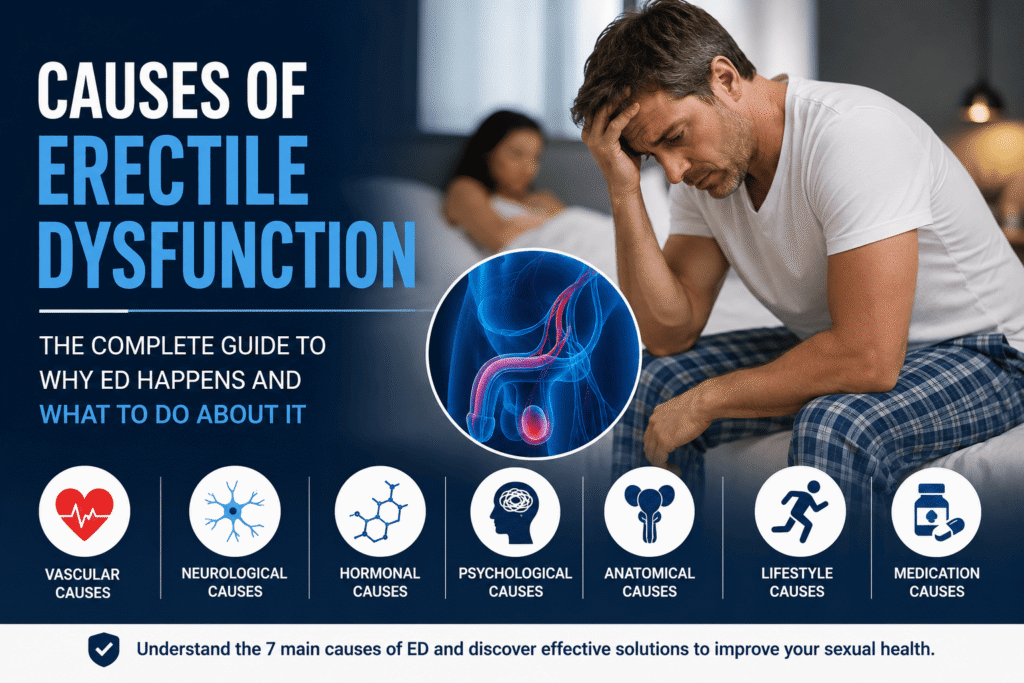
Erectile Dysfunction is the most common male sexual health condition worldwide, affecting an estimated 30 to 50 million men in the United States and projected to affect over 322 million men globally by 2025. Despite this prevalence, many men never seek treatment — often because they feel embarrassed or because they assume ED is an inevitable part of ageing. Neither is accurate. For the large majority of men, ED has an identifiable, treatable cause. The key is identifying which cause — or combination of causes — applies to each individual, because the treatment approach depends entirely on the root cause. This guide covers all seven recognised cause categories of Erectile Dysfunction: vascular, neurological, hormonal, psychological, anatomical, lifestyle-related, and medication-related. Understanding your cause is the most important step toward effective treatment Causes of Erectile Dysfunction .
In the past, Erectile Dysfunction was commonly believed to be primarily caused by psychological problems. We now know that for most men — estimated at over 70% of cases — ED is caused by physical (organic) problems, usually related to blood supply to the penis. According to Johns Hopkins Medicine, the most common physical cause is vascular disease (poor blood flow), which is also closely linked to cardiovascular health. This means a new ED diagnosis in a man under 60 can be an early warning sign of cardiovascular disease appearing 3 to 5 years before a cardiac event.
What Is Erectile Dysfunction?
Erectile Dysfunction (ED) is defined as the persistent inability to achieve or maintain an erection sufficient for satisfactory sexual performance. The key word is persistent — occasional difficulty achieving or maintaining an erection is common and normal at any age, and does not constitute ED. ED is diagnosed when the difficulty is consistent, recurrent, and causes personal distress or impacts quality of life.
ED is not a single disease — it is a symptom that can result from many different underlying conditions. This is why treatment must be tailored to the cause. A man whose ED is caused by performance anxiety requires a different approach than a man whose ED is caused by Diabetes or post-prostatectomy nerve damage.
How Erections Work — and Where They Can Go Wrong
Understanding the erection mechanism makes it easier to understand how and why ED develops. An erection requires a precisely coordinated sequence:
- Arousal signals from the brain or direct physical stimulation activate the parasympathetic nervous system
- Nerve endings release Nitric Oxide (NO) into the corpus cavernosum — the erectile tissue
- Nitric Oxide activates the enzyme guanylate cyclase, producing cyclic GMP (cGMP)
- cGMP relaxes the smooth muscle of penile blood vessels, allowing blood to flow in and fill the corpus cavernosum
- The expanding tissue compresses the veins, trapping blood inside and producing rigidity
- The enzyme PDE5 eventually breaks down cGMP, smooth muscle contracts, blood drains, and the erection ends
ED can result from failure at any point in this chain. Vascular disease reduces arterial inflow. Nerve damage disrupts signalling. Hormonal deficiency reduces the neurological initiation of the process. Psychological factors suppress the arousal signal before it even starts.
The Seven Categories of Erectile Dysfunction Causes
Clinical guidelines recognise seven main categories of ED causes. Most cases involve more than one category — for example, a man with Diabetes (vascular + neurological causes) and depression (psychological) has multiple concurrent causes requiring a comprehensive treatment approach.
1. Vascular Causes — the Most Common
Vascular disease is the most common cause of Erectile Dysfunction — accounting for the majority of organic (physical) ED cases. The penile arteries are 1 to 2 mm in diameter, compared to 3 to 4 mm for the coronary arteries supplying the heart. This smaller size means vascular damage from the same pathological processes affects the penis earlier — which is why ED often precedes diagnosed cardiovascular disease by 3 to 5 years.
- Atherosclerosis: The build-up of fatty plaques inside arterial walls that narrows and stiffens blood vessels, reducing blood flow to the penis. The same process that causes heart attacks and strokes causes ED — often earlier and more detectably.
- Hypertension (High Blood Pressure): Chronically elevated blood pressure damages the endothelial lining of blood vessels, reduces Nitric Oxide production, and promotes arterial stiffening — all of which impair the blood flow required for erection.
- High Cholesterol (Hyperlipidaemia): Elevated LDL cholesterol accelerates atherosclerosis and impairs endothelial function.
- Diabetes Mellitus: One of the most significant individual risk factors for ED. Diabetes damages blood vessels (vascular component) and nerves (neurological component) simultaneously. Between 35 and 50% of men with Diabetes experience ED, often at younger ages and with greater severity.
- Venous leakage: Normally, veins in the penis are compressed during erection to trap blood. Damage to the veno-occlusive mechanism allows blood to drain out, preventing sustained rigidity. This can be a result of ageing, injury, or Peyronie’s Disease.
2. Neurological Causes
The nervous system initiates and maintains erections through signals from the brain and spinal cord to the penile nerves. Neurological causes of ED disrupt this pathway at various levels.
- Multiple Sclerosis (MS): Demyelination of nerve fibres disrupts neural signalling along the pathways that control erection.
- Parkinson’s Disease: Dopaminergic pathway disruption affects both the initiation of arousal signals and the autonomic control of erection.
- Spinal cord injury: Depending on the level and completeness of the injury, different types of erections (reflexogenic, psychogenic, or nocturnal) may be affected or preserved.
- Stroke: Can disrupt brain centres involved in sexual arousal and autonomic erection control.
- Post-surgical nerve damage: Radical prostatectomy (prostate cancer surgery) is one of the most common causes of neurogenic ED. The neurovascular bundles running alongside the prostate can be damaged during surgery. Nerve-sparing surgical techniques and post-operative rehabilitation (including PDE5 inhibitors) help preserve erectile function where possible.
- Peripheral neuropathy: Nerve damage from Diabetes, chronic alcohol use, or other causes impairs the local nerve signals required for erection.
3. Hormonal Causes
Hormonal causes of ED involve disruption of the endocrine system signals that support sexual function.
- Low Testosterone (Hypogonadism): Testosterone supports libido, arousal, and the neurological initiation of the erection process. Confirmed low testosterone alongside symptoms (including reduced libido and ED) warrants medical evaluation. Note that testosterone alone does not produce erections — the vascular and neurological mechanism must be intact — but low testosterone weakens the conditions in which erections occur.
- Thyroid disorders: Both hypothyroidism (underactive) and hyperthyroidism (overactive) affect sexual function. Thyroid hormones influence cardiovascular function, energy levels, and mood — all of which affect erectile function.
- Hyperprolactinaemia (elevated prolactin): A pituitary adenoma or certain medications can elevate prolactin, suppressing LH and FSH production and reducing testosterone and libido.
- Cushing’s syndrome: Excess cortisol suppresses testosterone and affects vascular function.
4. Psychological Causes
In the past, most ED was attributed to psychological causes. We now know that over 70% of cases have a primary physical cause. However, psychological causes are still significant — accounting for the majority of ED in younger men and commonly co-existing with physical causes in older men.
- Performance anxiety: One of the most common psychological causes, particularly in younger men. The fear of losing an erection or failing to satisfy a partner activates the sympathetic nervous system (fight-or-flight), which directly inhibits the parasympathetic activation required for erection. This creates a self-reinforcing cycle: anxiety causes ED, which causes more anxiety, which worsens ED.
- Depression: A triad relationship exists between Depression, ED, and cardiovascular disease. Depression reduces sexual desire, suppresses the neurochemical environment required for erection, and the medications used to treat it can also affect erectile function.
- Generalised anxiety disorder: Chronic anxiety raises cortisol, which suppresses testosterone and creates persistent sympathetic nervous system activation that impairs erection.
- Stress: Work, financial, or relationship stress activates the same cortisol-driven pathway. Chronic stress is both a direct cause of ED and an indirect one, through its effects on sleep, diet, and relationship quality.
- Relationship difficulties: Poor communication, unresolved conflict, infidelity, or lack of emotional intimacy can suppress sexual desire and prevent the psychological safety required for arousal.
- Guilt, religious, or cultural sexual anxiety: Attitudes toward sexual activity that create guilt or shame can suppress arousal and cause psychogenic ED.
Clinical note: Distinguishing psychological from physical ED is clinically useful. Men with primarily psychological ED typically have normal morning and nocturnal erections but lose erections during partnered activity. Men with primarily physical ED typically find erection quality declining broadly — including during masturbation and on waking. A doctor can use this history, combined with tests like Nocturnal Penile Tumescence monitoring, to distinguish the two.
5. Anatomical Causes
Anatomical causes involve structural abnormalities of the penis or surrounding structures.
- Peyronie’s Disease: The development of fibrous scar plaques inside the corpus cavernosum, causing penile curvature, pain during erection, and — because the plaque distorts the veno-occlusive mechanism — ED. Affects approximately 1 in 11 men.
- Penile fracture: Rupture of the tunica albuginea (the fibrous sheath around the erectile tissue), usually from vigorous sexual activity. Can cause scarring that impairs future erections if not treated promptly.
- Phimosis: A tight foreskin that cannot retract during erection, causing pain and inhibiting sexual activity.
- Hypospadias or other congenital conditions: Structural differences in penile anatomy present from birth that may affect sexual function.
6. Lifestyle Causes
Lifestyle factors are modifiable causes of ED — meaning they can be improved with behavioural changes. Addressing lifestyle factors can produce meaningful improvement in ED and is often recommended as a first-line intervention alongside or before medication.
- Smoking: Smoking is one of the most directly damaging lifestyle causes of ED. It damages endothelial cells, reduces Nitric Oxide bioavailability, and promotes arterial stiffening — impairing the vascular mechanism of erection. A meta-analysis found smokers have a 51% higher risk of ED than non-smokers. The damage is partially reversible: stopping smoking improves erection quality within weeks for many men.
- Obesity: Excess weight — particularly abdominal fat — is associated with low testosterone (through aromatisation), insulin resistance, cardiovascular disease, and hypertension. A man with a 42-inch waist is 50% more likely to have ED than a man with a 32-inch waist.
- Physical inactivity: A sedentary lifestyle is independently associated with ED. Conversely, regular aerobic exercise reduces ED risk by approximately 41% (Harvard walking study). Exercise improves endothelial function, testosterone, and reduces obesity — all directly relevant to erection quality.
- Poor diet: Diets high in processed foods, saturated fat, refined carbohydrates, and excess sodium promote atherosclerosis, insulin resistance, and cardiovascular disease — all established ED risk factors. A Mediterranean-pattern diet is the most evidence-supported dietary approach for reducing ED risk.
- Excessive alcohol: Chronic heavy drinking lowers testosterone, damages blood vessels and nerves, and suppresses the nervous system. Acute heavy drinking prevents erections through CNS depression.
- Recreational drug use: Cocaine, opioids, cannabis at high doses, and other recreational substances can impair erections acutely and contribute to long-term ED with chronic use.
- Poor sleep: Testosterone is primarily produced during deep sleep. Chronic sleep deprivation and untreated Obstructive Sleep Apnoea reduce testosterone and increase cardiovascular risk — both contributing to ED.
7. Medication-Related Causes
Many prescription medications can cause or contribute to Erectile Dysfunction as a side effect. This is one of the most treatable causes of ED — adjusting the dose, switching to an alternative within the same drug class, or adding ED treatment can resolve the problem.
Common medication categories associated with ED include:
- Antidepressants (SSRIs, SNRIs): The most commonly implicated medication category. SSRIs and SNRIs frequently reduce libido, delay orgasm, and impair erection quality. Paroxetine has the highest rate of sexual side effects; bupropion and mirtazapine have lower rates.
- Anti-anxiety medications (benzodiazepines — alprazolam, diazepam): These are anxiolytics, not antidepressants. They suppress the CNS and can impair the arousal signals required for erection. They are also addictive with long-term use.
- Antihypertensives (blood pressure medicines): Beta-blockers and thiazide diuretics have the highest ED risk among antihypertensive classes. ACE inhibitors and ARBs (such as losartan) have more neutral or even positive effects on erectile function. Important: much of the ED attributed to blood pressure medication may actually be caused by the untreated hypertension itself — improving blood pressure control overall tends to improve erectile function.
- Opioids (morphine, oxycodone, tramadol): Suppress testosterone production through effects on the hypothalamic-pituitary axis, causing both hypogonadism and ED with long-term use.
- Antihistamines (diphenhydramine — Benadryl, Dramamine): Anticholinergic effects can impair smooth muscle relaxation in the penis.
- Finasteride (Propecia/Proscar): Used for male pattern hair loss and BPH. Can cause ED and loss of libido; some men report persistent sexual side effects even after stopping.
- Chemotherapy agents: Many chemotherapy drugs can affect testosterone and cause ED.
- Antipsychotics: Cause elevated prolactin (which suppresses testosterone and libido) and can directly impair the autonomic signals for erection.
Never stop a prescribed medication to address ED without discussing it with your prescribing doctor. Many people stop medications unnecessarily when a simple dose adjustment or switch to an alternative could resolve the side effect without compromising the treated condition.
ED as an Early Warning Sign of Cardiovascular Disease
This is one of the most clinically important aspects of Erectile Dysfunction and is entirely absent from the original article.
The penile arteries (1 to 2 mm diameter) are smaller than the coronary arteries (3 to 4 mm). When atherosclerosis begins to narrow blood vessels, the smaller penile arteries show the effects first. According to research cited by Harvard Medical School and Johns Hopkins Medicine, Erectile Dysfunction can precede a cardiovascular diagnosis by 3 to 5 years.
This means that for a man under 60 with new-onset ED and no obvious psychological cause, the appropriate response is not only to manage the ED symptom but to perform a cardiovascular risk assessment — checking blood pressure, cholesterol, blood sugar, and smoking status. Catching cardiovascular disease at this stage can be life-saving.
Clinical recommendation: If you are seeing a doctor about Erectile Dysfunction for the first time and you are under 60, ask for a cardiovascular risk review in the same appointment. The two conversations are medically connected. A doctor who prescribes PDE5 inhibitors without performing a basic cardiovascular assessment is missing an important opportunity for early intervention.
Is ED Normal with Ageing?
ED becomes more common with age — but age itself is not the cause. The Massachusetts Male Aging Study found that complete ED was three times more common in men aged 70 than in men aged 40. But the reason is not ageing per se; it is the accumulation of modifiable risk factors — cardiovascular disease, Diabetes, Obesity, medication burden, and decreased physical activity — that occurs over time.
Many men in their 70s and beyond have healthy erectile function. ED is not inevitable with age and should not be accepted without investigation. A gradual change in erection quality with age is normal; a sudden significant change is not and warrants medical evaluation.
When to See a Doctor
- When ED has been present for more than a few weeks and is not clearly linked to an obvious temporary cause (extreme stress, heavy alcohol intake)
- When ED is sudden in onset — this can signal a specific underlying cause including cardiovascular change, medication side effect, or hormonal shift
- When ED is accompanied by other symptoms — reduced libido, fatigue, mood changes, or urinary symptoms
- When ED is causing significant personal distress or relationship difficulty
- When ED is present in a man under 50 without an obvious psychological cause — cardiovascular evaluation is important
How ED Is Treated — an Overview
Treatment depends entirely on cause. This is why identifying the cause matters.
- Lifestyle changes: For ED with significant lifestyle contributors — stopping smoking, losing weight, exercising, improving diet, and reducing alcohol. Exercise alone reduces ED risk by approximately 41%.
- Oral PDE5 inhibitors (Sildenafil/Viagra, Tadalafil/Cialis, Vardenafil/Levitra, Avanafil/Stendra): First-line pharmacological treatment for most men with ED. They block the PDE5 enzyme that breaks down cGMP, extending the window for arousal to produce and sustain an erection. Require a prescription; contraindicated with nitrate medicines.
- Psychosexual therapy: For ED with significant psychological causes — performance anxiety, Depression, relationship stress. Often combined with medication for mixed-cause ED.
- Hormone treatment: TRT where confirmed hypogonadism is the cause; thyroid treatment or prolactin management where indicated.
- Treating the underlying condition: Managing Diabetes, hypertension, or high cholesterol often improves ED independently of direct ED treatment.
- Second- and third-line options: Vacuum erection devices, injectable alprostadil, and penile implant surgery for men who do not respond to first-line treatments.
Also Read: https://amozonpill.net/blog/sexual-wellness/best-natural-viagra-foods/
Certain foods – https://amozonpill.net/blog/sexual-wellness/worst-foods-for-erectile-dysfunction/
Conclusion
The causes of Erectile Dysfunction fall into seven categories — vascular, neurological, hormonal, psychological, anatomical, lifestyle-related, and medication-related — and most men with ED have more than one contributing factor. For the majority, the primary cause is vascular: the same processes that damage blood vessels and cause heart disease also impair the blood flow that erections depend on.
Understanding the cause of ED is not just academically interesting — it determines which treatment will work, and it may reveal an underlying condition (particularly cardiovascular disease) that warrants attention beyond the ED itself. New-onset ED in a man under 60 without obvious psychological explanation should prompt a cardiovascular assessment alongside ED management. Most causes of ED are treatable; the right starting point is a conversation with a doctor.
Frequently Asked Questions
-
What is the most common cause of erectile dysfunction?
Vascular disease — poor blood flow to the penis — is the most common cause of Erectile Dysfunction. The penile arteries are small and show the effects of atherosclerosis, hypertension, and high cholesterol earlier than the larger coronary arteries. This is why ED and cardiovascular disease are so closely linked, and why a new ED diagnosis in a man under 60 should prompt cardiovascular screening.
-
Can ED be caused by stress and anxiety?
Yes. Psychological causes — particularly performance anxiety and chronic stress — are the most common primary cause of ED in younger men. Stress activates the sympathetic nervous system (fight-or-flight), which directly inhibits the parasympathetic activation required for erection. This creates a self-reinforcing cycle where anxiety about ED causes more ED. Psychological ED typically responds to psychosexual therapy, mindfulness, and in some cases medication to break the anxiety cycle.
-
What medications cause erectile dysfunction?
The most commonly implicated medications include SSRIs and SNRIs (antidepressants), anti-anxiety medications (benzodiazepines such as alprazolam and diazepam), beta-blockers and some antihypertensives, opioids, antihistamines with anticholinergic effects (such as diphenhydramine), antipsychotics, finasteride, and chemotherapy agents. Never stop a prescribed medication without discussing it with your doctor — dose adjustment or switching to an alternative often resolves the side effect.
-
Can erectile dysfunction be cured?
For many men, yes — particularly when the cause is reversible. ED caused by lifestyle factors (smoking, obesity, inactivity) often improves significantly with lifestyle change. Medication-related ED often resolves when the medicine is adjusted. Psychological ED often responds well to therapy. Hormonal ED resolves when the hormonal imbalance is treated. Even ED with a significant organic cause can be effectively managed — if not cured — with oral PDE5 inhibitors or other treatments. ED is rarely untreatable.
-
Is erectile dysfunction a sign of heart disease?
It can be. Because the penile arteries are smaller than the coronary arteries, vascular damage from atherosclerosis typically affects erections before it causes detectable cardiac symptoms. Harvard Medical School research notes that ED can precede a cardiovascular diagnosis by 3 to 5 years. New-onset ED in a man under 60 without obvious psychological cause warrants a cardiovascular risk assessment — checking blood pressure, cholesterol, blood sugar, and smoking status — alongside ED management.
Citations
- Johns Hopkins Medicine. Erectile Dysfunction. https://www.hopkinsmedicine.org/health/conditions-and-diseases/erectile-dysfunction
- Cleveland Clinic. Erectile Dysfunction (ED): Causes, Diagnosis and Treatment. https://my.clevelandclinic.org/health/diseases/10035-erectile-dysfunction
- Dhaliwal A, Gupta M. PDE5 Inhibitors. StatPearls. NCBI Bookshelf. https://www.ncbi.nlm.nih.gov/books/NBK549843/
- NIH NCBI Bookshelf. Erectile Dysfunction. StatPearls. https://www.ncbi.nlm.nih.gov/books/NBK562253/
- Harvard Health Publishing. 5 natural ways to overcome erectile dysfunction. https://www.health.harvard.edu/mens-health/5-natural-ways-to-overcome-erectile-dysfunction
- Erectile Dysfunction. American Family Physician, 2016. https://www.aafp.org/pubs/afp/issues/2016/1115/p820.pdf
- National Institute of Diabetes and Digestive and Kidney Diseases. Erectile Dysfunction. https://www.niddk.nih.gov/health-information/urologic-diseases/erectile-dysfunction
This article is for general informational purposes only and does not constitute medical advice. If you are experiencing Erectile Dysfunction, consult a qualified healthcare provider. Never stop or change a prescribed medication without medical guidance.
