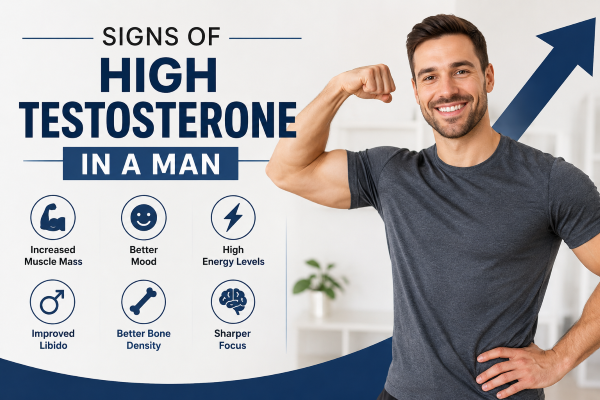
The signs of high testosterone in a man can range from obvious physical changes — rapid muscle growth, severe acne, mood shifts — to less visible but clinically important effects like elevated red blood cell count, high blood pressure, reduced sperm production, and testicular atrophy. Before examining the signs in detail, one important fact that is often missed: naturally high testosterone is actually rare in men.
Most cases of significantly elevated testosterone levels in adult men are caused by anabolic steroid use, testosterone therapy at too high a dose, or, less commonly, hormone-producing tumours. Understanding whether elevated testosterone is coming from inside the body or from an external source changes both the symptoms and the appropriate response. This article covers all the signs of high testosterone in a man, the causes, who is most at risk, what testing shows, and when to seek medical advice.
Testosterone levels follow a natural daily rhythm and are highest in the early morning, typically between 7 AM and 10 AM. This is why doctors recommend a blood test during these hours — later in the day, levels naturally fall and may give an inaccurately low reading. A single elevated test result is also not sufficient to diagnose High Testosterone; repeat testing is needed because levels vary day to day. Anabolic steroids used for bodybuilding can contain 10 to 30 times the testosterone of a prescribed TRT dose — explaining why their signs and side effects are far more pronounced.
What Does High Testosterone Mean?
In adult men, normal total testosterone typically falls between 300 and 1,000 nanograms per deciliter (ng/dL), though reference ranges vary slightly between laboratories. High Testosterone is generally considered when levels consistently exceed 1,000 ng/dL alongside symptoms. However, the threshold itself is less important than context: a man on high-dose anabolic steroids may have testosterone several times higher than this range, while a man with naturally elevated levels close to the upper normal limit may experience no symptoms at all.
An important clinical point that the original article understates: naturally elevated testosterone is rare in adult men. Most cases of significantly high testosterone are driven by anabolic steroid use, excessive TRT dosing, or, in a minority of cases, testosterone-secreting tumours or hormonal disorders. Lifestyle factors alone — diet, sleep, exercise — are not linked to testosterone levels rising above the normal range.
Signs of High Testosterone in a Man: The Full List
The signs of high testosterone in a man vary depending on how high the levels are and whether the source is internal or external. The following covers all recognised signs, with context for when each is clinically significant.
1. Increased muscle mass
Testosterone supports muscle protein synthesis. At normal physiological levels, this is simply a healthy function. Signs of high testosterone in this area include muscle growth that is significantly faster than expected for the training effort involved, or muscle gain that appears disproportionate and sudden. However, rapid muscle development is not a reliable standalone indicator — it becomes meaningful when accompanied by other signs.
2. High sex drive (libido)
Testosterone is one of the primary drivers of libido in men. A sudden, marked increase in sexual desire that feels unusual or difficult to manage can indicate elevated testosterone. However, high libido alone is common and non-specific — it becomes a sign of High T when it appears alongside other symptoms and when it represents a clear departure from an individual’s previous baseline.
3. Acne and oily skin
Testosterone stimulates sebaceous glands to produce sebum (skin oil). High testosterone increases this production, leading to clogged pores and acne — particularly on the face, chest, and back. Adult acne with the quality of teenage-type breakouts that don’t respond to standard skincare is a classic sign. This effect is mediated primarily through dihydrotestosterone (DHT), a potent testosterone metabolite with high affinity for sebaceous glands.
4. Male pattern hair loss
This sign is absent from the original article and is important. DHT — the same metabolite responsible for acne — also binds to hair follicles on the scalp and causes them to miniaturise and eventually stop producing hair. Men with high testosterone (or high DHT conversion) who are genetically predisposed may notice accelerated male pattern hair loss. Paradoxically, the same hormonal state that increases body and facial hair can accelerate scalp hair loss.
5. Increased facial and body hair growth
Testosterone and DHT promote terminal hair growth on the face, chest, back, arms, and legs. Men with significantly elevated testosterone may notice faster beard growth, increased density or extent of chest and back hair, and more pronounced hair on the extremities. Genetic predisposition strongly influences the degree of this response — not every man with high testosterone experiences conspicuous body hair changes.
6. Mood changes, irritability, and aggression
Testosterone affects neurological function and mood regulation. Significantly elevated levels — particularly from anabolic steroid use — are associated with irritability, sudden anger, reduced emotional regulation, and what is colloquially called ‘roid rage.’ Even naturally elevated testosterone can produce increased competitiveness and emotional reactivity. This is not universal, and many men with high T experience no significant mood disturbance, but it is a recognised pattern at supraphysiological levels.
7. Reduced body fat
Testosterone promotes lipolysis (fat breakdown) and supports lean muscle mass over fat mass. Unusually rapid fat loss without significant lifestyle change, or a body composition shift toward extreme leanness with rapid muscle definition, can signal elevated testosterone. This sign is most noticeable with externally elevated testosterone (steroids, TRT) rather than naturally high levels.
8. Sleep disturbances
High testosterone levels — particularly from TRT or steroids — can disrupt sleep architecture, contributing to insomnia, difficulty staying asleep, or poor quality sleep despite adequate hours. This may also be mediated by the associated increase in energy and restlessness. Sleep apnoea is also more common in men on TRT, which can further impair sleep quality.
9. Elevated red blood cell count (erythrocytosis)
Testosterone stimulates erythropoietin (EPO) production, which drives red blood cell synthesis. Elevated haematocrit — the proportion of red blood cells in the blood — is one of the most clinically important and least symptomatic early signs of high testosterone. When haematocrit rises above approximately 52 to 54%, blood viscosity increases, raising the risk of blood clots, deep vein thrombosis, stroke, and cardiovascular events.
Early-stage erythrocytosis often produces no noticeable symptoms — which is why it is identified most reliably through blood tests rather than symptoms. When it becomes more pronounced, symptoms can include headaches, dizziness, flushing, and fatigue.
10. High blood pressure
Elevated testosterone raises blood pressure through two mechanisms: increased red blood cell production thickens the blood and increases the workload on the heart; and testosterone stimulates the renin-angiotensin system, a hormone pathway that regulates blood pressure by controlling salt and water balance. High blood pressure may cause no symptoms in early stages but is a significant cardiovascular risk factor requiring monitoring.
11. Testicular atrophy and reduced sperm production
This sign applies specifically to externally elevated testosterone (steroids, TRT) and is absent from the original article’s main body despite being one of the most clinically significant effects. When testosterone enters the body from an external source, it suppresses the hypothalamic-pituitary-testicular (HPT) axis — shutting down the signals that drive both natural testosterone production and sperm synthesis. The testes reduce in size (testicular atrophy) and sperm production falls significantly, often to zero. This is one of the most important risks for younger men using anabolic steroids.
12. Prostate enlargement (in context)
Testosterone and DHT stimulate prostate tissue growth. Men with significantly elevated testosterone — particularly those who are older — may experience or worsen Benign Prostatic Hyperplasia (BPH) symptoms, including urinary frequency, weak stream, and incomplete bladder emptying. High testosterone in younger men typically does not cause clinically significant prostate enlargement, but it is a longer-term risk worth monitoring.
Signs Unique to Externally Elevated Testosterone (Steroids, TRT)
When testosterone comes from an external source — anabolic steroids, TRT, testosterone gels, patches, or injections — several signs occur that are not seen with naturally high testosterone:
- Testicular atrophy: The testes physically shrink as the HPT axis shuts down endogenous testosterone production. This is not seen with internally elevated testosterone.
- Suppression of natural testosterone production: The body’s own production diminishes as negative feedback kicks in. In men who use anabolic steroids long-term, natural production can take months to years to recover after stopping — and may not fully recover.
- More severe and rapid symptom onset: External testosterone elevates levels far above what the body would naturally produce. Anabolic steroids used for bodybuilding can contain 10 to 30 times the testosterone of a prescribed TRT dose, explaining why their associated signs are more dramatic.
- Gynecomastia (breast tissue development): Elevated testosterone aromatises (converts) to oestradiol (oestrogen) in fat tissue. At very high testosterone levels, the resulting oestrogen elevation can cause breast tissue growth in men — a side effect more commonly associated with steroid use than with natural high T.
- Injection site reactions: Specific to injectable testosterone, including pain, swelling, or nodule formation at injection sites.
Natural Causes vs External Causes of High Testosterone
Understanding the cause of high testosterone changes the clinical picture and the appropriate response.
| Basis | Internal (Natural) Causes | External Causes |
| Source | Produced naturally by the body | Steroids, TRT, gels, patches, supplements |
| Common causes | Leydig cell tumours, adrenal tumours, rare enzyme defects, genetic syndromes | Anabolic steroid misuse, excessive TRT dosing |
| How common | Rare in adult men | Most common cause of significantly elevated T |
| Onset | Gradual, subtle | Often faster and more pronounced |
| HPT axis | Natural regulation remains active | HPT axis suppressed; endogenous T production falls |
| Sperm production | Usually preserved | Often significantly reduced or absent |
| Testicular size | Usually unchanged | Testicular atrophy common with sustained use |
| Symptom intensity | Usually more moderate | Can be intense; dose-dependent |
Using anabolic steroids or testosterone products without medical supervision can permanently disrupt the body’s natural hormone balance. In some men, the HPT axis suppression caused by long-term steroid use does not fully recover after stopping — leading to lifelong dependence on testosterone replacement and permanent infertility. Never use testosterone-containing products without medical evaluation and supervision. If you are already using them and wish to stop, do not stop abruptly without medical guidance — the withdrawal can cause significant hormonal disruption.
How High Testosterone Is Diagnosed
A diagnosis of high testosterone requires blood tests — symptoms alone are not sufficient because many of the signs of high testosterone overlap with other conditions.
- Timing of the blood test: Total testosterone should be measured in the morning between 7 AM and 10 AM, when natural levels peak. Later testing may underestimate actual levels due to the natural daily decline.
- What is tested: Total testosterone is the primary measurement. Free testosterone and Sex Hormone Binding Globulin (SHBG) may also be measured, as the amount of testosterone available to tissues depends on how much is bound to proteins. A single elevated result is not sufficient — repeat testing is needed to confirm persistent elevation.
- Additional tests: Haematocrit (to detect erythrocytosis), LH and FSH (to distinguish internal from external elevation — LH/FSH will be suppressed if testosterone is coming from an external source), PSA (prostate-specific antigen if prostate enlargement is suspected), and liver function (particularly if steroid use is suspected).
- If no external source is identified: Imaging of the testes and adrenal glands may be recommended to look for testosterone-secreting tumours.
Long-Term Health Risks of Sustained High Testosterone
Signs of high testosterone in a man that go unaddressed or are caused by ongoing steroid or TRT misuse carry cumulative health risks:
- Cardiovascular disease: Elevated haematocrit thickens the blood and increases the risk of blood clots, deep vein thrombosis, pulmonary embolism, stroke, and heart attack. High blood pressure, another sign of elevated testosterone, further raises cardiovascular risk.
- Infertility: Prolonged HPT axis suppression from external testosterone causes testicular atrophy and absent sperm production. In younger men who wish to have children, this is one of the most serious long-term consequences. Recovery is not guaranteed.
- Liver strain: Particularly associated with oral anabolic steroids, which undergo first-pass liver metabolism and can cause liver toxicity, elevated liver enzymes, and, in severe cases, peliosis hepatis (blood-filled cysts in the liver).
- Prostate concerns: Long-term elevated testosterone and DHT stimulate prostate growth. Men with existing BPH or a family history of prostate cancer should have regular PSA monitoring if testosterone levels are elevated.
- Permanent hormonal disruption: In some men, long-term anabolic steroid use permanently disrupts the HPT axis. Natural testosterone production may not recover fully, even after stopping, leading to lifelong hypogonadism requiring medical management.
When to See a Doctor
You should consult a doctor if you notice any of the following:
- Sudden, unexplained physical changes — rapid muscle gain, marked acne, hair loss, or body composition shifts without clear cause
- Mood changes affecting daily life, relationships, or work — particularly new aggression or irritability
- Sleep disturbances alongside other physical changes
- Fertility concerns — particularly if using anabolic steroids or TRT
- Headaches, dizziness, or other symptoms that could indicate elevated haematocrit or high blood pressure
- You are currently using anabolic steroids or have been prescribed TRT and want to check whether your levels are appropriately managed
A morning blood test measuring total testosterone, haematocrit, LH, FSH, and a metabolic panel provides the information needed to assess hormone balance and identify any complications early.
Conclusion
The signs of high testosterone in a man cover a wide range — from rapid muscle gain and acne to the less obvious but clinically important erythrocytosis, high blood pressure, hair loss, and testicular atrophy. Understanding which signs you are experiencing, and whether they are more consistent with naturally elevated testosterone or testosterone from an external source, is the starting point for appropriate medical evaluation.
The most important context: Genuinely high testosterone is rare when caused by natural processes. Most adult men with significantly elevated testosterone are experiencing it as a result of anabolic steroid use, TRT dosing that is too high, or in fewer cases a hormone-producing tumour. In all cases, medical evaluation is the appropriate response. A morning blood test, interpreted by a doctor in context of your symptoms and any medications or supplements, is the right starting point.
Frequently Asked Questions
- Is it possible to have high testosterone without obvious symptoms?
Yes — many men with levels at the upper end of the normal range or mildly above it notice no significant symptoms. Most men don’t notice clear high testosterone symptoms when their levels are in the range of 20 to 30 nmol/L (approximately 580 to 865 ng/dL). Symptoms become more likely and more pronounced as levels rise further above the normal ceiling, particularly with exogenous (externally supplied) testosterone at high doses.
- Can gym supplements increase testosterone to dangerously high levels?
Most legitimate, properly-labelled supplements cannot raise testosterone to dangerous levels. However, products marketed as ‘testosterone boosters’ vary enormously in ingredient quality, dose accuracy, and safety. Some supplements contain undisclosed anabolic steroids or prohormones — particularly products marketed aggressively for muscle building. If you are using supplements and experiencing signs of high testosterone, check all ingredients and discuss with a doctor. Never combine multiple testosterone-boosting supplements without medical guidance.
- Can high testosterone return to normal on its own?
If the elevation is from a removable external source — stopping steroid use or reducing TRT dose — levels typically recover toward normal, though the timeline varies. Recovery of natural testosterone production after anabolic steroid use can take months to years, and in some cases is incomplete. If the cause is a hormone-secreting tumour or another internal condition, treatment of the underlying cause is required. Natural variation within the upper normal range typically does not need intervention.
- Can diet alone raise testosterone to unhealthy levels?
No. Diet can support optimal testosterone production within the normal physiological range — through adequate healthy fats (for steroid hormone synthesis), zinc-rich foods, and overall metabolic health. However, diet alone cannot raise testosterone above the normal ceiling. Extremely high testosterone levels are almost always caused by anabolic steroid use, excessive TRT dosing, or medical conditions — not dietary choices, however aggressive.
- Do signs of high testosterone differ between men on TRT and men using anabolic steroids?
Yes — in degree rather than kind. Both can produce acne, erythrocytosis, testicular atrophy, mood changes, and HPT axis suppression. However, anabolic steroids used for bodybuilding can contain 10 to 30 times the testosterone of a prescribed TRT dose, producing far more pronounced effects. Properly managed TRT aims to restore testosterone to the physiological normal range — excessive TRT dosing that raises levels well above normal produces the same risks as steroid misuse at higher doses.
Citations
- Harvard Health Publishing. Testosterone — What it does and doesn’t do. https://www.health.harvard.edu/staying-healthy/testosterone–what-it-does-and-doesnt-do
- Medical News Today. High testosterone in males: Signs and symptoms (Updated April 2025). https://www.medicalnewstoday.com/articles/signs-of-high-testosterone
- NCBI Bookshelf. Testosterone and hormonal disorders. https://www.ncbi.nlm.nih.gov/books/NBK216175/
- Sleep Foundation. Sleep and Testosterone. https://www.sleepfoundation.org/physical-health/sleep-and-testosterone
- Signs of High Testosterone in Men. https://www.manual.co/blog/signs-of-high-testosterone-in-men
- Voy Health. High Testosterone in Men: Signs, Causes, Side Effects & Treatment. https://www.joinvoy.com/blog/high-testosterone-in-men
- Thomson Medical. Signs of High Testosterone in Men: What You Need to Know. https://www.thomsonmedical.com/blog/signs-of-high-testosterone-in-a-man
- Hone Health. High Testosterone in Men: Signs and Causes of High T Levels. https://honehealth.com/edge/high-testosterone-in-men/
This article is for general informational purposes only and does not constitute medical advice. If you are experiencing symptoms of high testosterone or are using testosterone-containing products, consult a qualified healthcare provider for evaluation and guidance.