
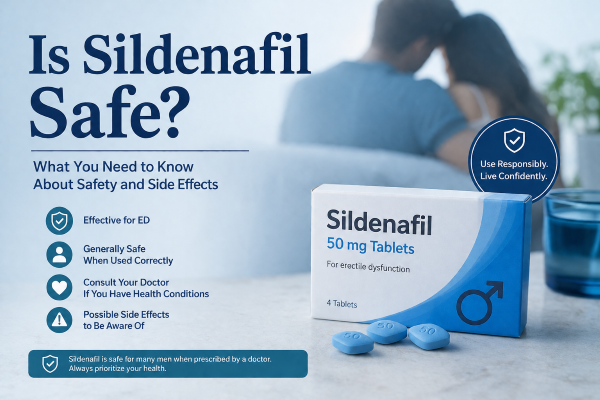
Is Sildenafil safe? It is one of the most searched questions about one of the most prescribed medicines in the world. The answer, supported by 27 years of clinical use and some of the largest drug safety datasets ever compiled for an ED medicine, is broadly yes — when used as prescribed, with proper medical screening, and without contraindicated medications. Clinical trial data from more than 13,000 patients and 7 years of post-marketing data found no special cardiovascular concerns when Sildenafil is used in accordance with its label, and no increased risk of serious events such as heart attack or death. But ‘broadly safe’ is not the same as ‘safe for everyone.’ The absolute contraindication with nitrates is serious and potentially fatal. Several other interactions and contraindications matter. This article explains the full safety picture — what the evidence says, who it is safe for, who should avoid it, the side effects that warrant emergency care, and how the long-term safety data addresses the most common concerns.
Table of Contents
- Is Sildenafil Safe? What the Evidence Shows
- Is Sildenafil Safe for the Heart?
- Is Sildenafil Safe for Daily Use?
- Is Sildenafil Safe for Older Men?
- Is Sildenafil Safe for Men with Diabetes?
- Common Side Effects of Sildenafil
- Serious Side Effects That Require Emergency Care
- Key Drug Interactions That Affect Safety
- Who Should Not Take Sildenafil
- The Tolerance Question — Clarifying a Common Misconception
- Emerging Research: Potential Long-Term Benefits
- Conclusion
- Frequently Asked Questions
- Citations
Sildenafil (Viagra) was FDA-approved in 1998 and has been prescribed to hundreds of millions of men worldwide since then. Clinical trial data from more than 13,000 patients, along with 7 years of post-marketing surveillance and observational studies of over 28,000 men in the UK and over 3,800 in the EU, found that when used according to its prescribing label, Sildenafil shows no special cardiovascular concerns and no increased risk of myocardial infarction or death compared with placebo.
Is Sildenafil Safe? What the Evidence Shows
Sildenafil Citrate has one of the most extensively studied safety profiles of any medication in its class. Since its FDA approval in 1998, it has been evaluated in dozens of Phase 2, 3, and 4 clinical trials, observational studies, and post-marketing surveillance programmes involving hundreds of thousands of patients across multiple countries and decades.
The overall finding across this evidence base is consistent: Sildenafil is generally safe and effective for treating Erectile Dysfunction in most adult men when prescribed appropriately, with the only absolute contraindication being concurrent use of organic nitrates in any form.
The safety profile is well characterised:
- Common side effects: Headache, flushing, nasal congestion, and indigestion — typically mild, dose-related, and self-resolving.
- Serious side effects: Rare, and almost always preventable when contraindications and drug interactions are properly observed before prescribing.
- Cardiovascular safety: Established across populations including men with pre-existing coronary artery disease, hypertension, and Diabetes — with the critical exception of nitrate co-administration.
- Long-term use: A 4-year safety review published in PubMed found Sildenafil remained effective and well-tolerated in men exposed for up to 4.5 years.
Is Sildenafil Safe for the Heart?
Cardiovascular safety is the most commonly asked aspect of Sildenafil safety, and the evidence is more reassuring than many people expect — with important caveats.
Sildenafil produces a transient, modest reduction in blood pressure: approximately 8 to 10 mmHg systolic and 5 to 6 mmHg diastolic, peaking at 1 hour after the dose and returning to baseline by 4 hours. This is a mild, temporary effect that is neither age-dependent nor dose-dependent across the therapeutic range (25 to 100 mg). It does not affect heart rate or the force of cardiac contraction. Clinical trials found Sildenafil does not increase the risk of ventricular arrhythmia and has no clinically significant effects on coronary oxygen consumption or ischemia during exercise.
The pooled data from clinical trials including men with coronary artery disease found no statistically significant difference in myocardial infarction rates between Sildenafil and placebo groups. The 2025 PMC review of PDE5 inhibitor cardiovascular effects found additional emerging evidence that Sildenafil use may be associated with reduced long-term cardiovascular risk — consistent with its mechanism of supporting vascular and endothelial health.
The critical cardiovascular caveat remains the absolute contraindication with nitrates:
— Absolute Contraindication: Sildenafil must never be combined with nitrate medicines in any form — nitroglycerin (GTN tablets or spray), isosorbide mononitrate, isosorbide dinitrate, or recreational nitrite inhalants (‘poppers’). The combined blood pressure drop can be severe, sudden, and potentially fatal. This is the only absolute contraindication to Sildenafil and it is without exception. If you take any nitrate medicine for chest pain, you cannot safely use Sildenafil. If you take Sildenafil and develop chest pain, do NOT take a nitrate — call emergency services and inform them you have taken Sildenafil.
Sildenafil is also used with appropriate caution — not contraindicated — in men with:
- Stable coronary artery disease not requiring nitrates
- Well-controlled hypertension (noting the modest additive blood pressure reduction)
- Stable heart failure — with appropriate specialist input
Men with unstable cardiovascular conditions — recent heart attack or stroke within 90 days, severe heart failure, severe hypotension or uncontrolled hypertension — should defer Sildenafil use until their cardiovascular status is stabilised and their cardiologist has been consulted.
Is Sildenafil Safe for Daily Use?
Sildenafil at standard on-demand doses (25 mg, 50 mg, 100 mg) is approved and studied primarily as an as-needed medicine. However, a separate formulation — Sildenafil 20 mg — is approved for three-times-daily use in Pulmonary Arterial Hypertension (as Revatio), and some clinicians use lower doses of standard Sildenafil off-label on a daily basis for ED.
The evidence for daily standard-dose Sildenafil safety is positive in open-label long-term studies, though daily use at the full 50 mg or 100 mg dose is not the standard recommendation for ED. The more commonly prescribed daily PDE5 inhibitor option is Tadalafil 2.5 mg or 5 mg, which is specifically FDA-approved for once-daily ED and BPH therapy.
If a doctor prescribes Sildenafil for daily use, the safety considerations are the same as for on-demand use — but monitoring for cumulative cardiovascular effects and regular review is appropriate.
Is Sildenafil Safe for Older Men?
Sildenafil is commonly prescribed in older men and has been studied specifically in this population. The evidence generally supports its safety in older men with appropriate starting dose adjustments.
- Starting dose for men aged 65 and older: 25 mg. This is because Sildenafil clears more slowly as renal and hepatic function declines with age, leading to higher blood levels and a longer duration of effect at the standard dose. Starting at 25 mg allows dose adjustment upward if well-tolerated and needed.
- Blood pressure sensitivity: Older men are more likely to be taking antihypertensives or alpha-blockers, which can have additive blood pressure-lowering effects with Sildenafil. Timing doses of alpha-blockers and Sildenafil to separate their peak effects reduces this risk.
- Cardiovascular evaluation: Older men with ED are more likely to have underlying cardiovascular disease. The same ED consultation is an appropriate opportunity to review cardiovascular risk — since ED can be an early indicator of coronary artery disease.
The 4-year long-term safety review found no difference in adverse event profile for older versus younger men on Sildenafil, supporting its safety across age groups when properly dosed.
Is Sildenafil Safe for Men with Diabetes?
Sildenafil is safe for men with Diabetes and is one of the most commonly prescribed treatments for ED in this population. ED is significantly more prevalent in men with Diabetes (35 to 50% prevalence) due to vascular and neurological damage.
Clinical trials specifically including men with Diabetes found Sildenafil was effective and the safety profile was consistent with the general ED population — no additional cardiovascular concerns beyond those already present from Diabetes itself.
Practical considerations for men with Diabetes:
- Monitor blood pressure — hypertension is common in Diabetes and adds to Sildenafil’s modest blood pressure reduction
- Review all medications — some Diabetes medications and Sildenafil have pharmacokinetic interactions worth discussing with a doctor
- Note that ED in men with Diabetes can be more severe and less responsive to Sildenafil than in men without Diabetes, due to the dual vascular and neurological component; higher doses or alternative treatments may be needed
Common Side Effects of Sildenafil
The side effects of Sildenafil are well characterised from decades of clinical trial data and are almost all mild, dose-related, and self-resolving. They arise from the vasodilating mechanism — Sildenafil dilates blood vessels throughout the body, not only in the penis.
Very common (affecting more than 1 in 10 users at standard doses)
- Headache — from vasodilation of blood vessels in the head; typically mild and resolves within a few hours
- Flushing — warmth, redness, or burning sensation in the face and neck; typically peaks within 30 to 60 minutes of the dose
- Nasal congestion — dilated blood vessels in the nasal passages
- Indigestion or stomach discomfort — Sildenafil relaxes the lower oesophageal sphincter
Less common
- Dizziness or lightheadedness — from modest blood pressure reduction; most noticeable on standing quickly
- Back pain or muscle aches — more common with Tadalafil than Sildenafil but can occur
- Visual disturbances — temporary blue tint, increased light sensitivity, or slightly blurred vision from mild PDE6 cross-reactivity in the retina; usually brief
Most side effects resolve within 2 to 4 hours as Sildenafil’s peak concentration passes. They are dose-dependent — more likely and more pronounced at 100 mg than at 25 mg. If side effects are consistently problematic at 50 mg, a doctor may recommend trying 25 mg.
Serious Side Effects That Require Emergency Care
These side effects are rare but require immediate medical attention. Knowing them is essential.
- Priapism: An erection lasting more than 4 hours that does not subside — a urological emergency. Without prompt treatment, permanent damage to erectile tissue can occur. Go to an emergency room immediately.
- Sudden vision loss in one or both eyes: May indicate non-arteritic anterior ischaemic optic neuropathy (NAION). Stop Sildenafil and seek emergency ophthalmological care. Risk is higher in men with Diabetes, hypertension, or pre-existing optic nerve conditions.
- Sudden hearing loss or severe tinnitus: Stop Sildenafil and seek immediate medical attention.
- Severe chest pain or symptoms suggesting a cardiovascular event: Seek emergency care without delay. Do not take a nitrate. Tell emergency services you have taken Sildenafil.
- Severe allergic reaction (anaphylaxis): Swelling of the face, throat, or tongue; widespread hives; or difficulty breathing — seek emergency care.
- Severe dizziness or fainting: May indicate an excessive blood pressure drop, particularly if combined with alcohol, alpha-blockers, or if nitrates have been taken. Emergency care required.
Key Drug Interactions That Affect Safety
Absolute contraindications — never combine
- Nitrate medicines (all forms): GTN, isosorbide mononitrate, isosorbide dinitrate, recreational nitrite inhalants (‘poppers’). Potentially fatal blood pressure drop. No safe dose combination exists.
- Riociguat (Adempas): Used for Pulmonary Hypertension. Absolutely contraindicated with all PDE5 inhibitors.
Significant interactions requiring medical guidance
- Alpha-blockers (Tamsulosin, Doxazosin): Additive blood pressure reduction. Start at 25 mg Sildenafil; space doses where possible.
- CYP3A4 inhibitors (Ritonavir, Ketoconazole, Itraconazole, Clarithromycin, Erythromycin): Slow Sildenafil metabolism, raising blood levels. A maximum starting dose of 25 mg is recommended; Ritonavir limits to 25 mg in any 48-hour period.
- CYP3A4 inducers (Rifampin, Carbamazepine, St John’s Wort): Speed up Sildenafil metabolism, reducing effectiveness.
- Other PDE5 inhibitors: Never combine with Tadalafil, Vardenafil, or Avanafil — additive blood pressure reduction and priapism risk.
- Grapefruit and pomelo: Inhibit CYP3A4, raising Sildenafil levels unpredictably. Avoid on dosing days.
Who Should Not Take Sildenafil
- Anyone taking any form of nitrate medicine — absolute contraindication
- Anyone taking Riociguat
- Men for whom sexual activity itself is medically unsafe (severe cardiovascular instability)
- Men with a recent heart attack or stroke (generally within 90 days)
- Men with severe heart failure or severe hypotension
- Men with uncontrolled hypertension (systolic >170 mmHg or diastolic >100 mmHg)
- Men with confirmed or suspected retinitis pigmentosa (due to PDE6 cross-reactivity)
- Men with a known allergy to Sildenafil or any tablet ingredient
The Tolerance Question — Clarifying a Common Misconception
The original article states that the body ‘may develop a tolerance to Sildenafil,’ requiring higher doses over time. This claim deserves clarification, because it is not well supported by the pharmacological evidence.
Pharmacological tolerance — where the body adapts to a drug requiring higher doses for the same effect — has not been established for Sildenafil at standard therapeutic doses. Each dose acts independently, and the mechanism does not produce receptor desensitisation at clinical doses.
However, men who report Sildenafil ‘becoming less effective over time’ are often experiencing one of the following:
- Progression of underlying conditions: Diabetes, cardiovascular disease, or other conditions causing ED may worsen over time, independently reducing the erectile response that Sildenafil amplifies.
- Psychological dependence on the pill: Anxiety about whether it will work this time can suppress the arousal response, making the drug appear less effective.
- Changed conditions: New medications, weight gain, increased alcohol use, or reduced fitness can all reduce Sildenafil’s apparent effectiveness.
If Sildenafil appears to be working less well over time, the appropriate response is a medical evaluation to investigate the reason — not simply increasing the dose. A dose increase beyond 100 mg is not approved and does not improve efficacy.
Emerging Research: Potential Long-Term Benefits
Beyond its approved ED indication, emerging research is identifying potential broader health benefits of long-term Sildenafil use that are not yet reflected in mainstream awareness:
- Cardiovascular protection: A 2025 PMC review found evidence suggesting PDE5 inhibitor use may be associated with reduced long-term cardiovascular risk, improved microvascular function in hypertensive patients, and reduced rates of adverse cardiovascular outcomes in observational cohort studies.
- Alzheimer’s disease prevention signal: Epidemiological data from a large UK cohort found that men prescribed Sildenafil had a significantly lower rate of incident Alzheimer’s disease. The biological mechanism under investigation involves Sildenafil’s effects on tau phosphorylation and amyloid beta pathways. This is observational data — not a causal finding — and clinical trials are ongoing.
- Anti-fibrotic effects: Long-term PDE5 inhibitor use has been found in pre-clinical models to prevent and even reverse fibrosis in penile tissue — which suggests that regular use may help preserve erectile tissue health in men with ED, beyond the acute erection-supporting effect.
These findings are promising but are at varying stages of evidence — from observational studies to clinical trials. None are yet reflected in prescribing guidelines, and they should not influence a decision to take Sildenafil outside its approved indications.
Conclusion
Is Sildenafil safe? Based on 27 years of clinical data, multiple large-scale safety reviews, and ongoing post-marketing surveillance: yes — for most men, when prescribed appropriately and used as directed. Clinical trial data from over 13,000 patients found no increased risk of heart attack, death, or serious cardiovascular events compared with placebo. Common side effects are mild and dose-related. Serious side effects are rare and almost always linked to contraindicated drug combinations — most importantly, the absolute contraindication with nitrates.
The men for whom Sildenafil is not safe are clearly identifiable: those taking nitrate medicines, those with recent serious cardiovascular events, and those with specific conditions that make blood pressure reduction hazardous. For everyone else, a proper medical consultation that reviews current medications, health history, and cardiovascular status is the appropriate path to safe use.
Frequently Asked Questions
-
Is Sildenafil safe for daily use?
Daily use of Sildenafil at the full on-demand doses (50 mg or 100 mg) is not the standard recommendation for ED — it is primarily an as-needed medicine. Sildenafil 20 mg three times daily is FDA-approved for Pulmonary Arterial Hypertension. For men who want a daily PDE5 inhibitor specifically for ED, Tadalafil 2.5 mg or 5 mg once daily is the more commonly prescribed and FDA-approved option. Discuss your specific situation with your doctor to determine the right approach.
-
Is Sildenafil hard on the heart?
Clinical trial data from over 13,000 patients and post-marketing surveillance of over 28,000 men found no increased risk of myocardial infarction or death with Sildenafil compared with placebo. Sildenafil produces a modest, temporary blood pressure reduction (8 to 10 mmHg systolic) that is well-tolerated in most men including those with stable coronary artery disease. The only serious cardiovascular contraindication is nitrate co-administration, which can cause a severe blood pressure drop. For men with stable cardiovascular disease who do not take nitrates, Sildenafil is generally safe with appropriate medical review.
-
What are the most common side effects of Sildenafil?
The most common Sildenafil side effects — affecting more than 1 in 10 users at standard doses — are headache, facial flushing, nasal congestion, and indigestion. These are mild, dose-related, and typically resolve within 2 to 4 hours as the medicine’s peak concentration passes. They are more pronounced at 100 mg than at 25 mg. If they are consistently bothersome, discussing a lower starting dose with your doctor is the recommended step.
-
Is Sildenafil safe for men with Diabetes?
Yes. Sildenafil is commonly and safely prescribed to men with Diabetes and is one of the most studied treatments for ED in this population. ED affects 35 to 50% of men with Diabetes, and clinical trials in this group show a safety profile consistent with the general ED population. Practical considerations include monitoring blood pressure (common in Diabetes), reviewing all co-medications, and noting that ED related to Diabetes may require higher doses or combined approaches due to the vascular and neurological component.
-
Can women take Sildenafil?
Sildenafil is FDA-approved for use in women — as Revatio (20 mg, three times daily) for Pulmonary Arterial Hypertension, in both adults and children aged 1 year and older. For female sexual dysfunction specifically, Sildenafil is not FDA-approved (Flibanserin and Bremelanotide are approved for hypoactive sexual desire disorder in premenopausal women). Some doctors prescribe Sildenafil off-label for women with certain conditions. Women should discuss specific options with their doctor.
Citations
- Goldstein I, et al. Cardiovascular safety of sildenafil citrate (Viagra): An updated perspective. Urology, 2006. https://www.goldjournal.net/article/S0090-4295(06)00891-0/abstract
- ACC/AHA Expert Consensus Document. Use of Sildenafil (Viagra) in Patients with Cardiovascular Disease. Circulation, 1999. https://www.ahajournals.org/doi/10.1161/01.cir.99.1.168
- Kloner RA, et al. A 4-year update on the safety of sildenafil citrate (Viagra). PubMed PMID 12414335. https://pubmed.ncbi.nlm.nih.gov/12414335/
- The impact of PDE5 inhibitors on cardiovascular outcomes. Global Cardiology Science and Practice, 2025. https://pmc.ncbi.nlm.nih.gov/articles/PMC12673857/
- NHS UK. Sildenafil (Viagra) — side effects and precautions. https://www.nhs.uk/medicines/sildenafil-viagra/
- S. Food and Drug Administration. Viagra (sildenafil citrate) prescribing information. https://www.accessdata.fda.gov/drugsatfda_docs/label/2014/020895s039lbl.pdf
- Medical News Today. Sildenafil — overview and safety. https://www.medicalnewstoday.com/articles/sildenafil
This article is for general informational purposes only and does not constitute medical advice. Sildenafil is a prescription-only medicine. Always consult a qualified healthcare provider before starting, stopping, or adjusting any medication. Never combine with nitrate medicines.
