
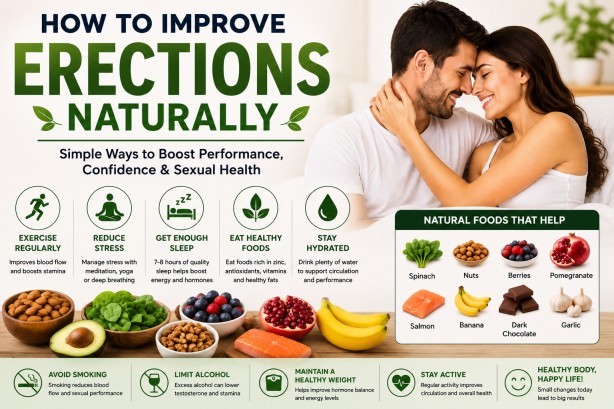
Erection quality is directly shaped by how you live: what you eat, how much you move, how well you sleep, how you manage stress, and how well your cardiovascular and hormonal systems are functioning. For many men — particularly those with mild to moderate Erectile Dysfunction, or those noticing early changes in erection firmness or reliability — lifestyle improvements can produce meaningful results without medication. This is not wishful thinking: the physiological mechanisms are well understood, and the evidence base is substantial. This guide covers four evidence-based methods to improve erections naturally, with specific, actionable steps under each one and realistic expectations for timelines.
Did you know?A Harvard study of over 22,000 men aged 40 to 75 found that men who exercised vigorously for 1.5 hours per week or did 3 hours of moderate activity had a 20% lower risk of Erectile Dysfunction. A separate Harvard analysis found that men who walked just 30 minutes daily had a 41% lower risk of ED. Both studies point to the same conclusion: cardiovascular activity is one of the most powerful non-pharmacological tools for protecting and improving erection quality.how to improve erections naturally
Method 1: Improve Vascular Health — the Foundation of Erection Quality
Erections require adequate blood flow to the corpus cavernosum — the erectile tissue. This blood flow is driven by Nitric Oxide (NO), which causes penile smooth muscle to relax and arterial blood vessels to dilate. Anything that impairs Nitric Oxide production or causes arterial stiffening and narrowing directly impairs erection quality.
1. Eat foods that support blood flow and Nitric Oxide production
Diet directly impacts endothelial function — the inner lining of blood vessels that produces Nitric Oxide. A 2016 Harvard study following 25,096 men for 10 years found that men with the highest intake of flavonoid-rich foods had a 19% lower risk of ED. The most beneficial foods:
- Nitrate-rich foods (leafy greens, beetroot, rocket): Rich dietary sources of inorganic nitrates, which the body converts to Nitric Oxide via a salivary-bacterial pathway.
- L-citrulline sources (watermelon): Converts to L-arginine and then to Nitric Oxide more efficiently than supplemental L-arginine.
- Omega-3 fatty acids (salmon, mackerel, sardines, walnuts): Support endothelial function, reduce arterial inflammation.
- Antioxidant-rich fruits (berries, pomegranate): Protect Nitric Oxide from free radical breakdown.
- Pistachios: Rich in L-arginine; a 2011 study found significant IIEF improvement with 100g daily for 3 weeks.
- Dark chocolate (70%+ cocoa): Contains flavanols that stimulate endothelial Nitric Oxide production.
Practical tip: For a quick blood flow boost, blend beetroot, watermelon, and leafy greens 2 to 3 hours before sexual activity. Beetroot juice measurably increases blood Nitric Oxide within this window. Paired with dark chocolate (for flavanols), these are among the fastest-acting dietary supports for erection quality.
2. Exercise regularly to improve blood flow and endothelial function
Exercise is one of the most powerful evidence-based interventions for erection quality. A 2018 meta-analysis in Sexual Medicine Reviews confirmed that aerobic exercise significantly improves erectile function in men with cardiovascular-related ED. The effective dose was 40 minutes of moderate-to-vigorous aerobic exercise four times per week.
Brisk walking (30–45 min/day, 5 days/week)
Walk at a pace that makes you breathe fasterhow to improve erections naturally but still allows light conversation. The Harvard data showing 41% lower ED risk was associated with 30 minutes daily — a highly achievable target.
Resistance training (15–20 min, 2–3 times/week)
Resistance training naturally supports testosterone production and improves insulin sensitivity. Compound movements (squats, glute bridges, rows) are most effective.
Pelvic floor exercises (Kegels) — daily
The bulbocavernosus and ischiocavernosus muscles of the pelvic floor trap blood in the penis during erection. A 2005 study published in BJU International found pelvic floor rehabilitation restored normal erectile function in 40% of men with ED and significantly improved function in a further 35%.
How to do Kegels: contract the muscles you use to stop urine flow midstream. Hold for 3 to 5 seconds, relax completely, repeat 10 to 15 times per set, 3 sets daily. Progress to 10-second holds over 4 to 6 weeks.
3. Quit smoking and manage alcohol
Smoking damages endothelial cells how to improve erections naturally and depletes Nitric Oxide. A meta-analysis found smokers have a 51% higher risk of ED. Erection quality measurably improves within 2 to 4 weeks of stopping smoking. Limit alcohol to 1 to 2 drinks on evenings when erection quality matters — heavy drinking acutely suppresses the CNS arousal signal and chronically lowers testosterone.
Method 2: Support Testosterone Levels Naturally
Testosterone supports libido, the psychological initiation of arousal, and the neurological conditions in which erections occur. It is not the direct driver of the erection mechanism, but low testosterone weakens the arousal signal and reduces desire.
1. Prioritise sleep quantity and quality
Testosterone is primarily produced during deep, slow-wave sleep, with levels peaking in the final REM cycles before waking. Men sleeping fewer than 5 hours per night show testosterone levels significantly lower than those sleeping 7 to 9 hours, with the reduction appearing within one week of sleep restriction.
- Aim for 7 to 9 hours per night with consistent bedtimes
- Keep the bedroom cool, dark, and screen-free
- If you snore heavily or wake unrefreshed, ask about screening for Obstructive Sleep Apnoea — OSA significantly suppresses testosterone and is closely linked to ED
2. Maintain a healthy body weight
Excess abdominal fat promotes testosterone-to-oestrogen conversion. Obese men are approximately 1.3 times more likely to experience ED than men with a healthy BMI (Frontiers in Endocrinology). A 42-inch waist is associated with a 50% how to higher ED risk than a 32-inch waist (Harvard).
3. Check testosterone levels if symptomatic
If you experience persistent low libido alongside erection problems, a morning serum testosterone blood test is the appropriate diagnostic step. If testosterone is confirmed below the clinical threshold (generally below 300 ng/dL) with symptoms, a doctor can discuss whether TRT or lifestyle optimisation is appropriate.
Method 3: Reduce Stress, Performance Anxiety, and Cortisol
Chronic stress elevates cortisol, which suppresses testosterone and activates the sympathetic nervous system (fight-or-flight) — directly opposing the parasympathetic state required for erection. Performance anxiety is particularly damaging: the fear of losing an erection itself activates the sympathetic system and triggers the feared outcome.
1. Reduce performance pressure and communicate with your partner
- Talk honestly with your partner about anxieties, expectations, and what feels good for both of you
- Keep physical affection alive outside of sexual contexts — intimacy not tied to performance reduces pressure
- Shift focus from outcome (achieving erection) to connection and presence — sensate focus exercises formalise this
- Regular sexual activity, including non-penetrative intimacy, desensitises performance anxiety over time
2. Manage stress and anxiety directly
Morning erection preserved but erection difficulty in partnered contexts = likely psychological cause. Psychosexual therapy and CBT are highly effective for performance anxiety and psychological ED; both individual and couples formats are available.
- Daily mindfulness meditation or deep breathing — activates the parasympathetic nervous system
- Regular aerobic exercise — the most evidence-based stress reducer
- Journaling, adequate sleep, and social connection reduce baseline cortisol load
Method 4: Protect Nerve Health and Manage Underlying Conditions
ED can precede a cardiovascular diagnosis by approximately 3 to 5 years — the penile arteries (1 to 2 mm diameter) show effects of atherosclerosis before the larger coronary arteries. ED is frequently an early warning sign of cardiovascular disease.
- Monitor blood pressure, blood sugar, and cholesterol regularly — annual checks if healthy
- Follow treatment plans for Diabetes, hypertension, or hyperlipidaemia — well-managed chronic conditions improve erectile function independently
- Review medications with a prescriber — some antihypertensives and antidepressants contribute to ED; alternatives may be available
- Limit dietary salt, added sugars, and saturated fats
How Long Do Natural Methods Take to Improve Erections?
- Stopping smoking: Improvement within 2 to 4 weeks; improvement continues over following months.
- Dietary changes (nitrate-rich foods): Acute Nitric Oxide effects within 2 to 3 hours; longer-term vascular improvement builds over 4 to 12 weeks.
- Aerobic exercise: First improvements typically within 4 to 6 weeks; greater improvement after 3 to 6 months of consistency.
- Kegel exercises: Noticeable pelvic floor strength improvement at 4 to 6 weeks; full benefit at 3 to 6 months.
- Weight loss: Improvement in testosterone and vascular health with meaningful weight loss over 3 to 6 months.
- Stress management and therapy: Psychosexual therapy typically shows improvement within 4 to 12 sessions.
When Natural Methods Are Not Enough
Natural methods are effective and important — but they are not sufficient for all men. Medical evaluation is appropriate when ED is consistent despite 8 to 12 weeks of genuine lifestyle improvement, when onset is sudden, when ED is accompanied by other symptoms, or when underlying conditions are present.
Prescription PDE5 inhibitors — Sildenafil (Viagra), Tadalafil (Cialis), Vardenafil (Levitra), Avanafil (Stendra) — are the evidence-based first-line medical treatment for most men with ED and can be used alongside lifestyle changes. A doctor can advise on which is most appropriate.
Conclusion
Improving erections naturally is achievable for many men through a consistent combination: improving vascular health through diet, exercise, quitting smoking, and alcohol management; supporting testosterone through adequate sleep, healthy body weight, and resistance training; reducing stress and performance anxiety through communication, mindfulness, and psychosexual therapy where needed; and managing underlying conditions.
The most consistently impactful single intervention is regular aerobic exercise — associated with a 41% lower ED risk in Harvard research. Combined with a Mediterranean-pattern diet, not smoking, adequate sleep, and stress management, these lifestyle measures address the underlying physiological causes of ED. For men where lifestyle changes are insufficient, medical evaluation is the appropriate next step.
Frequently Asked Questions
-
Why do I have strong erections when I’m alone but not with my partner?
This pattern is a classic indicator of a significant psychological component to ED — most commonly performance anxiety. When alone, there are no performance expectations, allowing arousal to develop naturally. Emotional disconnection, distraction, or unresolved relationship tension can also reduce arousal during partnered intimacy. A sex therapist or psychosexual counsellor can help address this pattern specifically — often more effectively than medication alone.
-
Does quitting smoking help Erectile Dysfunction?
Yes — significantly. Smoking damages endothelial cells and depletes Nitric Oxide, directly impairing the vascular mechanism of erection. Men who quit smoking typically notice improvements in erection quality within 2 to 4 weeks as endothelial function begins to recover. A meta-analysis found that smokers have a 51% higher risk of ED than non-smokers, and erection quality continues improving over the following months.
-
How long does it take for natural ED treatments to show results?
Most men notice first improvements within 4 to 8 weeks of consistent lifestyle changes, with more meaningful results by 12 weeks. Smoking cessation improves erection quality fastest — often within weeks. Aerobic exercise produces first improvements in 4 to 6 weeks. Pelvic floor exercises show noticeable strength gains at 4 to 6 weeks. Stress management and therapy typically shows improvement within 4 to 12 sessions.
-
When should I see a doctor for erectile problems?
See a doctor if erection problems persist over most sexual encounters for 8 to 12 weeks despite consistent lifestyle changes, if ED has a sudden onset, or if it is accompanied by other symptoms (reduced desire, fatigue, urinary changes). A doctor can identify underlying causes — hormonal, vascular, neurological — and recommend appropriate treatment. Do not rely on unverified supplements; consult a licensed clinician.
-
Can diet changes alone fix weak erections?
Diet changes alone rarely resolve ED fully, but are a meaningful component of a comprehensive approach. A Mediterranean-pattern diet improves vascular function and reduces ED risk — a large study associated high flavonoid intake with a 19% lower ED risk. However, diet alone cannot compensate for poor sleep, chronic stress, physical inactivity, or significant underlying conditions. The most effective approach combines dietary improvement with exercise, weight management, sleep optimisation, and stress management.
-
Is the ‘salt trick’ a real way to get better erections?
No. The ‘salt trick’ is a viral internet claim with no scientific evidence. High sodium intake is actually associated with hypertension — one of the most significant risk factors for Erectile Dysfunction — because it damages arterial walls and raises blood pressure. Reducing salt intake is one of the dietary changes associated with improved erectile health, not the opposite.
-
Does zinc supplementation improve erections?
Zinc deficiency does reduce testosterone, and supplementation in men with confirmed zinc deficiency can support testosterone levels and, indirectly, erectile function. However, supplementing when levels are adequate does not produce additional benefit. Blood testing to confirm deficiency before supplementing is the appropriate first step. Foods rich in zinc (oysters, pumpkin seeds, red meat, legumes) provide zinc alongside other nutrients beneficial to erectile health.
-
How long does it take to see improvement in erection quality from lifestyle changes?
Timeline varies by method: quitting smoking shows improvement within 2 to 4 weeks. Dietary changes produce gradual vascular improvement over 4 to 12 weeks. Aerobic exercise shows first results in 4 to 6 weeks, with more significant improvement by 12 weeks of consistency. Kegel exercises show measurable pelvic floor strength improvement at 4 to 6 weeks. Weight loss (where relevant) improves testosterone and vascular health over 3 to 6 months. Prescription PDE5 inhibitors work within 30 to 60 minutes of each dose.
-
Can cold showers help erections?
Cold showers can temporarily boost circulation and Nitric Oxide production, and they reduce cortisol — the stress hormone that suppresses testosterone. They also improve alertness and mental state, which supports arousal. While cold exposure is not a primary treatment for ED, regular cold showers may modestly support the vascular and hormonal conditions that underpin erection quality. They work best as part of a broader lifestyle approach rather than as a standalone intervention.
-
Does bad posture affect erections?
Yes. Poor posture — particularly anteriorly tilted pelvis from tight hip flexors — can compress nerves in the lower back and pelvis, reduce blood flow through the pudendal artery, and create pelvic floor muscle imbalances that affect erectile function. Strengthening the core, stretching the hip flexors, and improving postural alignment may modestly support erectile health, particularly in men who sit for extended periods. Hip flexor stretching and Kegel exercises address both issues simultaneously.
-
Does oral hygiene affect erectile function?
Yes — through a vascular mechanism. A study in the Journal of Sexual Medicine found that men with chronic periodontal (gum) disease had a significantly higher prevalence of Erectile Dysfunction than men with healthy gums. Researchers believe the link is vascular: the same chronic low-grade inflammation and endothelial damage that contribute to gum disease also impair the blood vessel health that erections depend on. Good dental hygiene and regular dental care protect vascular health.
-
Does body temperature affect erections?
Yes, indirectly. Extreme heat can reduce circulation efficiency, and very high testicular temperature reduces testosterone production (which is why the testes are external — they need to be cooler than core body temperature for optimal sperm and testosterone production). Prolonged high-heat exposure (very hot baths, saunas) may modestly suppress testosterone temporarily. Conversely, cold exposure (as above) can stimulate circulation and cortisol reduction. Normal environmental temperature variation does not meaningfully affect erections in healthy men.
This article is for general informational purposes only and does not constitute medical advice. If you are experiencing Erectile Dysfunction, consult a qualified healthcare provider for a proper diagnosis and treatment plan before beginning any supplement.
