
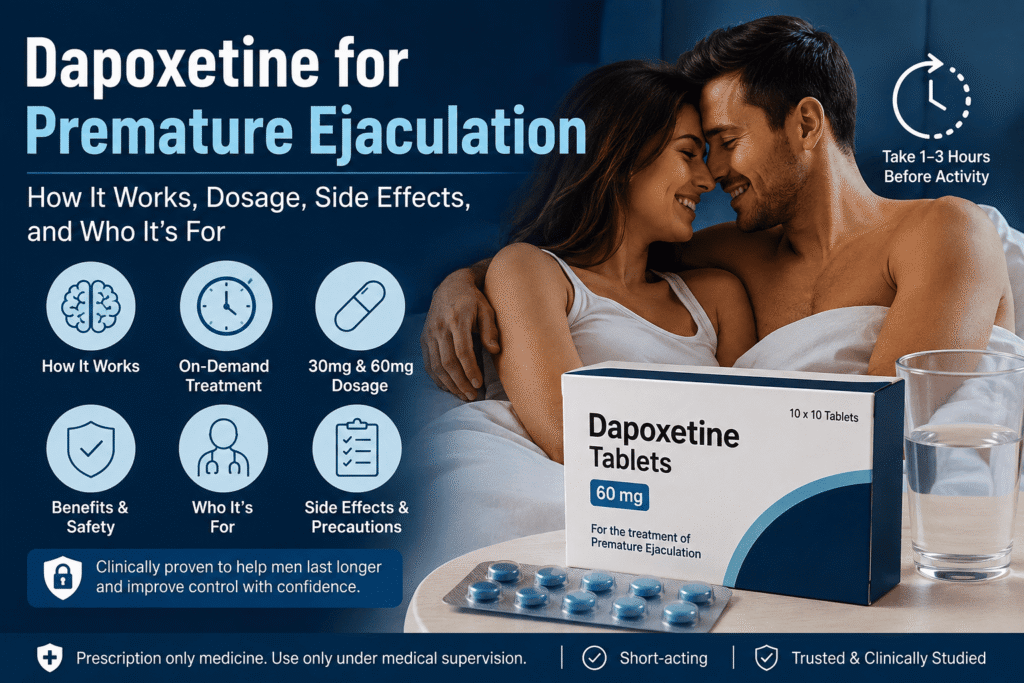
Dapoxetine for premature ejaculation is the only medication specifically developed and approved for on-demand treatment of Premature Ejaculation (PE). Unlike daily SSRIs such as paroxetine or sertraline — which are used off-label for PE and take 1 to 2 weeks of daily dosing to produce their effect — Dapoxetine is a short-acting SSRI taken 1 to 3 hours before sexual activity. It enters and leaves the body quickly, producing its ejaculation-delaying effect on demand. This guide covers how Dapoxetine works, the approved doses, who can take it, common and serious side effects, important drug interactions, and what men in the United States need to know about its availability.
Regulatory note: Dapoxetine is approved for Premature Ejaculation in many markets including the UK, EU, Australia, South Korea, New Zealand, and parts of Asia. It is NOT FDA-approved in the United States. US men are typically offered daily off-label SSRIs (paroxetine, sertraline, fluoxetine) or topical anaesthetics instead. This article is intended for men in markets where Dapoxetine is legally available by prescription.
Premature Ejaculation is the most common male sexual complaint worldwide, affecting an estimated 20 to 30% of men across all age groups. Clinical trials of Dapoxetine show that it approximately doubles to triples the time to ejaculation (IELT — Intravaginal Ejaculation Latency Time) compared to placebo, with 30 mg increasing IELT approximately 2.5 times over baseline and 60 mg approximately 3 times.
What Is Dapoxetine?
Dapoxetine is a short-acting Selective Serotonin Reuptake Inhibitor (SSRI) specifically designed for on-demand treatment of Premature Ejaculation. It was developed after researchers recognised that while daily SSRIs delayed ejaculation as a side effect, most men preferred an on-demand medicine rather than a daily medication for a situational problem.
Its key pharmacokinetic properties distinguish it from all other SSRIs:
- Rapid absorption: Peak blood concentration (Tmax) approximately 1 to 2 hours after oral ingestion.
- Short half-life: Approximately 1.3 to 1.4 hours for Dapoxetine itself. This short effective half-life allows the drug to be taken on demand without systemic accumulation.
- Rapid clearance: Largely cleared from the body within 24 hours, making it unsuitable and unnecessary as a daily medication.
This pharmacokinetic profile is what makes Dapoxetine uniquely suited for on-demand PE treatment — unlike paroxetine or sertraline, which need daily dosing for 1 to 2 weeks before their ejaculation-delaying effects build up.
How Does Dapoxetine Work?
Ejaculation is triggered by a complex interaction between the brain, spinal cord, and peripheral nerves, regulated in part by serotonin signalling. Serotonin is a neurotransmitter that modulates the ejaculatory reflex — higher serotonin activity in the synaptic cleft suppresses the ejaculatory threshold, while lower activity lowers it.
Dapoxetine blocks the serotonin transporter (SERT), preventing the reuptake (reabsorption) of serotonin after it has been released between nerve cells. This increases the concentration of serotonin in the synaptic cleft, raising the ejaculatory threshold and effectively delaying the reflex that triggers ejaculation.
The mechanism is the same as all SSRIs — but the rapid onset and short duration of Dapoxetine make it work on demand rather than requiring chronic accumulation. Sexual stimulation is not required for Dapoxetine to work (unlike PDE5 inhibitors), but the drug acts on the ejaculatory reflex specifically rather than on the erection mechanism.
What Is Premature Ejaculation?
PE is defined clinically as ejaculation occurring consistently within approximately 1 to 2 minutes of penetration, with an inability to delay ejaculation, causing personal distress. The average IELT (Intravaginal Ejaculation Latency Time) across populations is approximately 5 to 7 minutes.
- Lifelong (primary) PE: Present since first sexual experiences. Neurobiological component is typically stronger. Pharmacotherapy is often first-line.
- Acquired (secondary) PE: Develops after a period of normal ejaculatory control. Often associated with a new relationship, anxiety, or Erectile Dysfunction. Behavioural and psychological approaches may be more prominent.
Dapoxetine is appropriate for both lifelong and acquired PE, though the 2025 Global Andrology Forum Clinical Practice Guidelines recommend that acquired PE should also address the underlying trigger (particularly if co-existing ED is present).
Dapoxetine Dosage — 30mg vs 60mg
Dosage clarification: The approved doses of Dapoxetine for Premature Ejaculation are 30 mg and 60 mg. Some clinical studies used 90 mg, but 90 mg is outside the EMA-approved prescribing label and is not a standard recommended dose. The maximum approved dose in most markets is 60 mg per 24-hour period. Never self-escalate beyond 60 mg.
- Starting dose — 30 mg: The recommended starting dose for all men. Taken 1 to 3 hours before sexual activity. Clinical trials show IELT approximately 2.5 times over baseline at this dose.
- Dose escalation — 60 mg: If 30 mg is well-tolerated but insufficiently effective, a prescriber may increase to 60 mg. Allow at least 6 to 8 sexual attempts at 30 mg before requesting escalation — many men find 30 mg sufficient when used correctly. IELT approximately 3 times over baseline at 60 mg.
- Maximum dose: 60 mg per 24-hour period. Do not take more than one dose in 24 hours.
Dose escalation should always be made in consultation with a prescribing clinician — not self-initiated. The higher dose (60 mg) is associated with a higher rate of side effects, particularly nausea, dizziness, and the vasovagal syncope risk.
How to Take Dapoxetine
- Take Dapoxetine 1 to 3 hours before anticipated sexual activity
- Swallow the tablet whole with a full glass of water
- Can be taken with or without food
- Sit or lie down for a few minutes after taking — this is important to reduce the syncope (fainting) risk; see below
- Do not take alcohol with Dapoxetine — see interactions section
- Do not take more than once in any 24-hour period
- Take on an as-needed basis only — do not take daily
Safety tip: Dapoxetine can cause a sudden drop in blood pressure (vasovagal response) in some men, leading to dizziness or fainting — particularly when standing up too quickly after taking it. Sitting or lying down for 15 to 30 minutes after swallowing the tablet significantly reduces this risk. Be cautious about standing quickly in the first 1 to 2 hours after taking the dose.
Benefits of Dapoxetine
- Effective ejaculation delay: Clinical trials show IELT increase of approximately 2.5 to 3 times over baseline, representing a meaningful clinical improvement in most men.
- On-demand convenience: No need for daily medication; taken only when needed. Avoids the systemic side-effect burden of daily SSRIs.
- Rapid onset: Reaches effective blood concentration within 1 to 2 hours, with effects present for 3 to 5 hours.
- Rapid clearance: Largely cleared within 24 hours, reducing cumulative exposure and systemic side-effect risk compared to daily SSRIs.
- Improved sexual confidence: Clinical trial secondary outcomes consistently show improvements in self-reported control, satisfaction, and distress about PE.
- Safe for short-term use: When used as prescribed and at approved doses, Dapoxetine has been shown to be safe in multiple large randomised controlled trials.
- Works on demand without affecting daily function: Unlike daily SSRIs, Dapoxetine does not affect libido, mood, or general serotonin function throughout the day.
Dapoxetine for premature ejaculation Side Effects
Common side effects
The most frequently reported adverse events in Dapoxetine clinical trials, in descending order of frequency:
- Nausea — the most common side effect; typically mild and self-limiting; more common at 60 mg than 30 mg
- Headache
- Diarrhoea
- Dizziness
- Somnolence (drowsiness)
- Insomnia
- Nasopharyngitis (runny nose, nasal congestion)
- Fatigue
Most common side effects are mild, brief (resolving within a few hours as Dapoxetine clears), and dose-dependent. They are more frequent at 60 mg than at 30 mg — another reason to start at 30 mg and escalate only if needed.
Serious side effects
- Vasovagal syncope (fainting) — see dedicated section below
- Seizures — rare but documented; use with particular caution in men with seizure history
- Serotonin syndrome — if combined with other serotonergic agents; see interactions section
- Irregular heartbeat (arrhythmia) — rare
- Severe allergic reaction — rare
The Syncope (Fainting) Risk — A Specific Safety Point
Vasovagal syncope — a sudden, transient loss of consciousness caused by a drop in blood pressure — is a specific and documented risk with Dapoxetine that requires particular attention. It is more common than many patients realise and more common at 60 mg than at 30 mg.
Vasovagal syncope occurs through the following mechanism: Dapoxetine’s serotonergic and cardiovascular effects can trigger a reflex drop in blood pressure — particularly when standing up quickly (orthostatic hypotension), in warm environments, when dehydrated, or when alcohol has been consumed. The blood pressure drop temporarily reduces cerebral blood flow, causing lightheadedness and, in some cases, brief loss of consciousness.
Practical risk reduction:
- Sit or lie down for 15 to 30 minutes after taking the dose
- Stand up slowly — avoid rapid position changes in the first 1 to 2 hours
- Stay well-hydrated before and after taking the dose
- Avoid alcohol completely — alcohol significantly amplifies the syncope risk
- Avoid very warm environments (hot baths, saunas) in the dosing window
- Men with a history of unexplained fainting should discuss this with a prescribing clinician before use
If you experience fainting, severe dizziness, or loss of consciousness after taking Dapoxetine, seek medical advice before taking it again. Do not drive or operate machinery in the first 1 to 2 hours after taking Dapoxetine, as dizziness and syncope can affect the ability to concentrate and react safely.
Who Should Not Take Dapoxetine
- Men with a history of syncope (fainting) or presyncope (near-fainting)
- Men currently taking MAOIs (Monoamine Oxidase Inhibitors) — potentially fatal serotonin syndrome. A minimum 14-day washout after stopping an MAOI is required before starting Dapoxetine.
- Men on other serotonergic medicines (SSRIs, SNRIs, tramadol, triptans, St John’s Wort) — risk of serotonin syndrome
- Men with moderate or severe hepatic (liver) impairment — Dapoxetine is primarily metabolised by the liver
- Men with significant cardiovascular disease or heart failure
- Men with known prolonged QT interval or taking medicines that prolong QT
- Men with known allergy to Dapoxetine or any tablet ingredient
- Men under 18 years old
Drug Interactions with Dapoxetine
Absolute contraindications — never combine
- MAOIs (Monoamine Oxidase Inhibitors): Risk of life-threatening serotonin syndrome. 14-day washout after stopping MAOI before starting Dapoxetine. 7-day washout after stopping Dapoxetine before starting MAOI.
- Other SSRIs, SNRIs, clomipramine: Risk of serotonin syndrome and additive cardiovascular effects.
- Thioridazine: Absolute contraindication — combined cardiac risk.
Significant interactions requiring caution
- Alcohol: Significantly amplifies the syncope risk by causing additive vasodilation and CNS depression. Never combine Dapoxetine and alcohol.
- CYP3A4 inhibitors (Ketoconazole, Ritonavir, Clarithromycin): Slow Dapoxetine metabolism, raising blood levels. Use with extreme caution or avoid; a prescriber should assess before combining.
- CYP2D6 inhibitors (Fluoxetine, Paroxetine, Quinidine): Also slow Dapoxetine metabolism; additive SSRI effects.
- PDE5 inhibitors (Sildenafil, Tadalafil) for co-existing ED: The combination is used clinically but carries an additive blood pressure-lowering risk. Dapoxetine and PDE5 inhibitors should be combined only under medical guidance, starting with the lowest doses of each and monitoring for excessive blood pressure drop or dizziness.
- Tramadol: Serotonergic interaction — increased serotonin syndrome risk.
- Triptans (for migraine): Serotonergic interaction; use only under medical supervision.
Dapoxetine vs Daily SSRIs for PE
The choice between Dapoxetine and daily SSRIs for PE depends on individual preference, response, and circumstances:
- Dapoxetine on-demand: Best for men who want to avoid daily medication, have infrequent sexual activity, or prefer on-demand control. Works from the first dose.
- Daily SSRIs (paroxetine, sertraline, fluoxetine — off-label): Best for men with frequent sexual activity who want continuous coverage, or for whom on-demand dosing creates additional anxiety. Require 1 to 2 weeks of daily dosing before ejaculation delay builds; paroxetine has the strongest evidence for PE of the daily SSRIs. Lower syncope risk than Dapoxetine.
- Combination: Some evidence supports using low-dose daily Dapoxetine or a daily SSRI alongside on-demand Dapoxetine as needed in refractory cases — under prescriber supervision.
In the United States, where Dapoxetine is not FDA-approved, daily off-label SSRIs (paroxetine at 10 to 40 mg/day, sertraline at 25 to 200 mg/day) or topical anaesthetic sprays (lidocaine, benzocaine) are the most commonly prescribed pharmacological options.
Conclusion
Dapoxetine is the most purpose-built pharmacological option for Premature Ejaculation in markets where it is approved. Its rapid onset and short half-life make it uniquely suited to on-demand dosing — addressing PE without the need for daily medication or a 1 to 2 week buildup period. Clinical trials consistently show it doubles or triples ejaculation latency time compared to placebo.
The most important safety consideration unique to Dapoxetine is the vasovagal syncope risk — most effectively managed by sitting or lying down after taking the dose, staying hydrated, standing slowly, and avoiding alcohol entirely on dosing days. The combination of Dapoxetine and alcohol is associated with a significantly elevated fainting risk and should be avoided without exception.
If you are in the United States, discuss daily off-label SSRIs or topical anaesthetics with a doctor — these are the appropriate domestically available alternatives. If you are in a market where Dapoxetine is approved, obtain it through a licensed pharmacy with a valid prescription.
Frequently Asked Questions
-
How effective is Dapoxetine for Premature Ejaculation?
Clinical trials show that Dapoxetine 30 mg increases ejaculation latency time (IELT) approximately 2.5 times over baseline, and 60 mg approximately 3 times. Secondary outcomes in trials show improved ejaculatory control, reduced personal distress, and improved sexual satisfaction. Individual results vary — approximately 67 to 75% of men report meaningful improvement at the 30 mg dose.
-
When should I take Dapoxetine?
Take Dapoxetine 1 to 3 hours before anticipated sexual activity. Do not take it more than once in a 24-hour period. Take it with a full glass of water, then sit or lie down for 15 to 30 minutes to reduce dizziness and syncope risk. Do not combine with alcohol. It can be taken with or without food.
-
Can I take Dapoxetine with Sildenafil (Viagra)?
Dapoxetine and Sildenafil are sometimes prescribed together when a man has both Premature Ejaculation and Erectile Dysfunction. However, the combination carries an additive blood pressure-lowering risk and increases the risk of dizziness and syncope. This combination should only be used under medical guidance, starting with the lowest doses of each, and men should be particularly careful about standing slowly and avoiding alcohol.
-
Is Dapoxetine available in the United States?
No. Dapoxetine has not received FDA approval for any indication in the United States. It is approved in many other markets including the UK, EU, Australia, South Korea, and parts of Asia. US men with Premature Ejaculation are typically offered daily off-label SSRIs (paroxetine 10 to 40 mg/day, sertraline 25 to 200 mg/day), on-demand clomipramine, or topical anaesthetic sprays as alternatives.
-
What is the difference between Dapoxetine 30 mg and 60 mg?
Dapoxetine 30 mg is the recommended starting dose for all men. It produces an IELT increase of approximately 2.5 times over baseline and has a lower side-effect incidence than the 60 mg dose. If 30 mg is well-tolerated but insufficiently effective after 6 to 8 sexual attempts, a prescriber may increase to 60 mg — which increases IELT approximately 3 times over baseline but has a higher rate of nausea, dizziness, and syncope risk. Never self-escalate beyond 60 mg, which is the maximum approved dose in most markets.
This article is for general informational purposes only and does not constitute medical advice. Dapoxetine is a prescription-only medicine. Always consult a qualified healthcare provider. Do not combine with alcohol or MAOIs.
