
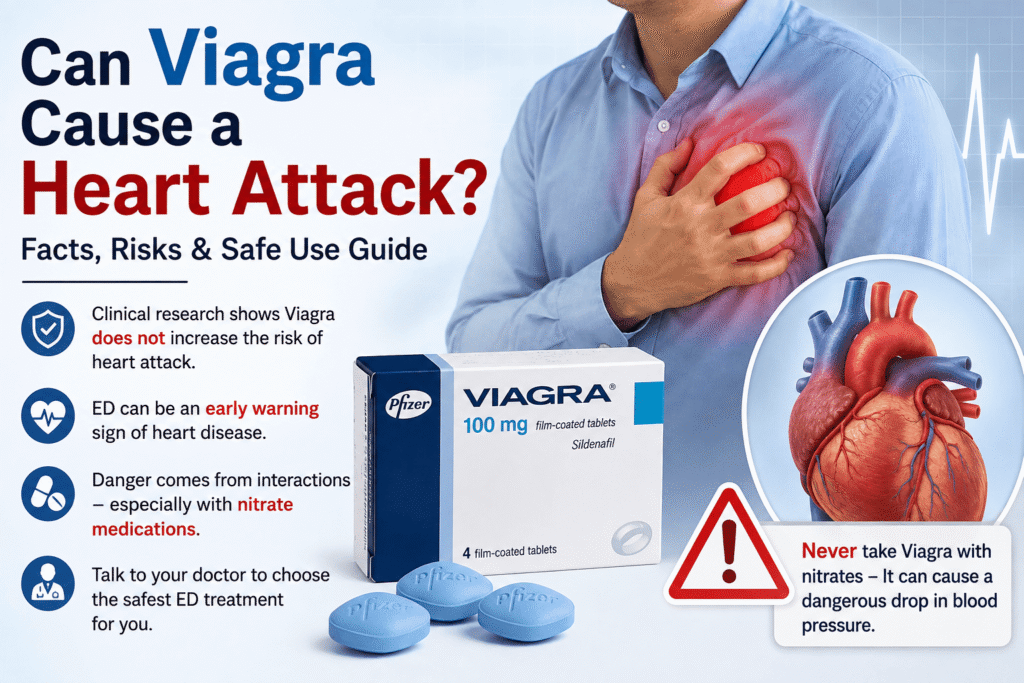
Viagra (Sildenafil) is one of the most effective and widely used oral medications for Erectile Dysfunction (ED), with a long track record of safety in most men. But it can cause real problems for people with certain heart conditions, and the relationship between Viagra, heart attacks, and ED itself is worth understanding properly rather than assuming the worst — or dismissing the risk entirely. This article addresses the question directly: can Viagra cause a heart attack?
The short answer: No — clinical research consistently shows that Sildenafil, used appropriately, does not increase the risk of myocardial infarction (heart attack) or sudden cardiac death. The real danger isn’t the drug itself in isolation; it’s specific interactions — above all, combining it with nitrate medicines — and using it despite an underlying cardiac condition that makes any physical exertion, including sex, genuinely risky.
Can Viagra Cause a Heart Attack?
According to clinical research, Viagra is a safe medication when used appropriately, and does not increase the risk of myocardial infarction (the medical term for heart attack) or sudden cardiac death. Individual response to the medication varies with age, body mass, weight, and other factors — some men experience no notable side effects at all, while others may have a more significant reaction, particularly if an underlying condition or interacting medication is involved.
The Connection Between ED and Heart Disease
While there’s no direct causal link between Viagra itself and heart disease, there’s a well-documented connection between Erectile Dysfunction and heart disease. Harvard Health notes that ED can be an early warning sign of broader cardiovascular problems — largely because both conditions can share a root cause: Atherosclerosis, the narrowing of arteries from fat and cholesterol buildup. When arteries can’t supply enough blood to the heart, penis, or other areas of the body, the result can be either erection difficulty or a cardiac event, depending on which vessels are most affected. This is exactly why new-onset ED, particularly in a man under 60, is worth raising with a doctor as a cardiovascular check-in, not just an ED consultation.
Viagra and Heart Medications — the Real Risk
Viagra is generally well-tolerated, causing mild to moderate side effects in most users. The gen uine danger comes from specific interactions:
- Nitrate medicines: Used to manage Angina (chest pain). Nitrates like Nitroglycerin and Viagra both work by dilating blood vessels, which lowers blood pressure. Combined, they can drop blood pressure to dangerous levels, raising the risk of heart attack or stroke. This is an absolute, non-negotiable contraindication with no safe dose combination.
- Riociguat: Used for Pulmonary Hypertension, this works through a related mechanism and carries the same absolute contraindication as nitrates.
- Recent heart attack or unstable cardiac condition: People recovering from a recent heart attack, or with an unstable heart condition, generally shouldn’t take Viagra — the body may not be able to safely handle the physical demands of sexual activity, and the medication can also interact with heart medicines being used for recovery.
Who Should Be Especially Cautious
- Anyone taking nitrate medicines in any form, including recreational nitrite inhalants (“poppers”) — absolute contraindication
- Anyone taking Riociguat
- Men with a recent heart attack, stroke, or unstable angina
- Men with significant, unstable heart disease, or where a doctor has advised against sexual activity due to cardiac risk
- Men with very low or uncontrolled high blood pressure
If any of these apply to you, talk to a doctor before considering Viagra — there are often other options that fit your specific health picture more safely.
ED Treatments Other Than Viagra
If Viagra isn’t the right fit — whether due to a heart-related caution, insufficient effectiveness, or personal preference — several other evidence-based options exist:
Other oral medications
The FDA has approved four oral ED medications, all belonging to the PDE5 inhibitor class: Sildenafil (Viagra), Tadalafil (Cialis), Vardenafil (Levitra), and Avanafil (Stendra). If Sildenafil isn’t giving you the results you need, a doctor may consider one of the other three — they share the same core mechanism but differ in onset, duration, and side-effect profile.
Injections and surgery
Injection therapy delivers medication directly into the penis using a small needle, and is effective for many men who don’t respond well to oral medication. Surgery — typically penile implants — is generally reserved for more severe, treatment-resistant ED.
Injection therapy carries a real risk of Priapism — a painful erection lasting 4 hours or more, which is a medical emergency requiring prompt treatment to prevent permanent damage.
Exercise
Research has found that moderate to vigorous regular exercise can help reduce ED symptoms and may help prevent them from developing in the first place, largely through its broader cardiovascular benefits. Talk to your doctor about an exercise plan suited to your current health.
Conclusion
Viagra has a long track record of effectiveness and, for most men, a good safety profile — but it isn’t risk-free for everyone. Research consistently shows it doesn’t directly increase the risk of a heart attack. That said, cases of heart attack, stroke, or Arrhythmia have occurred in men taking Viagra, and current evidence suggests these events are more often linked to the physical demands of sexual activity itself, or to underlying cardiovascular disease, rather than a direct effect of the drug. Viagra doesn’t play a direct causal role in causing a heart attack, but people with an underlying heart condition, or those recovering from one, should exercise real caution and involve their doctor before using it. If Viagra isn’t right for you, other FDA-approved PDE5 inhibitors and non-oral treatments are worth discussing.
Glossary
- Erectile Dysfunction: A sexual dysfunction in which a man is unable to achieve or maintain an erection sufficient for sexual activity.
- Hypotension: A condition in which blood pressure is lower than normal.
- Hypertension: A condition in which blood pressure is higher than normal.
- Arrhythmia: Irregular or abnormal heart rhythm.
Frequently Asked Questions
-
Can Viagra cause strokes?
Stroke isn’t a common side effect of Viagra on its own; the more typical side effects are nausea, headache, flushing, and occasionally vomiting. However, Viagra can interact with certain medications — nitrates most seriously — causing an extremely dangerous drop in blood pressure that can, in rare cases, contribute to an ischemic stroke. This underscores why disclosing your full medication list before starting Viagra matters.
-
Can Viagra cause chest pain?
Chest pain is a rare but serious side effect that requires medical attention. Other serious effects to watch for include fainting, Priapism, and severe dizziness. As a vasodilator, Viagra causes blood vessels to widen, which can lower blood pressure — and in some cases, this drop is significant enough to cause chest discomfort. If you experience chest pain after taking Viagra, seek medical attention.
-
Is Viagra harmful to the heart?
For most men with stable cardiovascular health, Viagra is generally safe. Research consistently shows no link between appropriate Sildenafil use and an increased risk of heart attack or other major cardiac events. It becomes a genuine concern specifically in men with unstable heart disease, a recent cardiac event, or those taking nitrate medicines or Riociguat — for these groups, the risk profile changes significantly.
This article is for general informational purposes only and does not constitute medical advice. Sildenafil is a prescription-only medicine. Always consult a qualified healthcare provider, particularly if you have any heart condition, before starting Viagra. Never combine with nitrate medicines or Riociguat.
