
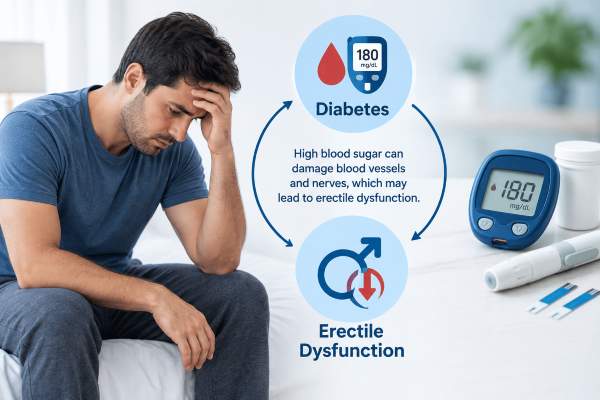
Diabetes and erectile dysfunction usually get discussed in one direction: diabetes as the cause, ED as the downstream complication. That’s real, but it’s only half the picture. One widely cited study found that 90% of men with erectile dysfunction either had diabetes or at least one major risk factor for it — high blood pressure, high cholesterol, or smoking. That makes ED less like a footnote to a diabetes diagnosis and more like an early signal that can show up before diabetes is ever diagnosed at all.
The Connection Most Men Don’t Know About
Most men assume erectile dysfunction is either an age issue or a stress issue, and diabetes rarely enters the conversation until it’s already been diagnosed through a separate test. But because the blood vessel and nerve damage that leads to ED often starts well before diabetes symptoms become obvious elsewhere in the body, erectile difficulty can be one of the first physical signs that blood sugar has been running high for a while. Bringing up ED at a checkup, rather than treating it as a private, separate issue, is one of the more practical ways men end up catching a metabolic problem earlier than they otherwise would.
How Diabetes Causes Erectile Dysfunction
An erection depends on a chain reaction: arousal triggers the release of nitric oxide, which relaxes the blood vessels and muscles in the penis and allows blood to flow in. Elevated blood sugar interferes with this chain at more than one point. Over time, high glucose levels reduce nitric oxide production, directly limiting how much blood flow is available. High blood sugar also damages the nerves that carry the arousal signal in the first place, a condition known as diabetic neuropathy, and damages the small blood vessels that supply the penis, which are particularly vulnerable because of their size.
The net effect is that diabetes can interrupt an erection in three separate ways at once — reduced nitric oxide, nerve signal damage, and vascular damage — which is part of why ED in men with diabetes tends to be both more common and more difficult to treat with a single approach than ED from an isolated cause.
How Common Is ED in Men With Diabetes?
The numbers here are considerably higher than most men expect. Somewhere between 35% and 75% of men with diabetes will experience some degree of erectile dysfunction over their lifetime. Roughly half of men diagnosed with diabetes develop ED within ten years of that diagnosis. Age compounds the risk further: about 50–60% of diabetic men over 50 report erectile difficulty, and by 70, the likelihood climbs to somewhere around 95%. Diabetes also tends to bring ED on earlier — typically 10 to 15 years sooner than men without diabetes experience it.
Can Erectile Dysfunction Signal Undiagnosed Diabetes?
Given how often ED and diabetes risk factors overlap, erectile difficulty in a man who hasn’t been diagnosed with diabetes is worth treating as a prompt to get blood sugar checked, not just erectile function. This is especially true when ED shows up alongside other early diabetes indicators — increased thirst, frequent urination, fatigue, or unexplained weight changes — or when there’s a family history of diabetes. Catching prediabetes or early type 2 diabetes at this stage, before complications progress further, generally leads to better outcomes than a diagnosis made later.
Is Diabetes-Related ED Reversible?
This depends heavily on timing and which mechanism is doing the most damage. Vascular-driven ED tends to respond reasonably well to improved blood sugar control, since blood flow can improve as vessel function stabilizes. Nerve damage is a different story: diabetic neuropathy can be slow to improve and, in cases of long-term nerve damage, may not fully reverse even after blood sugar is brought under good control. This is why earlier intervention tends to matter more than most men assume — the sooner blood sugar is managed after diabetes is diagnosed, the better the odds that erectile function is preserved rather than needing to be recovered later.
Other Diabetes-Related Risk Factors That Worsen ED
Diabetes rarely travels alone. High blood pressure, high cholesterol, obesity, and smoking are all common alongside diabetes, and each one independently worsens erectile function through its own effect on blood vessels. When several of these are present together, their effects tend to compound rather than simply add up, which is part of why ED can appear earlier and more severely in men managing diabetes alongside these other conditions.
How Diabetes-Related ED Is Treated
Treatment usually works on two tracks at once: managing the diabetes itself and addressing the erectile difficulty directly.
Oral Medications
PDE5 inhibitors like sildenafil, tadalafil, vardenafil, and avanafil are commonly used, though a doctor needs to weigh these carefully against any existing heart conditions, which are more common in men with diabetes and can affect which medications are appropriate.
Other Treatment Options
For men who don’t respond well to oral medication, options include vacuum erection devices, injection therapy, intraurethral therapy, topical treatments, and penile implants for more advanced cases. These are typically considered when nerve damage is significant enough that oral medication alone isn’t fully effective.
Blood Sugar Management
Improving blood sugar control doesn’t just slow the progression of nerve and vessel damage — in cases where vascular function is the primary driver of ED, it can meaningfully improve erectile function on its own, alongside whatever direct ED treatment is being used.
Lifestyle Changes That Help Both Diabetes and ED
The same changes that reduce diabetes complications generally also improve erectile function, since they target the same underlying blood vessel and nerve health:
- Losing even a modest amount of weight — around 7% of body weight has a measurable effect on both diabetes control and ED risk
- Shifting toward whole grains, vegetables, and fruit over refined carbohydrates
- Regular physical activity to support both cardiovascular health and blood sugar control
- Quitting smoking, which independently reduces nitric oxide availability on top of its other vascular effects
When to See a Doctor
It’s worth bringing up erectile dysfunction at a doctor’s visit whenever it’s persistent, regardless of whether diabetes has been diagnosed. If diabetes is already diagnosed and ED develops or worsens, that’s also worth raising directly rather than assuming it’s an unavoidable side effect, since treatment options and earlier intervention both tend to work better than waiting.
Frequently Asked Questions
Does managing diabetes improve erectile dysfunction?
Often, yes, particularly when vascular function is the main driver. Better blood sugar control can improve blood flow over time, though the degree of improvement depends on how much nerve damage has already occurred.
Can ED from diabetes be reversed?
Sometimes, especially when caught early and when blood vessel function — rather than nerve damage — is the primary cause. Long-term nerve damage is less likely to fully reverse, which is part of why earlier blood sugar management matters.
Is erectile dysfunction from diabetes permanent?
Not necessarily, but it also isn’t guaranteed to resolve. Outcomes vary based on how long blood sugar has been elevated, how well it’s managed going forward, and which underlying mechanism (vascular or nerve-related) is most responsible.
How can I prevent ED with diabetes?
Consistent blood sugar management, maintaining a healthy weight, staying active, not smoking, and managing blood pressure and cholesterol all reduce the risk. Addressing ED early, rather than waiting, also tends to produce better outcomes.
Key Takeaways
- About 90% of men with ED have diabetes or at least one major diabetes risk factor, making ED a potential early signal, not just a downstream complication
- Diabetes causes ED through three overlapping mechanisms: reduced nitric oxide, nerve damage, and vascular damage
- 35–75% of men with diabetes develop ED over their lifetime, often 10–15 years earlier than men without diabetes
- Vascular-driven ED tends to respond better to improved blood sugar control than nerve-damage-driven ED
- The same lifestyle changes that manage diabetes — weight loss, diet, exercise, quitting smoking — also improve erectile function
