
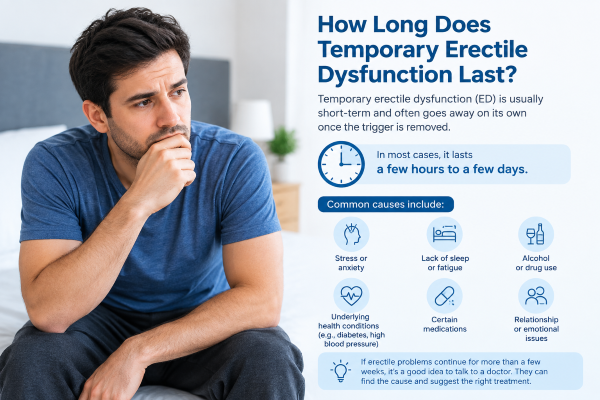
Most temporary erectile dysfunction clears up within a few days to a few months, depending entirely on what’s causing it. That’s a more specific answer than most articles on this topic are willing to give — a lot of them hedge with “it depends” and leave it there. It really does depend on the cause, but the causes themselves have fairly well-understood timelines, and knowing them makes it much easier to tell whether you’re on a normal recovery curve or whether it’s time to get it checked out. In this article we talk about how long temporary erectile dysfunction last and causes.
The Short Answer
For the most common triggers — a stressful week, a heavy night of drinking, a short illness, poor sleep — temporary ED typically resolves within a few days to a couple of weeks once the trigger passes. For causes that take longer to address, like weight, smoking, or a new medication, the timeline stretches to several weeks or a few months of sustained change before erectile function fully normalizes. If it’s still happening consistently after two to three weeks with no identifiable cause, or if it drags on for months without any improvement, that’s the point where it’s worth moving from self-monitoring to a doctor’s visit.
Temporary ED vs. Chronic ED: Two Different Definitions
Part of why this question is confusing is that “temporary” gets used two different ways. In everyday terms, temporary or situational ED means erectile trouble tied to an identifiable trigger — stress, alcohol, a bad night’s sleep — that resolves once the trigger is gone, usually within days to a few weeks.
Clinically, though, many diagnostic guidelines use a longer outer boundary: erectile difficulty typically isn’t classified as a persistent, diagnosable condition until it’s been going on for around six months.
In practice, most doctors don’t wait anywhere near that long to start investigating — a pattern that’s lasted more than a few weeks, or that’s clearly getting worse instead of better, is usually worth addressing well before hitting that six-month mark.
How Long Temporary ED Lasts, By Cause
The timeline for temporary ED depends heavily on what’s behind it. Here’s a general guide based on the most common causes:
| Cause | Typical Recovery Timeline |
| Stress or performance anxiety | Within a single encounter, or a few days to a couple of weeks if it repeats |
| A heavy night of drinking | 24 to 48 hours after drinking stops |
| Chronic heavy alcohol use | Several weeks of reduced intake before consistent improvement |
| Illness or infection | One to two weeks, generally resolving alongside the illness itself |
| A new medication’s side effect | Persists as long as the medication is used; improves within a few weeks of adjusting or switching |
| Poor sleep or fatigue | Usually within days of catching up on consistent rest |
| Smoking, inactivity, or excess weight | Four to twelve weeks of sustained change for noticeable improvement |
These are general patterns rather than guarantees — recovery time varies from person to person, and more than one of these causes is often at play at the same time.
When Temporary ED Doesn’t Go Away On Its Own
It’s worth being realistic about how often “temporary” actually resolves without any action. One long-term study following men with erectile dysfunction over five years found that only about 29% saw their symptoms improve during that time without targeted treatment.
That’s a meaningful reality check: waiting passively, without addressing the underlying trigger, often isn’t enough on its own — especially when the cause is something ongoing, like a drinking habit or unmanaged weight, rather than a single isolated event.
Factors That Make Temporary ED Last Longer
A handful of factors tend to extend recovery time well beyond the typical range:
- Alcohol dependence: roughly 72% of men with alcohol dependence report some form of sexual dysfunction, and recovery generally requires sustained reduction, not just a few sober days
- Regular nicotine use: studies have measured roughly a 23% reduction in physiological sexual arousal with nicotine exposure, meaning ongoing smoking keeps resetting the recovery clock
- Regular marijuana use: erectile dysfunction rates run roughly twice as high in regular users compared to non-users
- Excess weight: a large share of men with ED — around 79% in one analysis — have a BMI above the healthy range, and weight-related ED tends to resolve on the slower end of the timeline
None of these make temporary ED permanent on their own, but they do explain why recovery sometimes takes closer to the 4-to-12-week end of the range instead of just a few days.
When to See a Doctor
A doctor’s visit is worth prioritizing if erectile difficulty continues for more than two to three weeks without a clear, resolving cause, if it’s getting worse rather than better, or if it’s paired with low libido, fatigue, or other signs of an underlying health issue. There’s no downside to getting it checked earlier rather than later — a doctor can usually tell fairly quickly whether it’s still in temporary territory or whether it’s worth investigating further.
How to Speed Up Recovery From Temporary ED
The fastest path to resolution is almost always addressing the specific cause directly rather than just waiting: cutting back on alcohol if that’s the driver, prioritizing sleep, working through a stressful period with some deliberate stress management, or talking to a doctor about adjusting a medication that’s causing it. For cases tied to weight, smoking, or inactivity, consistent lifestyle changes sustained over several weeks tend to outperform any quick fix.
In some cases, especially where performance anxiety has built up around a physical trigger, short-term use of ED medication under medical guidance can help break the cycle while the underlying cause is being addressed.
Frequently Asked Questions
Does temporary ED always go away on its own?
Not always. It often resolves once the trigger passes, but ongoing causes — like a drinking habit, unmanaged weight, or an unaddressed medication side effect — usually need to be directly addressed rather than just waited out.
Can temporary ED last months?
Yes, particularly when it’s tied to a slower-resolving cause like weight, smoking, or a chronic habit. Months-long duration doesn’t automatically mean it’s become a permanent or chronic ed condition, but it is a reasonable point to get it evaluated if it hasn’t been already.
How do I know if my ED is temporary or permanent?
The clearest signal is trend and trigger: temporary ED usually has an identifiable cause and improves once that cause is addressed. If there’s no clear trigger, or if it isn’t improving despite lifestyle changes and enough time, that’s worth discussing with a doctor rather than trying to self-diagnose.
How long does alcohol-induced ED last?
A single heavy drinking episode typically resolves within 24 to 48 hours. Erectile difficulty tied to regular, heavy alcohol use takes longer — generally several weeks of reduced intake before consistent improvement.
Key Takeaways
- Most temporary ED resolves within days to a few weeks once the underlying trigger is addressed
- Causes tied to ongoing habits — weight, smoking, chronic alcohol use — take longer, typically four to twelve weeks of sustained change
- “Temporary” has both an everyday meaning (situational, days to weeks) and a broader clinical outer boundary (around six months before a formal diagnosis applies)
- Passive waiting isn’t always enough — one long-term study found only about 29% of men saw improvement without targeted treatment over five years
- More than two to three weeks without improvement, or a pattern that’s getting worse, is a reasonable point to see a doctor
