
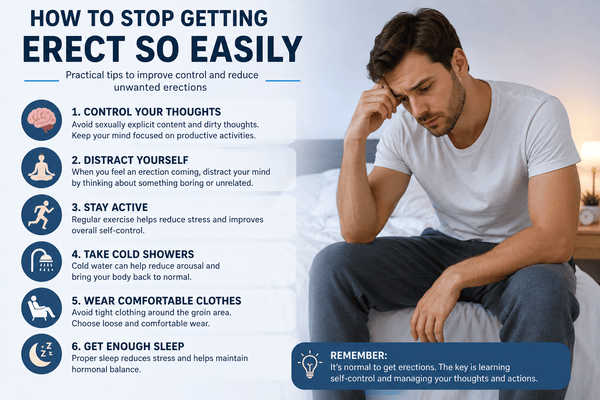
Spontaneous and unwanted erections are one of the most commonly experienced — and least talked about — aspects of male physiology, particularly during adolescence and young adulthood. They can appear in inconvenient situations: during a meeting, on public transport, or in a casual conversation, without any sexual stimulus or intention. For most men, this is a normal response of a healthy nervous system rather than a medical problem. However, the embarrassment and anxiety they cause are real and worth addressing with practical tools. This guide covers four methods for managing unwanted erections in the moment and reducing their how to stop getting erect so easily frequency over the long term — along with a clear explanation of when an erection pattern warrants medical attention.
Spontaneous (random) erections are a sign of healthy vascular and neurological function. The same nocturnal erection mechanism that occurs during REM sleep — producing 3 to 5 erections per night in healthy men — also generates daytime spontaneous erections in response to vibration, proximity, or even unrelated nerve stimulation. Their frequency naturally decreases with age as testosterone levels gradually decline from the late 20s onward.
Why Spontaneous Erections Happen
Spontaneous erections occur when the nervous system activates the erection mechanism without intentional sexual arousal. The most common triggers include:
- Vibration or pressure: Sitting on a vibrating surface (vehicle, train, bus), certain seating positions, or clothing pressure against the genital area can activate reflex erection pathways through the pudendal nerve.
- Hormonal cycles: Testosterone levels follow a diurnal (daily) rhythm, peaking in the early morning and remaining elevated through mid-morning. During high-testosterone windows, the threshold for spontaneous erection is lower.
- Emotional states: Heightened excitement, nervousness, or anxiety can activate the autonomic nervous system in ways that sometimes trigger erection — independent of sexual arousal.
- REM sleep carryover: Morning erections occur because the final REM sleep cycle produces an erection that has not fully subsided before how to stop getting erect so easily waking. This is the most common and clinically healthy form of unwanted erection.
- Adolescent hormonal activity: During puberty, surging testosterone and an extremely sensitive arousal threshold mean spontaneous erections are particularly frequent. This is entirely normal and gradually settles in the 20s.
- Heightened nerve sensitivity: Friction from clothing or bedding against genital skin can activate erection reflexes, particularly in younger men with high neural sensitivity.
When Unwanted Erections Are Normal vs When to Seek Help
Frequent spontaneous erections in adolescents and young men are a sign of healthy physiology, not a medical problem. They reflect good vascular function, healthy testosterone, and an intact nervous system.
However, certain patterns warrant medical evaluation:
- Priapism (erection lasting more than 4 hours): A painful erection that will not subside — unrelated to arousal — is a medical emergency. Ischemic Priapism causes oxygen deprivation in penile tissue within hours, potentially causing permanent damage. Go to an emergency room immediately. Do not wait.
- Persistent Genital Arousal Disorder (PGAD): An extremely rare condition characterised by persistent, unwanted genital arousal or erection sensation that is not related to desire and does not resolve after orgasm. PGAD causes significant distress and should be discussed with a doctor or sexual health specialist.
- Erections associated with pain: Any persistent pain accompanying erections — particularly curved or painful erections — should be evaluated. This can indicate Peyronie’s Disease (fibrous plaques in the corpus cavernosum) or other structural conditions.
- New pattern in an adult man with no prior history: If frequent spontaneous erections are new in a man who did not previously experience them, a hormonal evaluation (testosterone, prolactin) is appropriate.
Important: Morning erections (nocturnal penile tumescence) are a health indicator, not something to suppress. Their presence confirms that the vascular and neurological systems required for erection are intact. Men experiencing erectile dysfunction often find that the first improvement they notice is the return of morning erections. Do not attempt to consistently reduce morning erections — their occurrence is medically reassuring.
Method 1: Immediate Physical Techniques
When a spontaneous erection occurs in an inconvenient situation, these physical approaches can help resolve it within a few minutes by redirecting blood flow, changing nervous system state, or reducing reflex stimulation.
1. Light physical activity to redirect blood flow
Moving large muscle groups draws blood away from the pelvic area and into the working muscles, reducing genital blood flow. Simple, discreet movements work well:
- Walk briskly for 2 to 3 minutes — moving the legs engages the largest muscles in the body and reliably redirects circulation
- Climb stairs if available — stair climbing engages glutes, hamstrings, and quads simultaneously
- Perform standing stretches if privacy allows — gentle hamstring or quad stretches redirect blood flow to the legs
- Shift weight distribution — standing up from seated or changing position alters blood pooling patterns
2. Temperature therapy
Cold causes vasoconstriction (blood vessel narrowing), which reduces blood flow to the genitals. Warm water promotes parasympathetic relaxation, which shifts physiological state away from arousal.
Cold approaches:
- Apply a cold compress wrapped in cloth to the inner thighs for 30 to 60 seconds
- Cold shower if available — highly effective at resolving spontaneous erections quickly
- Hold something cold (a water bottle) against the back of the neck — the neck is highly temperature-responsive
Warm approaches:
- Splash warm water on the face and forearms — promotes relaxation of the arousal response
- Warm compress on the lower abdomen or thighs — calms physical tension without drawing attention
Never apply ice directly to skin or to genital areas — this can cause tissue damage. Always wrap cold items in cloth before contact with skin.
3. Muscle flexing to redirect blood flow
Contracting large muscle groups temporarily diverts blood from the pelvic area to the flexed muscles. This can be done discretely while sitting:
- Tense the thigh muscles firmly for 15 to 20 seconds, then release fully
- Repeat 3 to 4 times, focusing on the quads, hamstrings, and glutes
- Tighten the abdominal muscles simultaneously to engage the full lower body
- Maintain normal breathing throughout
This technique is effective because it can be performed while seated in any situation without being visible to others.
Method 2: Breathing and Mental Control
The nervous system controls erections through the autonomic pathway. Switching from sympathetic (arousal) to parasympathetic (calm) dominance via breathing and mental redirection can resolve an erection by changing the underlying physiological state. Research confirms that controlled breathing reduces physiological arousal — measured by heart rate, respiratory rate, and heart rate variability.
1. The 4-7-8 breathing technique
This specific pattern activates the parasympathetic nervous system, which counteracts arousal:
- Breathe in gently through the nose for a count of 4
- Hold the breath for a count of 7
- Exhale slowly through the mouth for a count of 8
- Repeat 4 to 6 cycles
The extended exhale phase is the key element — it activates the vagal brake, slowing heart rate and shifting the nervous system toward a calmer state. This technique works discreetly in any sitting position.
2. Thought redirection
Erections are maintained partly by mental engagement with arousal. Redirecting attention to unrelated, cognitively demanding material reduces the mental arousal component:
- Perform a mental arithmetic task — count backwards from 300 in steps of 7
- Recite complex information you have memorised — lyrics, sports statistics, capital cities
- Engage with a mentally absorbing problem relevant to your current context — a work challenge, a conversation topic
- Direct focused attention to specific non-arousing sensory details in your environment — colours, textures, sounds
The goal is to occupy working memory with content that crowds out the arousal signal. Actively redirecting attention when an arousing thought is first noticed is more effective than trying to suppress it after it has already built.
3. Mindfulness technique
For men who find erection anxiety compounds the problem (noticing it, becoming anxious, which delays resolution), non-judgmental acknowledgement is more effective than forced suppression:
- Acknowledge the sensation without attaching judgment or anxiety to it
- Shift attention gently to the breath — slow, even, diaphragmatic breathing
- Maintain awareness of the present environment without focusing on the erection specifically
- Allow the erection to resolve naturally as the nervous system calms
Research on mindfulness-based approaches confirms that non-judgmental awareness of physical sensations reduces their intensity and duration more effectively than anxious attempts to suppress them.
Method 3: Lifestyle Adjustments
For men who find spontaneous erections consistently problematic — particularly in adolescence and young adulthood — addressing the underlying physiological conditions that lower the erection threshold can reduce their frequency over time.
1. Optimise sleep quality
Testosterone levels are highest in the morning after adequate deep sleep. Poor sleep disrupts hormonal regulation, but it also disrupts the orderly cycling of nocturnal erections — which can result in more unpredictable daytime episodes.
- Aim for 7 to 9 hours of sleep per night with consistent bedtimes and wake times
- A cool, dark, screen-free bedroom environment supports deep sleep quality
- Avoiding caffeine after 2 PM and screens an hour before bed supports the onset of sleep
2. Manage stress effectively
Chronic stress elevates cortisol, which disrupts hormone balance and can paradoxically increase spontaneous arousal episodes in some men. Consistent stress management — daily meditation, yoga, journaling, physical exercise — reduces baseline cortisol and supports more predictable physiological responses.
- Daily mindfulness practice for 10 to 15 minutes reduces baseline physiological arousal
- Regular aerobic exercise reduces cortisol and improves hormonal regulation
- Social connection and adequate recovery time between stressful demands reduces chronic cortisol load
3. Clothing and seating adjustments
Practical environmental modifications reduce reflex stimulation from friction and pressure:
- Wear looser-fitting underwear and trousers — reduced friction against genital skin reduces reflex stimulation
- Choose seating positions that minimise perineal pressure on vibrating surfaces
- On long journeys by vibrating transport, stand up or shift position periodically
- Tighter fitting, supportive underwear can also help conceal erections when they do occur
4. Limit alcohol and maintain hydration
Alcohol disrupts hormonal regulation and nervous system function. While acute heavy drinking typically suppresses erections, alcohol’s hormonal effects at moderate-to-high regular intake can disrupt testosterone regulation in ways that affect arousal patterns. Adequate hydration supports consistent hormonal balance.
Method 4: Identify and Address Your Personal Triggers
Everyone’s pattern of spontaneous erection triggers is individual. Identifying your specific pattern allows for targeted prevention and preparation.
1. Track your pattern
Keep a brief mental or written log for two to three weeks:
- Time of day when episodes occur most frequently (morning is most common due to testosterone peak)
- Situations or environments where they occur (transport, meetings, certain social contexts)
- Emotional states at the time (anxious, excited, bored, fatigued)
- Physical factors (tight clothing, vibration, specific seating)
After two to three weeks, patterns typically become clear. Men who experience them primarily in the morning can adapt their schedule and clothing choices accordingly. Men who experience them in specific social contexts can prepare their preferred management technique in advance.
2. Prepare in advance for predictable situations
Once triggers are identified, prevention becomes more achievable:
- Choose clothing appropriate to high-risk situations — looser fit or darker colours that conceal better
- Practise your preferred management technique so it is automatic when needed
- Position yourself where a brief movement (standing, shifting) is easily possible
- Carry something cold (water bottle) if temperature therapy is your preferred approach
3. Seek professional guidance for significant distress
If spontaneous erections are causing significant anxiety, social avoidance, or distress despite consistent management efforts, a brief consultation with a GP, urologist, or sex therapist is appropriate. Professional assessment can rule out any underlying hormonal or neurological pattern and, where appropriate, discuss options including behavioural therapy.
Conclusion
Spontaneous and unwanted erections are a normal aspect of male physiology — particularly in adolescence and young adulthood — that reflect healthy vascular and neurological function rather than a medical problem. Their frequency naturally decreases over time as testosterone levels gradually decline from the late 20s. For men who find them socially disruptive in the interim, a combination of immediate techniques (physical redirection, breathing, thought control) and longer-term strategies (sleep, stress, clothing, trigger identification) provides reliable tools for management.
The distinction worth maintaining: spontaneous erections are signs of health, not problems to be eliminated. Morning erections in particular are a health indicator for vascular and neurological function. The goal is management in inconvenient moments — not suppression of a healthy physiological response. If the pattern causes significant distress or includes any painful, prolonged, or non-subsiding erections, medical evaluation is the appropriate next step.
Frequently Asked Questions
-
What causes frequent or unwanted erections?
Frequent or unwanted erections are most commonly caused by hormonal activity (testosterone peaks in the morning), reflex stimulation from vibration or clothing friction, emotional states (excitement, anxiety), and the natural carryover of nocturnal erections that occur during REM sleep. In adolescent and young adult men, surging testosterone how to stop getting erect so easily significantly lowers the threshold for spontaneous erection. This is normal and a sign of healthy sexual function. Frequency naturally decreases with age.
-
Is it normal to have frequent erections throughout the day?
Yes — frequent spontaneous erections are normal, particularly in men under 25. A healthy man typically has 3 to 5 erections during sleep each night and may have several during the day as a result of vibration, positional pressure, excitement, or hormonal peaks. These are painless and brief. Frequency naturally reduces with age as testosterone gradually declines from the late 20s onward. If an erection is painful, prolonged (over 4 hours), or persistent without arousal, seek medical evaluation.
-
How can I reduce morning erections?
Morning erections are a healthy physiological sign — they reflect normal vascular and neurological function and are not something to suppress. They occur during the final REM sleep cycle and are related to the overnight testosterone surge. They typically resolve within a few minutes of waking and moving. If a morning erection is causing discomfort, voiding the bladder upon waking (which reduces pudendal nerve pressure) and getting up and moving are the most natural ways to allow it to resolve. Attempting to chronically suppress morning erections would require interventions that could also impair healthy erectile function.
-
At what age do erections start?
Erections can occur even before birth — reflexive erections in male fetuses have been documented by ultrasound, driven by basic nerve reflexes rather than hormones. They are common in infants and young children for the same reflexive reasons. During puberty — typically between ages 9 and 13 — surging testosterone causes erections to become frequent and sometimes unexpected. By the late teens to mid-20s, the frequency of spontaneous erections typically begins to reduce as the hormonal system matures and testosterone peaks stabilise.
-
When should I see a doctor about erections?
See a doctor if: any erection lasts more than 4 hours without arousal and without subsiding — this is Priapism and a medical emergency requiring immediate care; if erections are consistently painful or curved; if you experience new onset of persistent unwanted arousal sensations unrelated to sexual desire (which may indicate Persistent Genital Arousal Disorder); or if the frequency of spontaneous erections is causing significant anxiety, social avoidance, or distress that management techniques are not addressing.
This article is for general informational purposes only and does not constitute medical advice. Spontaneous erections are generally a sign of healthy physiological function. If you are concerned about erection frequency, pain, or persistence, consult a qualified healthcare provider.
