
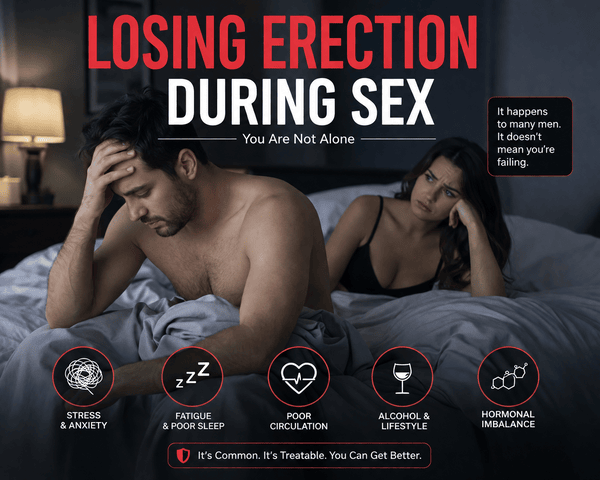
Losing an erection during sex is one of the most common — and most quietly distressing — experiences in men’s sexual health. It happens to men of all ages, in all kinds of relationships, and in the large majority of cases it has a clear, identifiable cause that can be addressed. Occasional erection loss during sex is normal and does not indicate a medical problem. When it happens consistently or repeatedly, it warrants understanding and, where appropriate, medical attention. This article explains why erections are lost during sex, how to distinguish occasional normal variation from a pattern that needs attention, the physical and psychological causes behind it, and the most effective in-the-moment and longer-term strategies for taking back control.
Losing an erection during sex affects men of all ages, but the cause profile differs by age. In men under 40, the cause is more frequently psychological — performance anxiety, stress, or relationship factors. In men over 50, vascular and hormonal causes become more common. Recognising which pattern applies to you helps direct the most effective response.
Why Erections Are Lost — the Physiology
Understanding the mechanics of erection loss makes it far less alarming. An erection is maintained by a continuous physiological process:
- Sexual arousal triggers Nitric Oxide (NO) release in the penis from nerve endings and blood vessel lining
- Nitric Oxide activates cGMP, which relaxes smooth muscle in penile blood vessels
- Relaxed smooth muscle allows blood to fill the corpus cavernosum, and drainage veins are compressed — maintaining rigidity
- The PDE5 enzyme continuously works to break down cGMP. Erection depends on the arousal signal (cGMP production) outpacing PDE5 breakdown
This process requires continuous sexual stimulation, mental arousal, and unimpaired blood flow. When any of these elements is disrupted — by a thought, a pause in stimulation, anxiety, a positional change, or fatigue — the erection can subside. This is not failure; it is normal physiology. Erections are not a switch that stays on; they are a continuous process that responds to the conditions.
Is It Normal to Lose an Erection During Sex?
Yes — occasional erection loss during sex is entirely normal. Almost all men experience it at some point, across all ages. A pause in stimulation, a moment of distraction, repositioning, a sudden anxious thought, or mild fatigue can all cause a temporary loss of erection. In the majority of cases, the erection returns with renewed stimulation and the right conditions.
The clinical concern arises when erection loss during sex:
- Happens consistently across most or all sexual encounters over several weeks
- Occurs even with adequate stimulation and no obvious cause
- Is accompanied by loss of morning erections (suggesting a physical rather than situational cause)
- Is causing significant personal distress, anxiety, or avoidance of intimacy
The ‘one in four encounters’ rule offers a useful informal threshold — if difficulty maintaining an erection occurs in fewer than 25% of sexual attempts and has no consistent pattern, it is likely within the range of normal variation. Consistent difficulty above this level warrants evaluation.
Common Reasons for Losing Erection During Sex
- Performance anxiety: The fear of losing the erection becomes the cause of losing it. Anxiety activates the sympathetic nervous system (fight-or-flight), which directly opposes the parasympathetic state required for erection. This is the most common psychological cause in men of all ages, particularly pronounced with new partners or after a first experience of erection loss.
- Insufficient or interrupted stimulation: Erections require sustained arousal. If the arousal signal weakens — because stimulation pauses, the sexual activity feels less engaging, or mental attention drifts — the erection will subside. This is physiology, not failure.
- Positional change: When changing positions during sex, there is often a brief interruption in stimulation and a change in blood distribution. Some positions redirect blood flow away from the pelvis, and some require physical effort that can reduce arousal focus. This is a common and overlooked cause of erection loss during sex.
- Mental distraction: Intrusive thoughts — about work, finances, body image, or performance — redirect attention away from arousal. The erection depends on continuous mental engagement; distraction disrupts the signal.
- Condom use: Some men experience erection loss when applying a condom, due to the interruption in stimulation, the physical sensation of the condom, or anxiety about the condom reducing pleasure. This is common and manageable — see strategies below.
- Fatigue or illness: Tiredness significantly reduces both testosterone and the nervous system’s responsiveness to arousal. Being physically exhausted or unwell reliably reduces erection quality and sustainability.
- Alcohol: More than 2 to 3 standard drinks suppresses the CNS arousal signal and reduces erection firmness — ‘whisky dick.’ Alcohol-related erection loss during sex is dose-dependent and extremely common.
Physical Causes of Losing Erections
When erection loss during sex is consistent, occurs even with adequate arousal, and has been present over several weeks, a physical cause is more likely. The most common physical causes:
- Cardiovascular disease and poor circulation: The penile arteries are small and show the effects of atherosclerosis earlier than larger vessels. Reduced arterial blood flow means insufficient blood enters the corpus cavernosum, and the erection is difficult to sustain.
- Hypertension (high blood pressure): Damages the endothelial lining of blood vessels, reducing Nitric Oxide production and arterial flexibility.
- Diabetes: Causes both vascular damage (reducing blood flow) and peripheral neuropathy (damaging the nerve signals required for erection). ED affects 35 to 50% of men with Diabetes.
- Low testosterone: Reduces libido and the neurological arousal response. Men with low testosterone alongside erection problems often describe ‘not feeling interested’ as much as
- Medications: SSRIs and SNRIs (antidepressants), beta-blockers, thiazide diuretics, opioids, and some antipsychotics can all impair erection quality. If erection loss began after starting a new medication, the medication is likely a contributor.
- Venous leakage: In some men, the venous compression mechanism that traps blood in the penis during erection is insufficient. Blood drains too quickly, making it difficult to maintain firmness regardless of arousal.
- Peyronie’s Disease: Fibrous plaques inside the corpus cavernosum can distort the veno-occlusive mechanism and cause pain during erection, both of which can lead to erection loss during intercourse.
Psychological Causes of Losing Erections
In men under 40, psychological causes account for the majority of consistent erection loss during sex. The key diagnostic clue: if morning erections are normal but erections are lost specifically during partnered sexual activity, the mechanism is more likely psychological than vascular.
- Performance anxiety: The self-reinforcing cycle — anxiety about losing the erection triggers the very loss being feared. This is one of the most common sexual health problems in younger men.
- Depression and chronic stress: Depression reduces dopamine signalling, which is involved in arousal initiation. Chronic cortisol elevation from stress suppresses testosterone and the parasympathetic nervous system.
- Relationship difficulties: Unresolved conflict, emotional distance, or reduced attraction can suppress arousal during partnered activity even when desire exists in other contexts.
- Body image concerns: Negative self-perception during intimate moments redirects attention away from arousal and toward self-monitoring, which reduces the arousal signal.
- Past negative sexual experiences: A previous episode of erection loss can create anticipatory anxiety that perpetuates the pattern — even when the original cause has resolved.
In-the-Moment Strategies to Stop Losing Erections
These approaches can be implemented during sexual activity to reduce erection loss in the moment.
- Stay present — focus on sensation, not performance: Redirect mental attention to physical sensation — what you are feeling, hearing, and experiencing — rather than monitoring whether you are hard enough. Performance monitoring activates the sympathetic system; sensory focus activates the parasympathetic system.
- Communicate rather than withdraw: If you feel an erection beginning to fade, saying something rather than panicking allows both partners to adapt without the moment collapsing. A brief, warm comment reduces pressure significantly more than silent anxiety.
- Resume stimulation or foreplay: Erections usually return with renewed stimulation. Transitioning back to foreplay briefly — without treating it as a failure — allows arousal to rebuild naturally.
- The start-stop technique: Practise pausing just before the point where arousal would peak, then allowing intensity to settle slightly before resuming. This builds familiarity with the arousal cycle and reduces the likelihood of sudden erection loss from overstimulation.
- Choose positions that maintain stimulation: Positions that keep the penis stimulated throughout (rather than requiring constant manual adjustment) reduce erection loss from stimulation interruption. Positions where your partner is more active can also reduce performance pressure.
- Condom strategy: If condom-related erection loss is the issue: keep the condom ready but don’t apply it mid-peak-arousal; maintain stimulation from your partner during application; consider internal condoms as an alternative; or apply the condom during foreplay as a practised, desensitised routine rather than a clinical pause.
- Limit alcohol on evenings where erection quality matters: More than 1 to 2 standard drinks consistently impairs erection sustainability. This is one of the most controllable and most impactful variables.
Lifestyle Changes That Help
For men with recurring erection loss during sex, lifestyle factors are among the most modifiable contributors:
- Regular aerobic exercise: Improves endothelial function, Nitric Oxide production, and cardiovascular fitness — all directly relevant to sustained erection. 150 minutes of moderate aerobic activity weekly is the evidence-based minimum.
- Mediterranean-pattern diet: A 2016 Harvard study found a 19% lower ED risk with high flavonoid intake. Nitrate-rich foods (leafy greens, beetroot), omega-3s, and antioxidant-rich fruits support vascular and erectile health.
- Adequate sleep: Testosterone is produced during deep sleep. Men consistently sleeping fewer than 6 hours show measurably lower testosterone and higher rates of ED.
- Maintain a healthy weight: Abdominal fat promotes testosterone-to-oestrogen conversion through aromatisation, reducing testosterone and sexual drive.
- Stop smoking: Smoking depletes Nitric Oxide and damages arterial walls. Erection quality measurably improves within 2 to 4 weeks of stopping.
Partner Communication — an Underrated Strategy
This section is absent from the original article but is consistently ranked by sex therapists and urologists as one of the most effective interventions for erection loss during sex.
Most erection loss during sex — particularly the kind driven by anxiety and pressure — occurs in the context of perceived expectations. When partners discuss openly what they enjoy, what pressure feels like, and how they want to handle moments when erections subside, the erection loss itself becomes far less loaded. The moment stops being a ‘failure’ and becomes just a pause.
- Discuss outside the bedroom — not immediately after erection loss — how you each experience intimacy and what would reduce pressure
- Agree on a response to erection loss: returning to foreplay, taking a break, or continuing non-penetrative intimacy — so there is no ambiguity in the moment
- Express desire and attraction verbally — this reduces the performance anxiety that partners often inadvertently trigger by being too quiet during moments of erection loss
- Consider couples sex therapy if communication about erection loss consistently leads to tension or withdrawal
Medical Treatments for Persistent Erection Loss
When lifestyle changes, in-the-moment strategies, and communication are insufficient — or where a physical or hormonal cause has been identified — medical treatment is appropriate and highly effective for most men.
- PDE5 inhibitors (first-line): Sildenafil (Viagra), Tadalafil (Cialis), Vardenafil (Levitra), and Avanafil (Stendra) work by blocking PDE5, allowing cGMP to remain elevated longer during arousal — making erections easier to achieve and sustain. They require sexual stimulation to work. They are contraindicated with nitrate medicines. All require a valid prescription.
- Testosterone replacement therapy: For men with confirmed low testosterone alongside persistent erection loss and reduced libido. Not appropriate for men with normal testosterone levels.
- Psychosexual therapy or CBT: Highly effective where the primary cause is performance anxiety, psychological, or relational. Often more effective than medication alone for psychogenic erection loss. Both individual and couples formats are available.
- Second-line treatments: For men who don’t respond to PDE5 inhibitors: injectable alprostadil (directly into the corpus cavernosum), vacuum erection devices, or low-intensity shockwave therapy (emerging, evidence-based for vasculogenic ED).
Note: Natural supplements marketed for erection improvement include L-arginine, ginseng (Panax ginseng), and others. L-arginine at clinical doses (3 to 5 g/day) has some evidence for mild ED. Panax ginseng has the most consistent evidence among herbal options, with modest but consistent results across meta-analyses. Evidence for most other marketed supplements — including icariin (horny goat weed) — is preliminary and based primarily on animal studies. Always consult a doctor before taking any supplement, particularly if you are on prescription medicines.
Kegel Exercises — How to Do Them
Kegel exercises strengthen the pelvic floor muscles that help maintain erection firmness by compressing the drainage veins during erection. A 2005 study in BJU International found pelvic floor rehabilitation restored normal erectile function in 40% of men with ED and significantly improved a further 35%.
How to do Kegels:
- Identify the correct muscles: stop urination midstream — those muscles are your pelvic floor
- Contract and hold for 3 to 5 seconds
- Relax completely for 3 to 5 seconds
- Repeat 10 to 15 times per set, 3 sets daily
- Progress to 10-second holds as strength improves over 4 to 6 weeks
- Can be done lying, sitting, or standing — anywhere, at any time
Results typically build over 4 to 6 weeks of consistent daily practice, with full benefit at 3 to 6 months.
When to See a Doctor
- Erection loss during sex is consistent across most encounters over several weeks
- It is accompanied by absent or significantly reduced morning erections
- It began suddenly — which can signal a new medication side effect, hormonal change, or cardiovascular event
- It is accompanied by reduced sexual desire, fatigue, or mood changes
- It is causing significant anxiety, avoidance of intimacy, or relationship tension
- You are under 50 and the pattern is consistent — cardiovascular screening alongside ED assessment is clinically appropriate, since ED can precede heart disease by 3 to 5 years in younger men
Conclusion
Losing an erection during sex is common, often temporary, and almost always has an identifiable and addressable cause. For most men, the cause is psychological — performance anxiety, stress, or mental distraction — particularly when morning erections are preserved. For men with consistent erection loss alongside physical risk factors or absent morning erections, a vascular, hormonal, or medication-related cause is more likely and warrants medical evaluation.
In-the-moment strategies — staying present, resuming stimulation, communicating calmly — address the immediate situation. Lifestyle changes, pelvic floor exercises, and partner communication address the pattern over weeks and months. Where these are insufficient, PDE5 inhibitors are the evidence-based first-line medical option, and psychosexual therapy is highly effective for the psychological dimension. The key is identifying which type of cause is driving the pattern — and then addressing it directly.
Frequently Asked Questions
- Does losing an erection during sex mean I have Erectile Dysfunction?
Not necessarily. Occasional erection loss during sex is normal and does not indicate Erectile Dysfunction. ED is diagnosed when difficulty achieving or maintaining an erection occurs in more than approximately 25% of sexual attempts, consistently over several weeks, and causes personal distress. If erection loss during sex happens occasionally without a clear pattern, it is most likely within the range of normal variation. Consistent difficulty warrants medical evaluation.
- Does sleep affect erections?
Yes, significantly. Testosterone is produced primarily during deep sleep, and nocturnal erections during REM sleep serve a physiological tissue-maintenance function. Research shows that men sleeping fewer than 5 hours per night have significantly lower testosterone than those sleeping 7 to 9 hours, with the difference appearing within one week of sleep restriction. Chronic sleep deprivation also raises cortisol, which suppresses testosterone and the arousal response. Aim for 7 to 9 hours of quality sleep per night.
- Can dehydration cause erection loss during sex?
Yes. Dehydration reduces blood volume, which reduces the pressure and flow available to fill the corpus cavernosum during erection. It also reduces energy and cognitive focus, both of which support arousal. Staying well-hydrated throughout the day — approximately 2 litres of water — is a simple and often overlooked factor in erection quality, particularly during physical activity like sex.
- Do Kegel exercises help with losing erections during sex?
Yes — there is solid clinical evidence. Kegel exercises strengthen the bulbocavernosus and ischiocavernosus muscles of the pelvic floor, which help compress the drainage veins and maintain blood inside the corpus cavernosum during erection. A 2005 BJU International study found pelvic floor rehabilitation restored normal erectile function in 40% of men with ED and significantly improved a further 35%. Kegels should be done daily (3 sets of 10 to 15 contractions) with consistent progression over 4 to 6 weeks.
- Why does my erection go away when I put on a condom?
Condom-related erection loss is extremely common and has two main causes: the interruption in stimulation during application, and anxiety about the condom reducing sensation or performance. Solutions: practise condom application as a desensitised routine rather than a high-stakes pause; keep stimulation going from a partner during application; apply the condom at high arousal rather than waiting; or consider internal condoms. If condom anxiety is the primary issue, discussing it openly with your partner significantly reduces the pressure that drives the erection loss.
This article is for general informational purposes only and does not constitute medical advice. If you are experiencing persistent erection loss during sex, consult a qualified healthcare provider for a proper diagnosis and treatment plan.
