
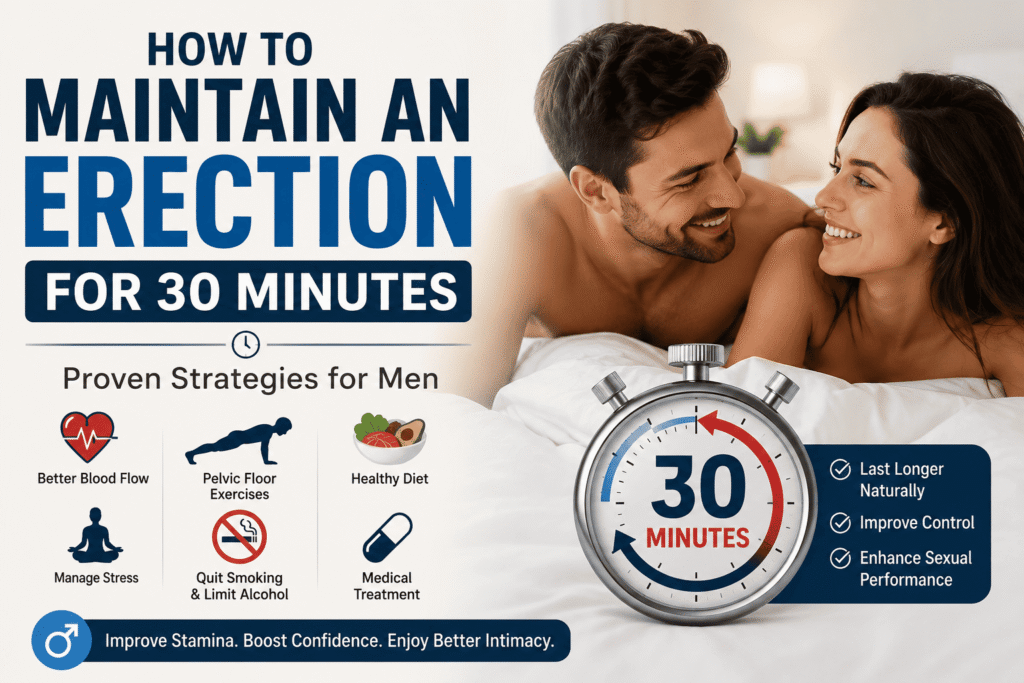
If you are looking for ways to maintain an erection for 30 minutes, you are asking one of the most searched questions in men’s sexual health — and the strategies that genuinely work are both broader and more practical than most guides suggest. Maintaining a long-lasting erection depends on blood flow, nerve signals, hormonal balance, psychological state, pelvic floor muscle strength, and lifestyle habits all working together. The good news is that every one of these is improvable. This article covers the evidence-based methods to maintain an erection longer — including both in-the-moment techniques and longer-term lifestyle and medical approaches — along with honest expectations for how long each approach takes to make a difference.
First: Setting Realistic Expectations About Erection Duration
Before covering how to maintain an erection for 30 minutes, it is worth putting 30 minutes in context — because unrealistic expectations are themselves one of the most common causes of erection problems.
Research on intravaginal ejaculation latency time (IELT) — the time between penetration and ejaculation — finds that the average is approximately 3 to 7 minutes for most men, not 30 minutes. A 2005 study in the Journal of Sexual Medicine involving 500 couples found a median of 5.4 minutes. Some couples have highly satisfying sex lives with penetrative intercourse lasting well under 10 minutes.
This does not mean 30 minutes is impossible or unreasonable as a personal goal — it simply means that the goal is better framed as ‘I want better erection control and stamina’ than ‘I am failing because I do not last 30 minutes.’ Performance anxiety driven by unrealistic comparisons is a common and significant cause of erection problems in younger men.
A 2005 study published in the Journal of Sexual Medicine measured the duration of penetrative sex in 500 heterosexual couples across five countries using a stopwatch over four weeks. The median intravaginal ejaculation latency time was 5.4 minutes, with a range from 0.55 to 44.1 minutes. Most sex therapists consider 3 to 7 minutes of penetration normal and 7 to 13 minutes ‘desirable.’
In-the-Moment Techniques to Maintain an Erection Longer
These strategies can be applied during sexual activity itself and do not require any prior treatment or preparation. They are often overlooked in favour of medication but can be highly effective, particularly when erection loss is related to arousal fluctuation or performance anxiety rather than vascular disease.
The start-stop method
The start-stop technique is a straightforward approach to maintaining an erection and building stamina over time. When you feel arousal or excitement building strongly — either toward ejaculation or simply at a high peak — you pause stimulation briefly, allow the intensity to reduce slightly, then resume. This gives the erection a chance to stabilise rather than peaking and subsiding rapidly.
Practised consistently — both during solo activity and with a partner — the start-stop method helps men develop better awareness and control of their arousal cycle. Many sex therapists recommend it as a first-line behavioural approach alongside or before medication.
Extend and prioritise foreplay
One of the most practical ways to maintain an erection for 30 minutes is to redistribute time within sexual activity rather than trying to extend penetration itself. Extended foreplay builds arousal gradually, ensures both partners are fully engaged, and gives the erectile mechanism time to operate at its peak before penetration begins.
Men who lose erections during penetration often find that the problem is not the erection itself but the shift from a highly arousing activity (foreplay) to one that may feel less stimulating. Maintaining arousal through varied stimulation — including manual, oral, and erotic communication — extends the effective sexual window without requiring the erection to be sustained continuously.
Adjust position and reduce distraction
Certain sexual positions create more physical stimulation and blood flow to the penis than others. Positions where the man is less weight-bearing (such as lying on his back or side-lying) reduce physical fatigue and allow more focus on arousal. Positions with more direct penile stimulation help maintain the arousal signal the erection depends on.
Mental distraction is one of the most common in-the-moment causes of erection loss. Thoughts about performance (‘Am I lasting long enough?’, ‘Am I getting soft?’) directly suppress the arousal signal. Focusing attention on physical sensation rather than performance outcome is easier said than done but is consistently supported by sex therapy research as an effective approach.
Stay warm and hydrated
Cold temperatures cause blood vessels to constrict, including the penile arteries, which can reduce erection quality. Ensuring the environment is warm supports blood flow. Dehydration reduces circulating blood volume and can noticeably impair erection firmness. Drinking adequate water before sexual activity is a simple and overlooked practical step.
Pelvic Floor (Kegel) Exercises for Erections
Pelvic floor exercises — commonly called Kegels — are one of the most evidence-based non-medical interventions for erection quality, yet they are widely associated only with women. The pelvic floor muscles, particularly the bulbocavernosus muscle, play a direct role in trapping blood inside the penis during an erection and controlling ejaculation timing.
A 2005 study published in BJU International found that pelvic floor rehabilitation — including Kegel exercises — restored normal erectile function in 40% of men with ED and significantly improved function in a further 35%, outperforming lifestyle changes alone.
How to do Kegel exercises for men
The correct muscles are those used to stop urination midstream or to prevent passing wind. To identify them: during urination, briefly stop the flow, then release. The muscles you contracted are the pelvic floor muscles.
- Contract these muscles and hold for 3 to 5 seconds.
- Relax completely for 3 to 5 seconds.
- Repeat 10 to 15 times per set.
- Complete 3 sets daily.
- Progress to 10-second holds as strength improves.
Kegels can be done anywhere — lying, sitting, or standing — and should not involve holding the breath, squeezing the buttocks, or tightening the abdomen. Results typically build over 4 to 6 weeks of consistent daily practice.
Diet: Foods That Help Maintain an Erection
Diet affects erection quality through two main pathways: cardiovascular health (maintaining healthy blood vessel function and flow) and Nitric Oxide production (the chemical that starts the erection process). A 2021 study published in Nutrients found a significant association between a Mediterranean-style diet and lower ED incidence across multiple large population studies.
Foods that support erection quality
- Dark leafy greens (spinach, rocket, kale): High in dietary nitrates, which the body converts to Nitric Oxide — the same molecule that initiates the erection mechanism. Spinach in particular has among the highest nitrate content of any food.
- Watermelon: Contains L-citrulline, an amino acid the body converts to L-arginine and then to Nitric Oxide. Some researchers describe it as a mild natural vasodilator.
- Beetroot: One of the richest dietary sources of Nitric Oxide precursors. Beetroot juice has been studied for athletic performance improvement through exactly the same vascular mechanism that supports erections.
- Fatty fish (salmon, mackerel, sardines): High in omega-3 fatty acids that reduce inflammation and support endothelial function — the inner lining of blood vessels critical for Nitric Oxide production.
- Pomegranate juice: Some small studies suggest pomegranate’s antioxidant content may protect Nitric Oxide from being broken down by free radicals, potentially extending its vascular activity.
- Nuts, particularly pistachios: A 2011 study in the International Journal of Impotence Research found that men who ate 100 g of pistachios daily for 3 weeks showed significant improvement in erectile function and cholesterol profiles.
- Dark chocolate (70%+ cocoa): Contains flavanols that stimulate Nitric Oxide production and support blood vessel flexibility.
Foods to reduce or avoid
- Processed meats and trans fats — promote arterial inflammation
- High-sugar foods and refined carbohydrates — worsen insulin resistance and vascular function
- Excessive salt — raises blood pressure, damaging arterial walls over time
- Heavy alcohol — see below
Regular Exercise and Cardiovascular Health
Regular aerobic exercise is one of the most evidence-based interventions for erection quality, independent of medication. It improves endothelial function, increases Nitric Oxide availability, lowers blood pressure and cholesterol, reduces body fat, and raises testosterone — all of which directly support erections.
A meta-analysis published in Sexual Medicine Reviews (2018) found that aerobic exercise significantly improved erectile function in men with ED related to cardiovascular risk factors, with the greatest benefit in men with moderate to severe ED. The effective dose in most studies was 40 minutes of moderate-to-vigorous aerobic exercise four times per week.
- Most effective exercise types: Brisk walking, jogging, cycling, swimming, and rowing. Aim for at least 150 minutes per week of moderate aerobic activity.
- Timeline: Men who start regular aerobic exercise often notice improvements in erection quality within 4 to 6 weeks. Greater changes accumulate over 3 to 6 months.
- Resistance training: Also beneficial, particularly for testosterone support. However, excessive high-intensity training without adequate recovery can raise cortisol and temporarily suppress testosterone and libido.
- Caution with cycling: Long-duration cycling on a hard narrow saddle can compress the perineal blood vessels, temporarily impairing blood flow to the penis. Use a well-padded saddle and take regular standing breaks if cycling frequently.
Quit Smoking and Limit Alcohol
Smoking
Smoking is one of the most directly damaging lifestyle factors for erectile function. It damages endothelial cells — the inner lining of blood vessels — and reduces Nitric Oxide bioavailability, impairing the very mechanism that produces erections. A meta-analysis in the American Journal of Epidemiology found that current smokers had a 51% higher risk of ED compared with non-smokers.
The encouraging news: research consistently shows that erection quality improves after quitting smoking, with measurable improvement in endothelial function within weeks of cessation. Men who stop smoking report improvements in erection firmness within 2 to 4 weeks in some studies.
Alcohol
Acute heavy alcohol consumption directly impairs the nerve signals and arousal pathways required for erection — hence the well-known phenomenon of ‘whisky dick.’ More than 2 to 3 standard drinks significantly reduces erection firmness and reliability. Chronic heavy drinking causes vascular and nerve damage and lowers testosterone, producing long-term ED.
One to two standard drinks is generally considered manageable for most men. On evenings when erection quality matters, limiting alcohol to this level or avoiding it entirely makes a measurable practical difference.
Testosterone Monitoring
Testosterone does not directly produce erections, but it supports the entire system that does — libido, arousal response, energy, mood, and penile tissue health. Low testosterone (hypogonadism) reduces sexual desire and makes the arousal signal weaker, which in turn makes erections less reliable and less sustained.
Men who notice reduced libido alongside erection problems — rather than erection problems without reduced desire — are more likely to have a testosterone component to their difficulty. Testing is a morning serum testosterone blood test; low testosterone requires medical evaluation and, where confirmed and symptomatic, can be addressed through TRT or other approaches under medical supervision.
Natural testosterone support includes adequate sleep (testosterone is primarily produced during deep sleep), resistance training, maintaining a healthy weight, and managing chronic stress — all of which are independently beneficial for erection quality.
Stress and Psychological Management
The brain is the most important sexual organ — and psychological factors are among the most common causes of erection problems, particularly in younger men. Stress raises cortisol, which suppresses both testosterone and the arousal signal required for erections. Performance anxiety creates a self-reinforcing cycle: worrying about losing an erection increases sympathetic nervous system activity (fight-or-flight), which physically prevents the parasympathetic (rest-and-digest) state required for erections.
- Mindfulness and meditation: Reduce cortisol and sympathetic nervous system arousal. Several studies show mindfulness-based interventions improve sexual satisfaction and erection quality, particularly in men with psychogenic ED.
- Deep breathing: Activates the parasympathetic nervous system during sexual activity, counteracting anxiety-driven erection loss. Simple 4-count inhale, 4-count hold, 4-count exhale cycles can be practised both before and during intimacy.
- Cognitive behavioural therapy (CBT): For men whose erection problems are primarily driven by anxiety, depression, or relationship stress, CBT or psychosexual counselling often produces better long-term results than medication alone.
- Treat underlying mental health: Untreated Depression and anxiety are major suppressors of libido and erection quality. Treating them — though some antidepressants themselves can affect erectile function — generally improves sexual well-being.
Talk to Your Partner
Open communication with a partner is one of the most consistently underrated strategies for maintaining erections longer. Performance anxiety is dramatically reduced when both partners share the same expectations and are comfortable expressing what feels good, when to pause, and when pace or approach might shift.
Men who feel pressure to perform — whether because of perceived expectations or their own comparison to unrealistic standards — are significantly more likely to experience erection loss than men in communicative, low-pressure sexual relationships. Discussing the desire to extend intimacy, what both partners enjoy most, and removing the goal-oriented pressure from sex are not ‘soft’ approaches — they are among the most effective behavioural interventions available.
If erection problems are creating tension or distance in a relationship, couples sex therapy offers a structured, evidence-based approach that works on both the physical and relational dimensions simultaneously.
Medical Treatment: Prescription ED Medicines
For men where lifestyle changes and behavioural techniques are not sufficient — or where an underlying vascular or hormonal cause requires direct medical treatment — prescription PDE5 inhibitors are the evidence-based first-line medical option. They extend the window during which arousal can produce and sustain an erection by blocking the enzyme that breaks down cGMP, the chemical signal that keeps penile smooth muscle relaxed and blood flowing in.
- Sildenafil (Viagra): Works within 30–60 minutes, lasts 4–6 hours. Most affordable, most studied.
- Tadalafil (Cialis): Works within 30 minutes to 2 hours, lasts up to 36 hours. Available as once-daily low dose for continuous benefit.
- Vardenafil (Levitra): Works within 30–60 minutes, lasts 4–5 hours.
- Avanafil (Stendra): Fastest onset — as early as 15 minutes, lasts up to 6 hours.
All require a prescription and sexual stimulation to work. None are appropriate combined with nitrate medicines for chest pain. A doctor can advise which is most suitable based on your health history and other medicines.
Important: Prescription ED medicines treat the symptom — they help you achieve and maintain an erection within the dose window. They do not address the underlying cause of erection problems. A persistent inability to maintain erections, particularly in men under 60, warrants a medical evaluation that includes cardiovascular screening — erection difficulties can be the first sign of vascular disease appearing years before a cardiac diagnosis.
Supplements for Erection — Honest Assessment
Several supplements are marketed for erection quality. Some have modest supporting evidence for specific mechanisms; none have the evidence base of prescription PDE5 inhibitors. The honest position is that supplements may support overall vascular and hormonal health as part of a broader lifestyle approach, but should not be relied upon in place of medical evaluation for persistent ED.
- L-arginine (3–5 g/day): Converts to Nitric Oxide in the body. Some studies show modest benefit for mild ED, particularly combined with Pycnogenol. Typical supplement doses are often lower than those studied.
- L-citrulline: Converts to L-arginine more efficiently than supplemental L-arginine itself. Found naturally in watermelon.
- Panax Ginseng (Red Ginseng): The most studied herbal option for ED. Multiple meta-analyses show modest but consistent benefit. 200–600 mg/day in standardised extract form.
- Pycnogenol (French maritime pine bark extract): Used in combination with L-arginine in several studies with positive results for erectile function.
Supplements are not FDA-approved to treat Erectile Dysfunction. Their quality, dose accuracy, and safety vary by product. Always inform your doctor about any supplement you take, as some interact with prescription medicines.
How Long Does Each Method Take to Work?
This is absent from the original article and most competitors — and it is one of the most practically useful things to know. Unrealistic timelines lead men to abandon effective strategies too early.
- Prescription ED medicines (Sildenafil, Tadalafil etc.): Work within 15–60 minutes of a single dose. Immediate effect in the dose window.
- Stopping smoking: Endothelial function improvements begin within 2–4 weeks; meaningful erection improvement often reported within 1–3 months.
- Aerobic exercise: First improvements in erection quality typically noticed within 4–6 weeks; greater changes over 3–6 months.
- Kegel exercises: Strength and control improvement begins at 4–6 weeks of consistent daily practice; full benefit at 3–6 months.
- Diet changes: Nitrate-rich foods can increase Nitric Oxide within hours of eating them. Longer-term vascular improvement builds over weeks to months.
- Reducing alcohol: Acute improvement possible within days of reducing consumption; long-term vascular benefit over weeks to months.
- Stress management and therapy: Psychosexual therapy typically shows meaningful improvement within 4–12 sessions; mindfulness practice over 4–8 weeks.
- Testosterone treatment (where clinically indicated): Testosterone levels normalise within weeks of treatment; libido and erection improvements typically emerge over 3–6 months.
When to See a Doctor
Occasional difficulty maintaining an erection is normal and does not require medical attention. The following situations do warrant a doctor’s evaluation:
- Persistent difficulty maintaining erections over several weeks that does not improve with lifestyle changes
- Sudden onset of ED — particularly in a man without previous erection problems — which can signal cardiovascular, hormonal, or neurological disease
- ED in a man under 50 without an obvious psychological cause
- ED accompanied by reduced libido, fatigue, or mood changes — which may indicate low testosterone
- Painful erections, or an erection lasting more than 4 hours that will not subside (Priapism — go to an emergency room immediately)
Conclusion
Knowing how to maintain an erection for 30 minutes is less about achieving a specific time target and more about supporting the physical, psychological, and lifestyle conditions that allow erections to be firm, reliable, and sustained. The most effective approaches work together rather than in isolation: cardiovascular exercise and a Nitric Oxide-supporting diet address the vascular foundation; Kegel exercises directly strengthen the mechanism that traps blood during erection; stress management and partner communication address the psychological signals that the erection mechanism depends on; and prescription medicines provide direct pharmacological support where lifestyle changes are insufficient.
Most erection problems in men of all ages are improvable. The key is understanding which approach suits your specific situation — lifestyle-driven, psychological, hormonal, or vascular — and, for persistent difficulties, speaking to a doctor rather than relying solely on supplements or self-management.
Frequently Asked Questions
-
What can I drink to help maintain an erection?
Drinks that support Nitric Oxide production and blood flow include beetroot juice (one of the richest dietary sources of Nitric Oxide precursors), pomegranate juice (antioxidants that protect Nitric Oxide from breakdown), watermelon juice (contains L-citrulline), and green tea (flavonoids that support vascular health). Staying well-hydrated with water is also important — dehydration reduces blood volume and can noticeably impair erection firmness.
-
Can communication with my partner help me keep an erection?
Yes — and it is one of the most consistently effective strategies. Performance anxiety is a leading cause of erection loss, particularly in younger men. Open communication reduces pressure, aligns expectations, and allows both partners to adjust pace and stimulation throughout the encounter. Men in communicative, low-pressure relationships have significantly better erection reliability than those under perceived performance pressure.
-
Is it normal to occasionally lose an erection during sex?
Yes. Occasional erection loss during sexual activity is common and normal for men of all ages. Stress, fatigue, alcohol, distraction, or a brief lull in arousal can all temporarily interrupt an erection. The erection will usually return with continued stimulation. Persistent difficulty maintaining erections across most sexual encounters over several weeks is more likely to indicate an underlying issue worth discussing with a doctor.
-
Does hydration affect erection quality?
Yes. Dehydration reduces blood volume and impairs circulation, which can noticeably reduce erection firmness. Staying adequately hydrated — around 2 litres of water per day, more in hot weather or after exercise — supports the blood flow the erection mechanism depends on. This is a simple and often overlooked practical step.
-
How does gut health affect the ability to maintain an erection?
An unhealthy gut microbiome can contribute to chronic inflammation and impaired cardiovascular function — both of which affect blood flow to the penis. A diet rich in fibre, fermented foods (yoghurt, kefir, sauerkraut), and prebiotic vegetables supports gut health and, indirectly, vascular and erectile function. The gut-cardiovascular connection is a growing area of research, though direct clinical evidence specifically linking gut health to erectile duration is still limited.
Citations
- Waldinger MD, et al. A multinational population survey of intravaginal ejaculation latency time. Journal of Sexual Medicine, 2005. https://pubmed.ncbi.nlm.nih.gov/16422843/
- Dorey G, et al. Pelvic floor exercises for erectile dysfunction. BJU International, 2005. https://pubmed.ncbi.nlm.nih.gov/15888852/
- Maiorino MI, et al. Mediterranean diet and erectile dysfunction: a cross-sectional study. Nutrients, 2021. https://pubmed.ncbi.nlm.nih.gov/34684028/
- Gurbuz N, et al. Pistachio diet improves erectile function parameters. International Journal of Impotence Research, 2011. https://pubmed.ncbi.nlm.nih.gov/21042082/
- Gerbild H, et al. Physical activity to improve erectile function: a systematic review of intervention studies. Sexual Medicine, 2018. https://pubmed.ncbi.nlm.nih.gov/29759813/
- Pourmand G, et al. Do cigarettes cause erectile dysfunction? A meta-analysis. International Journal of Impotence Research, 2004. https://pubmed.ncbi.nlm.nih.gov/14963417/
- Hannan JL, et al. Beneficial impact of exercise and obesity interventions on erectile function and its risk factors. Journal of Sexual Medicine, 2009. https://pubmed.ncbi.nlm.nih.gov/19694858/
This article is for general informational purposes only and does not constitute medical advice. If you are experiencing persistent erection problems, consult a qualified healthcare provider before starting any treatment.
