
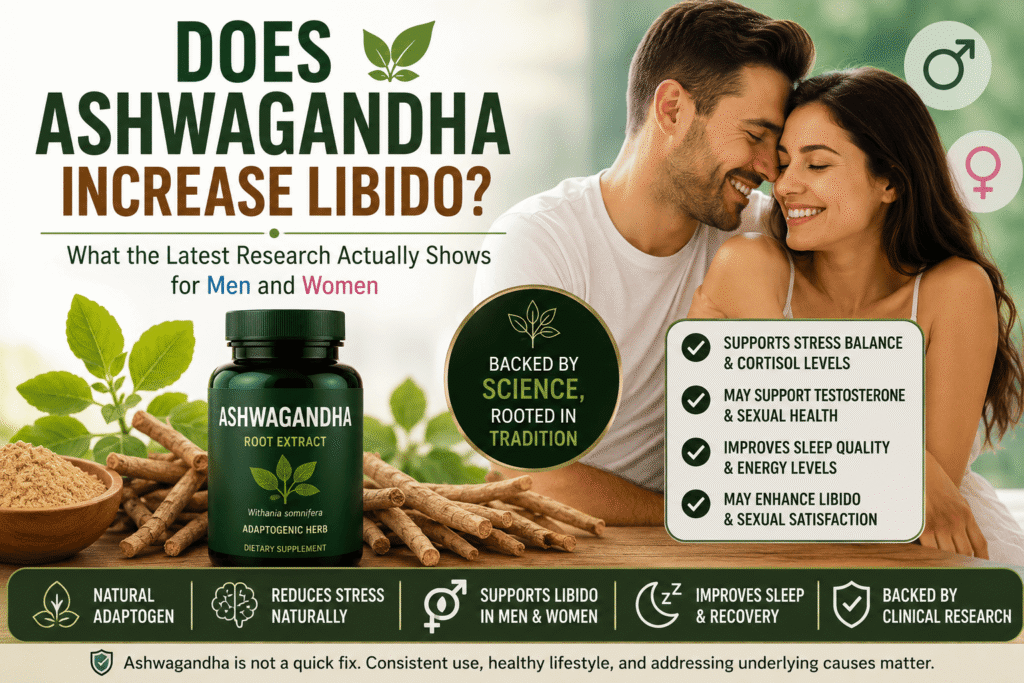
Ashwagandha — the root extract of Withania somnifera — has been used in Ayurvedic medicine for centuries as a Rasayana, a rejuvenating herb thought to support vitality and reproductive health. Today it is one of the most searched supplements for libido. The honest answer to whether it works is more nuanced than most guides admit: ashwagandha can improve libido-related outcomes in some people under some conditions, and the evidence for this has grown considerably in 2025 and 2026. But it is not a universal aphrodisiac, it does not work quickly, and it is unlikely to help when low libido stems from vascular disease, medication side effects, or confirmed hormone deficiency. This article explains what the clinical research actually shows — for both men and women — the mechanisms behind any benefit, how long it takes, who is most likely to respond, and the drug interactions most guides completely overlook.
A 2026 randomised, double-blind, placebo-controlled trial published in Frontiers in Reproductive Health found that ashwagandha root extract supplementation resulted in substantial improvements in IIEF total scores (a standard measure of erectile and sexual function), sexual desire, libido, and overall sexual satisfaction in healthy men over an eight-week period (Khanna et al., 2026).
What Is Ashwagandha?
Ashwagandha (Withania somnifera) is a small evergreen shrub native to India, North Africa, and parts of the Mediterranean. It belongs to the Solanaceae family and has been classified in Ayurveda as a Rasayana — a category of herbs used to promote longevity, strength, and reproductive health. The name combines the Sanskrit words for ‘horse’ and ‘smell,’ which is sometimes interpreted as signifying the strength and vitality the herb was thought to confer.
Pharmacologically, ashwagandha is classified as an adaptogen — a substance that helps the body respond to and recover from physical and psychological stress. Its primary active compounds are withanolides, a group of steroidal lactones concentrated in the root. Most clinical research on ashwagandha for sexual health has used standardised root extracts containing a specific percentage of withanolides, typically 2.5% to 5%, rather than raw root powder. This distinction matters when evaluating the evidence.
How Ashwagandha May Increase Libido: The Mechanisms
Ashwagandha does not work through a single pathway. Several overlapping mechanisms may contribute to its effect on libido, though the strength of evidence varies between them.
Cortisol reduction and the stress-libido connection
This is ashwagandha’s best-established mechanism. Ashwagandha modulates the hypothalamic-pituitary-adrenal (HPA) axis — the system that governs the body’s stress response. By doing so, it can meaningfully reduce circulating cortisol levels. This matters for libido because high cortisol directly suppresses testosterone production by competing with the signalling pathways that drive testosterone synthesis. In practical terms: chronic stress raises cortisol, cortisol lowers testosterone, low testosterone reduces sexual desire. Ashwagandha may interrupt this chain at the cortisol step. A placebo-controlled trial published in PMC found that participants taking ashwagandha root extract had significantly lower serum cortisol levels compared to the placebo group after eight weeks.
Testosterone support
Several trials have reported numerical increases in total and free testosterone in men taking ashwagandha. The most recent and rigorous of these — a 2025 PMC eight-week randomised controlled trial in 100 healthy men aged 30–50 — observed testosterone increases in the treatment group. However, the between-group differences were not statistically significant in that trial, meaning the finding should be treated as exploratory rather than definitive. An earlier study in men aged 40–70 did show statistically significant testosterone increases. The overall picture is that ashwagandha may modestly support testosterone levels, particularly in men with stress-related suppression, but it is not a reliable testosterone treatment for men with confirmed hypogonadism.
Sleep quality improvement
Sleep is when the majority of daily testosterone production occurs, during the deep, slow-wave stages of sleep. Ashwagandha has established sleep-supporting properties — a PMC study found it improved both sleep onset latency (how long it takes to fall asleep) and sleep efficiency. Because improving sleep quality can directly support testosterone production and general energy levels, this is a meaningful indirect pathway to improved libido, particularly in men and women whose low desire is connected to fatigue and poor sleep.
Nitric Oxide and blood flow
Some in vitro and animal research suggests ashwagandha may support endothelial function and Nitric Oxide bioavailability — the same molecule that initiates the erection response in men and increases genital blood flow in women during arousal. This potential mechanism is less well-established in human clinical trials than the cortisol and sleep pathways, and should be treated as preliminary.
Psychological well-being and sexual confidence
Clinical trials using validated sexual function questionnaires — including the IIEF (International Index of Erectile Function) for men and the FSFI (Female Sexual Function Index) for women — have found improvements not just in biological measures but in scores related to satisfaction, confidence, and overall sexual well-being. This suggests that ashwagandha’s anxiolytic (anxiety-reducing) effect may play a direct role in improving the psychological side of sexual desire, not just the hormonal one.
What the Clinical Evidence Shows for Men
The evidence base for ashwagandha and male sexual health has strengthened considerably in the past two years, though it remains limited in scale compared to pharmaceutical research.
- 2026 Frontiers in Reproductive Health RCT (Khanna et al.): A prospective, randomised, double-blind, placebo-controlled study found that ashwagandha root extract supplementation produced substantial improvements in IIEF total scores, sexual desire, libido, and sexual satisfaction. Testosterone levels showed numerical increases that were supportive but not between-group significant — an important caveat that the authors note.
- 2025 PMC eight-week RCT (100 men, 30–50 years): Participants received 300 mg of standardised ashwagandha root extract twice daily or placebo. The treatment group showed improvements in erectile function, desire, and sexual well-being scores. The study used validated questionnaires and is one of the better-controlled trials in this area.
- 2022 Health Science Reports RCT (Chauhan et al.): An eight-week randomised controlled trial found improvements in well-being and sexual performance scores in adult males. Self-reported sexual function and confidence improved significantly compared to placebo.
- Semen quality and fertility: A PMC review found consistent evidence across multiple studies that ashwagandha improves sperm count, motility, and morphology — which makes it one of the more evidence-supported supplements in male fertility, though this is distinct from libido per se.
The cumulative picture: ashwagandha may meaningfully improve sexual desire, function, and satisfaction in otherwise healthy men, particularly when the underlying issue is stress-related or fatigue-related. Effect sizes are generally modest to moderate. It is not a substitute for medical evaluation of ED or confirmed low testosterone.
What the Clinical Evidence Shows for Women
The women’s evidence is one of the most under-reported aspects of ashwagandha and libido — and it is genuinely promising. The original article and most competitors address only men. Here is what the research shows.
- 2025 Tandfonline prospective RCT (62 healthy women, 8 weeks): Standardised ashwagandha root extract 300 mg twice daily significantly improved FSFI total scores, FSDS-R (distress related to sexual problems), stress scores (PSS-10), and quality of life scores (SF-12) compared to placebo. Women in the treatment group reported improvements across arousal, lubrication, orgasm, and satisfaction domains.
- 2022 Cureus prospective RCT (80 women, 18–50 years, Ajgaonkar et al.): Women with hypoactive sexual desire disorder (HSDD) were randomised to 300 mg ashwagandha root extract twice daily or placebo for eight weeks. The treatment group showed significantly more satisfying sexual encounters, improved FSFI scores, and reduced sexual distress compared to placebo.
- 2016 PMC pilot study (50 women, KSM-66 extract): Women in the treatment arm showed significantly higher improvement in FSFI domains for arousal, lubrication, orgasm, and satisfaction. The number of successful sexual encounters also increased significantly compared to placebo.
The consistency across these trials is notable. In women, the primary benefit appears to be in desire, arousal, and satisfaction — domains closely tied to stress, mood, and psychological well-being, where ashwagandha has its clearest mechanisms.
Clinical note: These women’s trials used standardised root extract at 300 mg twice daily for eight weeks. Over-the-counter products vary widely in concentration and standardisation. Results in supplement products not matching these conditions cannot be assumed to replicate these trial findings.
KSM-66 vs Standard Extract — Does the Form Matter?
Most of the clinical trials showing positive results for libido used a specific standardised form — either KSM-66 (a trademarked full-spectrum root extract standardised to at least 5% withanolides) or Sensoril (another standardised extract). Generic ashwagandha powders or unstandardised capsules may contain significantly lower or inconsistent withanolide concentrations.
This matters practically: if you are choosing ashwagandha based on the research evidence, look for a product using KSM-66 or an equivalently standardised extract, and at a dose matching the studies — typically 300 mg twice daily. ‘Ashwagandha’ on a label without standardisation information may not deliver the same effect.
How Long Does Ashwagandha Take to Affect Libido?
This is where most articles mislead by vagueness. The original article says “several days or weeks.” The clinical trials tell a more specific story.
Most well-designed trials ran for eight weeks at minimum, and improvements in sexual function scores typically began to emerge at the four-week assessment but were more pronounced by eight weeks. Some researchers recommend 8–12 weeks of consistent daily use before drawing conclusions about effectiveness.
Unlike a PDE5 inhibitor such as Sildenafil which works within 30–60 minutes of a single dose, ashwagandha is cumulative. It works by gradually modulating cortisol, supporting sleep quality, and influencing hormonal milieu over time. Expecting results within a few days is not realistic, and abandoning it after one to two weeks is premature.
When Ashwagandha Is Unlikely to Help
This section is absent from virtually every ashwagandha and libido article, and it is arguably the most clinically useful content on the page. Ashwagandha’s mechanisms are specific — and when the cause of low libido is outside those mechanisms, it is unlikely to produce meaningful benefit.
- Confirmed low testosterone (hypogonadism): If testosterone is clinically deficient due to primary or secondary hypogonadism, the modest support ashwagandha provides is unlikely to be sufficient. Medical testosterone therapy is the appropriate evaluation.
- Vascular causes of ED: If Erectile Dysfunction stems from atherosclerosis, Diabetes-related vascular damage, or other causes of impaired penile blood flow, ashwagandha has no established effect on that pathway. This is the territory of PDE5 inhibitors and cardiovascular management.
- Medication-induced low libido: Many antidepressants (SSRIs, SNRIs), antihypertensives, and hormonal contraceptives reduce sexual desire as a side effect. Ashwagandha is unlikely to override a pharmacological effect. A conversation with the prescribing doctor about alternatives is more appropriate.
- Confirmed clinical Depression: While ashwagandha has mild anxiolytic effects, it is not an antidepressant and should not replace appropriate mental health treatment. Untreated depression is a common and significant driver of low libido.
- Relationship or psychological conflict: Ashwagandha reduces individual stress physiology; it does not address interpersonal factors, trauma, or communication difficulties that may underlie low desire. Sex therapy or counselling is more appropriate here.
- Thyroid dysfunction: Both hypothyroidism and hyperthyroidism affect libido significantly. Ashwagandha has some thyroid-stimulating effects (discussed in the safety section) and is not a substitute for thyroid testing and treatment.
Important: Low libido that is persistent, sudden in onset, or accompanied by other symptoms — fatigue, weight change, mood changes, or difficulty with erections — warrants medical evaluation before starting any supplement. These symptoms can indicate thyroid disease, low testosterone, depression, cardiovascular risk, or medication effects, all of which require specific treatment.
Dosage and How to Take It
The dosage used in the majority of clinical trials showing benefit for sexual health is:
- 300 mg of standardised ashwagandha root extract, twice daily (total 600 mg/day)
- Taken consistently for at least 8 weeks before assessing effect
- Can be taken with food to reduce the chance of mild gastric discomfort
Some studies have used 250–500 mg once daily with results, but the 300 mg twice-daily protocol is most consistent across the evidence base for sexual health specifically. The traditional Ayurvedic dose of ashwagandha root powder is considerably higher (3,000 mg twice daily) but this is raw powder rather than a concentrated extract — the standardised extract at 300 mg is intended to deliver an equivalent dose of active withanolides.
Ashwagandha can be taken as capsules, tablets, or powder mixed with warm milk or water. The form does not significantly affect efficacy provided the withanolide content is standardised. If using powder, the dose will be substantially higher by weight than the extract equivalent.
Drug Interactions and Who Should Not Use It
This is the section competitors most consistently omit. Ashwagandha has real, clinically relevant interactions that any reader considering it should know.
- Sedatives and sleep medicines: Ashwagandha has demonstrated sedative properties. Combining it with benzodiazepines, barbiturates, or other CNS depressants can amplify sedation. Use with caution and inform your doctor if you take any sleep or anti-anxiety medicines.
- Thyroid medicines: Ashwagandha appears to increase thyroid hormone levels — both T3 and T4 — in some studies. People with thyroid conditions or taking thyroid medicines (levothyroxine) should discuss ashwagandha with their doctor, as it could alter thyroid hormone balance and medication requirements.
- Immunosuppressants: Ashwagandha has immune-stimulating properties. This can theoretically oppose immunosuppressive medications used after organ transplant or for autoimmune conditions. People on immunosuppressants should avoid ashwagandha without specialist guidance.
- Diabetes medicines: Ashwagandha may lower blood sugar. Combined with insulin or oral hypoglycaemics, this can increase the risk of hypoglycaemia. Blood glucose monitoring is advisable.
- Blood pressure medicines: Some evidence suggests ashwagandha modestly lowers blood pressure. Combined with antihypertensives, this may produce an additive effect.
- Autoimmune conditions: Because ashwagandha stimulates immune function, it is generally not recommended for people with autoimmune diseases such as Rheumatoid Arthritis, Lupus, or Multiple Sclerosis.
Ashwagandha should be avoided during pregnancy. Animal studies have associated it with abortifacient effects at high doses, and there is insufficient safety data in humans to recommend it during pregnancy or breastfeeding. People with thyroid conditions, autoimmune diseases, or those taking immunosuppressants, thyroid medicines, sedatives, or blood pressure medicines should speak with a doctor before starting ashwagandha.
Side Effects
Ashwagandha is generally well-tolerated at the doses studied in clinical trials. The most commonly reported side effects are:
- Mild gastrointestinal discomfort — nausea, loose stools, or upset stomach, particularly at higher doses or on an empty stomach
- Drowsiness, especially at higher doses or when combined with other sedating substances
- Headache in some users
- Skin rash in rare cases
- Decreased appetite at higher doses
Rare but serious cases of liver injury associated with ashwagandha supplements have been reported in medical literature and to regulatory agencies. These appear to be rare and may be related to specific products or high doses, but they are worth noting. If you develop unexplained fatigue, yellowing of the skin or eyes, or abdominal pain while taking ashwagandha, stop use and seek medical evaluation.
Conclusion
The answer to “does ashwagandha increase libido” is a conditional yes — and the evidence for that conditional yes has meaningfully strengthened in 2025 and 2026. Multiple randomised, double-blind, placebo-controlled trials now support that standardised ashwagandha root extract can improve sexual desire, function, and satisfaction in both men and women, particularly when low libido is connected to stress, poor sleep, anxiety, or general well-being.
The key conditions apply: standardised extract matters, the dose studied is 300 mg twice daily, and the timeline is 8–12 weeks of consistent use — not days. When low libido stems from vascular disease, medication side effects, confirmed hypogonadism, untreated depression, or thyroid dysfunction, ashwagandha is unlikely to be the primary solution, and those conditions warrant medical evaluation.
Used appropriately, as part of a healthy lifestyle and with awareness of its real drug interactions, ashwagandha is one of the better-evidenced natural supplements for sexual health. It is not a replacement for medical care when medical care is what the situation calls for.
Frequently Asked Questions
-
How much ashwagandha should I take to increase libido?
The dose most consistently used in clinical trials for sexual health is 300 mg of standardised ashwagandha root extract (such as KSM-66) taken twice daily — a total of 600 mg per day — for at least eight weeks. Dosing with raw powder is different and considerably higher by weight. Speak with a doctor or pharmacist about which form suits your situation.
-
How long does ashwagandha take to work for libido?
Clinical trials consistently show that meaningful improvements in sexual desire and function appear at four to eight weeks of daily use, with more pronounced effects at eight to twelve weeks. Ashwagandha is cumulative in its action and is not designed for on-demand use. If you do not notice any change after twelve weeks of consistent use at the correct dose, speak with a doctor about other potential causes.
-
Can women take ashwagandha for libido?
Yes — and the evidence for women is genuinely good. Multiple randomised controlled trials, including a 2025 prospective RCT, have shown that standardised ashwagandha root extract improved arousal, lubrication, satisfaction, orgasm scores, and reduced sexual distress in women over eight weeks. It should not be used during pregnancy, and women with thyroid conditions should check with their doctor first.
-
Can ashwagandha replace Viagra or Sildenafil for Erectile Dysfunction?
No. Ashwagandha and Sildenafil work through completely different mechanisms. Sildenafil is a prescription PDE5 inhibitor that acts within 30–60 minutes to improve blood flow to the penis during arousal — it is specifically indicated for Erectile Dysfunction and has extensive clinical validation. Ashwagandha works over weeks through cortisol modulation and hormonal support. They address different aspects of sexual health and should not be used interchangeably.
-
Are there risks to taking ashwagandha every day?
For most healthy adults, daily ashwagandha at studied doses is well-tolerated. However, it interacts with thyroid medicines, sedatives, immunosuppressants, and blood pressure medicines, and should not be taken during pregnancy. Rare cases of liver injury have been reported. If you have a chronic health condition or take prescription medicines, discuss it with your doctor before starting.
Citations
- Khanna A, Khanna M, Panchal P. Efficacy and safety of ashwagandha root extract on sexual health in healthy men. Frontiers in Reproductive Health, 2026. https://www.frontiersin.org/journals/reproductive-health/articles/10.3389/frph.2026.1774098/full
- Efficacy and safety of eight-week therapy with Ashwagandha root extract in improvement of sexual health in healthy men. PMC, 2025. https://pmc.ncbi.nlm.nih.gov/articles/PMC12266485/
- Chauhan S, Srivastava MK, Pathak AK. Effect of standardized root extract of ashwagandha on well-being and sexual performance in adult males. Health Science Reports, 2022. https://doi.org/10.1002/hsr2.741
- Ajgaonkar A, Jain M, Debnath K. Efficacy and Safety of Ashwagandha Root Extract for Improvement of Sexual Health in Healthy Women. Cureus, 2022. https://www.ncbi.nlm.nih.gov/pmc/articles/PMC9701317/
- Ashwagandha root extract — sexual health in women RCT, 2025. Tandfonline. https://www.tandfonline.com/doi/full/10.1080/23311908.2025.2459467
- Dongre S, et al. Efficacy and Safety of Ashwagandha Root Extract in Improving Sexual Function in Women: A Pilot Study. PMC. https://www.ncbi.nlm.nih.gov/pmc/articles/PMC4609357/
- Pratte MA, et al. Ashwagandha and cortisol reduction. Journal of the American Nutraceutical Association, PMC. https://www.ncbi.nlm.nih.gov/pmc/articles/PMC3573577/
- Deshpande A, et al. Ashwagandha and reproductive health: semen quality and testosterone. PMC. https://www.ncbi.nlm.nih.gov/pmc/articles/PMC6438434/
This article is for general informational purposes only and does not constitute medical advice, diagnosis, or treatment. Dietary supplements are not FDA-approved medicines. Always consult your doctor before starting any supplement, particularly if you have a pre-existing health condition or take prescription medicines.
