
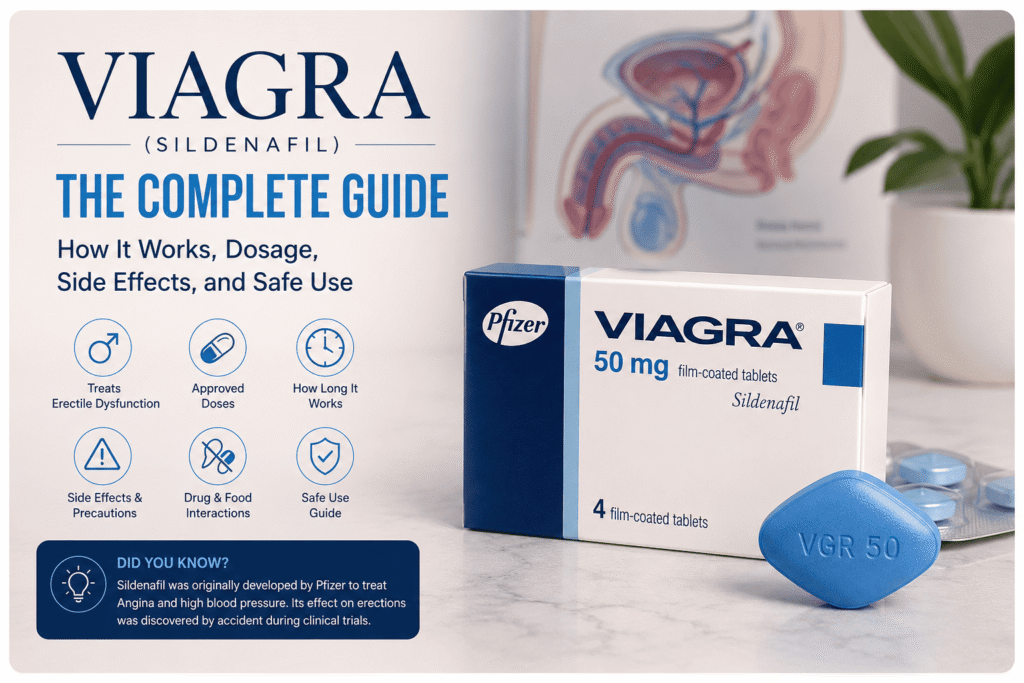
Viagra is one of the most recognised medicines in the world — and also one of the most misunderstood. Since the FDA approved it in 1998, Sildenafil Citrate has helped tens of millions of men manage Erectile Dysfunction, and it remains the first drug most doctors prescribe for the condition. Generic Sildenafil has made the same treatment available for a fraction of the brand price, and a new oral film formulation approved in 2024 has added another delivery option. Despite its familiarity, questions around how exactly it works, what it cannot do, which doses are safe, what it genuinely interacts with, and who should not take it at all remain widespread. This guide answers all of those questions accurately, in one place.
Sildenafil was originally developed by Pfizer to treat Angina pectoris (chest pain) and hypertension. Its effect on erections was discovered entirely by accident during early clinical trials, when participants were reluctant to return their unused pills. That unexpected finding led directly to Viagra — the first oral treatment ever approved for Erectile Dysfunction.
What Is Viagra?
Viagra is the brand name for Sildenafil Citrate, manufactured by Pfizer and FDA-approved in 1998. It is a small, diamond-shaped, blue-coated tablet that belongs to the Phosphodiesterase-5 (PDE5) inhibitor drug class. The same active ingredient — Sildenafil — is also available as a generic medicine at substantially lower cost since Viagra’s patent expired, and is sold under the brand names Revatio (for Pulmonary Arterial Hypertension) and Vybrique (oral film formulation for ED).
Viagra is available in three approved doses: 25 mg, 50 mg, and 100 mg. It is a prescription-only medicine in all major jurisdictions. The typical starting dose for most men is 50 mg, taken as needed approximately one hour before sexual activity. Your doctor will adjust the dose based on your response and tolerance.
Erectile Dysfunction affects an estimated 30 to 50 million men in the United States and is one of the most common male health conditions. Viagra does not cure ED — it manages symptoms on a dose-by-dose basis, providing a window of enhanced erectile function in response to sexual stimulation.
What Viagra Is — and Is Not — Used For
Understanding what Viagra does and does not do is one of the most important things a new user can know. Misconceptions about this are common.
What Viagra is approved for
- Erectile Dysfunction (ED) in adult men: The primary indication. Viagra helps men with ED achieve and maintain an erection firm enough for sex in response to sexual arousal.
- Pulmonary Arterial Hypertension (PAH): Sildenafil (as Revatio, 20 mg tablets) is FDA-approved to treat PAH in adults and children aged 1 year and older by relaxing the blood vessels supplying the lungs. Do not use Viagra and Revatio together, as both contain Sildenafil.
What Viagra does NOT do
- It does not create desire or increase libido: Sexual arousal is still necessary for Viagra to produce an erection. It supports the physical response; it does not generate the psychological desire.
- It does not make you last longer in bed: Viagra does not delay ejaculation or treat Premature Ejaculation. It only helps with the erection itself.
- It does not work without stimulation: Simply taking the pill does not produce an automatic erection. Physical or mental arousal must be present.
- It does not prevent STIs or pregnancy: Viagra has no contraceptive or infection-preventing properties.
- It does not permanently fix ED: Viagra treats symptoms per dose. Addressing the underlying cause of ED — vascular, hormonal, psychological — requires separate medical care.
One nuanced benefit worth noting: Viagra may reduce the refractory period — the recovery time between erections — for some men, meaning they may be able to achieve a second erection more quickly after ejaculation. This is a secondary effect, not its primary purpose.
How Viagra Works: The Full Mechanism
Viagra’s mechanism is precise and well-understood. Here is the complete chain of events:
- Step 1 — Arousal: Sexual stimulation (physical or psychological) activates the nervous system, sending signals to the erectile tissue of the penis.
- Step 2 — Nitric Oxide release: Nerve endings and the inner lining of blood vessels release Nitric Oxide (NO) into the corpus cavernosum — the spongy erectile tissue of the penis.
- Step 3 — cGMP production: Nitric Oxide activates the enzyme guanylate cyclase, which converts GTP into cyclic Guanosine Monophosphate (cGMP).
- Step 4 — Smooth muscle relaxation: cGMP causes the smooth muscle of the penile blood vessels to relax, allowing them to dilate. Blood flows into the corpus cavernosum and the penis becomes erect.
- Step 5 — Normal breakdown: Without Viagra, the enzyme PDE5 breaks down cGMP rapidly, ending the erection signal.
- Step 6 — Viagra’s role: Sildenafil occupies PDE5’s active site, blocking it from breaking down cGMP. cGMP remains elevated longer, the smooth muscle stays relaxed, and the erection is easier to achieve and sustain.
Because the entire chain depends on Nitric Oxide being released first, Viagra only works when sexual stimulation is present. It amplifies the body’s natural response rather than overriding it.
Viagra Dosage: Approved Doses and How They Differ
Viagra is FDA-approved in three doses: 25 mg, 50 mg, and 100 mg. There is no FDA-approved 150 mg dose of Viagra. Any product sold as “Viagra 150 mg” is not an approved formulation — it may be a generic Sildenafil product from another manufacturer but should not be described as a Viagra dose.
25 mg
The lowest dose. Typically recommended for men over 65, men with liver or kidney impairment, men taking CYP3A4 inhibitors (such as Ritonavir, Ketoconazole, Itraconazole, or Erythromycin), or men who experience significant side effects at 50 mg. Starting low reduces the risk of blood pressure effects, particularly in older or more medically complex patients.
50 mg
The standard starting dose for most adult men. Most prescribers begin here and adjust based on how well it works and whether side effects occur. This dose is taken approximately one hour before sexual activity and can be taken anywhere between 30 minutes and 4 hours beforehand.
100 mg
The maximum approved dose. Prescribed when 50 mg has been well-tolerated but has produced insufficient effect. Do not self-escalate from 50 mg to 100 mg without your doctor’s guidance. Higher doses increase the risk of side effects, particularly blood pressure-related ones.
Important: Take Viagra no more than once in any 24-hour period. Your doctor may recommend taking it less frequently depending on your health conditions and other medications. Never adjust your own dose without medical guidance.
A New Form: Vybrique (Sildenafil Oral Film)
Vybrique is a newer FDA-approved sildenafil formulation — an oral film that dissolves under or on the tongue — approved for Erectile Dysfunction. It is distinct from the standard tablet in several practical ways:
- Delivery: The film dissolves in the mouth and is absorbed through the oral mucosa, bypassing initial digestion in the stomach.
- Onset: Buccal absorption may produce a faster effective onset compared to the standard tablet for some men.
- Food effect: Less likely to be significantly delayed by a high-fat meal than the standard tablet.
- Available doses: 25 mg, 50 mg, 75 mg, and 100 mg oral film strips.
- Suitable for: Men who have difficulty swallowing tablets, or who find standard Sildenafil’s meal-timing requirement inconvenient.
Vybrique carries the same safety profile and contraindications as standard Viagra. Ask your doctor whether this formulation is available and appropriate for your situation.
How Long Viagra Takes to Work and How Long It Lasts
- Onset: Viagra typically begins working within 30 to 60 minutes of taking it. For some men it may take up to 2 hours. The best practice is to take it approximately one hour before sexual activity, though it can be taken anywhere between 30 minutes and 4 hours beforehand.
- Peak effect: Sildenafil reaches its peak concentration in the blood within 30 to 120 minutes of ingestion, according to the FDA-approved labelling.
- Duration: The effects of Viagra last approximately 4 to 6 hours. During this window, sexual stimulation can produce an erection more easily. The medicine does not maintain a continuous erection for that entire period.
- Food effect: A high-fat meal significantly delays absorption. Taking Viagra after a fatty meal can delay the onset by an hour or more and reduce peak Sildenafil concentration by approximately 29%. Take it on an empty stomach or after a light, low-fat meal for the most predictable timing.
- Alcohol: Alcohol is itself a vasodilator and nervous system depressant. More than one to two standard drinks on the same evening can compound the blood-pressure-lowering effect of Viagra and impair the arousal signal the drug depends on. Limiting alcohol on the day of use is advisable.
Viagra Side Effects: Common, Uncommon, and Serious
Common — usually mild and temporary
- Headache — most common, from generalised blood vessel dilation
- Facial flushing and warmth
- Nasal congestion or runny nose
- Indigestion or upset stomach
- Dizziness, particularly on standing up quickly
- Temporary blue-tinted or brighter-than-normal vision — due to mild cross-reactivity with PDE6 in retinal cells; usually brief and harmless
- Back pain and muscle aches (less common with Sildenafil than with Tadalafil)
These effects typically emerge within the first hour and resolve as the medicine clears. They do not require stopping treatment but should be mentioned at your next appointment.
Serious — require immediate medical attention
- Priapism: An erection lasting more than four hours is a urological emergency. Prolonged priapism can cause permanent damage to erectile tissue and irreversible ED. Go to an emergency department immediately. Do not wait.
- Sudden vision loss in one or both eyes: This may be a sign of non-arteritic anterior ischaemic optic neuropathy (NAION), a rare condition involving decreased blood flow to the optic nerve. Risk is higher in men over 50 with Diabetes, hypertension, high cholesterol, or pre-existing eye conditions. Stop Viagra and seek emergency eye care immediately.
- Sudden hearing loss or severe tinnitus: Stop the medicine and seek medical attention immediately.
- Severe chest pain, shortness of breath, or irregular heartbeat: Seek emergency care without delay. If this occurs during sexual activity, stop and call for help.
- Severe or prolonged drop in blood pressure: Symptoms include extreme dizziness, faintness, or collapse. Most likely if Viagra is combined with nitrates, alcohol, or alpha-blockers.
Drugs You Must Not Take with Viagra
Absolute contraindication — never combine
- Nitrate medicines of any kind: Nitroglycerin (GTN spray or tablet), isosorbide mononitrate, isosorbide dinitrate, and recreational nitrite inhalants (“poppers” — amyl nitrate or butyl nitrate). The combination can cause a sudden, severe, potentially fatal drop in blood pressure. There is no safe dose combination. If you use nitrates for chest pain or recreational purposes, do not take Viagra.
- Riociguat (Adempas): Used for Pulmonary Hypertension. Combining with any PDE5 inhibitor, including Sildenafil, is absolutely contraindicated.
Significant interactions requiring medical discussion
- Alpha-blockers (e.g. Tamsulosin, Doxazosin, Terazosin): These are used for high blood pressure and prostate symptoms. Combining with Viagra can cause orthostatic hypotension (dizziness when standing). Start at 25 mg Sildenafil if you take alpha-blockers, and allow several hours between doses.
- CYP3A4 inhibitors (e.g. Ritonavir, Ketoconazole, Itraconazole, Clarithromycin, Erythromycin, Saquinavir): These slow how your liver breaks down Sildenafil, raising blood levels significantly. A starting dose of 25 mg is recommended. For Ritonavir, the maximum dose is 25 mg within a 48-hour period.
- CYP3A4 inducers (e.g. Rifampin, Carbamazepine, St John’s Wort): These speed up Sildenafil breakdown and may reduce effectiveness.
- Other PDE5 inhibitors: Never take Viagra with Tadalafil, Vardenafil, Avanafil, or Revatio (which also contains Sildenafil). Stacking PDE5 inhibitors significantly increases the risk of side effects.
- Other ED treatments (e.g. alprostadil, yohimbine): Combining other ED medicines with Viagra increases priapism risk. Discuss with your doctor before combining any treatments.
Never take Viagra with any nitrate medicine or with recreational nitrite inhalants (poppers). This combination can cause a sudden, life-threatening blood pressure drop. Always tell your doctor about every medicine and supplement you take — including herbal products and OTC medicines — before starting Viagra. Never use Viagra purchased without a prescription or from an unverified source.
Foods and Substances That Affect Viagra
- High-fat meals: Significantly delay absorption and reduce peak Sildenafil levels by approximately 29%. Take on an empty stomach or after a light meal for best results.
- Grapefruit and grapefruit juice: Inhibit the CYP3A4 enzyme in the gut, raising Sildenafil levels unpredictably. Avoid grapefruit on the day you take Viagra.
- Alcohol: More than one to two standard drinks increases blood pressure lowering effects, impairs arousal response, and makes effects less predictable. Limit alcohol on the day of use.
Who Should Not Take Viagra
Viagra is not safe for everyone. A doctor reviews these factors before prescribing:
- Anyone currently taking any form of nitrate medicine (absolute contraindication)
- Anyone taking Riociguat (Adempas)
- Anyone for whom sexual activity itself is medically unsafe due to severe cardiovascular instability
- Anyone with a recent heart attack or stroke (generally within the last 90 days)
- Anyone with severe heart failure or severely low blood pressure (hypotension)
- Anyone with a known allergy to Sildenafil or any ingredient in the tablet
- Anyone with certain inherited retinal conditions (e.g. retinitis pigmentosa), due to PDE6 cross-reactivity
Lower starting doses (25 mg) are generally recommended for men over 65, men with moderate or severe kidney impairment, men with liver disease, and men taking CYP3A4 inhibitors.
Viagra as a Signal: ED and Cardiovascular Health
This section is absent from most Viagra guides and may be the most important for a subset of men reading this.
Erectile Dysfunction and cardiovascular disease share the same underlying pathology — damaged or narrowed blood vessels. The arteries supplying the penis are small (approximately 1–2 mm in diameter), while the coronary arteries supplying the heart are larger (3–4 mm). Because the penile arteries are smaller, atherosclerotic damage tends to appear there first. According to Harvard Medical School research, ED can predate a cardiovascular diagnosis by three to five years.
This means that new-onset ED in a man under 60, without an obvious psychological cause, warrants a cardiovascular risk assessment — not just a Viagra prescription. Cholesterol, blood pressure, blood sugar, and smoking status should all be reviewed. Most men with ED do not have serious heart disease, but for those who do, catching it early is the outcome that matters most.
If you are seeking a Viagra prescription and have not had a recent cardiovascular check, raise both topics with your doctor in the same appointment.
Viagra Alternatives
Generic Sildenafil
Generic Sildenafil is bioequivalent to Viagra — it contains the same active ingredient at the same dose and must meet FDA equivalence standards. With discount programmes such as GoodRx, generic Sildenafil can cost under $1 per tablet at some pharmacies. This is the most cost-effective option for the large majority of men.
Other FDA-approved PDE5 inhibitors
- Tadalafil (Cialis): Duration up to 36 hours; available as once-daily low dose; also approved for BPH. Food and alcohol have minimal effect on absorption.
- Vardenafil (Levitra / Staxyn): Similar timing to Sildenafil; fewer visual side effects; available as an orally dissolving tablet.
- Avanafil (Stendra): Fastest onset (as early as 15 minutes); least affected by food; fewest side effects from related enzyme cross-reactivity.
Natural supplements
Supplements marketed as “natural Viagra” — including L-arginine, Panax Ginseng, Yohimbine, and Epimedium (Horny Goat Weed) — do not have clinical evidence comparable to FDA-approved PDE5 inhibitors. Some have modest preliminary evidence for mild ED with a lifestyle or stress component. None are appropriate substitutes for medical evaluation or prescription treatment of persistent ED. Always disclose supplements to your doctor, as some interact with Sildenafil.
Can Women Take Viagra?
Viagra (Sildenafil) is not FDA-approved for sexual dysfunction in women. However, Sildenafil — as Revatio — is FDA-approved for Pulmonary Arterial Hypertension in both men and women, and in children aged 1 year and older.
Some doctors prescribe Sildenafil off-label for women with certain conditions. For female sexual dysfunction specifically, Flibanserin (Addyi) is FDA-approved for hypoactive sexual desire disorder (HSDD) in premenopausal women. Women experiencing sexual dysfunction should discuss the appropriate treatment options with their doctor.
How to Get Viagra Safely
Viagra is a prescription-only medicine in all major jurisdictions. Here is how to obtain it safely:
- Through your GP or urologist: A standard in-person consultation followed by a prescription. Your doctor can screen for contraindications and drug interactions and monitor your response over time.
- Through a licensed telehealth platform: Many legitimate online platforms provide ED consultations with licensed clinicians and issue prescriptions to accredited pharmacies. This is a safe, private, and increasingly common route, provided the platform is properly licensed in your state and requires a genuine clinical assessment.
- Verifying an online pharmacy: In the US, check any online pharmacy at safe.pharmacy (run by the National Association of Boards of Pharmacy). Look for the VIPPS (Verified Internet Pharmacy Practice Sites) seal. Avoid any site that does not require a prescription, has no physical address, or offers prices dramatically below licensed pharmacies.
Conclusion
Viagra — and its generic form, Sildenafil — remains the most prescribed, most studied, and most cost-effective first-line treatment for Erectile Dysfunction available. Its mechanism is well-understood, its efficacy is well-proven, and with generic availability now making it affordable for nearly everyone, cost is rarely the barrier it once was.
Using it correctly means taking it approximately one hour before sexual activity on an empty or light-fat stomach, limiting alcohol, never combining it with nitrates in any form, and starting at the dose your doctor recommends rather than self-adjusting. It works within its window; it requires arousal to work; and it does not address the underlying causes of ED on its own.
For men experiencing new-onset ED, particularly those under 60, the Viagra prescription appointment is also the right moment to ask for a cardiovascular review. The erection difficulty may be the most treatable problem in the room — or it may be pointing to something more important.
Frequently Asked Questions
-
Is Viagra safe for men in their 20s?
Yes, Viagra is generally safe for men over 18 when taken with a valid prescription and under medical supervision. ED in younger men is more likely to have a psychological or lifestyle component, and a doctor’s assessment helps confirm whether Sildenafil is appropriate or whether other approaches — such as therapy or lifestyle changes — should come first.
-
Can I take Viagra every day?
Viagra is an on-demand medicine, not a daily treatment. It should not be taken more than once in any 24-hour period. If you find you need it every time you have sex and want the convenience of a daily option, discuss daily low-dose Tadalafil with your doctor — it is the only PDE5 inhibitor with a once-daily approval.
-
What happens if Viagra does not work?
First review practical factors: meal timing, alcohol, anxiety level, and whether the dose is adequate. Guidelines recommend at least 6 to 8 properly timed attempts before concluding a drug is ineffective. If it genuinely fails, your doctor may increase the dose, switch to a different PDE5 inhibitor, investigate an underlying condition, or discuss other treatment options.
-
Is Viagra a steroid?
No. Viagra is a Phosphodiesterase-5 (PDE5) inhibitor. Steroids are synthetic hormones. Sildenafil has no hormonal or muscle-building properties and does not affect testosterone levels.
-
How should I store Viagra?
Store Viagra at room temperature, away from moisture and heat. Keep it out of reach of children. Do not use tablets past their expiry date — expired Sildenafil may be less effective. Never share your prescription medicine with anyone else.
Citations
- S. Food and Drug Administration. Viagra (sildenafil citrate) prescribing information. https://www.accessdata.fda.gov/drugsatfda_docs/label/2014/020895s039lbl.pdf
- com. Sildenafil — Uses, Dosage, Side Effects and Warnings (updated Feb 2026). https://www.drugs.com/sildenafil.html
- Mayo Clinic. Sildenafil (oral route) — Side effects and dosage. https://www.mayoclinic.org/drugs-supplements/sildenafil-oral-route/description/drg-20066989
- Sildenafil. U.S. National Library of Medicine. https://medlineplus.gov/druginfo/meds/a699015.html
- National Institute of Diabetes and Digestive and Kidney Diseases (NIDDK). Erectile Dysfunction. https://www.niddk.nih.gov/health-information/urologic-diseases/erectile-dysfunction
- Harvard Health Publishing. Erectile dysfunction as a harbinger of heart disease. https://www.health.harvard.edu/mens-health/erectile-dysfunction-as-a-harbinger-for-heart-disease
- Dhaliwal A, Gupta M. PDE5 Inhibitors. StatPearls. NCBI Bookshelf. https://www.ncbi.nlm.nih.gov/books/NBK549843/
- National Association of Boards of Pharmacy. Safe Pharmacy verification. https://safe.pharmacy/buy-safely/
This article is for general informational purposes only and does not constitute medical advice, diagnosis, or treatment. Viagra and Sildenafil are prescription-only medicines. Always consult a qualified healthcare provider before starting, stopping, or changing any medication. This article uses the term ‘men’ to refer to people assigned male at birth with male reproductive anatomy.
