
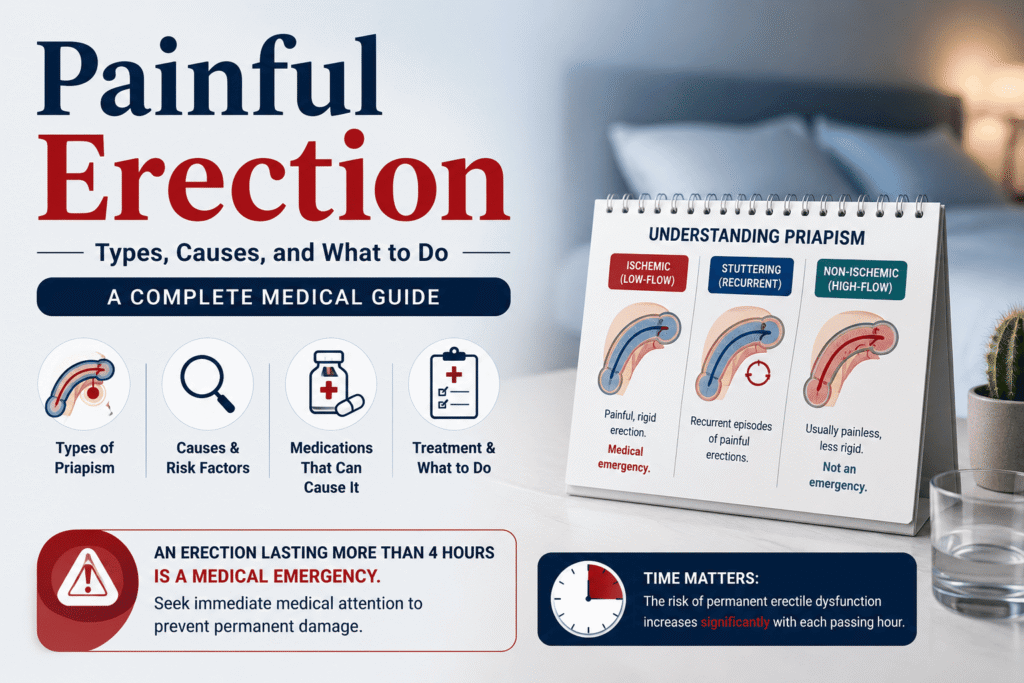
A painful erection is almost always a medical matter worth taking seriously. Most of the time it involves Priapism — a prolonged erection that occurs without sexual arousal or stimulation and does not resolve with ejaculation. Priapism is painful in approximately 95% of cases and can cause permanent damage to erectile tissue if not treated promptly. However, not all painful erections are Priapism, and not all types of Priapism carry the same urgency. Understanding the difference between types matters because the causes, level of emergency, and treatment approaches differ significantly. This article explains all three types of Priapism, the full range of causes, the specific medications most commonly involved, what to do at each stage, and when to go directly to an emergency room.
Emergency notice: If you have an erection lasting more than 4 hours that will not resolve, go to an emergency room immediately. Do not wait. Ischemic Priapism causes progressive oxygen deprivation to penile tissue, and the risk of permanent erectile dysfunction increases significantly with each passing hour. This is a genuine medical emergency — not a condition to manage at home.
What Is a Painful Erection?
A painful erection is an erection that causes discomfort, pain, or pressure and occurs either without sexual stimulation or persists well beyond sexual arousal. Most cases fall under the clinical diagnosis of Priapism — a prolonged, persistent erection unrelated to sexual desire and not relieved by ejaculation.
Priapism is defined clinically as an erection lasting more than four hours in the absence of sexual stimulation, though the diagnosis can be made earlier when the clinical picture is clear. It most commonly affects people with a penis in their 30s and older, though it can begin in childhood in those with Sickle Cell Disease.
Importantly, not every painful erection is Priapism. Some erections cause pain due to local conditions — Peyronie’s Disease, infection, or injury — without prolonged duration. This article covers both, with an emphasis on helping the reader distinguish between them and respond appropriately.
The Three Types of Priapism
The original article does not distinguish between types of Priapism. This distinction is clinically essential because the types differ in mechanism, urgency, pain profile, and treatment. Getting this wrong — treating all Priapism as the same condition — leads to either under-treatment of an emergency or inappropriate invasive procedures for a non-urgent condition.
1. Ischemic (Low-Flow) Priapism — the most common and most dangerous
Ischemic Priapism occurs when blood becomes trapped in the erectile chambers (corpus cavernosum) and cannot drain. Without outflow, the oxygen supply to penile tissue is progressively depleted — a state of increasing tissue ischemia. This is the type that is painful in the vast majority of cases, and it is the type that constitutes a true medical emergency.
- Appearance: The penis is rigid, fully erect, and painful. The rigidity is not accompanied by sexual arousal.
- Pain: Present in approximately 95% of ischemic cases. Pain typically increases with duration.
- Urgency: Tissue damage begins within hours. Permanent Erectile Dysfunction can result if treatment is delayed beyond 24–48 hours; the risk increases significantly even earlier.
- Common causes: Sickle Cell Disease, medications (oral or injected), blood disorders, and sometimes no identifiable cause (idiopathic).
2. Stuttering (Recurrent Ischemic) Priapism
Stuttering Priapism is a subtype of ischemic Priapism characterised by repeated episodes that come and go. Each episode may resolve on its own — sometimes in under four hours — but recurs, often becoming progressively longer and more painful over time. It is strongly associated with Sickle Cell Disease and affects up to 35% of men with that condition.
- Appearance: Episodes of painful erection that resolve spontaneously but recur frequently.
- Pain: Usually present, and often worsening with each recurrence.
- Urgency: Individual episodes under four hours may not require emergency care, but the recurrent pattern requires medical evaluation and long-term management. Any episode lasting over four hours should be treated as an emergency.
- Management aim: Prevent progression to full ischemic Priapism; address the underlying condition.
3. Non-Ischemic (High-Flow) Priapism — different mechanism, not an emergency
Non-Ischemic Priapism occurs when excessive, uncontrolled arterial blood flows into the penis — usually because an injury to the penile artery or perineum has created an abnormal connection (arteriovenous fistula or pseudoaneurysm) that bypasses normal blood flow regulation.
- Appearance: The penis is erect but not fully rigid. The erection is sustained rather than episodic.
- Pain: Usually absent or mild. This is a key distinguishing feature from ischemic Priapism.
- Urgency: Not a medical emergency in the same way as ischemic Priapism. Tissue oxygenation is generally maintained because blood continues to flow.
- Common cause: Trauma to the penis or the area between the scrotum and anus (perineum). Bicycle injuries, straddle injuries, and blunt perineal trauma are common triggers.
- Treatment: Observation, ice packs, and in some cases arterial embolisation (blocking the abnormal blood vessel) performed by a vascular radiologist. Invasive procedures used for ischemic Priapism are generally not appropriate here.
When Is a Painful Erection a Medical Emergency?
This is the question most readers are asking, and the original article answers it inadequately by simply saying “it may be a medical emergency.”
- Go to the emergency room immediately if: Your erection has lasted more than 4 hours, is painful and rigid, and shows no signs of resolving. This applies regardless of the suspected cause. Ischemic Priapism requires emergency intervention.
- Go to the emergency room immediately if: Your erection is accompanied by severe pain, even if it has been present for less than 4 hours. Early intervention produces better outcomes.
- See a doctor soon (not necessarily emergency) if: You have experienced repeated episodes of painful erection that each resolved within 4 hours — this is the stuttering pattern and warrants evaluation and preventive management.
- Seek medical advice if: Your erection is painless but has been sustained without stimulation for several hours, or if you have had a recent perineal injury followed by an erection — this may be non-ischemic Priapism requiring assessment.
- Monitor at home if: The erection is mildly uncomfortable, clearly linked to sexual arousal, and resolves within a normal timeframe with or without a cold compress. This is not Priapism.
Causes of Painful Erections
The original article lists three causes. The actual range is considerably broader.
Blood disorders
- Sickle Cell Disease: The most common identifiable cause of Priapism overall. Abnormally shaped red blood cells obstruct the small vessels draining the penis, causing ischemic Priapism. It occurs in 30–45% of people with Sickle Cell Disease, often beginning in childhood. Stuttering Priapism is particularly common in this group.
- Leukaemia and other blood cancers: Abnormal white blood cells can accumulate in penile tissue, obstructing drainage.
- Thalassaemia and other haemoglobinopathies: Other inherited red blood cell disorders that can cause similar vascular obstruction.
Neurological causes
- Spinal cord injury: Can disrupt the nerve signals that regulate penile blood flow and produce Priapism — typically ischemic.
- Multiple sclerosis, Parkinson’s disease: Neurological conditions that affect autonomic regulation of blood flow.
- Stroke: Rarely, cerebrovascular events can trigger prolonged erections through central nervous system dysregulation.
Trauma
- Perineal or penile injury: Blunt trauma to the base of the penis or perineum is the most common cause of non-ischemic Priapism. A bicycle seat injury is a classic example.
- Penile fracture: Rupture of the tunica albuginea (the fibrous envelope around erectile tissue) causes acute pain, swelling, and deformity — distinct from Priapism but another cause of a genuinely painful erection.
Peyronie’s Disease
Peyronie’s Disease involves the development of fibrous scar tissue (plaques) inside the penis, causing curvature and sometimes significant pain — particularly during erections. The pain in Peyronie’s arises from the mechanical stretch of the shortened, scarred tissue during erection rather than from blood flow obstruction. It is distinct from Priapism but is a common cause of painful erections, particularly in men aged 40–70.
Idiopathic (no identifiable cause)
In a significant proportion of Priapism cases — estimates range from 30% to 50% — no identifiable cause is found despite full investigation. This is called idiopathic Priapism and is managed the same way as other ischemic Priapism based on symptoms and type.
Recreational drugs
Several recreational substances are associated with Priapism, including cocaine, crystal methamphetamine, marijuana, and MDMA (ecstasy). These substances can disrupt the normal autonomic regulation of penile blood flow, leading to ischemic Priapism.
Medications That Can Cause Priapism
The original article says only “ED medicines.” The actual list is significantly broader and clinically important — particularly for people on long-term prescription medicines.
- Intracavernous injection therapy for ED: Alprostadil, papaverine, and phentolamine injected directly into the penis to treat Erectile Dysfunction are among the most common drug-related causes of Priapism. The dose is injected into the erectile tissue, directly affecting penile blood flow.
- Oral PDE5 inhibitors (Sildenafil, Tadalafil, Vardenafil, Avanafil): Oral ED medicines carry a rare but documented risk of Priapism. This is listed as a serious side effect on every PDE5 inhibitor FDA label. The risk is higher when these medicines are combined with other vasoactive substances.
- Antipsychotic medicines: Chlorpromazine, haloperidol, olanzapine, quetiapine, risperidone, and clozapine are all associated with Priapism, likely through alpha-adrenergic blocking activity.
- Antidepressants: Trazodone has the strongest evidence — it has a long-documented association with Priapism through its antagonism of alpha-1 adrenergic receptors. SSRIs and other antidepressants carry a lower but documented risk.
- Alpha-blockers (e.g. Prazosin, Tamsulosin, Doxazosin): Used for high blood pressure and prostate symptoms; alpha-adrenergic blockade can impair the detumescence mechanism.
- Anticoagulants and blood thinners: Heparin and Warfarin have been associated with Priapism, possibly through blood viscosity changes.
- Hormone therapies: Testosterone therapy and gonadotropin-releasing hormone analogues used in prostate cancer treatment have been associated with stuttering Priapism.
Important: If you are taking any of the medicines listed above and experience a prolonged painful erection, go to the emergency room and tell the treating team exactly what medicines you take — including doses. Do not stop taking long-term prescription medicines without medical advice, but do report the episode to your prescribing doctor as soon as possible.
Painful Erections Not Related to Priapism
Not every painful erection involves prolonged duration or blood-flow obstruction. The following conditions can cause erection pain without meeting the criteria for Priapism:
- Infection (STIs, prostatitis, urethritis): Sexually transmitted infections and inflammation of the prostate or urethra can cause pain during erection and intercourse.
- Phimosis: A tight foreskin that cannot fully retract during erection causes mechanical pain. Common in uncircumcised men and highly treatable.
- Penile skin conditions: Lichen sclerosus and similar dermatological conditions can cause pain during erection.
- Post-surgical or post-procedure pain: Following circumcision, penile surgery, or prostate procedures, erections may be painful during the healing period.
- Dyspareunia: Pain specifically during or after sexual intercourse — can involve the penis without being Priapism.
Does Priapism Affect Anyone with a Clitoris?
Yes — and this is almost never mentioned in articles on this topic. Clitoral Priapism is a recognised condition in which the clitoris becomes persistently engorged and painful without sexual arousal, analogous to penile Priapism. It is rare and is most commonly linked to medication effects — particularly SSRIs, antipsychotics, and trazodone — as well as pelvic vascular abnormalities.
Anyone experiencing persistent, painful clitoral engorgement lasting more than a few hours should seek medical evaluation. Treatment principles are similar to penile Priapism, though the evidence base is smaller.
Diagnosis
When a person presents with a prolonged erection, a doctor’s first task is to determine whether it is ischemic or non-ischemic, because the treatment approaches differ substantially. Diagnosis typically involves:
- Clinical history: Duration, pain level, whether stimulation was involved, medications, and relevant medical history (especially Sickle Cell Disease or recent trauma).
- Physical examination: Assessing rigidity, tenderness, and any signs of injury or deformity.
- Corporal blood gas analysis: A small sample of blood is drawn from the erectile chambers. Low oxygen and high carbon dioxide levels confirm ischemic Priapism; normal levels suggest non-ischemic. This is the primary diagnostic test in emergency settings.
- Penile Doppler ultrasound: Assesses blood flow into and out of the penis; particularly useful for diagnosing non-ischemic Priapism and identifying an arteriovenous fistula from trauma.
- Blood tests: Full blood count to screen for Sickle Cell Disease, leukaemia, or other blood disorders; urine toxicology if recreational drug use is suspected.
Treatment: What Happens at Each Stage
Treatment urgency and approach depend on type and duration. The original article describes this in a single vague paragraph. Here is the accurate clinical picture.
At home (erection under 1–2 hours, mildly uncomfortable)
- Gentle physical activity or a brisk walk may help by redistributing blood flow.
- A cold compress applied to the penis or perineum for short intervals may reduce blood flow and assist detumescence. Avoid prolonged icing — do not leave ice directly on skin for more than 10–15 minutes at a time to prevent frostbite.
- Urinating may sometimes help if the erection is mild and clearly post-arousal.
If the erection is rigid, painful, and shows no signs of resolving within the first 1–2 hours — especially if it started without arousal — do not wait. Seek emergency care.
Emergency department treatment — ischemic Priapism
- Aspiration and irrigation: The first-line hospital intervention. A needle is inserted into the corpus cavernosum and blood is aspirated to relieve pressure. Saline irrigation may follow. This is effective in many cases and provides immediate relief.
- Sympathomimetic injection: Phenylephrine (the preferred agent) is injected directly into the erectile tissue. It causes the blood vessels to constrict, restoring drainage. This is used alongside or after aspiration.
- Oral alpha-agonists (decongestants): Pseudoephedrine or similar medicines are sometimes tried in milder cases or before aspiration, but evidence for oral agents is weaker than for direct injection.
- Surgical shunting: If aspiration and injection fail, a urologist creates a surgical channel (shunt) between the corpus cavernosum and the glans or a nearby vein to allow blood to drain. This is reserved for refractory cases.
- Penile prosthesis: In cases where prolonged ischemia has already caused significant tissue damage and Erectile Dysfunction has resulted, early placement of a penile implant is sometimes considered.
Non-ischemic Priapism treatment
Because tissue oxygenation is generally maintained in non-ischemic Priapism, the urgency is lower and invasive approaches are usually avoided. Many cases are managed with observation, ice packs, and watchful waiting. If a fistula is confirmed on imaging and the erection is not resolving, arterial embolisation — a minimally invasive radiological procedure that blocks the abnormal blood vessel — is the standard treatment.
Stuttering Priapism — prevention and management
Men with recurrent stuttering Priapism need a long-term management plan rather than repeated emergency visits. Options discussed with a urologist may include:
- Oral phosphodiesterase-5 inhibitors at low daily doses — counterintuitively, some evidence suggests low-dose PDE5 inhibitors help regulate the cycle in recurrent priapism.
- Hormone therapy — antiandrogens may reduce the frequency of nocturnal priapism episodes in some men with sickle cell disease.
- Self-injection protocols — men with frequent stuttering episodes are sometimes taught to self-administer phenylephrine or etilefrine at home under medical guidance to abort episodes early.
- Treating the underlying condition — optimising management of Sickle Cell Disease (including hydroxyurea therapy) is fundamental to reducing Priapism frequency.
Long-Term Complications
Priapism that is not treated promptly — particularly ischemic Priapism — carries real and serious consequences.
- Erectile Dysfunction: The most common long-term complication. Ischemia damages the smooth muscle of the corpus cavernosum, leading to fibrosis (scar tissue formation). The longer Priapism is left untreated, the higher the risk and severity of subsequent ED.
- Penile fibrosis: Scar tissue build-up in the erectile chambers reduces elasticity and can cause penile shortening and curvature over time.
- Permanent impotence: In severe cases where treatment was significantly delayed, complete and irreversible loss of erectile function can occur.
The probability of recovering erectile function after Priapism is strongly time-dependent. Treatment within the first 4–6 hours is associated with significantly better outcomes than treatment after 24 hours. This is the primary clinical reason Priapism is treated as a time-sensitive emergency.
Preventing Recurrent Priapism
- If you take injected ED therapy: Ensure you are trained in the correct dose and the signs of Priapism. Know to call for help immediately if an erection lasts more than 4 hours after injection.
- If you take oral ED medicines: Do not combine with other vasoactive substances. Do not exceed your prescribed dose.
- If you have Sickle Cell Disease: Work with your haematologist on optimal disease management including hydroxyurea. Discuss a Priapism prevention plan with a urologist before an emergency occurs.
- If you take antipsychotics or trazodone: Discuss the risk with your prescriber. If you experience a prolonged erection while on these medicines, report it immediately — a different agent within the same drug class may carry lower risk.
- Avoid recreational substances: Cocaine, methamphetamine, and other stimulants are associated with Priapism. Avoiding them removes a preventable risk.
Conclusion
A painful erection is a symptom that can range from a mildly uncomfortable post-arousal experience to a genuine urological emergency requiring immediate hospital care. The distinction that matters most is between ischemic Priapism — where blood is trapped in the penis, oxygen supply fails, and permanent damage accumulates with every passing hour — and non-ischemic Priapism, where the mechanism is different and the urgency is considerably lower.
The causes are broader than most people realise: Sickle Cell Disease, neurological conditions, trauma, antidepressants, antipsychotics, anticoagulants, and recreational drugs all feature alongside ED medicines. Knowing which medicines you take and reporting any prolonged erection promptly is the most important thing a person on any of these medicines can do.
If you have a painful, rigid erection that has lasted more than four hours, go to an emergency room now. The window for full recovery narrows with every hour.
Frequently Asked Questions
-
Is every painful erection an emergency?
Not every painful erection is an emergency, but a painful, rigid erection lasting more than four hours always is. Ischemic Priapism requires emergency treatment to prevent permanent damage. Non-ischemic Priapism, which is usually painless, is less urgent. An erection that is mildly uncomfortable and resolves within a normal timeframe after sexual arousal is generally not a cause for concern.
-
Can Priapism resolve on its own?
Non-ischemic Priapism sometimes resolves without intervention. Ischemic Priapism rarely resolves safely on its own, and attempting to wait it out risks permanent erectile tissue damage. Stuttering Priapism episodes may resolve individually but will recur. Any episode lasting more than four hours requires emergency care regardless of whether prior episodes resolved spontaneously.
-
What medicines most commonly cause Priapism?
Intracavernous injections for ED (alprostadil, papaverine) carry the highest risk. Among oral medicines, trazodone (an antidepressant) has the strongest documented association. Antipsychotics (particularly chlorpromazine and risperidone), alpha-blockers, anticoagulants, and oral PDE5 inhibitors all carry documented risk. Always report a Priapism episode to the doctor who prescribes any of these medicines.
-
Can Priapism cause permanent Erectile Dysfunction?
Yes. Ischemic Priapism that is not treated within the first several hours carries a significant risk of permanent Erectile Dysfunction due to oxygen deprivation and subsequent fibrosis of the erectile tissue. The risk increases substantially the longer the episode is left untreated. Early treatment — ideally within 4–6 hours — is associated with much better outcomes.
-
What is the difference between ischemic and non-ischemic Priapism?
Ischemic Priapism involves trapped, oxygen-depleted blood in the penile chambers and is painful, rigid, and a medical emergency. Non-ischemic Priapism involves excessive arterial inflow — usually from a vascular injury — and is typically painless with a less rigid erection, not an immediate emergency. They require different diagnostic tests and entirely different treatments.
Citations
- Mayo Clinic. Priapism — Symptoms and causes. https://www.mayoclinic.org/diseases-conditions/priapism/symptoms-causes/syc-20352005
- Cleveland Clinic. Priapism: Causes, Symptoms, Diagnosis & Treatment. https://my.clevelandclinic.org/health/diseases/10042-priapism
- Salonia A, et al. Priapism. StatPearls. NCBI Bookshelf, updated September 2025. https://www.ncbi.nlm.nih.gov/books/NBK459178/
- Priapism: Practice Essentials, Background, Pathophysiology. https://emedicine.medscape.com/article/437237-overview
- Medical News Today. Priapism: Treatment, causes, symptoms, and types. https://www.medicalnewstoday.com/articles/318737
- Burnett AL, et al. Sickle cell disease-related priapism: a review of clinical and research data. BJU International, 2002. https://bjui-journals.onlinelibrary.wiley.com/doi/abs/10.1046/j.1464-410X.2002.03022.x
- Hims Health. Priapism: Symptoms, Causes & Treatment. https://www.hims.com/conditions/priapism
This article is for general informational purposes only and does not constitute medical advice. Priapism is a medical emergency. If you have a painful erection lasting more than four hours, go to an emergency room immediately. Always consult a qualified healthcare provider for any medical concern.
