
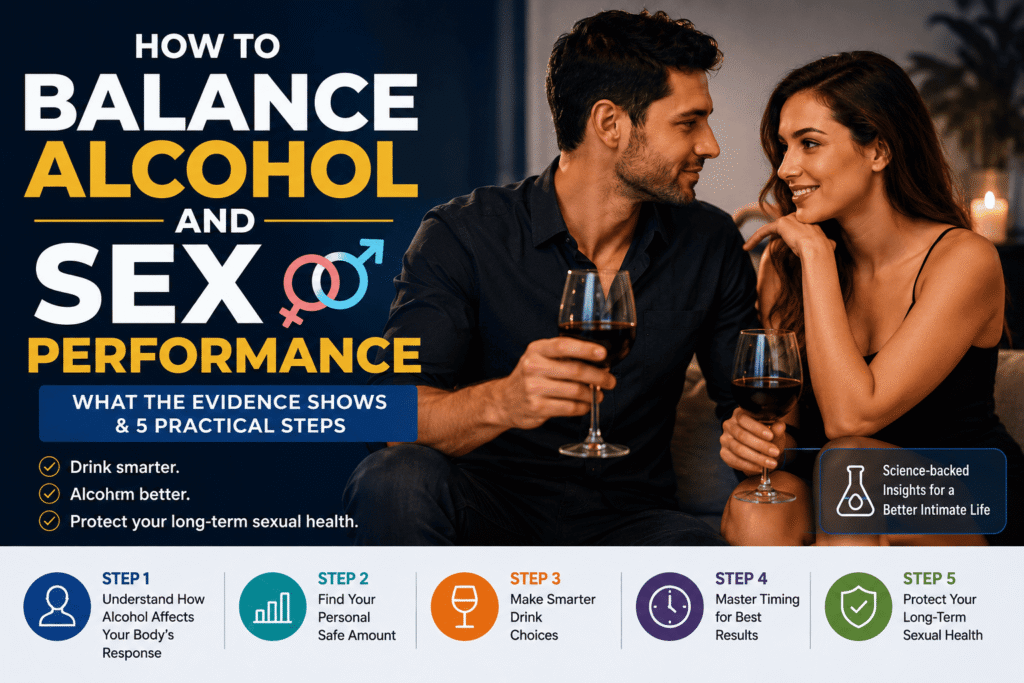
Alcohol and sexual performance have a genuinely complex relationship — one where the same substance that reduces inhibition and calms performance anxiety in moderate amounts can impair erections, delay or prevent orgasm, reduce sensitivity, and disrupt hormone levels when consumed in excess. The research on this is more nuanced than simple ‘alcohol is bad for sex’ guidance: a large meta-analysis of 24 studies involving 154,295 participants found that light to moderate drinking (under 21 drinks per week) was actually associated with a reduced risk of Erectile Dysfunction. But a separate meta-analysis of 46 studies involving 216,461 participants confirmed that regular heavy consumption significantly increases the risk. Navigating this requires understanding how alcohol affects the body’s sexual response at different amounts and timings — not a blanket rule, but a practical framework. This guide provides exactly that.
A meta-analysis of 24 studies (154,295 participants) found that light to moderate alcohol consumption under 21 drinks per week was associated with a 29% reduced risk of Erectile Dysfunction (OR 0.71) compared to non-drinkers. However, heavy or alcohol-dependent drinking reverses this — a cross-sectional study found that 77% of alcohol-dependent men experienced sexual dysfunction across multiple domains, with reduced sexual pleasure the most common complaint at 71.8%.
What the Research Actually Shows: The Nuanced Picture
The relationship between alcohol and sexual performance is dose-dependent — meaning the outcome depends entirely on how much you drink, not simply whether you drink. This is a more accurate framing than the binary ‘alcohol is bad for sex’ message often repeated.
- Light to moderate drinking (under 21 drinks/week): A 2016 dose-response meta-analysis of 24 studies found this level of consumption was associated with a 29% lower odds of Erectile Dysfunction compared with non-drinkers. The proposed mechanism is that moderate alcohol reduces performance anxiety and cardiovascular stress, both of which can impair erections.
- Regular heavy consumption (above 21 drinks/week): A larger meta-analysis of 46 studies with 216,461 participants found significant association between regular heavy alcohol use and Erectile Dysfunction. The protective effect seen at lower doses disappears at this level.
- Alcohol dependence: A cross-sectional study of 78 alcohol-dependent men found that 77% experienced sexual dysfunction in multiple domains — with reduced sexual pleasure (71.8%), low sexual desire (61.5%), and Erectile Dysfunction (43.6%) as the most common. Severity of sexual dysfunction was directly proportional to severity of alcohol dependence .
The practical takeaway: alcohol is not a simple villain or ally in sexual performance. The effect depends on amount, timing, frequency, and individual metabolism.
How Alcohol Affects Sexual Performance: The Mechanism
Understanding the physiology helps explain why the same drink that relaxes you before intimacy can also work against you.
The initial effect (first 30–60 minutes)
- Inhibition reduction — alcohol suppresses the prefrontal cortex, reducing self-consciousness and performance anxiety
- Mild vasodilation — modest relaxation of blood vessels can facilitate erection in men whose ED is primarily anxiety-driven
- Mood lift — dopamine release creates feelings of confidence and connection
The later effect (after 2+ drinks or 90+ minutes)
- CNS depression — alcohol progressively slows the nervous system, impairing the nerve signals required for erection and orgasm
- Vasodilation excess — too much vasodilation actually impairs erections, because the venous trapping mechanism (which keeps blood in the penis) requires smooth muscle tone that alcohol relaxes excessively
- Reduced sensitivity — nerve signal dampening reduces touch sensitivity in both men and women
- Diuresis — alcohol’s diuretic effect reduces blood volume, which directly impairs blood flow to the genitals
With chronic heavy use
- Testosterone suppression — alcohol disrupts the hypothalamic-pituitary-testicular axis, reducing testosterone production with prolonged heavy use
- Elevated oestrogen — alcohol impairs the liver’s ability to clear oestrogen, raising levels and further suppressing testosterone and libido
- Neural damage — very heavy, prolonged alcohol use can cause peripheral neuropathy affecting penile nerve sensitivity, sometimes permanently
- Sleep disruption — alcohol reduces REM and deep sleep quality, when most testosterone is produced
Step 1 — Understand How Alcohol Affects Your Body’s Response
The starting point is honest self-observation. Alcohol affects individuals differently based on body weight, metabolism, tolerance, what you have eaten, and your baseline anxiety level. Two people can have the same number of drinks and have very different experiences.
- Track the first-hour effect: Notice how you feel 30 to 60 minutes after your first drink. If you feel calmer and more connected, that is the anxiety-reduction benefit. If you feel noticeably more inhibited or tired, your body may process alcohol more quickly than average.
- Notice what happens after two or more drinks: This is where the CNS depression begins to work against sexual performance for most people. Track whether your arousal, sensitivity, or erection quality changes noticeably.
- Observe the morning-after effect: Heavy drinking the night before consistently impairs morning sexual performance and energy through dehydration, testosterone suppression, and sleep disruption.
Practical tip: Keep a brief journal for two or three weeks tracking what you drink, when you drink it, and how you feel during and after intimacy. Most people find clear personal patterns within 7 to 10 days — for example, that one or two drinks improves their experience but three or more consistently reduces performance or connection. Your personal pattern matters more than general guidelines.
Step 2 — Find Your Personal Safe Amount
The research supports a framework, but your personal limit may be lower than general guidance suggests.
General evidence-based guidance
- Maximum two standard drinks for men on an evening when sexual performance matters
- One standard drink for women, who typically process alcohol more quickly due to differences in body water and alcohol dehydrogenase enzyme activity
- One standard drink = 12 oz regular beer (5% ABV), 5 oz wine (12% ABV), or 1.5 oz spirits (40% ABV)
- Stop drinking at least 2 hours before planned intimacy to allow metabolism of the most impairing alcohol blood levels
Personal calibration
Find your personal threshold in low-pressure situations — not on evenings when performance matters most. Notice how different drinks affect you differently: high-proof spirits deliver alcohol faster than beer; wine sits in between. Food slows absorption significantly — drinking on an empty stomach produces higher peak blood alcohol at the same amount.
If you find it consistently difficult to limit yourself to one or two drinks, or if you feel you need alcohol to feel comfortable being intimate, these patterns are worth discussing with a healthcare provider. Alcohol dependency affects both sexual function and overall health, and support is available.
Step 3 — Make Smarter Drink Choices
Not all alcoholic drinks affect sexual performance equally. Making informed choices reduces risk while maintaining enjoyment.
Lower-risk options
- Beer (3–5% ABV): Slower absorption due to lower alcohol concentration. Quality beer also provides B vitamins and some antioxidants.
- Red wine (12–14% ABV): Contains resveratrol and polyphenols with documented cardiovascular and vascular benefits. The antioxidant content may modestly support the blood vessel health that underpins erections. Moderate consumption of 1 to 2 glasses is associated with the cardiovascular benefit.
- Pomegranate or dark berry cocktails with a spirit base: Add antioxidant content from pomegranate or berry juice, which supports Nitric Oxide bioavailability — the same mechanism that underpins erections.
Higher-risk options to limit
- High-proof spirits (40% ABV+): Deliver alcohol much faster, making it easier to exceed your personal threshold without realising it.
- Sugary cocktails: Add blood glucose spikes to the alcohol effect, combining two energy-disrupting mechanisms.
- Energy drink and alcohol combinations: Caffeine masks alcohol’s sedating effect, making it harder to accurately assess intoxication level while sexual performance impact continues.
An important caveat: the vascular benefits of red wine and pomegranate juice exist only at light to moderate consumption. They do not counteract the negative effects of heavy drinking.
Step 4 — Master Timing for Best Results
Timing is one of the most controllable variables in managing alcohol’s effect on sexual performance.
Optimal timing strategy
- Have your last drink 2 to 3 hours before intimacy: This allows blood alcohol concentration to fall from its peak before sexual activity begins. Most people’s performance is better at falling BAC than at the peak.
- Eat before or while drinking: Food significantly slows gastric emptying of alcohol, reducing the peak blood alcohol level from the same number of drinks. A protein-rich meal before drinking produces meaningfully lower peak BAC than drinking on an empty stomach.
- Alternate drinks with water: Counters dehydration (a major mechanism through which alcohol impairs both performance and the next morning). One glass of water for each alcoholic drink is a practical rule.
- Consider intimacy earlier in the evening: If you are planning both social drinking and intimacy, earlier intimacy — before significant drinking begins — avoids managing the negative effects entirely.
Recovery between drinking and intimacy
If the drinking-to-intimacy gap is shorter than ideal, physical recovery steps can help reduce the performance impact:
- Drink water — rehydrates and partially counteracts the diuretic effect
- Eat a light snack with protein and complex carbohydrate — stabilises blood sugar
- Take a brief walk or light stretching — promotes circulation and reduces sedation
- Cold or cool shower — vasoconstrictive effect partially counteracts excess vasodilation
- Practice slow breathing — activates the parasympathetic nervous system and counters performance anxiety
Step 5 — Protect Your Long-Term Sexual Health
Managing alcohol’s effect on sexual performance is not only about individual evenings — it is also about protecting the vascular, hormonal, and neurological health that sexual function depends on over months and years.
Nutritional support
- Zinc-rich foods (oysters, pumpkin seeds, red meat): Zinc is essential for testosterone synthesis. Alcohol depletes zinc; regular replenishment through food matters if you drink regularly.
- B vitamins (leafy greens, eggs, poultry): Alcohol depletes B vitamins through multiple mechanisms including increased urination and impaired absorption. B6 and B12 support energy production, nervous system function, and testosterone metabolism.
- Vitamin C (citrus, berries, bell peppers): Antioxidant that helps manage oxidative stress generated by alcohol metabolism and supports endothelial function.
- Electrolytes and hydration: Alcohol’s diuretic effect depletes sodium, potassium, and magnesium alongside water. Sports drinks or coconut water help restore electrolyte balance.
Exercise and lifestyle
- Cardiovascular exercise: Improves endothelial function and Nitric Oxide availability — the vascular foundation of erections. Also supports alcohol metabolism and reduces anxiety.
- Resistance training: Naturally supports testosterone production. Men who exercise regularly have measurably better testosterone levels and erectile function than sedentary peers.
- Adequate sleep: Most testosterone is produced during deep sleep. Alcohol disrupts REM and deep sleep stages, compounding the testosterone-suppressive effect. Prioritising sleep quality on drinking evenings means accepting alcohol’s sleep impairment and compensating with earlier bedtime and recovery sleep the following night.
- Stress management: Alcohol is often used to manage stress, but chronic stress elevates cortisol which suppresses testosterone — the same pathway as alcohol. Exercise, mindfulness, and adequate sleep address the stress that drives the drinking pattern as well as its sexual consequences.
Alcohol and Women’s Sexual Performance
The original article addresses women only in one FAQ answer. Women’s experience of alcohol’s effects on sexual performance deserves a proper section because the mechanisms and threshold effects differ meaningfully.
Women typically process alcohol more quickly than men of the same weight due to lower total body water, lower levels of alcohol dehydrogenase enzyme in the stomach, and hormonal cycle effects on metabolism. This means women typically experience the impairing effects of alcohol at lower doses than men.
- At low doses: Reduction in self-consciousness and performance anxiety, similar to men’s experience.
- At moderate-to-high doses: Reduced genital blood flow and vaginal lubrication; reduced clitoral and vaginal sensitivity; difficulty reaching or achieving orgasm; reduced subjective arousal even when physical arousal response is detectable.
- With chronic heavy use: Disruption of oestrogen and progesterone levels, irregular menstrual cycles, reduced sexual desire, and vaginal dryness.
A practical note: women are advised to follow lower-dose guidance (up to one standard drink) for sexual performance, not due to lesser tolerance culturally, but because the pharmacological reality is a lower safe threshold for most women.
Does Alcohol Interact with ED Medication?
This is one of the most clinically important sections for men taking prescription ED medication alongside alcohol — and it is underdeveloped in the original.
PDE5 inhibitors (Sildenafil, Tadalafil, Vardenafil, Avanafil) lower blood pressure as part of their mechanism. Alcohol also lowers blood pressure. The combination produces an additive blood-pressure-lowering effect that can cause:
- Dizziness and lightheadedness — particularly when standing up quickly
- Flushing and headache — more pronounced than either substance alone
- In higher alcohol amounts: symptomatic hypotension (significant drop in blood pressure causing faintness)
The FDA label for Sildenafil specifically notes that alcohol consumed in quantities greater than 0.5 g/kg (approximately 3 standard drinks for a 70 kg man) combined with Sildenafil may cause significant blood pressure reduction. Two standard drinks on the same evening as Sildenafil is generally considered manageable for most healthy men — but the conservative advice is to limit alcohol to one to two drinks maximum when taking any PDE5 inhibitor.
Never combine any PDE5 inhibitor with nitrate medicines — the absolute contraindication for nitrates applies regardless of alcohol consumption, and this combination can be fatal.
How Long After Quitting Alcohol Does Sexual Performance Return?
Recovery after reducing or stopping regular alcohol consumption is both real and measurable — though the timeline depends on how much and how long you were drinking.
- Within days: Sleep quality begins improving as alcohol’s REM-disrupting effect is removed. Better sleep supports testosterone recovery.
- 2 to 4 weeks: Most people notice significant improvements in erectile function, sexual desire, and energy levels within this window. Testosterone levels begin recovering as the HPT axis normalises.
- 2 to 3 months: Full recovery of testosterone levels, sensitivity, and overall sexual health typically completes within this period for men with alcohol-related sexual dysfunction. Recovery speed depends on previous consumption patterns, age, and overall health.
- Longer-term (rare): In men with alcohol-related peripheral neuropathy (nerve damage from prolonged very heavy use), some degree of reduced sensitivity may persist longer and, in severe cases, may be permanent. This is more common with alcohol use disorder than with moderate drinking.
When to Seek Professional Help
- Persistent sexual function problems — ED, delayed orgasm, or reduced desire — that do not improve after reducing alcohol consumption over 4 to 8 weeks
- Difficulty limiting alcohol to safe amounts consistently — this may indicate alcohol use disorder, which is a medical condition with effective treatments
- Using alcohol as the primary strategy for managing performance anxiety — the anxiety will intensify over time if alcohol is the only tool
- Relationship stress driven by alcohol-related sexual performance issues
- Symptoms suggesting hormonal disruption — persistent low libido, testicular atrophy, breast tenderness in men — warrant blood tests for testosterone and oestrogen
Conclusion
Balancing alcohol and sexual performance comes down to understanding the dose-dependent relationship that research confirms: light to moderate drinking may actually support erection quality in some men by reducing anxiety, while heavy or alcohol-dependent drinking consistently impairs sexual function across multiple domains. The goal is not abstinence as a rule but awareness — knowing your personal threshold, timing your consumption strategically, eating before drinking, staying hydrated, and protecting the underlying vascular and hormonal health that sexual performance depends on.
For men taking prescription ED medication, alcohol adds an important safety consideration: the additive blood-pressure-lowering effect of combining PDE5 inhibitors with alcohol means limiting intake to one to two drinks maximum. And for anyone who finds that alcohol has become central to sexual confidence, addressing that dependence directly — not managing it around sexual encounters — is the most effective long-term strategy.
Frequently Asked Questions
-
Can I have good morning sex after drinking heavily the night before?
It is likely to be impaired. Your body needs 6 to 8 hours to process significant alcohol, and heavy late-night drinking leaves morning performance affected by dehydration, reduced testosterone from disrupted sleep, and general fatigue. Rehydrating with water, eating a nutrient-rich breakfast, and allowing your body time to recover before intimacy produces better outcomes than attempting sex while still biochemically impaired.
-
Does alcohol act like Viagra?
No — in fact, the mechanisms are almost opposite. Viagra (Sildenafil) works by blocking the PDE5 enzyme to allow cGMP to accumulate, keeping penile smooth muscle relaxed and blood flowing in during arousal. It works with the erection mechanism. Alcohol in high amounts impairs the same mechanism by over-dilating blood vessels, depressing the nervous system, and reducing the smooth muscle tone required to trap blood in the penis. Moderate alcohol may reduce the anxiety that was preventing an erection — but this is a psychological effect, not a pharmacological one comparable to Sildenafil.
-
Is it true that alcohol helps you last longer in bed?
Partially true, but not beneficial. Alcohol reduces penile nerve sensitivity, which can delay ejaculation — but this is not controlled delay, and it also reduces pleasure for both partners. The reduced sensitivity that delays ejaculation also makes it harder to maintain an erection and harder for both partners to reach orgasm. The net effect is longer but less satisfying sex. For men with Premature Ejaculation, effective prescription treatment (dapoxetine, SSRIs, topical anaesthetics) addresses the issue without these trade-offs.
-
How long after quitting drinking will sexual performance improve?
Most men notice significant improvement in erectile function, sexual desire, and energy within 2 to 4 weeks of stopping or significantly reducing regular heavy alcohol consumption. Full recovery of testosterone levels and overall sexual health typically completes within 2 to 3 months. Recovery speed depends on the duration and amount of previous drinking. Men with alcohol-related nerve damage may take longer, and in severe cases some changes may be permanent.
-
Can women experience alcohol-related sexual performance issues?
Yes — and often at lower amounts than men, due to differences in body composition and alcohol metabolism. Women who drink moderately to heavily experience reduced genital blood flow and lubrication, reduced clitoral sensitivity, and difficulty reaching orgasm. Chronic heavy drinking disrupts oestrogen and progesterone levels, leading to irregular cycles, vaginal dryness, and reduced sexual desire. The safe alcohol amount for sexual performance in women is generally lower than for men — typically one standard drink as a reasonable upper limit.
Citations
- Cheng JY, et al. Alcohol consumption and erectile dysfunction: Meta-analysis of population-based studies (46 studies, 216,461 participants). Urologia Internationalis, 2021. https://karger.com/uin/article/105/11-12/969/829299/
- Arackal BS, Benegal V. Prevalence of sexual dysfunction in male subjects with alcohol dependence. PMC — Indian Journal of Psychiatry, 2007. https://pmc.ncbi.nlm.nih.gov/articles/PMC10954498/
- Dosage-response meta-analysis: Light to moderate alcohol and ED risk (OR 0.71, 154,295 participants). PubMed PMID 30232467. https://pubmed.ncbi.nlm.nih.gov/30232467/
- Does Drinking Alcohol Cause Erectile Dysfunction? https://www.goodrx.com/conditions/erectile-dysfunction/alcohol-and-erectile-dysfunction
- Alcohol and Sexual Performance. https://en.vertica-labs.com/blogs-articles/alcohol-and-sexual-performance/
- Alcohol-associated sexual dysfunction: How much is the damage? (2023). https://www.sciencedirect.com/science/article/abs/pii/S0377123722000715
- Global status report on alcohol and health. https://www.who.int/publications/i/item/9789241565639
This article is for general informational purposes only and does not constitute medical advice. If you are experiencing persistent sexual dysfunction, or if alcohol use is affecting your health or relationships, consult a qualified healthcare provider.
how to balance alcohol and sex performance
