
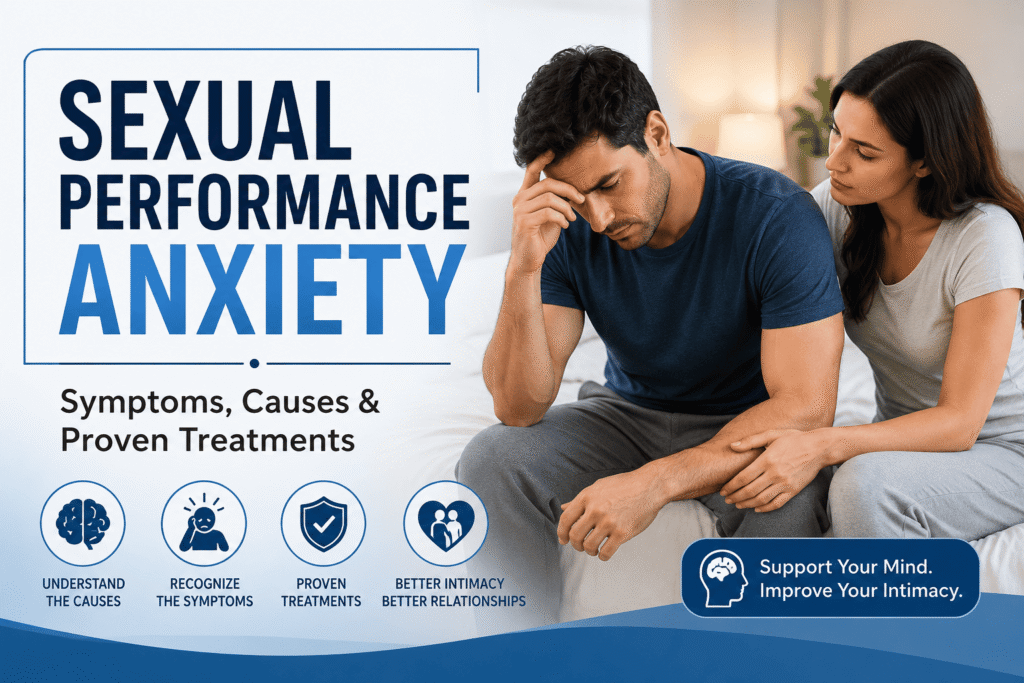
Sexual Performance Anxiety (SPA) is intense worry about sexual ability or fear of failure before or during sexual intimacy. Studies estimate that SPA affects up to 25% of men and 16% of women at some point in their lives. It is one of the most common psychological causes of Erectile Dysfunction in men under 40, and a significant driver of arousal and orgasm difficulty in women. Despite its prevalence, many people manage it in silence rather than seeking support — even though effective, evidence-based treatments are available. This article covers the full picture: what SPA is, how to recognise it, what causes it, how it is diagnosed, and how it is treated.
In men under 40, Erectile Dysfunction is more often psychological in origin, with Sexual Performance Anxiety being one of the leading causes. A key diagnostic clue: men with psychogenic ED typically still experience normal morning and nocturnal erections (because these occur independently of psychological state), but lose erections specifically during partnered activity. This pattern distinguishes SPA-related ED from vascular or neurological causes, which tend to impair all types of erection.
What Is Sexual Performance Anxiety?
Sexual Performance Anxiety is a pattern of fear, worry, or excessive self-monitoring during sexual activity that interferes with natural arousal and enjoyment. It shifts the brain from the parasympathetic state (rest and digest — the neurological environment required for arousal) into the sympathetic state (fight or flight), which constricts blood vessels, raises heart rate, and suppresses sexual response.
Occasional nervousness before intimacy is normal and short-lived. SPA is clinically significant when it:
- Occurs consistently rather than occasionally
- Causes personal distress or leads to avoidance of intimacy
- Persists despite a genuine desire for sexual connection
- Results in consistent sexual difficulty that cannot be explained by physical causes alone
The Anxiety-ED Cycle — How SPA Becomes Self-Reinforcing
One of the most important aspects of SPA to understand is that it tends to be self-perpetuating. Unlike a single episode of anxiety, the cycle reinforces itself:
- Step 1: A sexual difficulty occurs — perhaps triggered by stress, fatigue, alcohol, or an unfamiliar partner.
- Step 2: The experience creates worry about future encounters — ‘What if it happens again?’
- Step 3: This anticipatory anxiety activates the sympathetic nervous system before and during subsequent sexual activity.
- Step 4: The activated stress response directly impairs arousal — making the feared outcome more likely.
- Step 5: The repeated difficulty reinforces the belief that sexual failure is inevitable, deepening the anxiety.
This cycle is called spectatoring — a term from sex therapy for the experience of mentally stepping outside yourself during sex to critically observe your own performance. Spectatoring redirects attention away from the arousal experience and toward self-monitoring, which directly suppresses the neural signals that produce arousal. Breaking this cycle requires addressing the anxiety pattern itself, not just the sexual symptom.
Symptoms of Sexual Performance Anxiety
Physical symptoms in men
- Psychogenic Erectile Dysfunction: Anxiety restricts blood flow to the penis and suppresses the parasympathetic nervous system activity required for erection. This is a primary physical symptom in men with SPA.
- Premature Ejaculation: Anxiety accelerates the ejaculatory reflex, leading to climaxing sooner than desired.
- Delayed Ejaculation: Tension and self-monitoring can prevent reaching climax despite adequate stimulation.
- General autonomic responses: Racing heart, rapid breathing, sweating, muscle tension, and gastrointestinal discomfort — the physical signatures of sympathetic nervous system activation.
Physical symptoms in women
- Vaginal dryness and reduced lubrication: Anxiety reduces the genital blood flow and arousal response that drives natural lubrication.
- Arousal difficulties: Difficulty becoming physically aroused despite desire being present.
- Anorgasmia: Difficulty or inability to reach orgasm due to mental tension and self-monitoring.
- Genital tension or pain: Pelvic floor hypertonicity from chronic anxiety can cause discomfort during intercourse.
Psychological symptoms
- Negative self-talk: Persistent thoughts such as ‘I’m going to disappoint my partner’ or ‘I’m not good enough sexually.’
- Spectatoring: Observing and judging your own performance rather than being present in the experience.
- Anticipatory anxiety: Intense worry beginning hours or days before a planned sexual encounter.
- Performance pressure: Intimacy feels like a test with consequences rather than a shared experience.
- Fear of judgment: Intense concern about how a partner is perceiving your body or performance.
Behavioural signs
- Avoidance: Making excuses to avoid intimacy or withdrawing from physical affection to prevent escalation.
- Reduced libido: Desire drops when sexual intimacy has become consistently associated with stress.
- Relationship strain: Partners may misinterpret avoidance as rejection, creating distance and conflict.
- Substance reliance: Using alcohol to relax before sex — which paradoxically worsens physical sexual function.
Never attempt to manage Sexual Performance Anxiety by self-medicating with alcohol. While it may temporarily reduce inhibition, alcohol consistently worsens physical sexual function, impairs the arousal signal, reduces testosterone, and risks creating a dependency pattern. Alcohol-related sexual difficulty can become its own anxiety trigger.
Causes of Sexual Performance Anxiety
Psychological and emotional causes
- Fear of failure or judgment: Worrying about sexual ability or disappointing a partner creates the performance monitoring that suppresses arousal.
- Body image concerns: Insecurity about weight, appearance, or genital size creates self-consciousness that disrupts presence during intimacy.
- Past negative sexual experiences: A previous episode of ED, orgasm difficulty, or a critical partner response can create lasting anticipatory fear.
- Relationship tension: Unresolved conflict, poor communication, or lack of emotional safety with a partner translates directly into SPA during intimacy.
- Mental health conditions: Depression reduces arousal and desire. Generalised Anxiety Disorder elevates baseline sympathetic nervous system activity, making SPA more likely.
- Unrealistic expectations: Pornography-influenced or socially reinforced standards about what sex ‘should’ look like create a performance template that real intimacy cannot match.
Biological and physical triggers
- Fight-or-flight activation: When anxiety is present, cortisol and adrenaline redirect blood away from non-essential functions — including sexual organs — and constrict the blood vessels needed for arousal.
- Life stress: External pressures divert cognitive resources away from the present moment, making mental engagement with arousal difficult.
- Medication side effects: SSRIs and antidepressants, beta-blockers, and some antihypertensives can impair sexual function, which may then trigger SPA as a secondary psychological response.
- Chronic fatigue or illness: Physical depletion reduces sexual responsiveness and increases the likelihood of a ‘failure’ experience that then generates SPA.
Diagnosing Sexual Performance Anxiety
There is no single diagnostic test for SPA. Diagnosis involves a stepped process of ruling out physical causes before identifying psychological ones:
- Rule out physical causes: Blood tests (hormone levels including testosterone, prolactin, thyroid), cardiovascular assessment (blood pressure, cholesterol), and physical examination. These identify or exclude organic ED, hormonal disorders, or vascular disease.
- Pattern analysis: Situational ED — difficulty in some contexts but not others — is strongly suggestive of a psychological cause. Preserved morning and nocturnal erections in a man with partner-context ED is a classic psychogenic pattern.
- Onset pattern: SPA-related sexual difficulty often appears suddenly and with an identifiable psychological trigger (new partner, relationship stress, first episode of performance difficulty). Organic causes tend to develop gradually.
- Psychological assessment: A mental health professional or sex therapist can assess thought patterns, emotional history, relationship dynamics, and the presence of comorbid anxiety or depression.
- Validated questionnaires: The IIEF (International Index of Erectile Function) for men and the FSFI (Female Sexual Function Index) for women quantify symptom severity and help distinguish psychological from organic sexual dysfunction.
How to Manage Sexual Performance Anxiety
Self-help strategies
- Shift focus from outcome to experience: Direct attention to physical sensation, connection, and pleasure rather than monitoring performance or outcome. This is the foundational principle of sensate focus therapy — one of the most effective sex therapy techniques, developed by Masters and Johnson.
- Open communication with a partner: Talking honestly about anxiety reduces the isolation that sustains it and allows both partners to co-create a lower-pressure environment. Studies confirm that emotional safety with a partner is one of the strongest predictors of SPA reduction.
- Breathing exercises: Slow-paced breathing (exhaling longer than inhaling) activates the vagal brake, reducing heart rate and shifting nervous system dominance toward parasympathetic — the state required for arousal. Research published in PubMed confirms controlled breathing reduces physiological arousal markers including heart rate, respiratory rate, and heart rate variability.
- Mindfulness and meditation: Mindfulness-based practices improve attention regulation, reduce intrusive thoughts, and help individuals remain present during intimacy. A Johns Hopkins University review supports their effectiveness in reducing generalised anxiety with effects transferable to sexual contexts.
- Regular physical exercise: Reduces cortisol, raises testosterone, improves body image, and supports cardiovascular health — all of which directly reduce SPA risk.
- Limit alcohol before intimacy: While alcohol may reduce initial inhibition, it worsens erection and arousal quality, delays orgasm, and risks becoming a dependency.
Therapy and Counselling
Psychotherapy is the primary and most evidence-supported treatment for SPA. The specific approach depends on the individual cause, severity, and whether a partner is involved:
- Cognitive Behavioural Therapy (CBT): Identifies and restructures negative thought patterns driving SPA — including catastrophising, spectatoring, and fear of failure. Demonstrated effectiveness in reducing sexual anxiety and improving erectile function in psychogenic ED.
- Sex Therapy: Focuses on communication, sensate focus exercises, and graduated exposure without performance pressure. Masters and Johnson’s sensate focus technique involves non-sexual touching exercises that progressively reintroduce intimacy without goal pressure — one of the most effective approaches for SPA specifically.
- Couples Therapy: Addresses relationship dynamics, communication gaps, and attachment patterns that contribute to SPA. Particularly effective when relationship tension or partner response is a maintaining factor.
- Mindfulness-based sex therapy: Combines mindfulness practices with sex therapy frameworks to reduce spectatoring and improve present-moment engagement during intimacy.
- Hypnotherapy: Some individuals find hypnotherapy helpful for SPA. Evidence is still limited and developing, but some studies show benefit for stress and anxiety reduction in individuals who are responsive to hypnotic suggestion.
Medications and Medical Options
No medication is specifically FDA-approved for SPA as a standalone diagnosis. The following are used to treat the symptoms or contributing conditions:
- PDE5 inhibitors (Sildenafil, Tadalafil, Vardenafil, Avanafil): First-line pharmacological option for erectile difficulties driven by SPA. By reducing the threshold for erection during arousal, PDE5 inhibitors can break the anxiety-failure cycle and rebuild sexual confidence. Require prescription; absolutely contraindicated with nitrate medicines.
- Buspirone: An anxiolytic prescribed to reduce generalised anxiety levels, which can lower the background arousal threshold and reduce anticipatory anxiety before intimacy. Unlike benzodiazepines, Buspirone is non-addictive and does not impair sexual function.
- SSRIs (Paroxetine, Dapoxetine): For SPA-driven Premature Ejaculation, SSRIs delay ejaculation through serotonergic pathways. Note: most SSRIs themselves can reduce libido and delay orgasm as a side effect — this needs to be weighed in the context of SPA treatment.
- Topical anaesthetics (Lidocaine, Benzocaine): Reduce penile sensitivity for Premature Ejaculation, reducing performance pressure related to early ejaculation.
- Female-specific options: Flibanserin (Addyi) — now FDA-approved for HSDD in women under 65, including both premenopausal and postmenopausal women (expanded indication December 2025). Bremelanotide (Vyleesi) — FDA-approved for premenopausal women with HSDD, self-injected 45 minutes before activity.
- Vacuum Erection Devices (VEDs): Non-invasive, non-pharmacological support for erection that can rebuild confidence through repeated reliable use.
- Hormone therapy: Where low testosterone in men or menopausal hormonal changes in women contribute to reduced arousal and libido, hormonal assessment and treatment may address an underlying contributing cause.
When to See a Doctor
Seek professional support if:
- SPA has persisted for more than 4 to 8 weeks and is not responding to self-help strategies
- Sexual difficulty is occurring in most sexual encounters consistently
- Avoidance of intimacy is developing or worsening
- SPA is causing significant distress, low mood, or relationship strain
- Physical symptoms suggest an organic cause alongside or instead of SPA — including absent morning erections, persistent ED regardless of context, or ED with other symptoms like fatigue or reduced libido
- You are on medications that may be contributing — never stop a prescribed medicine without discussing it with your doctor first
A GP can screen for physical causes, assess hormonal and cardiovascular status, and refer to appropriate specialists — a urologist, sex therapist, or clinical psychologist with expertise in sexual health.
Conclusion
Sexual Performance Anxiety is a common, well-understood condition that responds effectively to evidence-based treatment. It operates through a clear physiological mechanism — the anxiety-activated stress response directly impairs the arousal physiology it is most feared to interfere with — and a self-reinforcing psychological cycle that perpetuates the pattern. Understanding this cycle is the most important first step toward breaking it.
Treatment success is high when individuals engage with appropriate support: self-help strategies reduce mild cases, while cognitive behavioural therapy and sex therapy produce the strongest outcomes for persistent SPA. Medication supports the process where physical symptoms are creating the psychological cycle. The most important action is seeking support rather than waiting in the hope that it will resolve on its own.
Frequently Asked Questions
-
Will Sexual Performance Anxiety go away on its own?
Mild, situational cases can resolve naturally when the precipitating stressor passes. However, persistent SPA rarely resolves without some form of intervention — because the anxiety cycle tends to be self-reinforcing rather than self-limiting. If SPA has been present for more than a month and is affecting most sexual encounters, professional support typically produces better outcomes than waiting.
-
Can Sexual Performance Anxiety happen even when medical tests are normal?
Yes. This is actually the typical presentation — SPA produces real physical sexual difficulties (erection problems, arousal failure, ejaculation issues) despite entirely normal hormone levels, vascular function, and physical examination. The mechanism is physiological: anxiety activates the sympathetic nervous system, which directly impairs arousal through vasoconstriction and stress hormone release.
-
How does age affect Sexual Performance Anxiety?
SPA can occur at any age but presents differently across life stages. In younger men, SPA is the most common cause of ED — with organic causes becoming more prevalent in men over 40. Age-related physical changes (slower arousal, longer refractory period, hormonal shifts) can increase anxiety about performance in men and women who are not aware that these changes are normal. For older women, menopausal hormonal changes that cause vaginal dryness can trigger SPA around pain avoidance. Hormone assessment alongside psychological support is appropriate across age groups.
-
Does Sexual Performance Anxiety affect people outside long-term relationships?
Yes — and often more acutely. New partners, casual encounters, and returning to intimacy after a break can all intensify SPA because they heighten self-awareness, fear of judgment, and the pressure to ‘perform.’ In established relationships, SPA is often maintained by accumulated history and communication patterns. Both contexts respond well to the same evidence-based approaches.
-
Can partners help reduce Sexual Performance Anxiety?
Significantly. Supportive partners who respond to SPA with patience, reassurance, and open communication — rather than frustration or withdrawal — consistently produce better outcomes than those who misinterpret the avoidance or difficulty as rejection. Partners who can co-create lower-pressure sexual environments, engage in sensate focus exercises, and communicate openly about needs and concerns are one of the most powerful therapeutic variables in SPA management.
-
Can diet help with Sexual Performance Anxiety?
Diet does not directly treat SPA, but it supports the physiological conditions that make managing anxiety easier. Foods rich in zinc (oysters, pumpkin seeds, legumes) support testosterone production. Omega-3 fatty acids reduce systemic inflammation associated with anxiety. Magnesium supports nervous system regulation. A Mediterranean-pattern diet improves cardiovascular and vascular health — which reduces the organic contribution to sexual difficulty that can trigger or compound SPA. Diet changes alone are insufficient; they work best as part of a comprehensive approach including therapy.
This article is for general informational purposes only and does not constitute medical advice. If you are experiencing Sexual Performance Anxiety, consult a qualified healthcare provider or licensed sex therapist.
