
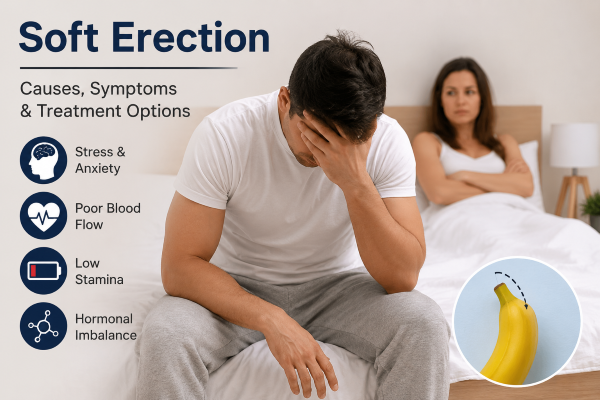
A soft erection — one that develops but doesn’t reach full firmness, or that starts firm and softens partway through sex — is one of the most common ways Erectile Dysfunction (ED) actually presents. It’s not always the total inability to get hard that people picture when they hear “ED”; for many men, it’s this specific, frustrating pattern of insufficient rigidity. This article covers what causes soft erections, the physical and psychological factors involved, and the treatment options that actually work.
Context: A functional erection for intercourse typically corresponds to Grade 3 or 4 on the clinical Erection Hardness Score (EHS) — hard and either fully or nearly fully rigid. A soft erection generally falls at Grade 1 or 2: larger than flaccid but not hard enough for comfortable penetration, or hard but noticeably bendable. Occasional softness isn’t unusual; a consistent pattern is what typically prompts a closer look.
What Counts as a Soft Erection?
A soft erection is the inability to achieve or maintain a firm enough erection for satisfactory sexual activity. It can show up in a few different ways: an erection that never quite reaches full firmness, one that starts firm and gradually softens during sex, or one that fluctuates unpredictably. This pattern is one of the most frequently reported symptoms of ED specifically, distinct from the complete inability to develop any erection at all.
Physical Causes
- Cardiovascular conditions: High blood pressure, heart disease, and atherosclerosis (the buildup of fatty plaque on artery walls) all impair blood flow to the penis, directly reducing the volume of blood available to produce a firm erection.
- Low testosterone or hormonal imbalance: Testosterone supports libido and the neurological conditions in which erections occur; when levels are low, the erectile response can be weaker even with adequate arousal.
- Neurological conditions: Multiple Sclerosis, Parkinson’s Disease, and spinal cord injuries can all interfere with the nerve signals that trigger and sustain an erection.
- Medications: Antidepressants (particularly SSRIs), antihistamines, and blood pressure medicines are among the most commonly implicated in causing softer or less reliable erections as a side effect. Finasteride, used for hair loss and Benign Prostatic Hyperplasia, lowers dihydrotestosterone (DHT) — a hormone involved in sexual function — and can contribute to weaker erections in some men, worth discussing with a doctor if the timing lines up.
- Alcohol, tobacco, and recreational drug use: All three impair the vascular and nervous system functions erections depend on — alcohol acutely, and smoking through progressive damage to blood vessel lining.
- Pelvic or penile injury: Trauma to the pelvic area or penis — including a straddle injury, pelvic fracture, or direct penile injury — can damage the arteries or nerves supplying the penis, sometimes causing persistent difficulty achieving a fully firm erection afterward. This is a less commonly discussed cause, but worth mentioning to a doctor if a soft-erection pattern began after a specific injury.
- Metabolic and respiratory conditions: Chronic Kidney Disease damages blood vessels and disrupts hormone regulation relevant to erectile function. Chronic Obstructive Pulmonary Disease (COPD) impairs breathing efficiency, meaning less oxygen reaches penile tissue during arousal — a less obvious but genuine contributor that’s often overlooked.
- Penile curvature (Peyronie’s Disease): Fibrous scar tissue inside the penis can cause curvature during erection, sometimes alongside pain or reduced firmness in the affected area. An Enlarged Prostate (Benign Prostatic Hyperplasia) can also contribute to erectile difficulty through associated urinary symptoms, discomfort, and sometimes the medications used to treat it.
- Cancer treatment and prostate surgery: Chemotherapy can affect nerve signalling, hormone levels, and circulation relevant to erections. Prostate surgery — particularly when the nerve bundles running alongside the prostate are affected — can directly disrupt the nerve and blood supply pathways an erection depends on, sometimes requiring dedicated penile rehabilitation afterward.
A degree of natural curve — up or down, left or right — is normal in most erections and doesn’t need treatment. A curve of roughly 30 degrees or less is generally considered within the healthy range. More significant curvature, particularly if it developed suddenly or comes with pain, is worth discussing with a doctor, since it can point to Peyronie’s Disease.
Psychological Causes
- Performance anxiety and stress: These directly interfere with the body’s ability to achieve and sustain an erection, independent of any physical cause.
- Depression and anxiety disorders: Both can reduce libido and disrupt the arousal signalling required for a firm erection.
- Relationship difficulties: Unresolved conflict or a lack of emotional connection with a partner can contribute to erectile difficulty even when physical health is otherwise normal.
The mechanism behind anxiety-related softness is worth understanding: anxiety activates the sympathetic nervous system, releasing stress hormones including adrenaline that constrict blood vessels throughout the body — including the ones supplying the penis. This directly opposes the vessel-widening response that arousal is trying to produce, which is why anxious moments so reliably correlate with reduced firmness, even when a man is genuinely aroused.
Lifestyle Contributors
Beyond specific medical or psychological causes, everyday habits meaningfully affect erection firmness:
- Regular exercise improves cardiovascular health and blood flow — both directly relevant to erection firmness
- A balanced diet supports the vascular health that underlies the erectile response
- Adequate sleep supports healthy testosterone production — poor sleep quality is consistently linked with fatigue and lower testosterone, both of which affect erection firmness over time
- Limiting alcohol and avoiding smoking protects the blood vessels erections depend on
Treatment Options
Lifestyle modification
Regular exercise and a balanced diet improve cardiovascular health and blood flow, with meaningful benefits for erection firmness over weeks to months. Relaxation techniques, mindfulness, or counselling can reduce the performance anxiety that contributes to inconsistent firmness.
Medications
Oral PDE5 inhibitors — Sildenafil (Viagra), Tadalafil (Cialis), and Vardenafil (Levitra) — enhance blood flow to the penis and are the first-line prescription treatment for ED-related softness. All require a valid prescription and a doctor’s assessment of suitability, particularly regarding cardiovascular health and any nitrate medicines you may be taking.
Medical devices
- Vacuum erection devices: Create a vacuum around the penis to draw blood in and produce an erection. Effective for short-term use, though not suitable for men with certain bleeding disorders or penile deformities — follow the device instructions and don’t exceed the recommended duration.
- Penile implants: A surgically placed device offering a long-term solution for men with severe ED who haven’t responded to other treatments.
Psychological interventions
A therapist or counsellor can address performance anxiety, relationship difficulties, or other psychological contributors. Specialised sex therapy can help individuals and couples work on communication, technique, and intimacy in a structured way.
When to See a Doctor
- Soft or inconsistent erections are persistent rather than occasional
- The difficulty is interfering with sexual satisfaction or your quality of life
- The pattern began suddenly, or specifically after an injury, new medication, or major life stressor
- You’re also noticing reduced libido, fatigue, or other symptoms that might point to a hormonal cause
Men’s Health Guide
Understanding sexual health involves more than treating a single concern. Factors such as lifestyle, sexual performance, erectile function, premature ejaculation, exercise, and medication safety can all play a role. Below are useful resources covering common men’s sexual health questions.
1.Viagra and Alcohol: What You Should Know
Learn how alcohol may affect the effectiveness and safety of Viagra and why moderation is important.
Explore the potential connection between cranberry juice, urinary health, and aspects of sexual wellness.
Understand how dapoxetine is used for premature ejaculation and the key considerations before using it.
4.Can I Take Cialis Without Erectile Dysfunction?
Find out whether Cialis is appropriate for people who do not have erectile dysfunction and what risks to consider.
Discover exercises and fitness approaches that may help improve endurance, pelvic control, and overall sexual performance.
Learn about common causes of weak erections and the lifestyle changes and treatment options that may help.
Conclusion
Soft erections can stem from physical causes (cardiovascular disease, hormonal imbalance, nerve damage, medication side effects, injury), psychological causes (anxiety, depression, relationship strain), or — most often — some combination of both. Understanding the likely driver behind your specific pattern is the most useful first step toward the right treatment, whether that’s a lifestyle change, medication, a device, counselling, or some combination of these. A doctor can help identify the underlying cause and build a treatment plan suited to your situation.
Frequently Asked Questions
-
What is a soft erection?
A soft erection refers to the inability to achieve or maintain an erection firm enough for satisfactory sexual intercourse. It’s usually a symptom of Erectile Dysfunction rather than a separate condition in its own right, and it can range from an erection that never quite firms up to one that starts firm and softens during activity.
-
What causes a soft erection?
Common causes include cardiovascular disease, Diabetes, and Obesity, as well as injury to the pelvic area or penis, side effects from certain medications (particularly antidepressants and blood pressure drugs), and alcohol or substance use. Psychological factors like anxiety, stress, and depression are equally common contributors, often alongside a physical cause rather than instead of one.
-
How can I improve a soft erection?
A doctor may prescribe PDE5 inhibitors such as Sildenafil, Tadalafil, or Vardenafil — always through a proper prescription rather than an unverified online source. Beyond medication, psychotherapy for anxiety or relationship factors, and lifestyle changes like regular exercise, a balanced diet, and reducing alcohol intake, can all meaningfully improve erectile firmness over time.
-
Can anxiety cause a soft erection?
Yes. Stress and performance anxiety disrupt the body’s normal response to sexual stimulation by activating the sympathetic nervous system, which releases stress hormones that constrict blood vessels — including the ones supplying the penis. This directly works against the blood-vessel-widening response that arousal is trying to produce, which is why anxious moments so often correlate with reduced firmness. Stress management, anxiety therapy, or counselling can meaningfully improve this pattern.
-
When should I see a doctor about soft erections?
If you experience persistent difficulty achieving or maintaining a firm erection that’s interfering with your sexual satisfaction or quality of life, it’s worth consulting a doctor. This is especially true if the pattern started suddenly, followed an injury or new medication, or is accompanied by other symptoms like reduced libido or fatigue — all of which can point toward a specific, treatable underlying cause.
-
Can sleeping pills cause soft erections?
Yes. Sleeping pills and sedatives — including benzodiazepines, so-called “Z-drugs,” and some antidepressants prescribed for sleep — work by suppressing central nervous system activity, which can slow the nerve signals involved in achieving and maintaining an erection. If you’ve started a sleep medication and noticed a change in erection firmness around the same time, it’s worth mentioning to your prescriber, who may be able to adjust the medication or dose.
-
Will a calcium-magnesium supplement cause soft erections?
No — there’s no evidence that calcium-magnesium supplements cause soft erections, and some research suggests the opposite may be true. Magnesium in particular plays a role in nerve and blood vessel function, and low levels have been associated with a higher risk of Erectile Dysfunction in some studies. That said, correcting a genuine deficiency (confirmed by blood testing) is a more reliable approach than supplementing indiscriminately.
-
Are soft erections reversible?
Often, yes. Many of the most common causes — lifestyle factors, psychological stress, and temporary or medication-related issues — are reversible once the underlying trigger is addressed. If a specific medication is the culprit, switching or adjusting it under medical guidance can restore normal erectile function. Causes tied to more significant nerve damage or long-standing vascular disease are less likely to fully reverse, but usually remain manageable with treatment.
-
Does frequent masturbation cause softer erections?
No — this is a persistent myth without scientific support. Multiple studies have consistently found no meaningful link between masturbation frequency and reduced erection quality or Erectile Dysfunction. If erection firmness is changing, it’s worth looking at the physical, psychological, and lifestyle causes covered in this article rather than masturbation habits.
This article is for general informational purposes only and does not constitute medical advice. If you are experiencing persistent soft erections, consult a qualified healthcare provider for a proper diagnosis and treatment plan.
