
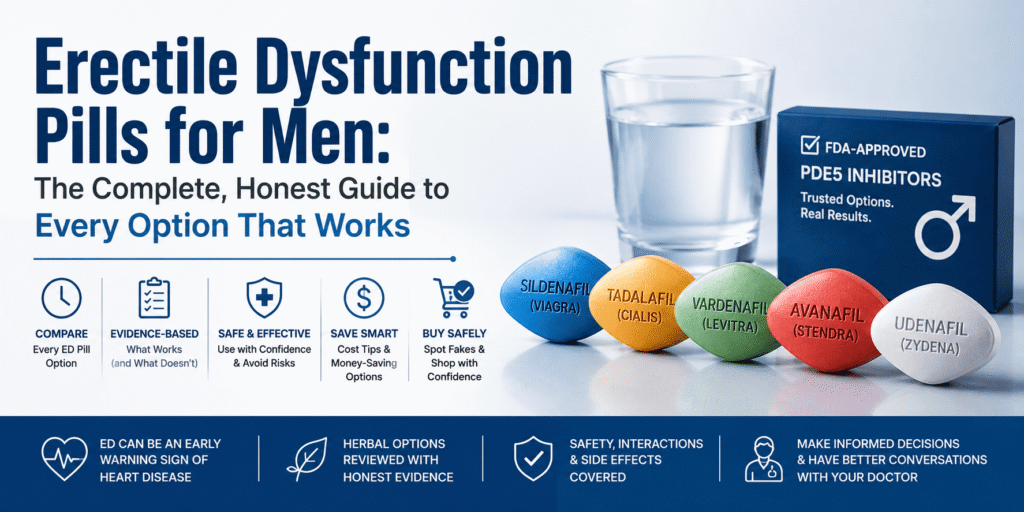
If your doctor has mentioned Phosphodiesterase-5 (PDE5) inhibitors — or you have seen names like Sildenafil, Tadalafil, Vardenafil, or Avanafil — you likely have questions that go beyond the basics. How exactly do they work? How are they different from one another? What makes one work better for your lifestyle than another? And what does a doctor actually consider before prescribing one? This guide covers all of that: the mechanism behind every drug in the class, a practical side-by-side comparison of the four FDA-approved options, the full safety picture including interactions most guides miss, reasons they sometimes fail and what to do about it, and a clear framework for the conversation with your doctor.
Did you know? The discovery that PDE5 inhibitors treat Erectile Dysfunction was completely accidental. Sildenafil was initially developed to treat Angina and High Blood Pressure. During early clinical trials, participants reported a consistent and unexpected side effect — improved erections — and researchers pivoted the entire drug program. Today, ED is estimated to affect about 320 million men globally by 2025, making PDE5 inhibitors one of the most prescribed drug classes in the world.
What Is PDE5 and Why Does It Matter?
Phosphodiesterase type 5 (PDE5) is an enzyme — a protein that speeds up a specific chemical reaction. Its job is to break down a molecule called cyclic Guanosine Monophosphate (cGMP). This matters because cGMP is a key chemical signal that tells smooth muscle to relax and blood vessels to widen.
PDE5 is found throughout the body, but it is especially concentrated in two places: the smooth muscle of the corpus cavernosum (the erectile tissue of the penis) and the smooth muscle of the pulmonary arteries (the blood vessels supplying the lungs). This distribution explains precisely why PDE5 inhibitors are useful for Erectile Dysfunction and Pulmonary Arterial Hypertension — and why their side effects cluster around blood pressure, vision (PDE6 in the retina shares similarity with PDE5), and muscle (PDE11 in skeletal muscle is similar to PDE5 in Tadalafil).
Understanding PDE5 also explains why these medicines require sexual stimulation: they do not generate cGMP themselves. They only prevent its destruction. Without arousal to start the cGMP signal in the first place, blocking PDE5 does nothing.
The Exact Chain: How PDE5 Inhibitors Produce an Erection
The erection process is a carefully timed sequence. PDE5 inhibitors intervene at one precise point in that chain:
- Step 1 — Arousal: Sexual stimulation (physical or mental) activates the nervous system, sending signals to the penile tissue.
- Step 2 — Nitric Oxide release: Nerve endings and the inner lining of blood vessels release Nitric Oxide (NO) into the corpus cavernosum.
- Step 3 — cGMP production: Nitric Oxide activates an enzyme called guanylate cyclase, which converts GTP into cyclic Guanosine Monophosphate (cGMP).
- Step 4 — Smooth muscle relaxation: cGMP lowers calcium levels inside smooth muscle cells, causing those cells to relax. Relaxed muscle allows penile arteries to dilate and blood to flow into the corpus cavernosum.
- Step 5 — Erection: The corpora fill with blood, the penis becomes rigid, and the veins that drain blood from the area are passively compressed, sustaining the erection.
- Step 6 (normal) — PDE5 breaks down cGMP: Normally PDE5 rapidly degrades cGMP, the smooth muscle contracts, blood drains, and the erection ends.
- Step 6 (with PDE5 inhibitor) — Breakdown is slowed: The PDE5 inhibitor occupies the enzyme’s active site, blocking it from breaking down cGMP. cGMP stays elevated longer, the smooth muscle stays relaxed longer, and the erection is easier to achieve and maintain.
This is why timing matters, why food and alcohol affect absorption, and why the medicines work only with arousal present — the entire mechanism depends on Nitric Oxide being released first.
Three Generations of PDE5 Inhibitors
Most guides treat all PDE5 inhibitors as interchangeable. They are not. Researchers classify them into three generations based on when they were developed and how selective they are for PDE5 over related enzymes.
- First generation — Sildenafil and Vardenafil: Developed in the 1990s and first to market. Effective and well-studied, but have relatively broader inhibition of enzymes related to PDE5 (particularly PDE6 in the retina for Sildenafil, explaining the blue-tint visual side effect, and minor QT-prolongation risk with Vardenafil).
- Second generation — Tadalafil: A structurally different molecule with far greater duration of action (up to 36 hours) and cross-reactivity with PDE11 in skeletal muscle, explaining the back-pain and muscle-ache side effects unique to this drug.
- Third generation — Avanafil: Engineered specifically for maximum selectivity for PDE5 over other PDE enzymes, a faster onset of action, and a cleaner side-effect profile. Because it is less likely to inhibit PDE6 and PDE11, visual disturbances and muscle aches are considerably rarer.
This generational difference is clinically important and rarely explained to patients. If you experience visual side effects with Sildenafil, switching to Tadalafil or Avanafil is a reasonable option to discuss with your doctor.
All Four FDA-Approved Drugs: A Detailed Comparison
The following profiles cover what each drug actually does differently — not just brand names and timings, but the practical distinctions that affect real use.
Sildenafil (Viagra / Revatio) — First generation
- Onset: 30 to 60 minutes on an empty stomach; up to 2 hours after a high-fat meal.
- Duration: 4 to 6 hours.
- Available doses (ED): 25 mg, 50 mg, 100 mg — starting dose is usually 50 mg.
- Distinctive side effect: Blue-tint or light-sensitivity visual disturbance (usually brief and harmless) due to cross-reactivity with PDE6 in retinal cells.
- Food interaction: High-fat meals significantly slow absorption — take at least 2 hours after a heavy meal for reliable timing.
- Best suited for: Planned encounters; patients with the largest evidence base for reassurance; also approved for Pulmonary Arterial Hypertension at lower doses (Revatio 20 mg three times daily).
Tadalafil (Cialis / Adcirca) — Second generation
- Onset: 30 minutes to 2 hours; peak effect around 2 hours.
- Duration: Up to 36 hours — the longest in the class, earning the nickname “the weekend pill.”
- Available doses (ED): 5 mg, 10 mg, 20 mg for on-demand use; 2.5 mg and 5 mg for once-daily use.
- Distinctive side effect: Back pain and muscle aches (myalgia) occurring 12 to 24 hours after the dose, usually mild and resolving within 48 hours, due to cross-reactivity with PDE11 in skeletal muscle.
- Food interaction: Not significantly affected by food or moderate alcohol — the most flexible option in this regard.
- Best suited for: Men who want spontaneity; men who find timing stressful; once-daily dosing for continuous benefit without planning; also FDA-approved for BPH with or without ED, and for PAH (Adcirca).
Vardenafil (Levitra / Staxyn) — First generation
- Onset: 30 to 60 minutes.
- Duration: 4 to 5 hours, similar to Sildenafil.
- Available doses (ED): 5 mg, 10 mg, 20 mg; Staxyn is an orally disintegrating tablet (10 mg).
- Distinctive feature: Fewer visual side effects than Sildenafil; less affected by moderate alcohol. However, it carries a small risk of QT-prolongation (a heart rhythm concern), so it requires extra caution in patients with certain heart conditions or on QT-prolonging medicines.
- Food interaction: High-fat meals may slow absorption, though to a lesser degree than Sildenafil.
- Best suited for: Patients who experience visual disturbances on Sildenafil; Staxyn formulation for those who prefer not to swallow tablets.
Avanafil (Stendra) — Third generation
- Onset: As early as 15 minutes in clinical studies — the fastest in the class.
- Duration: Up to 6 hours.
- Available doses (ED): 50 mg, 100 mg, 200 mg.
- Distinctive feature: Highest selectivity for PDE5 over related enzymes, meaning fewer visual disturbances and muscle side effects. Successful intercourse has been observed as early as 15 minutes after administration.
- Food interaction: Least affected by food or moderate alcohol in the class.
- Best suited for: Patients who want the fastest onset; patients who have experienced side effects on older agents; men for whom spontaneity is a high priority.
Clinical note: No PDE5 inhibitor works reliably on a full stomach of fatty food except Tadalafil. If Sildenafil or Vardenafil seem to have stopped working, the most common practical reason is not tolerance — it is taking the medicine too soon after a large meal. Ask your doctor about this before concluding the medicine has failed.
Approved Medical Uses Beyond Erectile Dysfunction
PDE5 inhibitors are not single-purpose drugs. Their ability to relax smooth muscle in blood vessel walls makes them therapeutically useful wherever vascular tone needs to be reduced.
- Pulmonary Arterial Hypertension (PAH): Sildenafil (Revatio) and Tadalafil (Adcirca) are both FDA-approved for PAH, a serious condition where abnormally high pressure in the pulmonary arteries strains the right side of the heart. In PAH, PDE5 inhibitors reduce that pressure, improve exercise capacity, and slow progression.
- Benign Prostatic Hyperplasia (BPH): Tadalafil (Cialis 5 mg daily) is FDA-approved for BPH symptoms with or without ED. It relaxes smooth muscle in the prostate, bladder neck, and urethra, improving urinary flow and reducing the feeling of incomplete bladder emptying.
- Altitude sickness (investigational): Early research shows PDE5 inhibitors may reduce high-altitude pulmonary oedema risk by lowering pulmonary vascular resistance at altitude. This use is not FDA-approved but is under investigation.
- Post-prostatectomy erectile rehabilitation (investigational): Some urologists use low-dose daily Tadalafil after nerve-sparing prostatectomy to support penile blood flow while nerves recover, though the evidence base is still developing.
- Raynaud’s phenomenon and systemic sclerosis (off-label): Small studies have explored PDE5 inhibitors for improving circulation in the fingers and toes in these conditions, with some promising but inconclusive findings.
Side Effects: Common, Uncommon, and Serious
Common — usually mild and temporary
- Headache (most common overall, related to generalised blood vessel dilation)
- Facial flushing and warmth
- Nasal congestion or runny nose
- Indigestion or upset stomach
- Blue-tinted or brighter-than-normal vision — Sildenafil specifically (PDE6 cross-reactivity)
- Back pain and muscle aches — Tadalafil specifically, typically 12–24 hours after the dose
- Dizziness, especially when standing up quickly (related to mild blood pressure drop)
Serious — require immediate medical attention
- Priapism: An erection lasting more than four hours is a urological emergency. Prolonged priapism can permanently damage the erectile tissue and cause irreversible ED. Go to an emergency department immediately. Do not wait.
- Sudden vision loss in one or both eyes: Rare cases of non-arteritic anterior ischaemic optic neuropathy (NAION) have been reported. Stop the medicine and seek emergency eye care immediately. Risk appears higher in men with pre-existing optic nerve or vascular risk factors.
- Sudden hearing loss or severe tinnitus: A direct causal link has not been firmly confirmed, but any sudden hearing change while on these medicines warrants immediate medical assessment.
- Severe chest pain, shortness of breath, or palpitations: Seek emergency care without delay.
- Severe hypotension (dangerous blood pressure drop): Most likely when combined with nitrates, alcohol, or alpha-blockers. Symptoms include extreme dizziness, fainting, or collapse.
Drug Interactions: The Complete Safety Picture
This is the section most guides underserve. PDE5 inhibitors have well-documented interactions that can be dangerous. Every prescriber reviews this list — patients should be aware of it too.
Absolute contraindication — never combine
- Nitrate medicines: Nitroglycerin, isosorbide mononitrate, isosorbide dinitrate, and any other nitrate — including recreational nitrite inhalants (“poppers”). The blood-pressure drop can be severe and fatal. There is no safe dose combination.
Significant interactions requiring medical review
- Alpha-blockers (e.g. Tamsulosin, Doxazosin): Used for prostate symptoms and high blood pressure. Combining with PDE5 inhibitors can cause significant orthostatic hypotension (dizziness on standing). Lower starting doses of the PDE5 inhibitor are typically needed.
- Other antihypertensive medicines: Additive blood-pressure-lowering effect. Usually manageable, but requires monitoring.
- CYP3A4 inhibitors (e.g. Ketoconazole, Itraconazole, Ritonavir, Clarithromycin): These medicines slow how the liver breaks down PDE5 inhibitors, raising their blood levels significantly. Your doctor will usually prescribe a lower starting dose if you take any of these.
- CYP3A4 inducers (e.g. Rifampin, Carbamazepine, St John’s Wort): These speed up breakdown of PDE5 inhibitors, potentially making them less effective.
- Other ED medicines or PDE5 inhibitors: Never combine two PDE5 inhibitors, or a PDE5 inhibitor with other ED treatments such as injectable alprostadil, without explicit medical guidance. The additive effect increases priapism risk.
- Grapefruit and grapefruit juice: Grapefruit inhibits CYP3A4 in the gut, which can raise levels of Sildenafil and Vardenafil unpredictably. Tadalafil and Avanafil are less affected but caution is still reasonable. Avoid grapefruit on the day you take any PDE5 inhibitor.
Warning: Never take a PDE5 inhibitor that was not prescribed specifically for you. Never exceed the prescribed dose, even if the medicine seems to have stopped working. Never buy these medicines from an unverified online source — counterfeit products are common and have been found to contain undisclosed ingredients, incorrect doses, or toxic substitutes. These are prescription-only medicines because a doctor must screen for heart disease, drug interactions, and other contraindications before you take them.
Daily Dose vs. On-Demand Use: Which Strategy Fits You?
Only Tadalafil is available in both an on-demand dose and a low-dose daily option. This is a genuine clinical decision, not just a preference.
On-demand dosing (all four drugs)
You take the medicine 15–60 minutes before anticipated sexual activity. This is the standard approach for most men starting treatment. It keeps medicine exposure limited to when it is needed and avoids any continuous blood pressure effect.
Daily low-dose Tadalafil (2.5 mg or 5 mg)
Tadalafil taken daily at a low dose maintains a steady baseline level in the blood, meaning no timing is needed before sex. This approach also provides continuous smooth-muscle relaxation in the prostate and bladder neck, which is why daily Tadalafil is the only PDE5 inhibitor approved for BPH.
Research suggests daily low-dose Tadalafil may also have a mild beneficial effect on endothelial health over time, though this remains an active area of study. Your doctor may recommend the daily approach if on-demand timing creates anxiety, if you have BPH alongside ED, or if the on-demand dose is producing inconsistent results.
Why PDE5 Inhibitors Sometimes Fail — and What to Do
PDE5 inhibitors do not work for everyone, and even when they work initially, some men find them less effective over time. Understanding why is essential before concluding that nothing will help.
- Insufficient arousal: The most overlooked reason. If Nitric Oxide release is low — because of low desire, anxiety, or distraction — the cGMP signal that the inhibitor is supposed to prolong simply is not strong enough. Address the psychological context, not just the dose.
- Food and timing errors: Taking Sildenafil or Vardenafil too soon after a fatty meal is one of the most common reasons for apparent failure. Switch to an empty-stomach window or switch to Tadalafil.
- Inadequate trial: Guidelines recommend trying a drug at least four to eight times before concluding it does not work, since early anxiety, timing errors, and dose adjustment all take time to resolve.
- Wrong dose: Starting doses are conservative. If 50 mg Sildenafil produces no effect, your doctor may increase to 100 mg. Never self-escalate without medical guidance.
- Severe underlying vascular disease: In men with significantly damaged penile arteries (from longstanding Diabetes, cardiovascular disease, or smoking), there may not be sufficient blood supply for the medicine to improve, regardless of dose. Here, other options — vacuum devices, injectable therapies, or surgery — are discussed.
- Nerve damage: After radical prostatectomy or in advanced neurological conditions, nerve signalling to the penis may be insufficient to trigger Nitric Oxide release. PDE5 inhibitors rely on that signal and will not work without it.
- Psychological ED: PDE5 inhibitors can break the anxiety-failure cycle that drives psychological ED, but they are not a permanent psychological fix. Combining medication with sex therapy or CBT is often more effective long-term than medication alone.
Clinical tip: If one PDE5 inhibitor has not produced results, do not assume the class has failed. Switching to a different agent — particularly from Sildenafil to Tadalafil, or from either to Avanafil — sometimes makes a meaningful difference because of differences in absorption, duration, and selectivity. Ask your doctor about trying a second option before pursuing other treatments.
Lifestyle Factors That Affect How Well They Work
PDE5 inhibitors do not work in a vacuum. Several everyday choices directly affect how well they perform — and most guides barely mention this.
- Alcohol: Alcohol is itself a vasodilator and a CNS depressant that can impair arousal and the neurological signal needed to start the erection process. More than one to two standard drinks significantly reduces the reliability of any PDE5 inhibitor and compounds the blood-pressure-lowering effect. Minimal alcohol on the day of use is the practical advice.
- Smoking: Smoking damages the endothelial lining of blood vessels and reduces Nitric Oxide bioavailability — the very signal PDE5 inhibitors depend on. Smokers consistently show lower response rates to PDE5 inhibitors than non-smokers. Stopping smoking is one of the highest-yield interventions for improving response.
- High-fat meals: Particularly relevant for Sildenafil and Vardenafil. A fatty meal slows gastric emptying, which delays peak absorption and can halve the effective peak concentration of the drug. Take these medicines at least two hours after a high-fat meal, or switch to Tadalafil or Avanafil if meal timing is consistently an issue.
- Physical fitness and metabolic health: Cardiovascular fitness, healthy weight, controlled blood sugar, and controlled blood pressure all improve endothelial function and Nitric Oxide availability. Men who improve their metabolic health often find PDE5 inhibitors more effective, and some men with mild ED see improvement from lifestyle changes alone.
- Psychological state: Anxiety — including performance anxiety specifically about whether the medicine will work — can suppress the arousal response enough to prevent adequate Nitric Oxide release. In this case the issue is not the medicine but the mental state around it. A relaxed, familiar setting often produces better results than a high-pressure situation.
- Grapefruit juice: As noted under drug interactions, grapefruit inhibits the gut enzyme that metabolises these medicines, potentially causing unpredictably high levels. Avoid grapefruit on the day of use.
Who Should Not Use PDE5 Inhibitors
PDE5 inhibitors are not suitable for everyone. A doctor assesses these factors before prescribing.
- Anyone currently taking nitrate medicines in any form (absolute contraindication).
- Anyone for whom sexual activity itself is unsafe due to cardiovascular instability.
- Anyone with a recent (within the last 90 days) heart attack or stroke.
- Anyone with severe heart failure or severe, uncontrolled Low Blood Pressure.
- Anyone with severe liver disease (impaired drug metabolism).
- Anyone with a known hypersensitivity to the specific medicine.
- People with certain inherited retinal diseases (e.g. retinitis pigmentosa) — particularly with Sildenafil.
Additionally, dose reductions are typically required in moderate kidney or liver impairment, and in older men who may be more sensitive to the blood-pressure-lowering effect.
Conclusion
PDE5 inhibitors are among the most thoroughly studied classes of prescription medicines available. They work by extending one of the body’s own chemical signals — cGMP — rather than forcing an artificial effect, which is why sexual stimulation remains necessary and why they generally integrate well into normal physiology.
The four FDA-approved options differ meaningfully in speed, duration, food sensitivity, and side-effect profile, and the right choice depends on your lifestyle, other health conditions, and what matters to you practically. Understanding the three-generation classification, the lifestyle factors that influence response, and the genuine reasons some men do not respond on the first try all make for a better conversation with your doctor — and better outcomes.
If you have questions about whether PDE5 inhibitors are appropriate for you, or if a current prescription is not working as expected, the most useful next step is an honest, detailed conversation with your prescribing doctor.
Frequently Asked Questions
- Can I take a PDE5 inhibitor every day?
Only Tadalafil is approved for once-daily use, at 2.5 mg or 5 mg. The other three are taken on an as-needed basis before sexual activity. Daily Tadalafil is also approved for Benign Prostatic Hyperplasia, offering urinary benefits alongside ED treatment. Your doctor will advise which approach suits your situation.
- What should I do if a PDE5 inhibitor stops working?
First, consider practical factors: meal timing, alcohol, anxiety, and dose adequacy. Guidelines recommend at least four to eight attempts before concluding a drug is ineffective. If it genuinely is not working, talk to your doctor about adjusting the dose, switching to a different drug in the class, or investigating whether an underlying condition has progressed.
- Are generic PDE5 inhibitors as effective as branded versions?
Yes. Generic medicines contain the same active ingredient in the same dose and must meet FDA bioequivalence standards. A large 2025 meta-analysis confirmed no clinically meaningful difference in efficacy or safety between generic and branded PDE5 inhibitors. The main practical difference is cost.
- Can PDE5 inhibitors affect the heart?
For most men with stable cardiovascular disease and without nitrate use, PDE5 inhibitors are considered safe under medical supervision. However, they do lower blood pressure modestly, and sexual activity itself increases cardiac workload. Your doctor will assess whether your heart health makes sex — and therefore PDE5 inhibitors — safe for you. Never take them without this evaluation if you have heart disease.
- Do PDE5 inhibitors affect fertility or testosterone?
PDE5 inhibitors do not meaningfully affect testosterone levels or sperm quality in the doses used for ED. They also do not treat low testosterone — if that is the underlying cause of your ED, a doctor would address it separately. These medicines improve the mechanics of erection; they do not affect hormones or fertility.
Citations
- Dhaliwal A, Gupta M. PDE5 Inhibitors. StatPearls. NCBI Bookshelf, NIH. https://www.ncbi.nlm.nih.gov/books/NBK549843/
- Cleveland Clinic. Phosphodiesterase Inhibitors: What They Are and How They Work. https://my.clevelandclinic.org/health/treatments/23211-phosphodiesterase-inhibitors
- Blount MA, et al. Advances in Phosphodiesterase 5 Inhibitors. PMC 2023. https://pmc.ncbi.nlm.nih.gov/articles/PMC10536424/
- Hatzimouratidis K, et al. Avanafil for erectile dysfunction: initial data and clinical properties. PMC 2013. https://pmc.ncbi.nlm.nih.gov/articles/PMC3547533/
- U.S. Food and Drug Administration. Stendra (avanafil) Prescribing Information. https://www.accessdata.fda.gov/drugsatfda_docs/label/2018/202276s018lbl.pdf
- Selvin E, et al. Prevalence and Risk Factors for Erectile Dysfunction in the US. American Journal of Medicine, 2007. https://www.amjmed.com/article/S0002-9343(06)00689-9/fulltext
- An overview on pharmaceutical applications of PDE5 inhibitors. PMC 2025. https://pmc.ncbi.nlm.nih.gov/articles/PMC12454544/
