
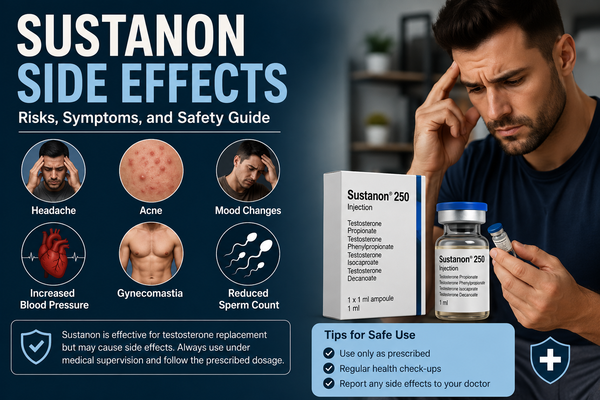
Sustanon 250 is an injectable testosterone formulation used to treat Low Testosterone (hypogonadism) in men. It contains a blend of four testosterone esters — testosterone propionate, phenylpropionate, isocaproate, and decanoate — that produce both a rapid initial rise and sustained testosterone levels over two to three weeks. Like all testosterone replacement therapies, Sustanon can cause side effects. Most are mild, predictable, and manageable with appropriate medical oversight. A small number are serious and require prompt attention. Understanding which side effects to expect, which to monitor, and which demand immediate care is essential to using Sustanon safely. This article covers them all — with guidance on management and a clear framework for who should avoid it entirely.
A study published in PLOS One found that when testosterone levels were artificially elevated in men, they became 27% less generous with money toward strangers compared to when they took a placebo. This is one of several studies demonstrating that testosterone levels influence prosocial behaviour — a relevant consideration when understanding mood and behavioural changes reported by some men during TRT.
Common Sustanon Side Effects
Common Sustanon side effects are typically mild to moderate, often resolve as the body adjusts to stable testosterone levels, and are more pronounced in the early weeks of treatment when hormone levels are fluctuating. They do not generally require stopping treatment but may warrant dose adjustment or additional management.
- Injection site reactions: Mild soreness, redness, warmth, or swelling at the injection site are common with any oil-based intramuscular injection. Sustanon 250 uses arachis (peanut) oil as its carrier, which can cause more localised irritation than some alternatives. Rotating injection sites and warming the ampoule before use (to reduce oil viscosity) reduce the likelihood and severity of site reactions.
- Acne and oily skin: Testosterone stimulates sebaceous glands to produce more sebum. This is the same mechanism that drives teenage acne — elevated androgens increasing sebum production and clogging pores. The effect is mediated primarily through Dihydrotestosterone (DHT), a potent testosterone metabolite.
- Increased body and facial hair: Testosterone and DHT promote terminal hair growth on the chest, back, arms, and face. Men who are genetically predisposed may notice accelerated or more extensive growth.
- Mood changes and irritability: Testosterone levels fluctuate across the injection cycle with Sustanon — peaking in the first few days after injection and declining toward the end of the dosing interval. These fluctuations can cause mood swings, irritability, or increased emotional reactivity, particularly noticeable in the days immediately after injection and in the days before the next dose. More frequent smaller doses (every 2 weeks rather than every 3 to 4 weeks) can reduce this fluctuation.
- Sleep disturbances: Some men experience insomnia or restlessness, particularly in the early weeks of TRT. This may relate to the increased energy and arousal drive that testosterone supports. Sustanon can also worsen or unmask Obstructive Sleep Apnoea in predisposed men.
- Fluid retention and weight gain: Testosterone promotes sodium and water retention, which can cause mild facial puffiness or ankle swelling and a modest increase in body weight in early treatment. This typically stabilises as the body adapts.
- Musculoskeletal discomfort: Mild joint and muscle discomfort can occur as the body adapts to changing testosterone levels and the beginning of accelerated muscle protein synthesis.
- Prostate changes: Testosterone and DHT stimulate prostate tissue. Some men experience an increase in prostate size and associated urinary symptoms — increased frequency, reduced flow, or urgency — particularly those with pre-existing Benign Prostatic Hyperplasia (BPH).
- Gastrointestinal effects: Mild abdominal discomfort, bloating, or nausea can occur, particularly in the early weeks of treatment.
Rare and Serious Sustanon Side Effects
These side effects are less common but require immediate medical attention if they occur. They are more likely with high doses, prolonged use without monitoring, or in men with existing risk factors.
- Erythrocytosis (elevated red blood cell count / haematocrit): Testosterone stimulates erythropoietin (EPO) production, increasing red blood cell synthesis. When haematocrit rises above approximately 52 to 54%, blood viscosity increases significantly, raising the risk of deep vein thrombosis, pulmonary embolism, and stroke. This is the most important laboratory abnormality to monitor on TRT and is detected by routine blood testing. Haematocrit should be checked at 3 months, 6 months, and annually.
- Blood clots and thromboembolism: The combination of elevated haematocrit and testosterone’s prothrombotic effects increases the risk of blood clot formation. Deep vein thrombosis (DVT — blood clot in the leg) and pulmonary embolism (PE — blood clot in the lung) are serious and potentially life-threatening. Symptoms: leg pain or swelling (DVT), chest pain or shortness of breath (PE) — seek emergency care immediately.
- Pulmonary oil microembolism: A specific risk of injectable testosterone — if a small amount of oily vehicle enters a blood vessel during injection, it can travel to the lungs and cause symptoms including cough, shortness of breath, palpitations, and chest discomfort. Usually self-limiting, but severe cases require emergency care. This reinforces the importance of proper injection technique and aspiration checks.
- Priapism: A painful erection lasting more than 4 hours unrelated to sexual stimulation. A urological emergency — ischemic Priapism causes tissue damage that can lead to permanent Erectile Dysfunction. Seek emergency care immediately.
- Severe allergic reaction (anaphylaxis): Men with peanut or soya allergy must not use Sustanon 250, which contains arachis (peanut) oil. Even without a known allergy, severe allergic reactions are possible. Symptoms: difficulty breathing, widespread hives, swelling of the face or throat — emergency care required.
- Liver effects: Injectable testosterone at therapeutic doses carries minimal hepatotoxic risk compared to oral anabolic steroids (which have much higher liver toxicity). Elevated liver enzymes can occur, particularly at high doses, and warrant monitoring. Dark urine, jaundice, or abdominal pain require immediate medical evaluation.
- Severe cardiovascular effects: Sustained high haematocrit, high blood pressure, and testosterone-mediated changes in lipid profiles (reduced HDL, increased LDL) contribute to cardiovascular risk with long-term TRT. Men with pre-existing cardiovascular disease should have explicit specialist review before starting Sustanon.
- Virilisation in women and children: If testosterone gel or injectable testosterone is transferred to women or children (through skin contact), it can cause virilisation effects. Sustanon 250 is injectable, but this warning applies if the injection site or ampoule is handled by others without protective gloves. Women, children, and pregnant individuals must not handle Sustanon.
- Gynaecomastia: Testosterone is partially converted to oestradiol (oestrogen) through aromatisation. Elevated oestrogen in men can cause breast tissue growth or tenderness. More common with supraphysiological (above-normal) doses.
Fertility and Sperm Production — A Critical Consideration
This section deserves its own heading because it is one of the most clinically important Sustanon side effects for younger men — and one that is often insufficiently communicated before treatment begins.
Like all exogenous testosterone, Sustanon suppresses the hypothalamic-pituitary-testicular (HPT) axis. Luteinising Hormone (LH) and Follicle-Stimulating Hormone (FSH) — the signals that drive both natural testosterone production and sperm synthesis — are suppressed. The result is testicular atrophy and significantly reduced or absent sperm production, often falling to zero with sustained use.
Research cited by the NCBI confirms that 10% of men on testosterone replacement therapy will not recover their spermatogenesis even after treatment is stopped. Recovery can take months to years, and in some cases is incomplete.
Men who wish to preserve fertility should discuss this explicitly before starting any TRT. Options include:
- Human Chorionic Gonadotrophin (hCG) — used alongside TRT to maintain testicular function and sperm production by mimicking LH
- Clomiphene citrate — an off-label oral option that stimulates natural testosterone production without suppressing sperm
- Sperm banking — before starting TRT, if future fertility is a priority
This is a conversation to have with a urologist or reproductive endocrinologist before beginning treatment — not after fertility problems arise.
Who Should Avoid Sustanon
Medical conditions requiring avoidance
- Confirmed or suspected prostate cancer or male breast cancer: Testosterone and DHT stimulate growth of prostate and breast cancer cells. Absolute contraindication.
- Severe cardiovascular disease or recent cardiovascular event: Sustanon can worsen fluid retention and increase haematocrit in men already at elevated cardiac risk.
- Severe untreated Obstructive Sleep Apnoea: TRT can worsen OSA significantly. Assessment for sleep apnoea before initiating TRT is recommended.
- Peanut or soya allergy: Sustanon 250 contains arachis (peanut) oil. Men with known peanut or soya allergy must not use it. Alternative testosterone formulations are available in different carrier oils.
- Elevated haematocrit (above 52-54%): Starting TRT in men with already elevated haematocrit significantly increases thrombosis risk.
- Severe liver or kidney disease: Impaired clearance and additional organ stress make TRT unsafe in severe impairment.
- History of blood clots or high thrombosis risk: TRT’s prothrombotic effects compound existing risk.
- Women and children: Sustanon is not approved for use in women or children (except under specialist supervision for specific paediatric indications). Pregnant women and those wishing to conceive must not use or handle it.
Drug Interactions with Sustanon
- Warfarin (and other anticoagulants): Testosterone enhances the anticoagulant effect of Warfarin by affecting clotting factor metabolism. This can cause excessive blood thinning and bleeding risk. INR should be monitored closely when starting or stopping TRT in men on Warfarin.
- Corticosteroids: Combining corticosteroids with testosterone increases the risk of fluid retention and associated cardiovascular effects.
- Insulin and oral antidiabetic medicines: Testosterone improves insulin sensitivity. Men with Diabetes on TRT may need their insulin or antidiabetic medication doses reduced, as blood glucose can fall more than expected.
- Opioids: Long-term opioid use suppresses natural testosterone production through the HPT axis. Combining opioids with TRT does not resolve the underlying suppression, and the combination increases hormonal management complexity.
Never combine Sustanon with Cyclosporin (an immunosuppressant used after organ transplant). The combination can cause acute kidney failure, uncontrolled blood pressure leading to stroke, and dangerous cardiac arrhythmias. This interaction is potentially life-threatening and must be discussed with both the prescribing physician and specialist before any testosterone therapy is considered in transplant patients.
How to Manage Sustanon Side Effects
- Regular medical monitoring: Blood tests at 3 months, 6 months, and annually — checking haematocrit, total testosterone (mid-cycle), PSA, lipid profile, liver function, and blood pressure. Early detection of haematocrit elevation or PSA rise prevents serious complications.
- Injection site management: Rotate injection sites between left and right gluteal muscles and/or vastus lateralis. Allow the ampoule to warm to room temperature before injection to reduce oil viscosity. Use appropriate needle gauge and injection technique. A cold compress after injection reduces local inflammation.
- Manage dose frequency: If mood swings or injection-site reactions are significant, discuss with your doctor whether more frequent smaller doses (e.g. every 2 weeks rather than every 3 to 4 weeks) would reduce peak-and-trough testosterone fluctuation.
- Manage haematocrit elevation: If haematocrit rises above 54%, options include dose reduction, increased dosing frequency (smaller more frequent doses), therapeutic phlebotomy (donation of blood), or switching to a different testosterone formulation.
- Manage gynecomastia: If breast tissue growth or tenderness develops, discuss with your doctor. Aromatase inhibitors (anastrozole, exemestane) are sometimes prescribed to reduce oestrogen elevation from testosterone aromatisation, though over-suppression of oestrogen carries its own risks.
- Lifestyle support: Regular aerobic exercise reduces cardiovascular risk and helps manage weight gain. A low-sodium diet reduces fluid retention. Avoiding smoking and heavy alcohol reduces cardiovascular and liver stress.
- Correct injection technique: Use the upper outer quadrant of the gluteal muscle or the outer mid-thigh. Sustanon 250 must be administered intramuscularly — subcutaneous injection is not appropriate (the benzyl alcohol content makes SubQ unsuitable).Sexual dysfunction
Monitoring While on Sustanon
Routine monitoring is not optional — it is mandatory for safe TRT management. The monitoring schedule recommended by the Endocrine Society:
- Before starting: Total testosterone (morning), haematocrit/full blood count, PSA (men over 40), liver function, lipid profile, blood pressure.
- At 3 months: Total testosterone (mid-interval), haematocrit, symptoms review. Dose or frequency adjustment if needed.
- At 6 months: Full panel — testosterone, haematocrit, PSA, lipids, liver function, blood pressure. Specialist referral if PSA increases significantly.
- Annually thereafter: Full monitoring panel. More frequent if haematocrit is borderline or any concerning findings emerge.
Conclusion
Sustanon 250 is an effective treatment for confirmed testosterone deficiency, but it requires informed consent about its side effects and a commitment to regular medical monitoring. Common side effects — injection site reactions, acne, mood changes, fluid retention, and prostate changes — are manageable with good technique and dose optimisation. Rare but serious effects — erythrocytosis, blood clots, Priapism, and pulmonary oil microembolism — require prompt medical response.
The most clinically important but often underemphasised consideration is fertility: Sustanon, like all exogenous testosterone, suppresses sperm production. Men who wish to father children should discuss fertility preservation options before starting treatment, not after problems arise. With appropriate monitoring, dose management, and medical oversight, most Sustanon side effects can be detected early and managed effectively.
Frequently Asked Questions
-
How quickly does Sustanon work?
Sustanon 250 begins releasing testosterone within 24 to 48 hours of the injection due to its short-acting propionate ester component. Early improvements in energy, libido, and mood typically appear within 2 to 3 weeks. More significant physical changes — improved sexual function, muscle development, and body composition changes — generally take 3 to 6 weeks or longer to become noticeable. Full therapeutic effect, with stable blood levels, takes several weeks to months of regular dosing.
-
How long does Sustanon stay in the system?
A single Sustanon 250 injection can maintain elevated testosterone levels for approximately 3 to 4 weeks in most men, with levels detectable in blood for up to 14 days at therapeutic concentrations. The decanoate ester is the last to be cleared. Complete elimination from the system takes weeks to months depending on the detection method — blood testing (days to weeks), urine testing (variable), hair and nail testing (months to over a year depending on length). This long detection window is clinically important for anti-doping purposes.
-
Can Testosterone help with joint or knee pain?
Testosterone may help with joint pain in men with confirmed hypogonadism by improving muscle strength and reducing inflammation through its anabolic and anti-inflammatory properties. Some evidence supports improvement in joint symptoms in men with low testosterone, particularly those with early osteoarthritis. However, TRT is not a primary treatment for joint disease, and evidence is limited. Men with significant joint pain should discuss this with a rheumatologist or orthopaedist alongside their testosterone assessment.
-
How can I reduce pain from the Sustanon injection?
To reduce injection site pain: choose the upper outer quadrant of the gluteal muscle or the outer thigh — areas with thicker muscle and fewer pain receptors. Warm the ampoule to room temperature before injecting (cold oil is more viscous and harder to inject). Clean the skin thoroughly with alcohol before injecting. Inject slowly and steadily, keeping the muscle as relaxed as possible. Rotate injection sites consistently. Apply a cold compress or ice pack for 5 to 10 minutes after the injection to reduce localised swelling and discomfort.
-
Does Sustanon cause hair loss?
Sustanon can accelerate male pattern hair loss in men who are genetically predisposed. Testosterone is converted in the body to Dihydrotestosterone (DHT) — a potent androgen that binds to hair follicle receptors and causes them to miniaturise over time. Men with a family history of male pattern baldness (androgenetic alopecia) are more likely to experience accelerated hair loss on TRT. DHT-blocking medications such as Finasteride are sometimes prescribed alongside TRT in men for whom this is a significant concern, though these carry their own side effects worth discussing with a doctor.
Citations
- PLOS One. Exogenous testosterone reduces generosity in men. https://journals.plos.org/plosone/article?id=10.1371/journal.pone.0008330
- Testosterone replacement therapy and clinical outcomes. https://pmc.ncbi.nlm.nih.gov/articles/PMC11732302/
- NCBI Bookshelf. Testosterone supplementation reduces sperm counts and spermatogenesis. https://www.ncbi.nlm.nih.gov/books/NBK534853/
- Bhasin S, et al. Testosterone Therapy in Men with Hypogonadism: An Endocrine Society Clinical Practice Guideline. Journal of Clinical Endocrinology and Metabolism, 2018. https://academic.oup.com/jcem/article/103/5/1715/4939465
- European Medicines Agency. Sustanon 250 Summary of Product Characteristics. https://www.ema.europa.eu/en/medicines/human/EPAR/sustanon
- NHS UK. Testosterone (Sustanon) — what it is used for and side effects. https://www.nhs.uk/medicines/testosterone/
- NCBI PMC. Pulmonary oil microembolism after testosterone injection. https://pmc.ncbi.nlm.nih.gov/articles/PMC4859800/
This article is for general informational purposes only and does not constitute medical advice. Sustanon is a prescription-only controlled substance. Always consult a qualified healthcare provider before starting or adjusting testosterone therapy. Never use Sustanon without medical supervision.
