
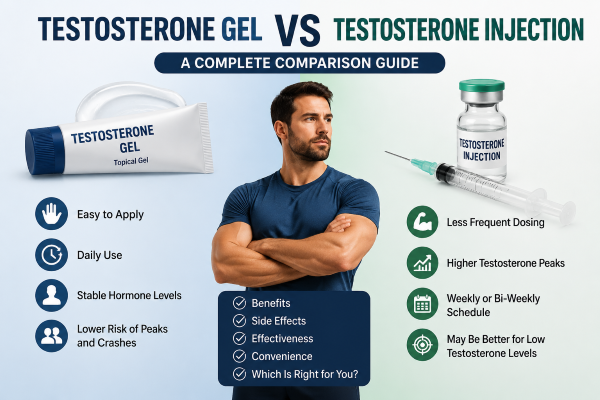
Testosterone gel vs injection is one of the most common decisions men face when starting Testosterone Replacement Therapy (TRT). Both are FDA-approved, both are effective at raising testosterone levels, and both are widely prescribed — but they differ in ways that can meaningfully affect your daily life, your symptom response, your safety monitoring requirements, and your long-term satisfaction with treatment. The right choice between injectable testosterone and gel depends on your lifestyle, schedule, cost tolerance, whether you have children or a pregnant partner at home, and how your body responds. This guide covers every dimension of that decision — including the injection types most guides skip, the hormonal fluctuation problem that frequency of dosing (not the method itself) usually drives, the erythrocytosis risk that requires monitoring on both forms, and the fertility impact anyone trying to conceive must understand.
Testosterone skin patches were the first transdermal TRT option tested, predating gels. However, they caused frequent skin irritation and had poor absorption consistency, which led to the development of testosterone gels as a more tolerable and reliable alternative. Today, multiple gel formulations exist — including axillary gels and nasal gels — alongside the familiar shoulder and arm applications.
What Is TRT and Who Needs It?
Testosterone Replacement Therapy is prescribed for men with clinically confirmed Low Testosterone (hypogonadism) — not just low-normal levels, but levels accompanied by symptoms. Symptoms that may indicate low testosterone include:
- Reduced libido and sexual desire
- Erectile Dysfunction or reduced morning erections
- Persistent fatigue and low energy despite adequate sleep
- Mood changes — irritability, low mood, or Depression
- Reduced muscle mass and strength
- Increased body fat, particularly abdominal
- Reduced bone density
- Difficulty concentrating or brain fog
A diagnosis requires both symptoms and a confirmed low serum testosterone level on at least two morning blood tests. TRT is not indicated solely on the basis of age-related testosterone decline without symptoms, and it is not appropriate for men who want to use it for performance enhancement or bodybuilding.
Testosterone Gel vs Injection: Full Comparison at a Glance
| Feature | Testosterone Gel | Testosterone Injection |
| Administration | Applied to skin daily (shoulders, arms, abdomen, thighs) | Injected into muscle or subcutaneous fat weekly to every 2–4 weeks |
| Absorption | Gradual, steady transdermal absorption | Rapid IM/SubQ absorption with predictable peak |
| Hormone level pattern | Stable daily levels — minimal peaks and troughs | Peak-and-trough pattern; frequency of dosing determines stability |
| Onset of symptom improvement | 4–6 weeks for full effect | Days to 2–3 weeks (faster initial response) |
| Dosing frequency | Once daily | Weekly, twice weekly, or every 2–4 weeks (cypionate/enanthate) |
| Cost without insurance | $150–$500/month (branded); $50–$150 generic | $20–$100/month (generic cypionate or enanthate) |
| Transfer risk | Yes — undried gel can transfer to partners, children, or pets | No transfer risk |
| Fertility impact | Suppresses sperm production (both methods equally) | Suppresses sperm production (both methods equally) |
| Erythrocytosis risk | Present — requires monitoring | Present — may be slightly higher with IM injections |
| Needle required | No | Yes |
| Suitable for | Men who prefer daily routine, dislike needles, have no household transfer risk | Men who prefer less frequent dosing, want faster response, lower cost |
How Testosterone Gel Works
Testosterone gel is a transdermal formulation applied to the skin daily. It is absorbed through the skin and enters the bloodstream over several hours, providing a relatively steady level of testosterone throughout the day. Common brand names include AndroGel, Testim, Vogelxo, and Fortesta. A nasal gel version (Natesto) is also available, applied inside the nose three times daily, which avoids skin transfer risk.
Application sites vary by product but typically include the shoulders, upper arms, abdomen, or inner thighs. The gel dries on the skin and should not be washed off for several hours after application to allow adequate absorption. Clothing covering the application site further reduces transfer risk.
- Key practical considerations: Wait at least 5–6 hours before swimming, showering, or intense sweating. Avoid skin-to-skin contact at the application site with partners, children, or pets until the gel is fully dry — ideally until washed. Cover the site with clothing if contact is likely.
- Absorption variability: Unlike injections, gel absorption can vary between individuals based on skin hydration, body temperature, application site, and skin condition. This means hitting a precise target testosterone level can sometimes require more dose adjustment than with injections.
Types of Testosterone Injections: Cypionate, Enanthate, Propionate
The original article discusses ‘testosterone injections’ as if they were a single product. In practice, there are several ester formulations with different pharmacokinetic profiles — and the choice between them affects dosing frequency, level stability, and side-effect experience.
- Testosterone Cypionate (most common in the US): A long-acting ester with a half-life of approximately 8 days. Typically injected weekly or every 2 weeks. The most widely prescribed injectable form in the US and the most affordable generic option. Weekly dosing reduces the peak-and-trough swing compared to every-2-week dosing.
- Testosterone Enanthate: Very similar to cypionate with a half-life of approximately 4.5 days. Common in Europe and available in the US. Can be injected weekly or every 2 weeks. Some men report a slightly faster clearance than cypionate.
- Testosterone Propionate: A short-acting ester with a half-life of approximately 2 days, requiring injections every 2–3 days. Produces more stable levels than cypionate/enanthate on weekly schedules, but the frequent injection requirement makes it less practical for most men on long-term TRT.
- Testosterone Undecanoate (Aveed, Nebido): A very long-acting ester administered by deep intramuscular injection every 10–14 weeks. Provides stable levels without frequent dosing but requires office-based administration due to the risk of pulmonary oil microembolism.
Intramuscular vs Subcutaneous Injections
The original article describes only intramuscular (IM) injection into the gluteal muscle or thigh. A subcutaneous (SubQ) approach is increasingly used in TRT and is absent from most consumer guides.
- Intramuscular (IM): Injected into the muscle — typically the gluteal (buttock) muscle or the vastus lateralis (outer thigh). Provides reliable absorption and is the traditional TRT route. Requires a longer needle (typically 1–1.5 inches).
- Subcutaneous (SubQ): Injected into the fat layer just beneath the skin — typically the abdomen or outer thigh. Uses a shorter, thinner needle. Many men find SubQ more comfortable and less daunting than IM. Absorption is slightly slower than IM but produces more stable levels, which suits daily or twice-weekly microdosing protocols.
SubQ testosterone injections are not FDA-labelled for testosterone cypionate, but are widely used off-label in TRT clinics and supported by clinical evidence. The advantage is that smaller, more frequent SubQ doses (e.g. daily or twice-weekly) produce testosterone levels as stable as gel — without the transfer risk.
Hormone Level Stability: The Peak-and-Trough Problem Explained
This is the most commonly misunderstood aspect of injectable testosterone vs gel — and a nuance the original article does not address.
The claim that ‘injections cause hormonal fluctuations’ is often cited as a reason to prefer gel. This is partly true — but it is more accurately a dosing frequency problem than an inherent limitation of the injection method itself.
- Once-weekly IM cypionate: Testosterone can peak at 900–1,100 ng/dL on the day of injection and trough to 300–450 ng/dL by day 7. This swing can produce side effects at the peak (acne, water retention, irritability, elevated hematocrit) and low-T symptoms at the trough (fatigue, low mood).
- Twice-weekly or more frequent injections: By splitting the same weekly dose into two smaller injections (or daily SubQ microdoses), the peak-to-trough variation narrows dramatically. Men who shift from once-weekly to twice-weekly injections often experience the same level stability that gel provides — with none of gel’s disadvantages.
- Gel levels: Gel produces stable daily levels with minimal peaks and troughs, which some men find easier to tolerate psychologically and physically. However, gel absorption varies between individuals in a way that injections do not.
Clinical note: If you have been told injections cause mood swings or hormonal instability and are considering switching to gel, it is worth first discussing whether increasing injection frequency (to twice-weekly) would resolve the issue. Many men who switch from once-weekly to twice-weekly injections find the stability they were seeking — without the daily application routine or transfer risk of gel.
Effectiveness and Symptom Improvement
Both testosterone gel and injection are equally effective at raising total testosterone levels when dosed and monitored correctly. Neither method is categorically superior in terms of overall testosterone restoration.
The primary practical difference in effectiveness is speed of initial response:
- Testosterone injections: Typically produce noticeable improvements in energy, libido, and mood within days to 2–3 weeks, due to the rapid rise in testosterone following the first injection.
- Testosterone gel: More gradual absorption means full symptom improvement generally takes 4–6 weeks to become apparent. Early weeks may feel underwhelming, which can affect adherence if men are not prepared for the timeline.
For men who need fast symptom relief — for example, those with very symptomatic hypogonadism — injections offer a clinical advantage in the initial phase of treatment. For long-term maintenance, both methods work equivalently when properly monitored.
Cost Comparison: Testosterone Gel vs Injection
Cost is one of the clearest practical differences between testosterone injection vs gel, and it is relevant to long-term adherence.
- Testosterone gel (branded): Monthly costs typically range from $300 to $500 without insurance for branded formulations such as AndroGel or Testim.
- Testosterone gel (generic): Generic transdermal testosterone is considerably more affordable, ranging from approximately $50 to $150 per month depending on pharmacy and dose.
- Testosterone injections (generic cypionate or enanthate): Among the most affordable TRT options available — typically $20 to $100 per month for the medication itself. The main additional costs are needles, syringes, and any administration fees if clinic-based.
- Insurance coverage: Most insurance plans cover generic testosterone injections. Coverage for gels is more variable and often requires prior authorisation. Checking your specific plan before starting treatment avoids surprises.
For men on long-term TRT without comprehensive insurance coverage, the cost difference between generic injection and branded gel can amount to several thousand dollars per year — making it a genuine consideration in treatment planning.
Side Effects: Gel vs Injection
Testosterone gel side effects
- Application site reactions: Skin irritation, redness, rash, burning, or hives at the application site are the most common complaints. Usually mild and manageable by rotating sites or trying a different formulation.
- Skin dryness or flaking: Some men experience dryness at the application site over time.
- Acne: Can occur with any form of TRT as testosterone increases sebum production.
- Transfer to others: Discussed separately — this is a significant and underappreciated safety issue.
Testosterone injection side effects
- Injection site reactions: Pain, bruising, swelling, or redness at the injection site. Usually mild and reduced by rotating sites and warming the oil before injection.
- Post-injection cough: A brief, harmless cough sometimes occurring immediately after IM injection — thought to be caused by minor oil droplet reaching the pulmonary circulation.
- Acne and oily skin: Related to the testosterone peak, particularly noticeable with once-weekly injections. Often improves with more frequent smaller doses.
- Mood changes around peak and trough: Irritability or aggression near peak, and fatigue or low mood near trough, with once-weekly dosing. More frequent injections typically resolve this.
Side effects common to both methods
- Erythrocytosis (elevated red blood cell count / hematocrit): The most common lab abnormality on TRT — discussed in its own section below.
- Testicular atrophy: Exogenous testosterone suppresses the body’s own testosterone production signal (LH/FSH), causing the testes to reduce in size over time.
- Oedema (fluid retention): Some men experience mild fluid retention, particularly in the early weeks of treatment.
- Sleep apnoea: TRT can worsen or unmask Obstructive Sleep Apnoea in predisposed men.
Never apply testosterone gel to open wounds or freshly shaved or broken skin — absorption becomes unpredictable and significantly increases the risk of side effects. Do not apply to genitals unless specifically directed by your prescriber. Always wash hands thoroughly after application, and cover the site with clothing before any contact with household members.
Transfer Risk: A Critical Safety Consideration
Transfer risk is one of the most important — and most underweighted — factors in the testosterone gel vs injection decision, particularly for men who live with children or a pregnant partner.
When testosterone gel that has not fully dried makes skin-to-skin contact with another person, it transfers testosterone to them. This is a documented, serious safety concern. Testosterone transferred to children can cause premature puberty, early bone plate closure, and significant developmental consequences. Testosterone transferred to a pregnant woman can virilise a female fetus.
- FDA warning: The FDA has issued warnings about accidental testosterone transfer from gel users to children, including cases of reported virilisation in young children living in households where gel was not managed carefully.
- Risk reduction measures: Allow gel to dry completely (at least 5–6 hours), cover the application site with clothing, wash the site before contact with household members, and wash hands immediately after application.
- Nasal gel (Natesto): The intranasal formulation eliminates skin transfer risk entirely, as it is contained within the nasal passages. It requires three-times-daily application but is worth considering for men with young children or pregnant partners.
- Injections: Carry zero transfer risk, making them the safer household choice where children or pregnant partners are present.
TRT and Fertility: What Men Trying to Conceive Must Know
Both testosterone gel and testosterone injections suppress the body’s natural testosterone production by suppressing Luteinising Hormone (LH) and Follicle-Stimulating Hormone (FSH) — the hormones that drive both testosterone production and sperm development. This means both forms of TRT significantly reduce sperm production, often to zero with long-term use.
This is one of the most important facts about TRT and is absent as a developed section from the original article. Men who wish to preserve fertility should not start any form of TRT without discussing this explicitly with their doctor.
- Alternative approaches for fertility preservation: Human Chorionic Gonadotrophin (hCG) can be used alongside TRT or instead of it to maintain testicular function and sperm production. Clomiphene citrate (an off-label use) can stimulate the body’s own testosterone production without suppressing sperm. These options should be discussed with a urologist or reproductive endocrinologist.
- Recovery after stopping TRT: Sperm production can recover after stopping TRT, but recovery is not guaranteed and may take months to years. Some men do not recover fertility fully, particularly after long-term use.
Erythrocytosis and Lab Monitoring on TRT
Erythrocytosis — an elevated red blood cell count and hematocrit — is the most common lab abnormality associated with TRT. It is not discussed in the original article, yet it is one of the most important safety considerations for men on long-term TRT.
Testosterone stimulates erythropoietin (EPO) production, which in turn drives red blood cell production. This raises hematocrit. When hematocrit exceeds approximately 52–54%, the risk of blood viscosity-related complications — including deep vein thrombosis, stroke, and cardiovascular events — increases.
- Injection vs gel risk: Injections — particularly with the peak-and-trough pattern of once-weekly dosing — may produce a slightly higher erythrocytosis risk than gel, due to the supraphysiological testosterone peaks. More frequent, smaller injection doses reduce this.
- Monitoring requirements: Hematocrit should be checked before starting TRT, at 3 months, at 6 months, and then annually. If hematocrit exceeds 54%, dose reduction, increased injection frequency, therapeutic phlebotomy (blood donation), or switching delivery method may be recommended.
- Both methods require monitoring: Gel users are not exempt from erythrocytosis risk. Regular lab monitoring is mandatory for any form of TRT — not optional.
Who Should Choose Testosterone Gel?
- Men who strongly prefer to avoid needles
- Men who tolerate and prefer a consistent daily application routine
- Men who live alone or whose household members are not at risk from gel transfer
- Men in whom injection site reactions are persistent or severe
- Men whose insurance covers gel but not injections
- Men who struggle with maintaining injection schedules or technique
- Men for whom the gradual, stable level profile of gel better manages mood or energy
Who Should Choose Testosterone Injections?
- Men who want faster initial symptom improvement
- Men for whom cost is a primary consideration (generic injections are significantly cheaper)
- Men who live with children or a pregnant partner — transfer risk eliminated
- Men who prefer less frequent administration (every 1–2 weeks rather than daily)
- Men who want more precise, predictable dosing unaffected by skin absorption variability
- Men who are comfortable with injections or can be trained to self-inject
- Men who find the daily gel routine inconvenient or easy to forget
Other TRT Delivery Methods
For completeness, several other FDA-approved TRT delivery methods exist beyond gel and injection — each with distinct profiles:
- Testosterone patches (Androderm): Applied once daily to the back, abdomen, thigh, or upper arm. Provide steady levels but carry a higher rate of skin irritation and allergic reaction than gel.
- Testosterone pellets (Testopel): Implanted subcutaneously by a clinician every 3–6 months. Provide very stable, long-duration testosterone levels. The main drawback is that the dose cannot be easily adjusted once implanted.
- Testosterone nasal gel (Natesto): Applied three times daily inside the nose. Eliminates skin transfer risk. Provides stable levels. Requires discipline for three-times-daily application.
- Oral testosterone undecanoate (Jatenzo, Kyzarol): FDA-approved oral capsules taken with food. Convenient but require twice-daily dosing with fat-containing food. Not the same as older oral testosterone formulations (which had liver toxicity concerns — these newer formulations avoid first-pass liver metabolism).
Switching Between Testosterone Gel and Injection
Switching between delivery methods is possible and sometimes medically indicated — for example, if gel is causing persistent skin irritation, or if injection-related mood swings are not resolving with more frequent dosing.
- Gel to injection: Can usually be transitioned with close monitoring. Your doctor will stop the gel and begin the injection protocol, typically checking levels 4–6 weeks after the switch to calibrate the dose.
- Injection to gel: Similar process. It takes several weeks for gel absorption to establish steady-state levels, during which monitoring and possible dose adjustment is needed.
- What to expect: Symptom response during the transition period may be variable. Some men feel a temporary dip or change as the delivery pattern changes. Patience and lab-guided dose adjustment are the appropriate responses — not immediately reverting to the previous method.
Conclusion
The testosterone gel vs injection decision does not have a universal answer — it has the right answer for your specific circumstances. Gels offer daily, stable, needle-free delivery with a lower initial cost barrier and suit men who prefer a predictable daily routine. Injectable testosterone offers faster symptom onset, greater cost-effectiveness in the long term, zero transfer risk to household members, and the flexibility to modulate level stability through injection frequency.
The most important factors to weigh are: whether you have children or a pregnant partner at home (transfer risk favours injections strongly), your budget and insurance situation (injections are dramatically cheaper generically), your preference for daily application vs less frequent injections, and how quickly you need symptom improvement. Both methods require the same medical monitoring — including hematocrit checks and testosterone level testing — and both suppress fertility, which must be discussed before starting.
The most productive step is a detailed conversation with your doctor or a TRT specialist who can review your full health picture, lifestyle, and goals before recommending a form of testosterone replacement therapy that is likely to work for you long-term.
Frequently Asked Questions
- Can testosterone gel be used after showering?
Yes. Testosterone gel should be applied to clean, dry skin after showering. It should not be washed off for at least 5–6 hours after application to allow adequate absorption. Waiting a few minutes before dressing reduces transfer to clothing.
- Do testosterone injections require rotating injection sites?
Yes. Rotating injection sites prevents localised soreness, scar tissue formation, and lumps. Common sites include the gluteal muscles and the outer thighs. If you self-inject, your doctor or nurse should guide you on safe rotation technique and the correct injection depth.
- Can testosterone gel or injection affect sleep?
TRT can improve sleep in men whose sleep disruption was driven by low testosterone — particularly those with related fatigue or mood issues. However, TRT can also worsen or unmask Obstructive Sleep Apnoea in predisposed men. Some users report initial restlessness, particularly if the dose is too high. Sleep quality should be monitored and discussed at follow-up appointments.
- Does TRT affect fertility, and is it reversible?
Both gel and injection suppress sperm production by suppressing the hormonal signals that drive spermatogenesis. In many cases this is reversible after stopping TRT, but recovery can take months to years and is not guaranteed. Men who wish to conceive should discuss alternatives — such as hCG or clomiphene — with a urologist or reproductive endocrinologist before starting any form of TRT.
- Is it safe to use testosterone for bodybuilding or performance enhancement?
No. Testosterone gel and injections are prescription medicines indicated for medically confirmed hypogonadism, not for bodybuilding or athletic enhancement. Use without a medical indication is not only unsupported clinically but is also a violation of sports regulations and, depending on jurisdiction, may be legally restricted. Using TRT at doses above those needed to restore normal physiological levels significantly increases the risk of cardiovascular, haematological, and endocrine side effects.
Citations
- Mayo Clinic. Testosterone therapy: Potential benefits and risks as you age. https://www.mayoclinic.org/healthy-lifestyle/sexual-health/in-depth/testosterone-therapy/art-20045728
- Testosterone. US National Library of Medicine. https://medlineplus.gov/druginfo/meds/a614015.html
- S. Food and Drug Administration. FDA Drug Safety Communication — testosterone gel transfer risk. https://www.fda.gov/drugs/drug-safety-and-availability/fda-drug-safety-communication-fda-classifies-new-safety-information-testosterone-products-regarding
- Noble Health Clinic. Testosterone Gel vs Injection: TRT Guide 2025. https://noblehealthclinic.com/testosterone-gel-vs-injection-trt-guide/
- Dhaliwal A, Gupta M. Hypogonadism and testosterone replacement. StatPearls. NCBI Bookshelf. https://www.ncbi.nlm.nih.gov/books/NBK532933/
- Bhasin S, et al. Testosterone Therapy in Men with Hypogonadism: An Endocrine Society Clinical Practice Guideline. Journal of Clinical Endocrinology and Metabolism, 2018. https://academic.oup.com/jcem/article/103/5/1715/4939465
This article is for general informational purposes only and does not constitute medical advice. Testosterone replacement therapy is a prescription treatment requiring medical evaluation, diagnosis, and ongoing monitoring. Always consult a qualified healthcare provider before starting, stopping, or adjusting any hormone therapy.
