
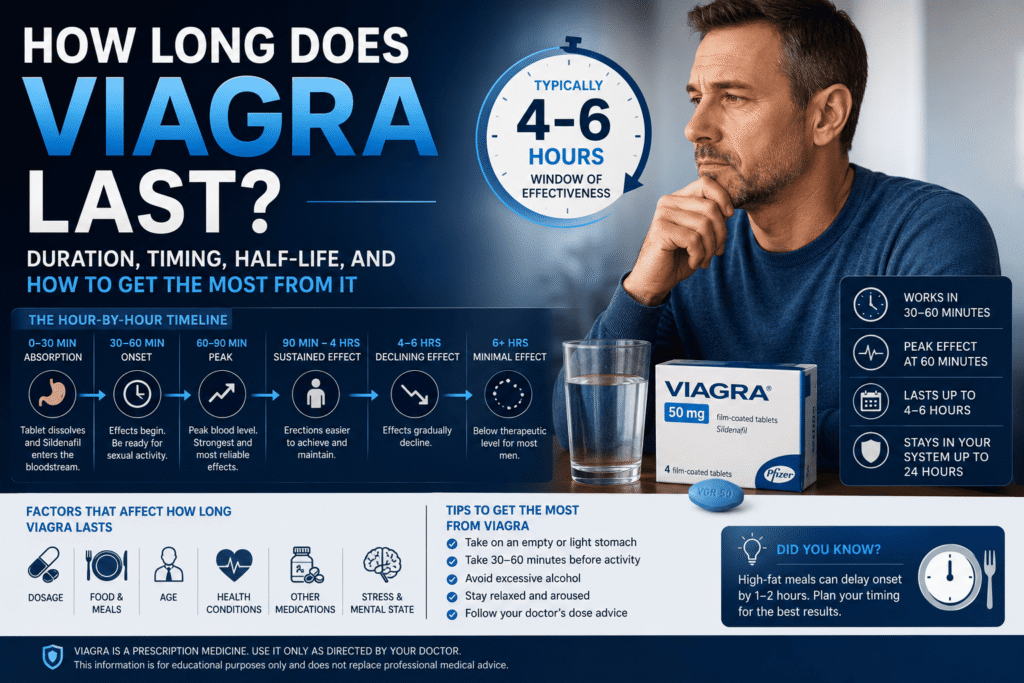
How long does Viagra last? It is one of the most commonly asked questions about the medicine — and the honest answer is more specific than most guides suggest. For the majority of men, Viagra’s effects last 4 to 6 hours, but what that window actually means in practice, how it varies by dose, age, meal timing, and health, how long Sildenafil stays in your system after the effects fade, and what you can do to maximise the duration are all questions that deserve a proper answer. This article covers all of that — including the hour-by-hour timeline most men want to see, the half-life explained, a comparison with how long Tadalafil lasts, and practical steps to get the best results from every dose.
Sildenafil — the active ingredient in Viagra — is not only used for Erectile Dysfunction. A lower-dose formulation called Revatio (20 mg, three times daily) is FDA-approved for Pulmonary Arterial Hypertension in both men and women. The same molecule, different dose, completely different indication — and a different duration profile at that lower dose.
How Long Does Viagra Last? The Short Answer
Viagra (Sildenafil Citrate) typically lasts 4 to 6 hours. During this window, the medicine makes it easier to achieve and maintain an erection in response to sexual stimulation. Some men find effects are noticeable closer to 4 hours; others report benefits up to 6 hours or, in some cases, slightly beyond.
Two things are important to understand from the outset: first, Viagra does not produce a continuous 4–6 hour erection — it creates a window during which arousal can more easily produce and sustain an erection. Second, the drug remains in your system for longer than its effects are noticeable, which has practical implications for timing and safety.
The exact duration for any individual depends on dose, age, what you have eaten, your general health, other medicines, and your psychological state during the window. All of these are covered in detail below.
The Hour-by-Hour Viagra Timeline
This is the section most men want and few guides provide clearly. Here is what to expect from the moment you take Viagra, assuming a standard 50 mg dose on an empty or light stomach:
- 0–30 minutes (absorption): The tablet dissolves in the stomach and Sildenafil begins entering the bloodstream. You are unlikely to notice any effect yet. The body is processing the drug.
- 30–60 minutes (onset): Sildenafil reaches sufficient concentration in the blood for most men to begin experiencing enhanced erectile response to arousal. This is the recommended window to begin sexual activity. Some men notice effects as early as 15–20 minutes; others may need closer to an hour, particularly after a meal.
- 60–90 minutes (peak): Sildenafil reaches its peak blood concentration approximately 60 minutes after ingestion on an empty stomach. This is typically when the medicine is most effective — arousal produces the firmest erections and they are most easily sustained.
- 90 minutes – 4 hours (sustained effect): Blood levels remain at therapeutically effective concentrations for most men. Erections can be achieved and maintained in response to arousal throughout this window, though effects may be somewhat less intense than at peak.
- 4–6 hours (declining effect): Sildenafil concentration is falling as the liver metabolises it. Many men still find the medicine effective in this window, though the response may be less reliable than at peak. This is where individual variation is greatest.
- 6+ hours (below therapeutic threshold): For most men at standard doses, effects are negligible beyond 6 hours. However, the drug is not fully eliminated — it remains detectable in the body for up to 24 hours, though at concentrations too low to produce meaningful benefit.
Clinical tip: A high-fat meal taken within 2 hours of Viagra can push the entire timeline 1 to 2 hours later — delaying onset from the expected 30–60 minutes to potentially 90–120 minutes. This is one of the most common reasons men report Viagra ‘not working’ at the expected time. It has not failed; it has been delayed. If meal timing is consistently an issue, discuss Tadalafil with your doctor — it is not significantly affected by food.
Viagra Half-Life: How Long Does Viagra Stay in Your System?
Understanding Sildenafil’s half-life is the key to understanding both how long Viagra lasts and why it eventually stops working — and it is almost never explained clearly.
Sildenafil has a half-life of approximately 3 to 5 hours. This means that every 3 to 5 hours, the amount of Sildenafil in your bloodstream is reduced by half. Here is what that looks like in practice at a 50 mg dose:
- At 0 hours (dose taken): 50 mg absorbed (approximately).
- At 4 hours: Approximately 25 mg equivalent remaining — still at or near therapeutic levels for most men.
- At 8 hours: Approximately 12.5 mg remaining — below effective concentration for most men.
- At 16–24 hours: Trace amounts remaining — functionally cleared for most men, though technically still detectable.
The practical implication: how long Viagra lasts (4–6 hours of noticeable effect) is shorter than how long Viagra stays in your system (up to 24 hours for full elimination). This is why you should not take another dose within 24 hours even if the first dose’s effects have faded — you would be stacking doses and raising the risk of side effects and dangerous blood pressure interactions.
In older men and those with liver or kidney impairment, the half-life is longer — meaning Sildenafil clears more slowly and effects (and risks) may persist longer.
How Long Does Viagra Take to Work?
How long Viagra lasts and how long it takes to work are two separate questions that are often confused.
- Standard onset (empty stomach): 30 to 60 minutes. This is the recommended window — take Viagra approximately one hour before anticipated sexual activity for the most predictable timing.
- Fastest reported onset: Some men notice effects in as little as 12 to 15 minutes on an empty stomach. This is at the early end of the range and not the norm.
- After a high-fat meal: Onset can be delayed to 90 to 120 minutes, and peak concentration may be reduced by approximately 29%. Taking Viagra at least 2 hours after a heavy meal, or with a light snack, is consistently the most practical advice for reliable timing.
- Vybrique (Sildenafil oral film): A newer formulation that dissolves in the mouth and is absorbed through the oral mucosa. Buccal absorption bypasses stomach processing, potentially producing a faster onset than the standard tablet and reducing the food-related delay.
7 Factors That Affect How Long Viagra Lasts
1. Dose
Viagra comes in three FDA-approved doses: 25 mg, 50 mg, and 100 mg. Higher doses generally produce stronger and slightly longer-lasting effects, but also carry a higher risk of side effects. The standard starting dose for most men is 50 mg. If 50 mg works but wears off too quickly, your doctor may increase to 100 mg — not decrease to 25 mg, which is the lower dose. Always adjust dose only under medical guidance.
Note: the original article incorrectly stated the dose can be ‘increased to 25 mg.’ The dose scale runs 25 mg (lowest) → 50 mg (standard) → 100 mg (maximum). Doses are increased upward, not downward.
2. Age
As men age, the liver and kidneys clear Sildenafil more slowly. In men over 65, this slower metabolism means Viagra can remain at effective concentrations for longer — sometimes producing effects beyond the standard 4–6 hour window, up to 8–12 hours in some cases. Because of this extended duration, men aged 65 and older are typically recommended a starting dose of 25 mg. This accounts for both the slower clearance and the greater likelihood of other medicines that interact with Sildenafil.
3. Diet and meal timing
A high-fat meal is the most commonly overlooked factor affecting Viagra’s timing and effectiveness. Fat slows gastric emptying, which delays Sildenafil’s absorption from the stomach. This pushes the onset later and reduces peak concentration. Taking Viagra on an empty stomach or at least 2 hours after a fatty meal produces the fastest onset and the most predictable duration. A light, low-fat snack does not significantly impair absorption.
4. Metabolism and body composition
Men with faster metabolisms will process and eliminate Sildenafil more quickly, potentially experiencing a shorter effective window. Men with slower metabolisms — common with age, obesity, or certain health conditions — may find effects last longer. Body weight itself has a limited direct effect on duration, but metabolic health broadly influences how the liver handles the drug.
5. General health and underlying conditions
Conditions that impair blood vessel function or nerve signalling reduce Viagra’s effectiveness regardless of duration. Diabetes, cardiovascular disease, Hypertension, Obesity, and neurological disorders can all reduce how well Viagra works and, in some cases, shorten the useful duration. Liver and kidney disease slow Sildenafil clearance, potentially extending the duration but also increasing the risk of side effects at standard doses.
6. Other medicines
Two types of drug interaction affect how long Viagra lasts:
- CYP3A4 inhibitors (Ritonavir, Ketoconazole, Itraconazole, Clarithromycin, Erythromycin): These slow Sildenafil’s breakdown in the liver, raising blood levels and extending both the duration and the intensity of effects — along with the risk of side effects. A lower starting dose (25 mg) is recommended if you take any of these.
- CYP3A4 inducers (Rifampin, Carbamazepine, St John’s Wort): These speed up Sildenafil breakdown, reducing both effectiveness and duration.
- Nitrates and alpha-blockers: Do not change how long Viagra lasts, but they create dangerous blood-pressure-lowering combinations and should never be combined with Sildenafil.
7. Psychological state
Viagra works only with sexual arousal. If stress, anxiety, distraction, or performance pressure suppresses the desire signal, the drug cannot fully activate — not because it has worn off, but because the mechanism requires sexual stimulation to engage. A relaxed, confident, emotionally connected environment is not a luxury; it is a functional prerequisite for Viagra to produce its full effect throughout the duration window.
How Long Does Viagra Last vs Tadalafil (Cialis)?
This comparison is one of the most searched follow-up questions and is absent from the original article.
- Viagra (Sildenafil): Duration 4 to 6 hours. On-demand use, taken 30–60 minutes before activity. Affected by high-fat meals. Best for planned encounters where flexible timing matters less.
- Tadalafil (Cialis) on-demand: Duration up to 36 hours — the longest in the class. Not significantly affected by food or moderate alcohol. Best for spontaneity, frequent activity, or men who find timing stressful.
- Tadalafil (Cialis) daily low dose: 5 mg or 5 mg taken once daily maintains a steady baseline, removing timing from the equation entirely. Also the only PDE5 inhibitor approved for Benign Prostatic Hyperplasia (BPH) alongside ED.
- Avanafil (Stendra): Duration up to 6 hours. Fastest onset in the class — as early as 15 minutes. Least affected by food.
- Vardenafil (Levitra): Duration 4 to 5 hours. Similar to Sildenafil. Also available as an orally dissolving tablet (Staxyn).
If Viagra’s 4–6 hour duration is consistently not long enough for your needs, discussing Tadalafil with your doctor is the most appropriate next step. Never combine two PDE5 inhibitors — the additive blood-pressure-lowering effect is dangerous.
What Does the Duration Window Actually Mean?
This is a common source of confusion. Viagra’s 4–6 hour duration window does not mean:
- You will have an erection for 4 to 6 continuous hours
- You cannot lose an erection during the window (it will return with stimulation)
- You will have the same level of response throughout the full window
What it does mean:
- During the 4–6 hour window, sexual stimulation can more easily produce and sustain an erection than without the medicine
- You may be able to achieve multiple erections within the window — once the refractory period (recovery time after ejaculation) passes
- The effect is strongest around the 60–90 minute mark and gradually declines from around the 3–4 hour point
There is some evidence that Sildenafil may shorten the refractory period — the recovery time between erections — for some men. This means that within the 4–6 hour window, a second erection may be achievable sooner than without the medicine. This is not the same as preventing the refractory period entirely, and results vary significantly between individuals.
Important: If an erection persists for more than 4 hours and will not subside — especially if it is painful — this is Priapism and requires emergency medical care. Go to an emergency room immediately. This is a rare side effect but a genuine medical emergency that can cause permanent tissue damage if not treated promptly.
How to Make Viagra Last Longer — and Work Better
While you cannot extend Viagra’s pharmacological half-life, several practical steps maximise the useful portion of the duration window:
- Take it at the right time: One hour before sexual activity on an empty or light-meal stomach. This gives peak concentration the best chance of coinciding with activity.
- Avoid high-fat meals: They delay onset by 1–2 hours and reduce peak concentration by approximately 29%, shortening the practical effective window even though the drug is still present.
- Limit alcohol: Alcohol independently impairs the arousal signal Viagra depends on. More than 1–2 drinks reduces both the quality of erections and the reliability of the duration window — the drug may still be present but arousal is suppressed.
- Stay hydrated: Dehydration reduces circulating blood volume, which can limit blood flow to the penis and reduce the medicine’s apparent effectiveness.
- Reduce performance anxiety: Anxiety is one of the most common reasons the 4–6 hour window is not fully utilised. A relaxed setting, familiar environment, and open communication with a partner all support the arousal signal the medicine depends on.
- Exercise regularly: Regular cardiovascular exercise improves endothelial function, Nitric Oxide availability, and blood vessel health — the very conditions that allow Sildenafil to work most effectively. Smokers who quit and overweight men who lose weight consistently report improved Viagra response.
- Avoid smoking: Smoking damages endothelial cells and reduces Nitric Oxide bioavailability — the molecule Viagra’s mechanism relies on. Smokers consistently experience weaker and shorter responses than non-smokers at the same dose.
- Avoid grapefruit: Grapefruit inhibits CYP3A4 enzymes in the gut, raising Sildenafil levels unpredictably. While this can technically prolong effects, unpredictable blood levels also increase the risk of side effects including a pronounced blood-pressure drop.
Does Viagra Lose Effectiveness Over Time?
This is a common concern for men who use Viagra regularly, and one the original article does not address.
The pharmacological answer is that Sildenafil does not cause tolerance — the body does not adapt to the drug in a way that requires higher doses for the same effect. Each dose acts independently, and the half-life and mechanism remain consistent over time.
However, men may notice Viagra seeming less effective after months or years of use. The most common reasons are:
- Progression of underlying conditions: Diabetes, cardiovascular disease, or other conditions that impair blood flow may worsen over time, independently reducing erectile function and Viagra’s apparent effect.
- Lifestyle changes: Weight gain, reduced physical activity, or increased stress can reduce the baseline erectile response that Viagra amplifies.
- Psychological dependence: Some men become anxious about whether the medicine will work, which itself suppresses arousal and makes Viagra appear less effective.
Long-term studies have shown mixed results: one study found effectiveness may decline after approximately 2 years of consistent use, while other research found Sildenafil remained effective and safe after 4 years. The difference likely relates to progression of underlying conditions rather than true pharmacological tolerance. If Viagra’s effectiveness appears to be declining, discuss it with your doctor rather than self-escalating the dose.
Who May Experience a Longer or Shorter Duration
Longer duration than average
- Men over 65: Slower hepatic clearance means Sildenafil remains active longer — sometimes 8–12 hours.
- Men with liver impairment: Reduced metabolic capacity slows clearance. Lower starting doses are typically required.
- Men with moderate kidney impairment: Can extend the half-life modestly.
- Men taking CYP3A4 inhibitors: Ritonavir, Ketoconazole, and similar drugs markedly slow Sildenafil metabolism.
Shorter or weaker duration than average
- Men with Diabetes: Vascular and nerve damage can reduce the erectile response Sildenafil amplifies, making the useful window feel shorter even though the drug is present.
- Smokers: Reduced Nitric Oxide availability limits Sildenafil’s mechanism at every point in the duration window.
- Men taking CYP3A4 inducers: Rifampin and St John’s Wort speed clearance, shortening effective duration.
- Men under high psychological stress: Arousal suppression limits how much of the pharmacological window is actually used.
Conclusion
How long does Viagra last? For most men, 4 to 6 hours — with peak effectiveness around 60 to 90 minutes after taking the dose. The drug stays in the body for up to 24 hours after that, but at concentrations too low to produce meaningful effect. The 4–6 hour window is not a continuous erection; it is a window during which sexual stimulation can more reliably produce and sustain one.
Duration is shaped by dose, age, meal timing, health conditions, and other medicines — all of which are modifiable to varying degrees. Avoiding high-fat meals around the time of the dose, limiting alcohol, timing intake correctly, and supporting vascular health through exercise and not smoking are the most practical and evidence-based steps to maximise how long Viagra lasts in practice.
If the 4–6 hour window consistently feels insufficient, or if Viagra seems less effective over time, the right response is a conversation with your doctor — not self-escalating the dose. Tadalafil’s 36-hour duration or once-daily low dose may be a better fit depending on your lifestyle and health profile.
Frequently Asked Questions
-
How long does Viagra last for most men?
For most men, Viagra lasts 4 to 6 hours. During this window, sexual stimulation can more easily produce and maintain an erection. Effects are strongest around 60 to 90 minutes after taking the dose and gradually decline. Individual duration varies with dose, age, health, and meal timing.
-
How long does Viagra stay in your system?
Sildenafil has a half-life of 3 to 5 hours, meaning concentrations halve every 3 to 5 hours. The drug is not fully eliminated until approximately 20 to 24 hours after the dose, though effects are negligible well before that point. This is why taking a second dose within 24 hours is not recommended even after the first dose’s effects have faded.
-
How long does Viagra take to kick in?
Viagra typically takes 30 to 60 minutes to work on an empty or light-meal stomach. Some men notice effects in as little as 15 minutes; others may need close to an hour. A high-fat meal can delay onset to 90 to 120 minutes. Taking it approximately one hour before sexual activity on an empty or light stomach gives the most predictable timing.
-
Does dehydration affect how long Viagra lasts?
Dehydration reduces circulating blood volume, which can limit blood flow to the penis and make Viagra appear less effective — without changing the drug’s actual half-life or pharmacological duration. Staying well-hydrated supports optimal blood flow and circulation, helping the medicine work as intended throughout the duration window.
-
Can Viagra last longer than 6 hours?
Yes, in some men. Men over 65, those with liver or kidney impairment, and those taking CYP3A4 inhibiting medicines may find Sildenafil clears more slowly, producing noticeable effects for up to 8 to 12 hours. In these cases, doctors typically recommend starting at 25 mg to reduce the risk of prolonged side effects. An erection lasting more than 4 hours that will not subside is Priapism — a medical emergency requiring immediate care.
Citations
- S. Food and Drug Administration. Viagra (sildenafil citrate) prescribing information. https://www.accessdata.fda.gov/drugsatfda_docs/label/2014/020895s039lbl.pdf
- com. How long does Viagra (sildenafil) work and last? https://www.drugs.com/medical-answers/long-viagra-work-last-3561221/
- Medical News Today. How long does Viagra last and how soon does it work? https://www.medicalnewstoday.com/articles/326034
- Ro Health. How long does Viagra last? https://ro.co/erectile-dysfunction/how-long-does-viagra-last/
- How long does Viagra last? Duration, effects and key factors. https://www.credihealth.com/blog/how-long-does-viagra-last
- Dhaliwal A, Gupta M. PDE5 Inhibitors. StatPearls. NCBI Bookshelf. https://www.ncbi.nlm.nih.gov/books/NBK549843/
This article is for general informational purposes only and does not constitute medical advice. Viagra and Sildenafil are prescription-only medicines. Always consult your doctor before starting, stopping, or adjusting any medication.
