
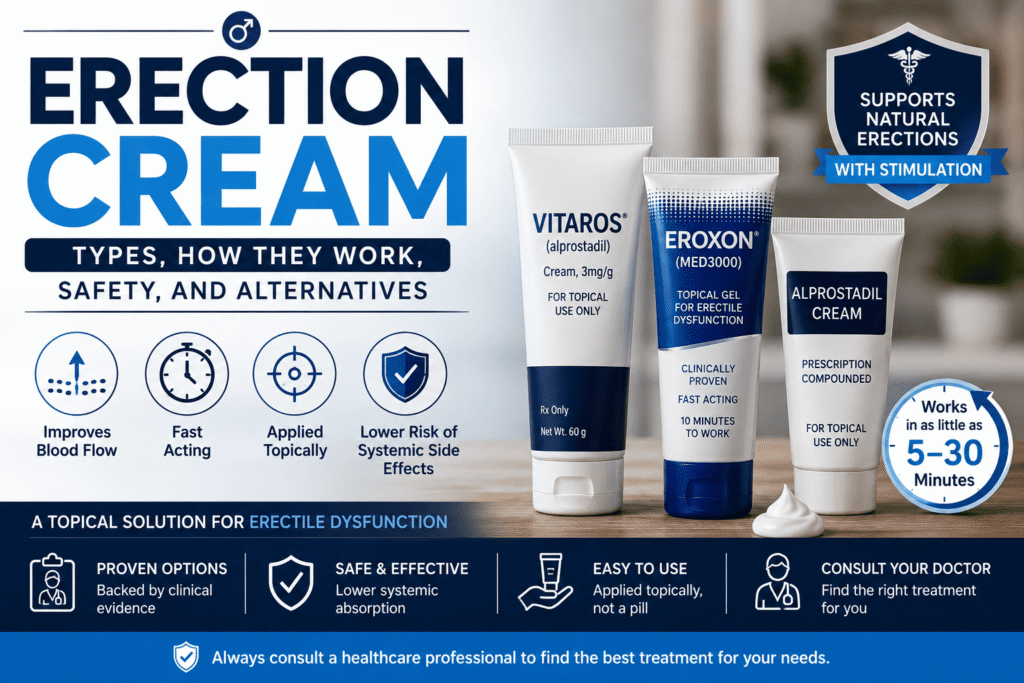
Oral medication is usually the first-line treatment for Erectile Dysfunction (ED), but topical erection creams and gels offer a genuine alternative for men who prefer not to take a tablet, want a faster-acting option, or have specific contraindications to oral PDE5 inhibitors. Since they’re applied directly to the penis and enter the bloodstream in only small amounts, they generally carry a lower risk of systemic side effects than pills. This article covers the main types of erection cream available, how each works, how to use them safely, and what alternatives exist if a cream isn’t the right fit.
Research projections suggest as many as 322 million men worldwide could be affected by Erectile Dysfunction in the coming years, driven largely by an ageing global population and rising rates of Diabetes and cardiovascular disease. The good news: ED remains one of the most treatable conditions in men’s health, with oral medication, topical treatments, and other options all backed by solid clinical evidence.
What Is Erection Cream and How Does It Work?
Erection cream is a topical medication or device applied directly to the penis to help produce or improve an erection. It appeals to men who prefer a locally-acting option to a tablet, or who want something that can be applied close to the moment of sexual activity. Most erection creams work as vasodilators — they widen the blood vessels supplying the penis, increasing blood flow into the erectile tissue.
An important point that applies to every product covered here: erection cream still requires sexual stimulation to work. None of these products override the need for arousal — they support and amplify the body’s own erectile response rather than replacing it. Effectiveness also varies from person to person and by the severity and underlying cause of ED.
Prescription Creams: Vitaros and Alprostadil-Based Options
Vitaros and Befar are the best-known prescription creams, both containing Alprostadil — a synthetic form of prostaglandin E1, a compound the body naturally uses to regulate smooth muscle contraction and blood flow. Alprostadil itself is an FDA-approved active ingredient (also used in injectable and urethral suppository forms for ED), but approval of the topical cream formulation specifically varies by country — check its regulatory status where you live before considering it.
- How it works: Alprostadil relaxes smooth muscle in the penis and reduces intracellular calcium, which reduces blood vessel contraction. This allows the vessels to widen and blood flow to increase, producing an erection.
- Effectiveness: Clinical trial data has reported significant improvement in erectile function in the large majority of men using Vitaros in studies of this kind, though real-world results vary with the underlying cause and severity of ED.
- Onset and duration: Effects typically begin within 5 to 30 minutes and last approximately 1 to 2 hours.
- Frequency limit: Vitaros specifically should not be used more than 2 to 3 times per week — follow your prescriber’s guidance, since frequency limits can differ between specific Alprostadil cream products.
OTC Cream: Eroxon (MED3000)
Eroxon, also known by its ingredient code MED3000, is the first and only FDA-cleared over-the-counter gel for ED, cleared in June 2023 and classified as a de novo Class II medical device — a new regulatory category created specifically because no directly comparable product existed before it. It’s a non-medicated product: rather than an active pharmaceutical ingredient, it contains inactive compounds including glycerin, water, alcohol, propylene glycol, carbomer, and potassium hydroxide.
- How it works: Eroxon works through a physical rather than pharmacological mechanism. It evaporates rapidly on application, creating a quick cooling sensation followed by a gradual warming effect. This temperature change stimulates local nerve endings in the penis, triggering the release of Nitric Oxide (NO) — the same molecule that initiates the erection process during natural arousal — which widens blood vessels and increases blood inflow.
- Effectiveness: In clinical trials, 63% of men achieved an erection within 10 minutes of application, and 71% were able to have penetrative sex within 15 minutes.
- Onset and duration: Effects typically begin within 10 minutes. The manufacturer doesn’t specify an exact duration, but it’s generally intended to support one session of sexual activity.
- Age restriction: FDA-approved for use in men aged 22 and older specifically — not the standard 18+ threshold used for most other ED treatments.
Because Eroxon has minimal systemic absorption and no active pharmaceutical ingredient, it can be a reasonable option for some men who cannot take oral PDE5 inhibitors, though it hasn’t been studied in men following radical prostatectomy and should still be discussed with a doctor if you have significant underlying health conditions.
Other Off-Label Topical Options
Beyond Alprostadil creams and Eroxon, a handful of other topical formulations are sometimes used off-label for ED — generally less common and with a smaller evidence base:
- Papaverine: A vasodilator and PDE inhibitor primarily used to treat blood vessel spasm elsewhere in the body. In gel form, it’s sometimes used off-label for ED, often combined with Phentolamine (another vasodilator).
- Verapamil: Primarily used topically for Peyronie’s Disease (a condition causing curved, painful erections from scar tissue). It has a secondary vasodilating benefit that can support blood flow and reduce discomfort, but it’s used far less commonly than Alprostadil specifically for standalone ED.
- L-arginine (topical, herbal OTC gels): Marketed in some over-the-counter ‘male enhancement’ products as a libido and erection support ingredient. L-arginine supports Nitric Oxide production when taken orally, but evidence for a topical formulation producing a direct erectile benefit is limited.
Papaverine and Verapamil typically work more slowly than Alprostadil or Eroxon — onset within 30 to 90 minutes, lasting around an hour. Topical L-arginine products tend to be the least reliably effective of the group, with onset around 15 to 45 minutes and effects lasting under an hour where they work at all.
Be cautious of unregulated ‘male enhancement’ creams and gels sold at convenience stores or through unverified online sellers. Many contain undisclosed active ingredients — sometimes including unlabelled Sildenafil analogues — that can cause serious side effects including stroke and dangerous heart rhythm changes, particularly when combined with other medications without medical knowledge.
How Erection Creams Compare
| Product | Onset | Duration | Type |
| Vitaros / Befar (Alprostadil) | 5–30 min | 1–2 hours | Prescription, active ingredient |
| Eroxon (MED3000) | ~10 min | ~1 session | OTC, non-medicated device |
| Papaverine (± Phentolamine) | 30–90 min | ~1 hour | Off-label, compounded |
| Verapamil | 30–90 min | ~1 hour | Off-label, primarily for Peyronie’s |
| Topical L-arginine | 15–45 min | Under 1 hour | OTC, herbal, limited evidence |
How to Use Erection Cream Safely
- Consult a doctor or pharmacist before starting, particularly for prescription options, to confirm the right product and dose for you
- Wash and dry the genital area before application
- Apply exactly as directed on the label or by your prescriber — more is not more effective, and overuse increases side-effect risk
- Do not apply to open wounds, broken skin, or the urethral opening unless the product specifically directs otherwise
- Wait for the stated onset time (typically 10 to 15 minutes) before sexual activity
- Wash your hands thoroughly after application to avoid transferring the product to your partner or your eyes
- Respect frequency limits — Vitaros, for example, should not be used more than 2 to 3 times weekly
Who Should Avoid Erection Cream
- Penile deformity (an exception applies for Verapamil, which is sometimes used specifically for Peyronie’s Disease)
- Sore, red, broken, or otherwise damaged penile skin
- Known allergy to the active or inactive ingredients in the specific product
- Under age 22 for Eroxon specifically, or under 18 for other erection creams
- Active genital infection
- Severe cardiovascular conditions, including a recent heart attack, or any situation where a doctor has advised against sexual activity — sexual activity itself increases cardiac strain regardless of the treatment used
- Bleeding disorders
Side effects to watch for include redness, irritation, tingling, burning, or warmth at the application site. Rarely, partner irritation, rash, allergic reaction, or pain can occur — stop use and consult a doctor if these develop.
Because most erection creams have minimal systemic absorption, they carry a lower drug-interaction risk than oral medications, but this isn’t zero: combining a cream with another ED treatment without medical guidance can produce an overlapping effect, and in rare cases interactions with nitrate medicines or blood pressure drugs are possible. Never combine an erection cream with a nitrate medicine, and check with a doctor before combining any two ED treatments.
Condom Compatibility
Condom compatibility depends on the specific product’s formulation, and it’s worth checking before relying on a cream during sex with a condom. Eroxon has been specifically tested and found safe for use with latex and polyisoprene condoms, but is not compatible with polyurethane condoms — this is confirmed directly in Eroxon’s FDA clearance documentation. For Alprostadil, Papaverine, Verapamil, or topical L-arginine products, follow the specific manufacturer’s guidance, since oil-based or certain other formulations can weaken latex; water-based condom-compatible alternatives may be advisable in some cases.
Alternatives to Erection Cream
Erection cream isn’t the right fit for every man — particularly those with sensitive skin conditions, severe ED, significant chronic vascular disease, ED following prostatectomy, or those who experience persistent irritation from topical use. In these situations, other treatments — used under medical supervision — may be more reliable:
- Oral PDE5 inhibitors: Sildenafil, Tadalafil, Vardenafil, and Avanafil last considerably longer than most creams — typically 4 to 6 hours, with Tadalafil lasting up to 36 hours. They’re effective for approximately 70% of men with ED. Common side effects include headache, flushing, and nasal congestion.
- Penile injection: For men who don’t respond to oral medication, injectable Alprostadil (or combinations with Papaverine and Phentolamine) delivers medication directly into the penis, producing a rapid and reliable erection. Common side effects include redness or swelling at the injection site.
- Intraurethral suppository (MUSE): A small Alprostadil-containing pellet inserted into the urethra, absorbed to increase blood flow without a needle. Can cause mild urethral burning, discomfort, or pain.
- Vacuum erection device (VED): A non-pharmaceutical pump that draws blood into the penis, with a constriction ring at the base to maintain the erection. Side effects can include mild numbness or discomfort.
Conclusion
Erection creams offer a genuine, evidence-backed alternative to oral ED medication for many men. Prescription Alprostadil-based creams like Vitaros work within 5 to 30 minutes and last 1 to 2 hours by directly relaxing penile smooth muscle. Eroxon, the first FDA-cleared OTC option, works through a physical cooling-warming mechanism that stimulates natural Nitric Oxide release, with effects typically starting within 10 minutes. Off-label options like Papaverine, Verapamil, and topical L-arginine exist but generally work more slowly and have a smaller evidence base.
All erection creams still require sexual stimulation to work, and safe use means following dosing and frequency guidance, checking condom compatibility, and being alert to side effects. If a cream proves ineffective or unsuitable — particularly for more severe ED — oral medication, injections, urethral suppositories, or a vacuum device are all well-established alternatives worth discussing with a doctor.
Frequently Asked Questions
-
Do erection creams really work?
Yes — both prescription options like Alprostadil cream and the FDA-cleared OTC option Eroxon have clinical trial evidence supporting meaningful improvement in erectile function, particularly for mild to moderate ED. They tend to be less reliable for severe ED compared with injections or oral medication, and individual response varies. If a cream doesn’t work well for you after a few genuine attempts, that’s a reasonable prompt to discuss alternatives with a doctor rather than a sign you’re using it wrong.
-
Is Eroxon gel available over the counter in the US?
Yes. Eroxon received FDA clearance in June 2023 as the first over-the-counter gel for treating ED in the US, available without a prescription through pharmacies and major retailers. Stock and pricing can vary by location, so it’s worth checking with a specific store or its online ordering option before a special trip.
-
Can you taste Eroxon gel?
Eroxon contains no added fragrance or flavour and isn’t intended for ingestion, so there’s no deliberate taste to it. It’s applied only to the head of the penis. It’s generally considered compatible with oral intimacy after it has been absorbed, but if you have any concern about this, using a condom or waiting until the gel has fully absorbed is a reasonable precaution.
-
Does Eroxon affect a female partner?
Eroxon is formulated and approved specifically as a topical treatment for men with ED — it isn’t intended for use by women. Partner-related side effects are uncommon, though mild local irritation is possible in rare cases from incidental contact. If you’re concerned, using a condom during intercourse (latex or polyisoprene — not polyurethane) reduces the chance of any transfer.
-
Are erection creams safer than ED pills?
Not necessarily safer overall, but they generally carry a lower risk of systemic (whole-body) side effects, since only a small amount of active ingredient enters the bloodstream when applied topically. Oral PDE5 inhibitors have a much larger safety and efficacy evidence base built up over decades, and remain the standard first-line treatment for most men. The ‘safer’ choice depends on your specific health situation — a doctor can advise which option makes the most sense for you.
This article is for general informational purposes only and does not constitute medical advice. Prescription erection creams require a doctor’s prescription. Consult a qualified healthcare provider before starting any ED treatment, and never combine with nitrate medicines.
