
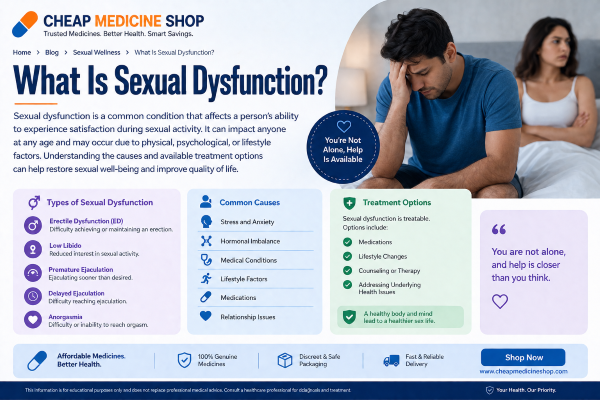
Sexual Dysfunction (SD) is an umbrella term for a group of conditions that make it difficult for a person to feel pleasure or satisfaction during sexual activity. It can affect desire, physical arousal, orgasm, or comfort during sex — and it affects people of all genders, ages, and relationship types. Research indicates that up to 40% of women and 30% of men experience some form of sexual dysfunction at some point in their lives, yet the majority never seek treatment — most often due to embarrassment, the misconception that these problems are untreatable, or uncertainty about who to consult. Sexual dysfunction is, in the large majority of cases, a treatable medical condition rather than an inevitable feature of ageing or personal failing. This article covers the four main types, how to recognise the symptoms in men and women, the physical and psychological causes, how diagnosis works, and the full range of evidence-based treatment options available.
Research published in the Journal of the American Medical Association found that sexual dysfunction is more prevalent than many people assume — affecting approximately 43% of women and 31% of men at some point. Despite this prevalence, studies consistently show that fewer than 1 in 4 affected individuals seek medical help. Early diagnosis significantly improves treatment outcomes for most forms of sexual dysfunction.
What Is Sexual Dysfunction?
Sexual dysfunction is defined as a persistent or recurrent difficulty in one or more phases of the sexual response cycle that causes personal distress or interpersonal difficulty. The key diagnostic element — personal distress — distinguishes clinical sexual dysfunction from individual variation in sexual desire or frequency, which is not a disorder.
Sexual dysfunction is not simply having less interest in sex than a partner, or going through a low-desire period. It is a persistent problem causing distress that warrants clinical attention. Many forms of sexual dysfunction have effective treatments, and seeking assessment early produces better outcomes than managing symptoms in silence for years.
The Sexual Response Cycle — Why It Matters
Sexual dysfunction is classified based on which phase of the sexual response cycle it disrupts. Understanding the cycle helps explain why different types of sexual dysfunction are categorised separately and require different approaches.
- Desire phase: The motivation or interest in sexual activity — libido. This is driven by hormonal, psychological, and relational factors.
- Arousal phase: Physical response to sexual stimulation. In men, this includes erection; in women, vaginal lubrication, clitoral engorgement, and genital swelling.
- Orgasm phase: The peak of sexual excitement, involving rhythmic muscular contractions and, in men, ejaculation.
- Resolution phase: The return to the unaroused state. Includes the refractory period in men.
Sexual dysfunction can affect one or more of these phases, and it is common for difficulties in one phase to create secondary difficulties in another — for example, pain during arousal suppressing desire over time.
The Four Types of Sexual Dysfunction
1. Desire disorders (low libido)
Desire disorders involve a persistent reduction or absence of sexual interest or motivation, causing personal distress. They are the most common category of sexual dysfunction in women and a significant category in men.
- In men: Male Hypoactive Sexual Desire Disorder (MHSDD) — persistent low or absent sexual desire, without another sexual dysfunction explaining it. Often associated with low testosterone, depression, or chronic illness.
- In women: Female Sexual Interest/Arousal Disorder (FSIAD) — covers both loss of interest in sex and/or difficulty becoming physically aroused. In the DSM-5, desire and arousal disorders in women are combined because they so frequently co-occur.
2. Arousal disorders
Arousal disorders involve difficulty achieving or maintaining the physical response to sexual stimulation, despite mental desire being present.
- In men: Erectile Dysfunction (ED) — difficulty achieving or maintaining an erection sufficient for satisfying sexual activity. Affecting an estimated 30 to 50 million men in the US, it is the most prevalent male sexual dysfunction, with prevalence increasing with age.
- In women: Genital arousal difficulty — reduced lubrication, reduced clitoral and labial engorgement, or reduced genital sensation during arousal, causing discomfort and reduced pleasure.
- Persistent Genital Arousal Disorder (PGAD): A rare and distressing condition — primarily in women — characterised by spontaneous, unwanted, persistent genital arousal unrelated to sexual desire. It is not a desire or pleasure disorder but a pain and arousal regulation disorder that causes significant distress.
3. Orgasm and ejaculatory disorders
These disorders involve difficulty reaching orgasm or problems with ejaculation timing.
- Anorgasmia (women and men): Difficulty reaching orgasm despite adequate arousal and stimulation. More common in women — affecting approximately 5 to 10% — but also occurs in men (male orgasmic disorder).
- Premature Ejaculation (PE): The most common male sexual dysfunction — affecting approximately 20 to 30% of men. Ejaculation occurs sooner than the man or his partner would like, consistently.
- Delayed Ejaculation: Ejaculation takes an unusually long time or does not occur despite adequate stimulation. Can be caused by medications (particularly SSRIs), neurological conditions, or psychological factors.
- Retrograde Ejaculation: Semen is redirected into the bladder rather than exiting through the urethra. Common after prostate surgery or with certain medicines.
4. Pain disorders
Pain disorders involve physical discomfort or pain during sexual activity — one of the most undertreated categories of sexual dysfunction.
- Dyspareunia: Persistent genital pain during or after sexual intercourse. Affects both men and women, though significantly more common in women. Causes include infections, hormonal changes, insufficient lubrication, endometriosis, or structural issues.
- Vaginismus: Involuntary contraction of the vaginal muscles that makes penetration painful, difficult, or impossible. Can be primary (always present) or secondary (developing after a period of normal function). Highly treatable with pelvic floor physiotherapy and therapy.
- Pelvic floor hypertonicity: Chronically tightened pelvic floor muscles that cause pain during sex, in both men and women. Often presents as perineal pain, urinary symptoms, and painful orgasm.
Sexual Dysfunction Symptoms in Men
Men can experience sexual dysfunction across all four categories, though different types predominate at different life stages.
- Low or absent sexual desire — not explained by stress alone, persistent over weeks
- Difficulty achieving an erection despite sexual desire and stimulation
- Difficulty maintaining an erection throughout sexual activity
- Premature ejaculation — ejaculation consistently occurring before desired
- Delayed ejaculation — difficulty ejaculating despite adequate stimulation
- Difficulty reaching orgasm
- Pain during ejaculation (uncommon but occurs — can indicate prostate or nerve issues)
- Performance anxiety — significant worry about sexual failure that is self-perpetuating
An important diagnostic clue for men: if morning erections are preserved but erectile difficulties occur specifically in partnered contexts, the cause is more likely psychological. If morning erections have also diminished or are absent, the cause is more likely physical — vascular, neurological, or hormonal.
Sexual Dysfunction Symptoms in Women
Sexual dysfunction symptoms in women are often more complex and overlapping than in men, and they are more frequently undertreated — partly because some providers do not ask about them routinely.
- Persistent low or absent interest in sexual activity, causing distress
- Absent or reduced sexual thoughts, fantasies, or receptivity to initiation
- Difficulty becoming physically aroused — reduced lubrication, reduced clitoral and genital engorgement
- Reduced genital sensitivity during sexual activity
- Difficulty reaching orgasm or experiencing less intense orgasms than previously
- Pain during intercourse — burning, throbbing, or sharp pain inside or at the vaginal opening
- Vaginal tightness or involuntary muscle spasm (Vaginismus) making penetration painful or impossible
- Emotional distress — anxiety, low self-esteem, or relationship strain caused by sexual difficulties
Hormonal changes — from the menstrual cycle, pregnancy, postpartum period, perimenopause, or menopause — are among the most common drivers of fluctuating symptoms in women. Low oestrogen in particular causes vaginal dryness and reduced genital sensitivity. Discussing these changes with a doctor or gynaecologist is appropriate and effective.
Causes of Sexual Dysfunction
Sexual dysfunction most commonly arises from a combination of physical and psychological factors — often with both present simultaneously. Identifying which factors are driving the difficulty is the key to selecting the right treatment.
Physical (physiological) causes
- Hormonal imbalances: Low testosterone (men and women), oestrogen deficiency (women — particularly postmenopause), elevated prolactin, thyroid disorders.
- Cardiovascular disease: Atherosclerosis and hypertension reduce blood flow to the genitals — the same mechanism driving Erectile Dysfunction in men also impairs genital arousal in women.
- Diabetes: Damages blood vessels and nerves affecting genital sensation and arousal response in both sexes. ED affects 35 to 50% of men with Diabetes.
- Neurological conditions: Multiple Sclerosis, Parkinson’s Disease, spinal cord injury, and post-surgical nerve damage can disrupt the neural pathways controlling sexual response.
- Chronic illnesses: Kidney disease, liver disease, cancer and its treatments (chemotherapy, radiation, hormone therapy) all commonly affect sexual function.
- Gynaecological conditions: Endometriosis, pelvic inflammatory disease, fibroids, and vulvodynia are common physical causes of painful intercourse in women.
- Ageing: Natural hormonal decline reduces desire and genital responsiveness over time; postmenopausal vaginal atrophy reduces lubrication and sensation.
Medications that cause sexual dysfunction
- SSRIs and SNRIs (antidepressants) — the most commonly implicated medication class; commonly reduce desire, delay orgasm, and cause arousal difficulties
- Antihypertensives (especially beta-blockers and thiazide diuretics) — reduce genital blood flow
- Opioids — suppress testosterone production over time
- Oral contraceptives — can reduce libido in some women through progestin effects and testosterone binding
- Antipsychotics — elevate prolactin, suppressing libido
- Chemotherapy agents — can affect hormonal function and genital sensitivity
Psychological causes
- Performance anxiety — particularly in men; creates a self-perpetuating cycle where fear of failure suppresses arousal
- Depression and anxiety — both directly reduce desire and arousal and are bidirectionally linked with sexual dysfunction
- Past sexual trauma or abuse — can create persistent avoidance, pain responses, or difficulty with intimacy
- Relationship difficulties — conflict, poor communication, emotional distance, infidelity, or major life stress
- Body image concerns — negative self-perception suppresses desire and comfort with intimacy
- Guilt or cultural/religious conflict about sexuality — can create ongoing psychological barriers to desire and arousal
Diagnosing Sexual Dysfunction
A diagnosis of sexual dysfunction is made through a combination of clinical history, physical examination, and targeted tests. The process varies depending on the symptoms and suspected cause.
- Clinical history: The most important diagnostic tool. A clinician will ask about the nature, onset, and pattern of symptoms, other health conditions, current medications, relationship context, psychological history, and lifestyle factors.
- Physical examination: Checks for hormonal, vascular, or structural issues. May include blood pressure measurement, pelvic examination (women), or genital examination (men).
- Laboratory tests: Hormone panels (testosterone, LH, FSH, prolactin, oestrogen, thyroid), fasting blood glucose (for Diabetes), lipid profile (cardiovascular risk), and kidney/liver function.
- Specialist tests: Penile Doppler ultrasound for vascular ED in men; vaginal or pelvic examination or ultrasound for women with pain disorders; nocturnal penile tumescence monitoring to distinguish psychogenic from organic ED.
- Psychological assessment: Validated questionnaires — such as the IIEF (International Index of Erectile Function) for men or the FSFI (Female Sexual Function Index) for women — quantify symptom severity and track treatment response.
Seeking diagnosis early rather than waiting months or years is clinically advantageous — most causes of sexual dysfunction are more effectively treated before secondary psychological complications (anxiety, avoidance, relationship damage) develop.
Treatments for Sexual Dysfunction
Treatment depends on the cause, type, and individual circumstances. Most cases of sexual dysfunction are treatable — often with a combination of approaches.
Lifestyle changes
- Regular aerobic exercise: Improves cardiovascular function, Nitric Oxide production, testosterone, and mood — all directly relevant to sexual function. A Harvard study found 30 minutes of walking daily reduced Erectile Dysfunction risk by 41%.
- Balanced diet: A Mediterranean-pattern diet supports vascular health and hormone balance. Reducing processed foods, alcohol, and excess salt directly improves the physiological conditions for sexual response.
- Quit smoking and limit alcohol: Smoking impairs genital blood flow; heavy alcohol suppresses the nervous system, reduces testosterone, and impairs arousal response.
- Manage chronic conditions: Controlling Diabetes, hypertension, and cardiovascular disease directly improves sexual function — often independently of any specific sexual dysfunction treatment.
Medications — for men
- PDE5 inhibitors (Sildenafil, Tadalafil, Vardenafil, Avanafil): First-line pharmacological treatment for Erectile Dysfunction. Require sexual stimulation. Contraindicated with nitrate medicines.
- Testosterone Replacement Therapy (TRT): For men with confirmed hypogonadism (low testosterone) alongside symptoms including reduced desire and ED.
- Dapoxetine: On-demand SSRI specifically approved in many markets for Premature Ejaculation. Not yet FDA-approved in the US, where daily off-label SSRIs are used instead.
- Alprostadil: Prostaglandin E1, available as an intracavernosal injection or intraurethral suppository (MUSE), for men with ED who do not respond to PDE5 inhibitors.
Medications — for women
- Flibanserin (Addyi): FDA-approved for premenopausal women with Hypoactive Sexual Desire Disorder. Taken daily. Acts on serotonin and dopamine pathways in the brain. Requires alcohol avoidance.
- Bremelanotide (Vyleesi): FDA-approved for premenopausal women with HSDD. Self-injected subcutaneously 45 minutes before sexual activity. Acts on melanocortin receptors.
- Buspirone and Bupropion: Sometimes used off-label for women with desire or arousal difficulties — particularly when SSRIs are the cause of sexual dysfunction (Bupropion tends to have fewer sexual side effects than most antidepressants).
- Vaginal oestrogen: For women with genitourinary syndrome of menopause (vaginal dryness, atrophy, and associated dyspareunia). Available as cream, ring, or pessary. Minimal systemic absorption makes it suitable for most postmenopausal women.
- Testosterone for women (off-label): Low-dose testosterone gel is used off-label by some clinicians for women with HSDD, particularly postmenopause. Evidence is positive; approved products for women are not yet widely available in all markets.
- Hormone Replacement Therapy (HRT): Combined oestrogen-progesterone or oestrogen-only HRT in postmenopausal women restores hormonal environment and can improve desire, arousal, and genital comfort.
Psychosexual therapy and counselling
For sexual dysfunction with a significant psychological component — or as an adjunct to pharmacological treatment for any type — psychosexual therapy is evidence-based and highly effective. It is recommended by the American Association of Sexuality Educators, Counselors, and Therapists (AASECT) as first-line for desire and arousal disorders with psychological drivers.
- Sex therapy — includes sensate focus exercises, CBT for performance anxiety, and communication skills training for couples
- Individual therapy — for depression, anxiety, or trauma contributing to sexual dysfunction
- Couples counselling — addresses relationship factors that perpetuate desire discrepancy or avoidance
Mechanical and surgical aids
- Vacuum erection devices (VEDs): Non-pharmacological second-line treatment for male ED. Success rate above 90% for producing erections sufficient for intercourse.
- Penile implants: Third-line surgical option for men with severe, treatment-refractory ED. Patient satisfaction rates consistently above 90%.
- Vaginal dilators: Graduated dilators used in Vaginismus treatment to gradually relax and desensitise the vaginal muscles.
- Vibrators and stimulation devices: Recommended by sex therapists and gynaecologists to improve arousal response and assist with anorgasmia treatment.
Pelvic Floor Physiotherapy — An Underutilised Option
Pelvic floor physiotherapy is one of the most evidence-based but least utilised interventions for sexual dysfunction, particularly pain disorders and arousal difficulties in women, and ED and ejaculatory disorders in men.
A pelvic floor physiotherapist trained in sexual health can assess and treat:
- Vaginismus — through supervised dilator use, muscle release, and biofeedback
- Dyspareunia — by identifying and treating specific pelvic floor muscle dysfunction or trigger points contributing to pain
- Pelvic floor hypertonicity — overly tightened muscles causing pain, spasm, or restricted blood flow
- ED in men — the 2005 BJU International study found pelvic floor rehabilitation restored normal erectile function in 40% of men and significantly improved a further 35%
- Post-prostatectomy ED — pelvic floor exercises are part of standard penile rehabilitation protocols after prostate surgery
Referral to a pelvic floor physiotherapist should be considered for any pain disorder, for women with Vaginismus or arousal difficulties, and for men with ED without established vascular cause.
Many over-the-counter supplements marketed for sexual performance contain undisclosed pharmaceutical compounds — including unlabelled Sildenafil analogues, DHEA, or herbal compounds that interact with prescription medicines. These products are not FDA-approved for sexual dysfunction and have not been tested for safety or purity. Some may interact dangerously with blood pressure or heart medicines, causing severe hypotension. Always check labels carefully and consult a doctor before using any supplement for sexual dysfunction.
When to See a Doctor
Many people wait years before seeking help for sexual dysfunction — often unnecessarily. Consider seeing a doctor if:
- Sexual difficulties have been present for several weeks or months and are causing personal distress
- Your symptoms are affecting your relationship, self-esteem, or mental health
- You have noticed a sudden change in sexual desire, arousal, or function
- Sexual activity has become painful
- You are taking a medicine you suspect is contributing to the problem — never stop a prescription medicine without discussing it with your doctor first
- You have a condition associated with sexual dysfunction (Diabetes, cardiovascular disease, hormonal disorder) and are experiencing sexual difficulties
A GP, gynaecologist, urologist, or sexual health specialist can all be appropriate first contacts depending on your specific symptoms. Sexual dysfunction is a clinical condition — not a character failing or an inevitable consequence of age — and it deserves the same medical attention as any other health condition.
Conclusion
Sexual dysfunction encompasses a broad range of conditions — desire disorders, arousal disorders, orgasm and ejaculatory disorders, and pain disorders — and it affects both men and women across all age groups. Understanding which type you or your partner may be experiencing is the first step toward effective treatment, since different causes and different types require different approaches.
The prevalence is high — up to 40% of women and 30% of men experience it at some point — but the treatment landscape is rich and improving. For most people, a combination of addressing the underlying cause (physical or psychological), targeted medication where appropriate, psychosexual therapy, and pelvic floor physiotherapy where relevant can produce meaningful and sustained improvement. The most important action is the same regardless of type or severity: seek a medical evaluation rather than managing the problem in silence.
Frequently Asked Questions
- Is Sexual Dysfunction permanent?
No — sexual dysfunction is not permanent in the majority of cases. Many causes are reversible or effectively manageable: lifestyle changes can resolve dysfunction related to cardiovascular risk factors; hormone therapy restores function lost to hormonal deficiency; psychosexual therapy is highly effective for psychological causes; and medication changes can resolve drug-induced sexual dysfunction. Some causes — such as post-surgical nerve damage — may not fully resolve, but effective management options (including medical treatments and devices) exist even for these.
- Which fruit is good for Sexual Dysfunction?
No single fruit treats sexual dysfunction, but certain fruits support the vascular and hormonal foundations of sexual function. Watermelon contains L-citrulline, which converts to Nitric Oxide and supports genital blood flow. Pomegranate juice has antioxidants that protect Nitric Oxide from breakdown. Berries are rich in flavonoids associated with a 19% lower risk of Erectile Dysfunction in men in a large Harvard study. These work best as part of a consistently balanced, heart-healthy diet rather than as one-off interventions.
- At what age do women have Sexual Dysfunction?
Women can experience sexual dysfunction at any age. In younger women, desire and arousal difficulties are often related to stress, depression, relationship factors, hormonal contraceptive effects, or postpartum changes. In middle-aged and older women, perimenopause and menopause drive significant hormonal changes that commonly cause reduced desire, vaginal dryness, and painful intercourse. However, these are not untreatable — hormone therapy, vaginal oestrogen, and sex therapy are effective at any age.
- How does a man with Erectile Dysfunction feel?
The psychological impact of ED is often as significant as its physical dimension. Men commonly report frustration, shame, embarrassment, reduced self-esteem, and fear of intimacy. Performance anxiety — worrying about whether an erection will occur — frequently develops as a secondary problem that perpetuates the cycle. ED also affects partners, who may misinterpret it as loss of attraction or desire. Open communication with a partner and early medical help — without shame — significantly improves outcomes for both partners.
- Can Sexual Dysfunction be prevented?
Many forms of sexual dysfunction can be reduced in risk or delayed by maintaining good cardiovascular health — through regular exercise, a balanced diet, not smoking, and limiting alcohol — and by managing chronic conditions like Diabetes and hypertension. For psychological sexual dysfunction, maintaining open communication with a partner, managing stress, treating depression and anxiety early, and seeking sex therapy when relationship difficulties develop are preventive. No approach eliminates all risk, but most of the lifestyle factors that protect cardiovascular health also protect sexual function.
Citations
- Laumann EO, et al. Sexual dysfunction in the United States: prevalence and predictors. JAMA, 1999. PubMed PMID 10022110. https://pubmed.ncbi.nlm.nih.gov/10022110/
- Cleveland Clinic. Sexual Dysfunction: Disorders, Causes, Types and Treatment. https://my.clevelandclinic.org/health/diseases/9121-sexual-dysfunction
- Mayo Clinic. Female sexual dysfunction — symptoms and causes. https://www.mayoclinic.org/diseases-conditions/female-sexual-dysfunction/symptoms-causes/syc-20372549
- Dorey G, et al. Pelvic floor exercises for erectile dysfunction. BJU International, 2005. PubMed PMID 15888852. https://pubmed.ncbi.nlm.nih.gov/15888852/
- American Family Physician. Sexual Dysfunction in Men and Women. https://familydoctor.org/condition/sexual-dysfunction-in-men-and-women/
- S. News Health. Sexual Disorder and Dysfunction: Types, Symptoms, Causes and Treatment. https://health.usnews.com/conditions/sexual-disorder-dysfunction
- NHS UK. Female sexual problems. https://www.nhs.uk/conditions/female-sexual-problems/
This article is for general informational purposes only and does not constitute medical advice. If you are experiencing sexual dysfunction, consult a qualified healthcare provider for an individual assessment and treatment plan.
