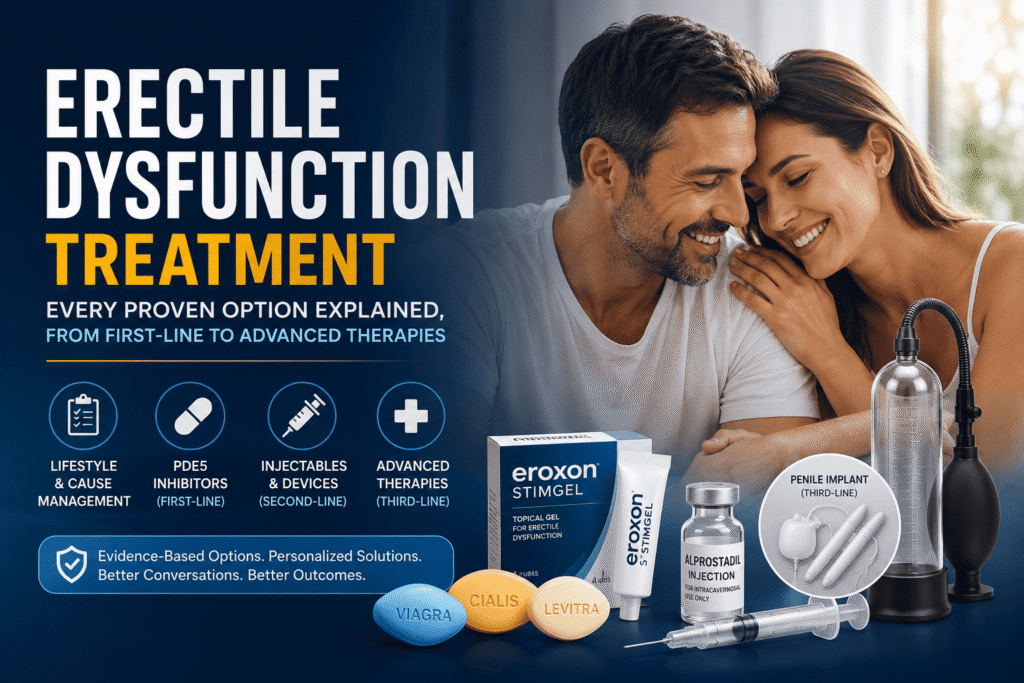
Erectile Dysfunction treatment has evolved considerably, and the 2025 guidelines from the International Consultation on Sexual Medicine (ICSM) — the most comprehensive clinical authority on ED management — confirm that effective options now exist for virtually every type and severity of ED. The question is no longer whether ED is treatable, but which treatment is most appropriate for each individual man. This guide covers the full treatment landscape in the order clinical guidelines recommend: lifestyle and addressing underlying causes first, then first-line pharmacotherapy with PDE5 inhibitors, then second-line options for the approximately 30% of men who don’t respond to oral medication, and finally advanced therapies including surgical and emerging treatments. Understanding the framework helps men have better conversations with their doctors and set realistic expectations for each approach.
The 2025 Fifth International Consultation on Sexual Medicine (ICSM) guidelines confirm that PDE5 inhibitors remain first-line treatment for most men with ED. However, approximately 30% of men prescribed PDE5 inhibitors do not respond adequately — often because of incorrect timing, food interactions, insufficient stimulation, or an underlying cause that hasn’t been addressed. Understanding why a treatment isn’t working is as important as choosing the treatment in the first place.
Why Treatment Selection Depends on Cause
ED is not a single disease — it is a symptom that can result from vascular disease, nerve damage, hormonal imbalance, psychological factors, medication side effects, or combinations of all of these. The best treatment depends entirely on identifying which cause or causes apply to the individual man.
A man whose ED is caused primarily by performance anxiety requires a different approach than a man with Diabetes-related vascular and neurological ED, who in turn requires a different approach than a man with post-prostatectomy nerve damage. This is why a medical evaluation before starting treatment — not just purchasing a medication — is the recommended starting point.
The Treatment Tier Framework (2025 ICSM Guidelines)
Clinical guidelines organise ED treatment into tiers, with simpler, less invasive options tried first. This hierarchy reflects both evidence for effectiveness and the principle of starting with the least burdensome approach.
| Tier | Treatment Options | Typical Indication |
| Foundation | Lifestyle modification, addressing underlying conditions (hypertension, Diabetes, obesity), stopping implicated medications | All men with ED — before or alongside any pharmacotherapy |
| First-line | PDE5 inhibitors (Sildenafil, Tadalafil, Vardenafil, Avanafil), psychosexual therapy, Eroxon topical gel | Most men with ED regardless of cause |
| Second-line | Intracavernosal injections (alprostadil, Trimix), intraurethral alprostadil (MUSE), vacuum erection devices | Men who don’t respond to or can’t use PDE5 inhibitors |
| Third-line | Penile prosthesis (implant surgery) | Men who don’t respond to second-line treatment |
| Adjunctive / Specialised | Testosterone Replacement Therapy (confirmed hypogonadism), arterial revascularisation (selected young men with vascular injury), low-intensity shockwave therapy | Selected patients based on clinical assessment |
Foundational Step: Lifestyle and Addressing Underlying Causes
The 2025 AFU/SFMS guidelines and ICSM both confirm that lifestyle optimisation is the foundational step — not an optional addition. For men with modifiable risk factors, addressing them can produce meaningful improvement in erectile function independently of any pharmacotherapy.
- Exercise: At least 150 minutes of moderate aerobic activity weekly. Harvard research found 30 minutes of daily walking reduced ED risk by 41%. A 2018 meta-analysis confirmed aerobic exercise significantly improves erectile function in men with cardiovascular-related ED.
- Weight management: Obesity is associated with low testosterone, insulin resistance, and vascular disease — all ED risk factors. A 42-inch waist increases ED risk by 50% compared to a 32-inch waist. Weight loss alone has resolved ED in some studies.
- Quit smoking: Smoking damages endothelial cells and depletes Nitric Oxide. Smokers have a 51% higher ED risk. Erection quality improves measurably within weeks of stopping.
- Limit alcohol: Limit to 1 to 2 standard drinks on evenings when sexual activity matters. Heavy drinking acutely prevents erections and chronically lowers testosterone.
- Mediterranean-pattern diet: Rich in leafy greens, healthy fats, fatty fish, and whole grains — the most evidence-supported dietary pattern for reducing ED risk (19% lower risk with high flavonoid intake in a Harvard study of 25,000 men).
- Address underlying conditions: Well-controlled Diabetes, blood pressure, and cholesterol directly improve erectile function. Reviewing medications that cause ED with a prescriber can also resolve the problem without additional treatment.
- Treat psychological factors: For men whose ED is primarily anxiety- or depression-related, addressing the psychological cause is more effective than prescribing medication alone.
First-Line: PDE5 Inhibitors (Oral ED Medication)
PDE5 inhibitors are the evidence-based first-line pharmacological treatment for most men with ED, confirmed by the 2025 ICSM, AUA, EAU, and AFU/SFMS guidelines. They work by blocking the PDE5 enzyme that breaks down cGMP — the chemical signal produced during sexual arousal that relaxes penile smooth muscle and allows blood flow in. Without sexual stimulation, they have no effect.
The four FDA-approved PDE5 inhibitors for ED are:
- Sildenafil (Viagra, generic Sildenafil): The original and most widely prescribed. Effective for approximately 70% of men with ED when used correctly. Most affordable as a generic — under $1 per tablet with discount programmes in some US pharmacies.
- Tadalafil (Cialis, generic Tadalafil): Longest duration (up to 36 hours — ‘the weekend pill’). Also available as once-daily 2.5 mg or 5 mg for continuous coverage. The only PDE5 inhibitor also approved for Benign Prostatic Hyperplasia (BPH). Not significantly affected by food.
- Vardenafil (Levitra, Staxyn): Similar mechanism and onset to Sildenafil. Available as an orally dissolving tablet (Staxyn). Slightly fewer visual side effects.
- Avanafil (Stendra): Fastest onset — as early as 15 minutes. Highest selectivity for PDE5 over related enzymes, producing fewer side effects from cross-reactivity.
Critical safety note: PDE5 inhibitors are absolutely contraindicated with nitrate medicines in any form — nitroglycerin, isosorbide, and recreational nitrite inhalants (‘poppers’). The combined blood pressure drop can be severe and fatal. They also require prescription and medical review because interactions with alpha-blockers, CYP3A4 inhibitors, and other medicines require dose adjustment. Never use them without a prescription or medical screening.
PDE5 Inhibitor Comparison: Timing, Duration, and Food Effects
| Medicine | Onset | Peak Effect | Duration | Food Effect |
| Sildenafil | 30–60 min | ~60 min | 4–6 hours | High-fat meal delays onset 60–90 min, reduces peak 29% |
| Tadalafil | 30 min–2 hrs | ~2 hrs | Up to 36 hours | Minimal effect — can be taken with food |
| Vardenafil | 30–60 min | ~60 min | 4–5 hours | High-fat meal delays; light meal acceptable |
| Avanafil | 15–30 min | ~30 min | Up to 6 hours | Minimal effect |
Note: All PDE5 inhibitors require sexual stimulation to work and should not be taken more than once in any 24-hour period.
First-Line Alternative: Eroxon Topical Gel
Eroxon is a non-prescription topical gel applied directly to the head (glans) of the penis that received FDA de novo authorisation in 2023 for Erectile Dysfunction in adults. It is the first topical ED treatment available in the US without a prescription.
How it works: Eroxon creates a cooling and then warming sensation that activates local nerve endings and promotes the natural release of Nitric Oxide — the same molecule that initiates erections. It does not contain Sildenafil or any PDE5 inhibitor. It works through a purely physical, localised mechanism.
- Onset: Effects typically begin within 10 minutes of application.
- Application: Applied to the glans (head) of the penis with a fingertip, approximately 5 to 30 minutes before sexual activity.
- Suitability: An option for men who cannot take oral PDE5 inhibitors due to cardiovascular contraindications or medication interactions. Also useful for men who prefer a non-systemic, non-prescription option.
- Evidence: A Phase 3 randomised controlled trial showed Eroxon significantly improved erectile function compared to placebo. A meta-analysis comparing it favourably to Sildenafil in terms of onset speed has been cited, though direct head-to-head comparative efficacy studies are limited.
Eroxon is generally well-tolerated. Common side effects are mild local reactions. It is not a contraindication with nitrate medicines, unlike PDE5 inhibitors — making it an important option for men on nitrates.
Psychosexual Therapy and Counselling
Psychosexual therapy is a first-line treatment for ED with a significant psychological component — particularly performance anxiety, depression, stress, or relationship difficulties. It is also recommended alongside pharmacotherapy in mixed-cause ED, where addressing the psychological component improves the response to medication.
A 1992 study published by Springer found that 69.4% of 36 couples who underwent sex therapy for male ED reported positive outcomes. More recent research demonstrates that combining psychosexual therapy with PDE5 inhibitors produces better and more sustained outcomes than either approach alone.
Evidence-based psychosexual approaches include sensate focus exercises, cognitive behavioural therapy (CBT), mindfulness-based interventions, and couples communication therapy. Both individual and couples formats are available. A sex therapist with credentials from AASECT (US) or COSRT (UK) is recommended.
Second-Line: Injectable Medications
Intracavernosal injection (ICI) therapy is the most commonly used second-line treatment for ED, with effectiveness rates above 70% across most ED types. The 2025 AFU/SFMS guidelines confirm ICI may also be offered as a first-line alternative for men who prefer not to take oral medication.
Common injectable options:
- Alprostadil (Prostaglandin E1) alone: The most widely used single-agent injectable. Produces erections by directly relaxing penile smooth muscle, independently of nervous system arousal signals. Effective even in men with significant nerve damage (post-prostatectomy, spinal cord injury).
- Bimix (Papaverine + Phentolamine): Dual-agent formulation. Effective for men who don’t respond adequately to alprostadil alone.
- Trimix (Alprostadil + Papaverine + Phentolamine): Triple-agent formulation. Most potent injectable option. Used for severe or refractory ED. Requires preparation by a compounding pharmacy.
- Intraurethral alprostadil (MUSE — Medicated Urethral System for Erection): Alprostadil suppository inserted into the urethra rather than injected. Less effective than intracavernosal injection but less invasive for men who are averse to needles.
Injections are self-administered after proper training from a clinician. The main reasons men discontinue are discomfort, reduced spontaneity, and priapism risk. Starting with the lowest effective dose and rotating injection sites reduces complications. Priapism (erection lasting more than 4 hours) is the most serious risk — men must know to seek emergency care immediately if this occurs.
Important: Intracavernosal injection is not recommended in men at high risk for priapism — including those with Sickle Cell Disease, Leukaemia, or Multiple Myeloma. A clinician must assess suitability and provide training before a patient self-administers.
Second-Line: Vacuum Erection Devices (VED)
Vacuum Erection Devices are non-pharmacological, non-surgical second-line options with a success rate of more than 90% for producing erections sufficient for intercourse. They consist of a cylinder placed over the penis, a pump that creates negative pressure to draw blood in, and a constriction ring at the base to maintain the erection.
VEDs are particularly suitable for older men in stable relationships, men with penile implant contraindications, men who prefer to avoid medication, and men recovering from prostate surgery (penile rehabilitation protocols often include VEDs). They require practice to use effectively and can reduce penile temperature and natural feeling, which some men and partners find off-putting.
VEDs are available both by prescription and over the counter in some markets. Medical-grade devices (with proper constriction rings and vacuum limits) are safer than novelty versions.
Third-Line: Penile Implant Surgery
Penile implants (prostheses) are the definitive third-line treatment for men who have not responded to first- and second-line treatments, or who have irreversible organic ED from conditions like radical prostatectomy, Peyronie’s Disease, or severe vascular disease. They have among the highest long-term patient and partner satisfaction rates of any ED treatment — typically above 90% — because they permanently solve the problem rather than managing it dose by dose.
Two main types:
- Malleable (semi-rigid) implants: Bendable rods that keep the penis in a firm but repositionable state. Simpler mechanism, lower cost, and suitable for men with poor hand dexterity. Less natural appearance and concealment.
- Inflatable implants (2-piece and 3-piece): Hydraulic devices where the patient pumps a reservoir to inflate the device for an erection and deflates it afterward. Most closely mimics natural function. The 3-piece inflatable is the most commonly implanted device globally.
Surgery is irreversible — once a penile implant is placed, the natural erectile tissue is no longer functional. This makes it appropriate only after exhausting other options and with careful patient counselling about the permanence of the decision.
Hormonal Therapy for ED
Testosterone Replacement Therapy (TRT) is indicated specifically for men with confirmed hypogonadism — testosterone below 300 ng/dL alongside symptoms including reduced libido, fatigue, and mood changes. It is not a first-line ED treatment for men with normal testosterone levels.
When both ED and confirmed hypogonadism are present simultaneously, guidelines recommend treating both together — PDE5 inhibitors for the erection mechanism and TRT for the hormonal environment in which erections occur. TRT improves libido and the overall sexual response; PDE5 inhibitors improve the mechanical erection quality.
Important: TRT suppresses sperm production. Men who wish to father children should discuss alternatives (hCG, clomiphene) with a reproductive specialist before starting TRT.
Arterial Revascularisation Surgery
Microsurgical penile revascularisation is a specialised surgical technique reserved for a narrow indication: younger men (typically under 40) with ED caused by specific pelvic or perineal vascular injury (such as a bicycle or straddle injury) that has blocked blood flow to the penis — without generalised atherosclerosis.
The procedure creates a bypass around the blocked penile artery, restoring arterial inflow. It is not appropriate for men with generalised atherosclerosis (arterial hardening throughout the body), as the procedure requires healthy recipient vessels to create the bypass.
When properly selected, outcomes are good. However, this procedure is performed by a small number of specialist centres and is only appropriate for a specific patient subset.
Emerging and Investigational Treatments
Low-intensity shockwave therapy (Li-SWT)
The most evidence-supported emerging treatment. The 2025 AFU/SFMS guidelines and multiple systematic reviews now support Li-SWT as a treatment option for vasculogenic ED — stimulating new blood vessel growth (angiogenesis) and restoring erectile tissue health over multiple sessions.
Li-SWT uses sound waves applied externally to the penis (not the painful high-energy shockwaves used in kidney stone treatment). Multiple treatment sessions over weeks are required. Evidence supports effectiveness in mild to moderate vasculogenic ED; evidence in severe ED and non-vasculogenic ED is less consistent. It is increasingly available at men’s health clinics and urology centres.
Platelet-rich plasma (PRP) therapy
PRP involves injecting the patient’s own concentrated platelets into penile tissue. The growth factors in platelets are proposed to stimulate tissue repair and blood vessel growth. Early clinical data is promising in some populations. Not yet endorsed in mainstream guidelines as a standard option; evidence is still building.
Stem cell therapy
Experimental treatment using stem cells to repair damaged erectile tissue. Active area of research, particularly for post-prostatectomy ED and severe vasculogenic ED where other treatments have failed. Not currently available as a standard clinical treatment outside of clinical trials.
Botulinum toxin (Botox) injection
A 2025 systematic review found intracavernosal Botox injection shows promise by relaxing cavernosal smooth muscle through a different mechanism to traditional injectables, with potential effects lasting up to 6 months from a single injection. Still investigational and not in standard guidelines.
Gene therapy
An experimental approach targeting the genetic pathways that regulate Nitric Oxide production, nerve repair, and penile smooth muscle function. Several trials are underway, particularly for post-radical prostatectomy ED. A genuinely futuristic treatment at this stage.
Why Around 30% of Men Don’t Respond to PDE5 Inhibitors — and What to Do
The 2025 ICSM guidelines specifically address the approximately 30% of men who don’t respond adequately to PDE5 inhibitors. Before concluding a PDE5 inhibitor has failed, the following should be checked:
- Timing — was it taken 30 to 60 minutes before sexual activity? (Not 15 minutes, not 3 hours)
- Food — was a high-fat meal taken within 2 hours? (Reduces Sildenafil peak by 29%, delays onset by 60 minutes)
- Arousal — was there adequate sexual stimulation? PDE5 inhibitors cannot create an erection without it
- Dose — was it a sufficient dose? If 50 mg Sildenafil is not working, 100 mg may be needed (under medical guidance)
- Number of attempts — guidelines recommend 6 to 8 properly timed attempts before concluding failure
- Underlying condition — is there a hormonal, neurological, or anatomical cause that PDE5 inhibitors cannot address?
If genuine PDE5 inhibitor failure is confirmed, switching to a different PDE5 inhibitor, combining low-dose daily Tadalafil with on-demand Sildenafil, or moving to second-line options (injection therapy or VED) are the evidence-supported next steps.
When to See a Doctor
- ED persists over most sexual encounters for more than a few weeks
- ED develops suddenly rather than gradually — may signal a specific new cause
- ED is accompanied by reduced libido, fatigue, or mood changes (possible hormonal cause)
- You are under 60 with new-onset ED — cardiovascular screening is appropriate
- You are taking a medicine that may be causing ED — discuss with the prescriber
- You have Diabetes, cardiovascular disease, or prostate cancer history
- ED is significantly affecting your relationship or mental health
Conclusion
Erectile Dysfunction is one of the most treatable conditions in men’s health, and the treatment landscape has never been better. The 2025 ICSM guidelines confirm a clear hierarchy: lifestyle and addressing underlying causes first; PDE5 inhibitors as first-line pharmacotherapy for most men; second-line options (injectable therapy, vacuum devices) for those who don’t respond; and penile implant surgery as a definitive third-line option with very high long-term satisfaction. Eroxon topical gel now offers a prescription-free first-line alternative for men who cannot take oral PDE5 inhibitors. And emerging treatments — particularly low-intensity shockwave therapy — are gaining guideline support for vasculogenic ED.
The most important principle is the same across every treatment tier: identifying the cause of ED determines which treatment will work. A medical evaluation is not a bureaucratic obstacle to accessing treatment — it is the step that makes treatment effective.
Frequently Asked Questions
-
Is salt treatment for Erectile Dysfunction a viable option?
No. There is no clinical evidence for salt as an ED treatment, and high salt intake worsens hypertension — one of the most significant risk factors for ED. Any claim that salt treats ED is not supported by medical research. If you are looking for dietary approaches to support erectile health, the most evidence-based option is a Mediterranean-pattern diet rich in vegetables, healthy fats, lean protein, and whole grains — and low in processed food, refined carbohydrates, and excess sodium.
-
What is the best treatment for Erectile Dysfunction?
There is no single ‘best’ treatment — it depends on the cause, severity, and individual circumstances. For most men, PDE5 inhibitors (Sildenafil, Tadalafil, Vardenafil, or Avanafil) are the evidence-based first-line pharmacological choice. For men who cannot take oral medication, Eroxon topical gel is a prescription-free first-line alternative. For men who don’t respond to oral medication, injectable alprostadil or Trimix are highly effective second-line options. The best treatment is the one that works for you — which requires identifying the cause first.
-
How is Eroxon gel helpful in treating Erectile Dysfunction?
Eroxon is an FDA-authorised topical gel applied to the glans (head) of the penis before sexual activity. It works by creating a cooling then warming sensation that activates local nerve endings and promotes Nitric Oxide release — triggering a natural erection through a physical rather than systemic mechanism. Unlike PDE5 inhibitors, it does not enter the bloodstream, making it an option for men on nitrate medicines or those with cardiovascular contraindications to oral ED drugs. Onset is typically within 10 minutes.
-
Are over-the-counter medications safe for ED treatment?
It depends on the specific product. Eroxon gel is FDA-authorised and clinically studied. However, the vast majority of OTC supplements marketed for ED — testosterone boosters, herbal combinations, ‘natural Viagra’ products — are not FDA-approved for ED and often have weak or no clinical evidence. Some contain undisclosed pharmaceutical compounds (including unlabelled Sildenafil or analogues) that carry the same drug interactions as prescription PDE5 inhibitors without the safety screening. Never assume OTC supplements are safe without checking with a doctor.
-
What is the latest treatment for Erectile Dysfunction?
The most evidence-supported emerging treatment gaining clinical guideline recognition is low-intensity shockwave therapy (Li-SWT), which stimulates new blood vessel growth in the penis over multiple sessions and is particularly beneficial for vasculogenic ED. Platelet-rich plasma (PRP) injection and stem cell therapy are also in active investigation. Intracavernosal Botox injection — which may produce effects lasting up to 6 months from a single injection — shows promise in early studies. Gene therapy remains the most experimental frontier. None of these have yet fully entered standard first-line guidelines, but Li-SWT is closest.
This article is for general informational purposes only and does not constitute medical advice. Always consult a qualified healthcare provider before starting any treatment for Erectile Dysfunction. Never combine PDE5 inhibitors with nitrate medicines.