
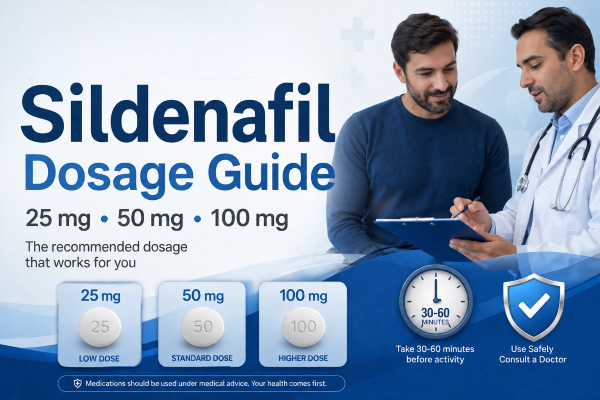
Sildenafil Citrate is the active ingredient in Viagra and is available in three FDA-approved doses for Erectile Dysfunction: 25 mg, 50 mg, and 100 mg. Understanding which dose is appropriate, how each one differs in practice, what factors determine the right starting dose, and how to take it correctly for best results is the most practical knowledge any man starting Sildenafil needs. This guide covers all three FDA-approved Sildenafil Dosage with clinical evidence, the factors that determine your starting dose, food and timing guidance, when dose adjustment is appropriate, side effects by dose level, drug interactions, and who should avoid Sildenafil entirely.
Important — FDA-approved doses: Sildenafil (Viagra) is FDA-approved for Erectile Dysfunction in three doses only: 25 mg, 50 mg, and 100 mg. Some generic products marketed online (such as Cenforce 120mg, 150mg, or 200mg) exceed the FDA-approved maximum dose of 100mg per day. Higher doses do not produce better erections — they produce more side effects and carry greater cardiovascular risk. The information in this article applies to the three FDA-approved doses only.
In clinical trials, approximately 71% of men achieved erections within 30 minutes of taking Sildenafil 50 mg. The 50 mg dose is the standard starting dose for most men because it balances efficacy and tolerability — it is sufficient for most cases of mild to moderate ED with fewer side effects than the 100 mg maximum dose.
What Is Sildenafil and How Does It Work?
Sildenafil Citrate is a Phosphodiesterase-5 (PDE5) inhibitor — the first oral medicine approved for Erectile Dysfunction, receiving FDA approval in 1998 as Viagra. It is also approved for Pulmonary Arterial Hypertension (PAH) as Revatio, at different doses and dosing frequency to those used for ED.
Mechanism: sexual arousal triggers the release of Nitric Oxide (NO) in erectile tissue. NO activates an enzyme that produces cyclic Guanosine Monophosphate (cGMP), which relaxes smooth muscle in penile blood vessels, allowing blood to flow in and produce an erection. The PDE5 enzyme normally breaks down cGMP and ends the erection. Sildenafil blocks PDE5, allowing cGMP to remain active longer — making erections easier to achieve and sustain in response to arousal.
Critical point: Sildenafil only works with sexual stimulation. Without arousal triggering Nitric Oxide release, there is no cGMP for Sildenafil to protect. It does not produce automatic erections and does not increase sexual desire.
The Three FDA-Approved Sildenafil Doses for ED
Sildenafil 25 mg
The lowest FDA-approved dose for ED. 25 mg is the recommended starting dose for specific patient groups (see below) where standard 50 mg may be too strong or cleared too slowly. It is also the appropriate dose when significant drug interactions reduce Sildenafil clearance.
In clinical practice, 25 mg is not as commonly prescribed as 50 mg for first-time users without particular risk factors, but it is an important starting point for older men, those with impaired kidney or liver function, and those taking certain interacting medicines.
Sildenafil 50 mg — the standard starting dose
The standard first-line Sildenafil dose for most adult men. It strikes the best balance between efficacy and tolerability for the majority of users. Clinical trials show approximately 71% of men achieve erections within 30 minutes at this dose. Most prescribers begin here and adjust based on response and side effects.
If 50 mg produces adequate results with manageable side effects, it is the appropriate ongoing dose. If it is well-tolerated but insufficiently effective after 6 to 8 properly timed attempts, a doctor may increase to 100 mg. If side effects are bothersome, the dose may be reduced to 25 mg.
Sildenafil 100 mg — the maximum approved dose
The maximum FDA-approved dose for ED. It is prescribed when 50 mg has been well-tolerated but is insufficiently effective, or in men with more severe ED who have been assessed as appropriate candidates for the higher dose.
100 mg carries a higher risk of side effects than 50 mg — particularly headache, flushing, nasal congestion, and visual disturbances — because these effects are dose-dependent. Never self-escalate from 50 mg to 100 mg without medical guidance. And never exceed 100 mg per day — higher doses are not approved and do not improve erections; they increase risk.
Sildenafil Dosage by Age and Health Status
The appropriate starting dose depends not just on ED severity but on individual health factors. The following summarises the key guidance from Mayo Clinic and FDA label:
| Patient Group | Starting Dose | Reason |
| Most adult men (under 65, no major health concerns) | 50 mg | Standard starting dose — best efficacy/tolerability balance |
| Men aged 65 and older | 25 mg | Slower hepatic and renal clearance raises blood levels; lower start reduces side-effect risk |
| Men with moderate hepatic (liver) impairment | 25 mg | Reduced Sildenafil metabolism raises blood levels |
| Men with severe renal (kidney) impairment | 25 mg | Reduced clearance raises blood levels and prolongs duration |
| Men taking CYP3A4 inhibitors (ritonavir, ketoconazole, itraconazole, clarithromycin) | 25 mg (max 25 mg in 48 hrs for ritonavir) | CYP3A4 inhibitors dramatically slow Sildenafil breakdown |
| Men taking alpha-blockers | 25 mg | Additive blood pressure reduction; lower start is safer |
| Men who experienced dose-limiting side effects at 50 mg | 25 mg | Dose reduction to maintain tolerability |
Which Sildenafil Dose Should I Start With?
If you are a healthy adult man under 65 with no liver or kidney impairment, not taking CYP3A4 inhibitors or alpha-blockers, and have not previously used Sildenafil, the standard starting dose is 50 mg. This is what the FDA label, Mayo Clinic, and NHS all recommend as the first-line dose.
If you are 65 or older, have significant liver or kidney impairment, or take any of the interacting medicines listed above, 25 mg is the appropriate starting dose. This is not because 25 mg is less effective — it is because drug clearance is slower in these groups, meaning the same amount of Sildenafil produces higher blood levels and longer-lasting effects.
Key rule: Start at the dose your doctor prescribes. Take it for 6 to 8 properly timed attempts before deciding whether a dose adjustment is needed. Many perceived ‘failures’ at a given dose are due to incorrect timing, food interactions, or insufficient arousal — not an inadequate dose. Resolve these variables before requesting a higher dose.
How to Take Sildenafil for Best Results
- Timing: Take Sildenafil 30 to 60 minutes before planned sexual activity. Some men notice effects as early as 15 to 20 minutes on an empty stomach; others may need closer to an hour. A window of 30 to 60 minutes is the consistent recommendation.
- Maximum advance time: Do not take it more than 3 to 4 hours before planned activity — levels will have declined significantly below the effective range by then.
- Frequency: Once per day maximum. Never take a second dose within 24 hours even if the first dose has worn off.
- Swallow whole: Sildenafil tablets should be swallowed whole with a glass of water. Do not crush or chew.
- Sexual stimulation required: Sildenafil will not produce an erection without sexual arousal. Ensure the conditions for arousal are in place.
- Hydration: Stay well-hydrated. Dehydration reduces blood volume and can reduce erection quality.
Food and Alcohol — How They Affect Sildenafil Dosage
Food
Food significantly affects Sildenafil absorption — and this is the most common reason men report that a dose ‘didn’t work’ on a particular occasion.
- Empty stomach (best): Fastest and most predictable absorption. Takes effect in 15 to 30 minutes. If possible, take Sildenafil 2 to 3 hours after your last meal.
- Light, low-fat meal (acceptable): Minimal impact on absorption. Small delay possible. Suitable if a completely empty stomach causes discomfort.
- High-fat meal (avoid): A high-fat meal delays the time to peak Sildenafil concentration by approximately 60 minutes and reduces maximum concentration by approximately 29%, according to FDA label data. Practical impact: onset may be delayed to 90 to 120 minutes and effectiveness may be reduced. If you have eaten a heavy meal, wait 2 to 3 hours before taking the dose, or take it slightly earlier to account for the delay.
- Grapefruit and pomelo: Must be avoided on dosing days. Both inhibit the CYP3A4 enzyme that metabolises Sildenafil, raising blood levels unpredictably and increasing both effects and side-effect risk.
Alcohol
Moderate alcohol (1 to 2 standard drinks) is generally manageable but can amplify flushing and dizziness. More than 2 drinks significantly compounds the blood-pressure-lowering effect of Sildenafil and impairs the arousal signal the drug depends on. Limit alcohol on evenings you take Sildenafil.
Sildenafil for Pulmonary Arterial Hypertension — Different Dosing
Sildenafil is also FDA-approved for Pulmonary Arterial Hypertension (PAH) as Revatio. The dosing for PAH is entirely different from ED dosing and the two should never be confused:
- PAH dose: Revatio 20 mg taken three times daily (every 8 hours), with or without food.
- ED dose: Viagra/generic Sildenafil 25 to 100 mg taken once daily as needed, 30 to 60 minutes before sexual activity.
Never use Viagra and Revatio together — both contain Sildenafil. Do not use ED-dose Sildenafil (50 mg or 100 mg) as a substitute for Revatio in PAH treatment. The dosing is different and using the wrong regimen can be dangerous.
Sildenafil Side Effects by Dose Level
Sildenafil side effects are dose-dependent — more common and more pronounced at 100 mg than at 25 mg. All side effects arise from its vasodilating mechanism rather than toxicity.
Common side effects (all doses, more frequent at higher doses)
- Headache — from generalised vasodilation; affects approximately 25% of users at standard doses
- Facial flushing and warmth — affects approximately 31% of users; peaks at 30 to 60 minutes and fades
- Nasal congestion — dilated nasal blood vessels
- Indigestion or stomach discomfort — Sildenafil relaxes the lower oesophageal sphincter
- Dizziness — from modest blood pressure reduction
- Visual disturbances — temporary blue tint or increased light sensitivity from mild cross-reactivity with PDE6 in the retina
Note: Fever, sore throat, and difficulty speaking are not standard Sildenafil side effects and are not listed in the FDA label. If you experience these symptoms, they are unlikely to be caused by Sildenafil and should be evaluated for their own cause.
Serious side effects — seek emergency care immediately
- Priapism — an erection lasting more than 4 hours that will not subside; a urological emergency
- Sudden vision loss in one or both eyes — may indicate NAION (non-arteritic anterior ischaemic optic neuropathy)
- Sudden hearing loss or severe tinnitus
- Severe chest pain or symptoms of cardiovascular event
- Severe allergic reaction — swelling of face, throat, or tongue; widespread hives; difficulty breathing
Drug Interactions That Affect Sildenafil Dosage
Absolute contraindications — never combine regardless of dose
- Nitrate medicines: Nitroglycerin, isosorbide mononitrate, isosorbide dinitrate, and recreational nitrite inhalants (‘poppers’). The combined blood pressure drop can be severe and fatal. There is no safe combination of any Sildenafil dose with any nitrate medicine.
- Riociguat (Adempas): Used for Pulmonary Hypertension. Absolutely contraindicated with all PDE5 inhibitors.
Interactions requiring dose adjustment or caution
- CYP3A4 inhibitors (ritonavir, ketoconazole, itraconazole, clarithromycin, erythromycin): Slow Sildenafil metabolism and raise blood levels. Start at 25 mg; Ritonavir limits maximum dose to 25 mg per 48-hour period.
- CYP3A4 inducers (rifampin, carbamazepine, St John’s Wort): Speed up Sildenafil breakdown, reducing efficacy. May require a higher dose or more frequent dosing under medical guidance.
- Alpha-blockers (Tamsulosin, Doxazosin): Additive blood pressure reduction. Start at 25 mg; allow several hours between doses where possible.
- Other PDE5 inhibitors: Never combine Sildenafil with Tadalafil, Vardenafil, or Avanafil — additive blood pressure reduction and priapism risk.
Who Should Not Take Sildenafil
- Anyone taking nitrate medicines in any form — absolute contraindication
- Anyone taking Riociguat
- Men with recent heart attack or stroke (within 90 days)
- Men with severe heart failure or severe low blood pressure
- Men for whom sexual activity is medically unsafe
- Anyone with a known allergy to Sildenafil or any tablet ingredient
- Men with retinitis pigmentosa or similar inherited retinal conditions
- Anyone under 18 years old
Men with moderate liver or kidney impairment, or those taking CYP3A4 inhibitors, are not absolute contraindications but require reduced starting doses and medical supervision.
When to Ask Your Doctor About Dose Adjustment
Consider asking about a lower dose (25 mg) if:
- Side effects are consistently bothersome at 50 mg
- You are 65 or older and have not yet tried 25 mg
- You have started a new medicine that interacts with Sildenafil
- You notice effects lasting longer than expected (may indicate accumulation)
Consider asking about a higher dose (100 mg) if:
- You have completed 6 to 8 properly timed attempts at 50 mg with optimal food conditions
- 50 mg is well-tolerated but consistently produces insufficient effect
- You are under 65, do not have liver or kidney impairment, and are not taking dose-limiting medicines
Important: Never self-escalate from 50 mg to 100 mg without medical guidance. And never exceed 100 mg per 24 hours — there is no approved dose above 100 mg for Erectile Dysfunction. Products marketed as 120 mg, 150 mg, or 200 mg Sildenafil are not FDA-approved at these strengths for ED and carry significantly increased risk of severe side effects including dangerous blood pressure drops.
Conclusion
Sildenafil is available in three FDA-approved doses for Erectile Dysfunction: 25 mg, 50 mg, and 100 mg. The 50 mg dose is the standard starting point for most men, with 71% of men achieving erections within 30 minutes in clinical trials. The 25 mg dose is appropriate for men aged 65 and older, those with liver or kidney impairment, and those taking interacting medicines. The 100 mg dose is the maximum and is only appropriate when 50 mg is well-tolerated but insufficiently effective.
Beyond the dose itself, how you take Sildenafil matters significantly: timing (30 to 60 minutes before activity), food (empty or light-fat stomach), and avoiding grapefruit and heavy alcohol all affect how quickly and reliably any dose works. Dose escalation should follow at least 6 to 8 properly timed attempts at the current dose — not be driven by a single suboptimal experience.
Frequently Asked Questions
-
Can you take 2 Sildenafil pills at once?
No. Never take two Sildenafil doses at once or more than one dose in any 24-hour period. Taking a second pill does not produce a stronger or more reliable erection — it increases the risk of side effects including severe dizziness, low blood pressure, headache, and in rare cases Priapism. If a single dose is not working, the issue is more likely timing, food, or conditions rather than an insufficient dose. Discuss persistent lack of response with a doctor rather than doubling the dose.
-
How long does Sildenafil last?
Sildenafil typically produces an effective window of 4 to 6 hours, with peak effect in the first 2 to 3 hours after onset. It is not fully cleared from the body for approximately 24 hours, which is why a second dose should not be taken within that period even after the effects have faded. Duration is longer in older men and those with liver or kidney impairment due to slower clearance.
-
Is Sildenafil weaker than Viagra?
No. Sildenafil and Viagra contain the same active ingredient at the same doses. Viagra is the brand name; Sildenafil is the generic. Both must meet the same FDA bioequivalence standards for manufacturing quality, purity, and potency. Generic Sildenafil is essentially identical to Viagra in terms of active ingredient and effect — at a significantly lower price.
-
Can I take Sildenafil if I don’t have Erectile Dysfunction?
Sildenafil does not improve erectile function in men who do not have ED — the PDE5 inhibitory mechanism amplifies the body’s natural response to arousal, and in men with normal function there is no impairment to amplify. Some research suggests Sildenafil may modestly reduce the post-orgasmic refractory period in some men. However, using Sildenafil without ED is not approved and not medically indicated — and the drug carries the same interaction and contraindication risks regardless of the reason for use.
-
Is 100 mg of Sildenafil safe?
Yes, 100 mg is the FDA-approved maximum dose for ED and is considered safe when prescribed appropriately for suitable patients. However, it carries a higher incidence and intensity of common side effects (headache, flushing, nasal congestion, visual disturbances) than lower doses. It is not appropriate as a first dose for men aged 65 and older, those with liver or kidney impairment, or those on CYP3A4-inhibiting medicines. Always take the dose your doctor prescribes and do not self-escalate.
Citations
- S. Food and Drug Administration. Viagra (sildenafil citrate) Prescribing Information. https://www.accessdata.fda.gov/drugsatfda_docs/label/2014/020895s039lbl.pdf
- Mayo Clinic. Sildenafil (oral route) — proper use and dosing. https://www.mayoclinic.org/drugs-supplements/sildenafil-oral-route/proper-use/drg-20066989
- NHS UK. Sildenafil (Viagra) — dosage and side effects. https://www.nhs.uk/medicines/sildenafil-viagra/
- Padma-Nathan H, et al. On-demand IC351 (Tadalafil/Sildenafil clinical comparison). PMC. https://www.ncbi.nlm.nih.gov/pmc/articles/PMC2699643/
- Goldstein I, et al. Oral sildenafil in the treatment of erectile dysfunction. New England Journal of Medicine, 1998. PubMed PMID 9562578.https://pubmed.ncbi.nlm.nih.gov/9562578/
- com. Sildenafil dosage information. https://www.drugs.com/dosage/sildenafil.html
- Sildenafil oral tablet (Viagra) — dosage. https://www.healthline.com/health/sildenafil-oral-tablet
This article is for general informational purposes only and does not constitute medical advice. Sildenafil is a prescription-only medicine. Always consult a qualified healthcare provider before starting, stopping, or adjusting any dosage. Never exceed 100 mg per day or combine with nitrate medicines.
