
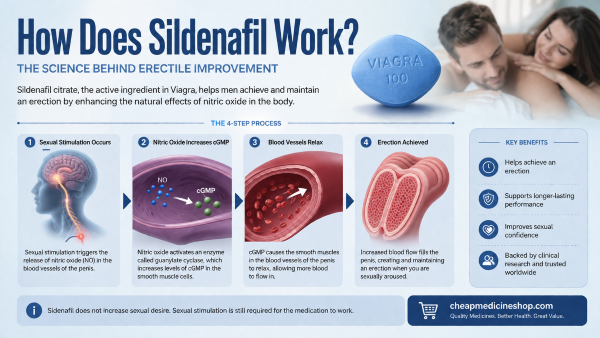
How does Sildenafil work? It is one of the most frequently asked questions about the world’s most prescribed Erectile Dysfunction medicine. The short answer is that Sildenafil blocks the PDE5 enzyme to prolong the chemical signal that produces erections during sexual arousal — but understanding the full mechanism explains why it works the way it does, why it requires sexual stimulation, why food and alcohol affect it, and why some men get better results than others. This guide covers the complete step-by-step mechanism, how quickly it works, what influences its timing and effectiveness, and the key practical points for getting the best results.
Sildenafil (Viagra) was not originally developed for Erectile Dysfunction. It was being tested as a treatment for angina (chest pain) and high blood pressure when clinical trial participants in Wales in the early 1990s reported unexpected erections as a side effect. Pfizer recognised the opportunity, pivoted the drug’s development, and Viagra became the first FDA-approved oral treatment for Erectile Dysfunction in 1998 — changing men’s sexual health medicine permanently.
How Erections Happen — The Physiology That Sildenafil Works On
To understand how Sildenafil works, it helps to first understand how a normal erection occurs without it — because Sildenafil doesn’t create erections; it amplifies the body’s natural response to arousal.
The penis contains two parallel chambers of spongy erectile tissue called the corpus cavernosum. These chambers contain smooth muscle cells, arteries, veins, and spaces that can fill with blood. In the flaccid state, the smooth muscle is contracted and arterial blood flow is minimal.
When sexual arousal occurs — from physical touch, visual stimulation, or psychological cues — the brain and local nerves release Nitric Oxide (NO) into the corpus cavernosum. Nitric Oxide is the critical chemical messenger that starts the erection cascade:
- Nitric Oxide activates the enzyme guanylate cyclase
- Guanylate cyclase converts GTP (guanosine triphosphate) into cyclic Guanosine Monophosphate (cGMP)
- cGMP causes smooth muscle cells in the penile arteries to relax
- Relaxed smooth muscle allows the arteries to dilate widely
- Blood rushes into the corpus cavernosum, filling the spongy tissue
- As the tissue expands, it compresses the veins that drain the penis (the veno-occlusive mechanism)
- Trapped blood causes the penis to become rigid — an erection
Normally, the enzyme PDE5 (Phosphodiesterase type 5) breaks down cGMP, ending the relaxation signal and allowing the smooth muscle to contract again. Blood drains, and the erection subsides. PDE5 is the enzyme Sildenafil targets.
How Does Sildenafil Work: The Complete Step-by-Step Mechanism
Sildenafil belongs to the Phosphodiesterase-5 (PDE5) inhibitor drug class. Here is the complete mechanism in sequence:
- Step 1 — Arousal occurs: Sexual stimulation (physical, visual, or psychological) activates nerve signals that release Nitric Oxide into the corpus cavernosum.
- Step 2 — cGMP is produced: Nitric Oxide activates guanylate cyclase, which produces cGMP. This is the signal that will relax penile smooth muscle.
- Step 3 — Sildenafil blocks PDE5: Sildenafil selectively binds to and inhibits the PDE5 enzyme. This prevents PDE5 from breaking down cGMP.
- Step 4 — cGMP accumulates: With PDE5 inhibited, cGMP levels remain elevated for longer than they would naturally.
- Step 5 — Smooth muscle stays relaxed: Elevated cGMP keeps the smooth muscle in the penile arteries relaxed and dilated.
- Step 6 — Increased blood flow: The dilated arteries allow more blood to flow into the corpus cavernosum.
- Step 7 — Erection is achieved and sustained: The expanding corpus cavernosum compresses drainage veins, trapping blood and maintaining rigidity. The erection is easier to achieve and sustain within the dose window.
- Step 8 — After Sildenafil clears: As Sildenafil is metabolised (half-life approximately 3 to 5 hours), PDE5 inhibition diminishes, cGMP levels normalise, smooth muscle tone returns, and erection response returns to baseline.
Key insight: Sildenafil’s mechanism is an amplification of the natural erection response, not an override. It extends the window during which the body’s own arousal-triggered signals can produce and sustain an erection. This is fundamentally different from a drug that forces an erection regardless of arousal — and it is why sexual stimulation is non-negotiable for Sildenafil to work.
Why Sildenafil Only Works with Sexual Stimulation
This is one of the most important points about how Sildenafil works, and it surprises many first-time users.
Sildenafil blocks PDE5 — the enzyme that breaks down cGMP. But cGMP is only produced when Nitric Oxide is present. And Nitric Oxide is only released when sexual arousal occurs and activates the nerves supplying the penis. Without arousal:
- No arousal signal → no Nitric Oxide release
- No Nitric Oxide → no guanylate cyclase activation
- No guanylate cyclase activity → no cGMP produced
- No cGMP to protect → PDE5 inhibition has nothing to act on
- Result: no erection, regardless of the Sildenafil blood level
This is why Sildenafil does not produce automatic or spontaneous erections. Taking a pill and waiting will not produce an erection. Sexual stimulation — physical touch, visual stimulation, or psychological arousal — must be present to trigger the Nitric Oxide release that starts the erection cascade Sildenafil then extends.
A practical implication: anxiety about whether the pill will work, which suppresses arousal, can prevent Sildenafil from working. The pharmacological success of Sildenafil depends on the arousal signal being strong enough to release Nitric Oxide in the first place.
How Long Does Sildenafil Take to Work?
Sildenafil is absorbed from the gastrointestinal tract and reaches peak blood concentration (Tmax) approximately 60 minutes after taking it on an empty stomach. The onset of its erection-enhancing effect follows the blood concentration curve:
- Fastest onset (empty stomach): Some men notice effects within 15 to 30 minutes. This is the early rise in blood concentration before peak.
- Typical onset (light meal or empty): 30 to 60 minutes. The standard clinical guidance and the timeframe to plan around.
- After a high-fat meal: Onset delayed to 90 to 120 minutes. A high-fat meal slows gastric emptying, delaying the tablet reaching the small intestine where absorption occurs. FDA label data shows peak Sildenafil concentration is delayed by approximately 60 minutes and reduced by approximately 29% after a high-fat meal.
The optimal strategy: take Sildenafil on an empty or light-meal stomach, approximately 45 to 60 minutes before anticipated sexual activity.
How Long Does Sildenafil Work (Duration)?
Sildenafil has a half-life of approximately 3 to 5 hours, meaning blood concentration halves every 3 to 5 hours. The effective duration — the window during which arousal can more easily produce and sustain an erection — is approximately 4 to 6 hours for most men.
Important nuances:
- 4–6 hours is a window, not a continuous erection: During this period, sexual stimulation can produce an erection. Once stimulation ends, the erection subsides. Another erection can be achieved again with renewed stimulation — within the refractory period.
- Peak effect is in the first 2–3 hours: Effectiveness is strongest when blood concentration is highest — the first 2 to 3 hours after onset. It declines toward the end of the 4 to 6 hour window.
- Older men may experience longer duration: Sildenafil clears more slowly in men over 65 due to reduced hepatic and renal clearance. The drug may remain at effective concentrations for longer — which is one reason the starting dose for older men is 25 mg.
- Drug remains in body longer than its effects: Sildenafil is not fully eliminated for approximately 24 hours. This is why a second dose should not be taken within 24 hours even after the effects have worn off.
What Makes Sildenafil Work Better
- Empty or light stomach: Fastest and most reliable absorption. Take 2 to 3 hours after your last meal if possible. A light, low-fat snack is acceptable with minimal impact on absorption.
- Sexual stimulation: Not optional — see mechanism section above. The physical, visual, and psychological conditions for arousal must be in place.
- Relaxed mindset: Anxiety suppresses the arousal signal Sildenafil depends on. Performance anxiety is one of the most common reasons Sildenafil appears to ‘not work.’ A calm, low-pressure setting makes the drug significantly more effective.
- Adequate timing: Taking it 45 to 60 minutes before activity gives the best balance between onset time and peak concentration. Neither too early (more than 4 hours) nor too late (less than 20 minutes).
- Good hydration: Dehydration reduces blood volume and impairs circulation. Staying well-hydrated supports the vascular mechanism Sildenafil relies on.
- Cardiovascular health: Sildenafil amplifies the body’s own vascular response to arousal. Men with healthy blood vessels, good endothelial function, and adequate Nitric Oxide production respond better than those with significant vascular disease. This is why lifestyle management (exercise, diet, not smoking) compounds the benefit of Sildenafil.
- No heavy smoking: Smoking acutely reduces Nitric Oxide bioavailability — the very molecule Sildenafil depends on. Avoid smoking before or during the dose window.
What Makes Sildenafil Work Less Well
- High-fat meal within 2 hours: Delays onset by 60 minutes and reduces peak concentration by 29%. The most controllable and most common reason for variable results.
- Grapefruit and pomelo: Inhibit CYP3A4, the enzyme that metabolises Sildenafil. Raise blood levels unpredictably, making effects inconsistent and side-effect risk higher. Avoid on dosing days.
- Heavy alcohol: Suppresses the CNS arousal signal Sildenafil depends on. More than 2 drinks significantly impairs erection quality regardless of Sildenafil blood level.
- Performance anxiety: Activates the sympathetic nervous system (fight-or-flight), which opposes the parasympathetic activation required for arousal and Nitric Oxide release. Anxiety literally prevents the mechanism that Sildenafil is trying to amplify.
- Taking it too far in advance: Taking Sildenafil more than 3 to 4 hours before sexual activity means peak blood concentration has already passed. Never take it more than 3 to 4 hours ahead.
- CYP3A4 inducers (rifampin, carbamazepine, St John’s Wort): Speed up Sildenafil metabolism, reducing blood levels and shortening effective duration.
- Significant vascular disease: If ED is caused by severely narrowed penile arteries from Diabetes or advanced atherosclerosis, the vasodilatory response to Nitric Oxide and cGMP may be so blunted that Sildenafil cannot overcome the physical limitation alone. Second-line treatments may be more appropriate.
Does Sildenafil Work for Everyone?
Sildenafil is effective for approximately 70% of men with ED when used correctly and under appropriate conditions. The approximately 30% who don’t respond adequately typically fall into one of two categories:
- Suboptimal use: Incorrect timing, high-fat meal, insufficient arousal, performance anxiety, or fewer than 6 to 8 properly conditioned attempts. Addressing these factors often resolves apparent non-response.
- Genuine non-response: Significant underlying vascular disease, post-prostatectomy nerve damage, or other organic causes that PDE5 inhibition cannot overcome. These men require second-line treatments.
The 2025 ICSM guidelines note that before concluding genuine PDE5 inhibitor failure, all practical factors should be checked and optimised, and 6 to 8 properly timed attempts made.
Clinical tip: If Sildenafil has not worked on a particular occasion, before concluding the drug doesn’t work for you, check: Was it taken 30 to 60 minutes before? Was there a high-fat meal within 2 hours? Was there adequate sexual stimulation? Was there significant alcohol? Was there significant anxiety? A ‘no’ to any of these explains many apparent failures more reliably than the drug itself not working.
What Sildenafil Does NOT Do
- It does not produce erections without sexual stimulation — arousal is required
- It does not increase sexual desire (libido) — it supports erection mechanics, not desire
- It does not make you last longer in bed — it does not delay ejaculation or treat premature ejaculation
- It does not ‘keep you hard after coming’ — ejaculation triggers detumescence normally; the refractory period is not eliminated
- It does not permanently fix Erectile Dysfunction — each dose acts for a dose window; it does not address the underlying cause
- It does not work as an aphrodisiac or performance enhancer in men without ED — it amplifies a response that is already intact, not one that is absent
- It does not protect against sexually transmitted infections or prevent pregnancy
Sildenafil vs Other PDE5 Inhibitors — How the Mechanism Differs
All four FDA-approved oral PDE5 inhibitors — Sildenafil, Tadalafil, Vardenafil, and Avanafil — work through the same fundamental mechanism: blocking PDE5 to preserve cGMP during arousal. The differences are in selectivity, pharmacokinetics, and food interactions:
- Tadalafil (Cialis): Half-life of approximately 17 hours, producing a duration of up to 36 hours. Not significantly affected by food. Available as a once-daily low dose for continuous coverage. Same PDE5 inhibition mechanism.
- Vardenafil (Levitra): Very similar mechanism and timing to Sildenafil. Higher selectivity for PDE5 relative to PDE6 (the retinal enzyme), meaning fewer visual side effects for some men.
- Avanafil (Stendra): Fastest onset (as early as 15 minutes). Highest selectivity for PDE5 over related enzymes, resulting in fewer off-target side effects from PDE11 and PDE6 cross-reactivity. Least affected by food.
None of these medicines require arousal less than Sildenafil — all PDE5 inhibitors require sexual stimulation for the same fundamental reason. The difference is in onset speed, duration, food sensitivity, and side-effect profile.
Conclusion
How does Sildenafil work? It selectively inhibits the PDE5 enzyme, which normally breaks down the cGMP produced during sexual arousal. By blocking PDE5, Sildenafil allows cGMP to remain elevated longer, keeping penile smooth muscle relaxed and blood vessels dilated — making erections easier to achieve and sustain within the 4 to 6 hour dose window.
Because the entire mechanism depends on Nitric Oxide being released during arousal first, Sildenafil is fundamentally an amplifier of the body’s natural response — not an override. Without sexual stimulation, it has no mechanism to act on. With stimulation, optimal timing (30 to 60 minutes before), and appropriate conditions (empty or light-fat stomach, limited alcohol, relaxed mindset), it is effective for approximately 70% of men with ED.
Frequently Asked Questions
-
Does Sildenafil work?
Yes — Sildenafil is an FDA-approved, clinically proven treatment for Erectile Dysfunction with over 27 years of clinical use and safety data. It is effective for approximately 70% of men with ED when used correctly: taken 30 to 60 minutes before sexual activity on an empty or light-meal stomach, with adequate sexual stimulation. The 30% who report initial non-response often have suboptimal timing, food, or conditions rather than a true pharmacological failure.
-
What does Sildenafil do?
Sildenafil selectively inhibits the PDE5 enzyme that normally breaks down cGMP — the chemical signal produced during sexual arousal that relaxes penile smooth muscle and allows blood to flow in. By blocking PDE5, Sildenafil extends the duration of cGMP activity, making erections easier to achieve and sustain in response to sexual stimulation. It does not create erections spontaneously, increase libido, or delay ejaculation.
-
How long does Sildenafil work?
Sildenafil’s effective window — the period during which sexual stimulation can more easily produce and sustain an erection — is approximately 4 to 6 hours. Effects are strongest in the first 2 to 3 hours after onset. The drug itself remains in the body for approximately 24 hours after the dose, which is why a second dose should not be taken within 24 hours even after the effects have faded.
-
How fast does Sildenafil work?
Sildenafil typically begins working within 30 to 60 minutes of taking it on an empty stomach. Some men notice effects as early as 15 to 20 minutes. A high-fat meal delays onset by approximately 60 minutes and reduces peak concentration by 29%. For the most predictable timing, take Sildenafil 45 to 60 minutes before anticipated sexual activity on an empty or light-meal stomach.
-
Does Sildenafil keep you hard after coming?
No. Ejaculation triggers the natural detumescence response — blood drains from the corpus cavernosum and the penis returns to its flaccid state. Sildenafil extends the window for arousal to produce erections but does not eliminate the refractory period or maintain an erection after ejaculation. A second erection may be achievable sooner during the active dose window, but this is an individual variable rather than a guaranteed effect.
Citations
- Dhaliwal A, Gupta M. PDE5 Inhibitors. StatPearls. NCBI Bookshelf. https://www.ncbi.nlm.nih.gov/books/NBK549843/
- S. Food and Drug Administration. Viagra (sildenafil citrate) Prescribing Information. https://www.accessdata.fda.gov/drugsatfda_docs/label/2014/020895s039lbl.pdf
- Goldstein I, et al. Oral sildenafil in the treatment of erectile dysfunction. New England Journal of Medicine, 1998. PubMed PMID 9562578. https://pubmed.ncbi.nlm.nih.gov/9562578/
- Padma-Nathan H, et al. Onset of action of sildenafil. PMC2699643. https://www.ncbi.nlm.nih.gov/pmc/articles/PMC2699643/
- Corbin JD. Mechanisms of action of PDE5 inhibition in erectile dysfunction. International Journal of Impotence Research, 2004. https://www.nature.com/articles/3901205
- NHS UK. How and when to take sildenafil. https://www.nhs.uk/medicines/sildenafil-viagra/how-and-when-to-take-sildenafil/
- Food interactions with sildenafil. https://www.sciencedirect.com/science/article/abs/pii/S0149291813011259
This article is for general informational purposes only and does not constitute medical advice. Sildenafil is a prescription-only medicine. Always consult a qualified healthcare provider before starting any medication. Never combine with nitrate medicines.
