
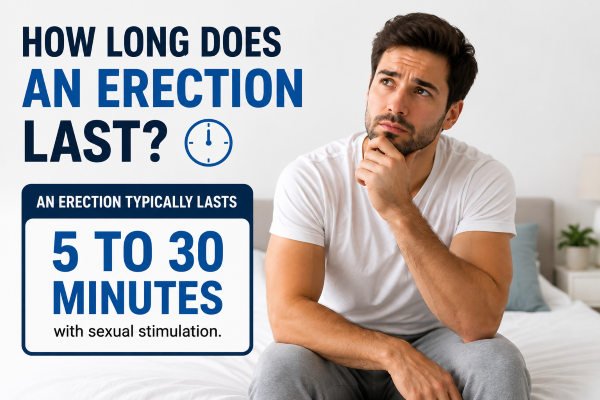
The answer depends entirely on context — an erection during sex lasts very differently from a nocturnal erection, a medication-supported erection, or an erection from using a vacuum device. Understanding what is normal in each context, what factors affect duration, and when an unusually long or unusually short erection becomes a medical concern is what this article covers.
A landmark study published in the Journal of Sexual Medicine measured ejaculation latency times in 500 couples across five countries (Netherlands, UK, Spain, Turkey, and USA) using a stopwatch method. The median IELT (Intravaginal Ejaculation Latency Time) was 5.4 minutes, with a wide range from 33 seconds to 44 minutes. This study confirms both the wide natural variation and the approximate 5 to 7 minute average most guidelines reference.
How Long Does an Erection Last? By Context
| Context | Typical Duration | Notes |
| Sexual activity (to ejaculation) | 5 to 7 minutes (median IELT) | Wide natural variation — 33 seconds to 44 minutes in one study |
| Nocturnal erections (sleep) | 20 to 35 minutes each | 3 to 5 per night during REM cycles |
| Morning erection (post-REM) | A few minutes after waking | Subsides with movement and voiding the bladder |
| Spontaneous erections | A few minutes | Resolve with movement or distraction |
| With Sildenafil (Viagra) | Effective window: 4–6 hours | Not a continuous erection — a window where arousal produces erection |
| With Tadalafil (Cialis) | Effective window: up to 36 hours | Longest duration of any PDE5 inhibitor |
| With Eroxon gel | Effective window: similar to arousal | Onset approximately 10 minutes; duration tied to stimulation |
| With vacuum erection device (VED) | As long as constriction ring is on | Remove ring after 30 minutes maximum |
| Priapism (emergency) | More than 4 hours | MEDICAL EMERGENCY — go to ER immediately |
Average Erection Duration During Sex
The most clinically rigorous data on erection duration comes from the 500-couple stopwatch study published in the Journal of Sexual Medicine (Waldinger et al., 2005). Across participants in five countries, the median Intravaginal Ejaculation Latency Time (IELT) was 5.4 minutes, ranging from 33 seconds to 44 minutes. The median was lower in younger men and varied by country.
It is important to understand that IELT measures time to ejaculation — the erection typically continues briefly after ejaculation before subsiding. The total duration of an erection during a sexual encounter may therefore be somewhat longer than the IELT, depending on the extent of foreplay before penetration and whether erection is maintained through the refractory recovery.
There is no clinically ‘correct’ erection duration for sexual activity. Duration is adequate if it allows satisfying sexual activity for both partners. Duration is clinically insufficient when it consistently causes sexual dissatisfaction or occurs in fewer than 25% of attempts — which is the threshold for Erectile Dysfunction.
Nocturnal and Morning Erections — How Long Do They Last?
Healthy men typically experience 3 to 5 erections per night during REM (Rapid Eye Movement) sleep cycles. Each nocturnal erection typically lasts 20 to 35 minutes. Total nocturnal erection time is approximately 100 minutes per night in young healthy men, declining gradually with age.
Morning erections are the last nocturnal erection of the night that persists into waking. They typically subside within a few minutes of waking, movement, and voiding the bladder. Their presence is clinically reassuring — it confirms that the vascular and neurological erection systems are intact, independent of psychological state. Consistently absent morning erections in a man with erectile difficulties suggest an organic (physical) cause worth investigating medically.
How Long Does an Erection Last with Medication?
Sildenafil (Viagra) — 4 to 6 hours
Sildenafil’s effective window is approximately 4 to 6 hours. This does not mean a continuous 4 to 6 hour erection — it means that during this period, sexual stimulation can more easily produce and sustain an erection. Erections arise and subside normally in response to arousal. Sildenafil reaches peak concentration approximately 60 minutes after dosing on an empty stomach.
Tadalafil (Cialis) — up to 36 hours
Tadalafil has the longest effective window of any FDA-approved PDE5 inhibitor — up to 36 hours. Again, this is a window of enhanced responsiveness, not a continuous erection. This extended duration, and the availability of once-daily low-dose formulations, distinguishes Tadalafil from other PDE5 inhibitors.
Vardenafil (Levitra) — 4 to 5 hours
Similar effective window to Sildenafil. Vardenafil reaches peak concentration in approximately 60 minutes and maintains its effective window for 4 to 5 hours.
Avanafil (Stendra) — up to 6 hours
Fastest onset (as early as 15 minutes) with an effective window of up to 6 hours. The fastest of the four FDA-approved PDE5 inhibitors.
Eroxon topical gel — onset ~10 minutes
Eroxon is an FDA-authorised topical gel applied to the glans of the penis before sexual activity. It works through a cooling and warming mechanism that stimulates local Nitric Oxide production rather than systemic PDE5 inhibition. Onset is approximately 10 minutes. Duration is tied to arousal rather than a fixed pharmacological window — the erection lasts as long as stimulation and arousal are maintained, similar to an unmedicated erection.
How Long Does an Erection Last with a Pump (VED)?
A Vacuum Erection Device (VED) creates negative pressure around the penis, drawing blood in to produce an erection. A constriction ring placed at the base of the penis after pumping traps the blood and maintains the erection after the pump is removed.
The erection can be maintained for as long as the constriction ring is worn. The ring should never be worn for more than 30 minutes — leaving it on longer restricts blood flow and can cause penile tissue damage. The resulting erection may feel slightly different from a natural erection (cooler, slightly less firm at the base) because the blood is trapped rather than actively circulating.
What Affects Erection Duration?
- Age: Erections tend to become less sustained with age due to gradually declining testosterone, reduced Nitric Oxide production, and vascular changes. The refractory period between erections also lengthens significantly.
- Cardiovascular health: The penile arteries are small and show the effects of atherosclerosis early. Poor cardiovascular health reduces arterial inflow, making erections harder to sustain.
- Testosterone: Low testosterone reduces arousal drive and the neurological conditions that support sustained erection.
- Psychological state: Anxiety, distraction, or performance pressure can interrupt the arousal signal and shorten erection duration even in men without physical ED.
- Level of stimulation: Erections require sustained sexual stimulation to be maintained. A pause in stimulation will typically cause the erection to begin to subside.
- Alcohol: More than 1 to 2 standard drinks reduces erection quality and sustainability by suppressing the CNS arousal signal.
- Smoking: Directly damages endothelial cells and depletes Nitric Oxide, impairing the vascular mechanism of sustained erection.
- Medications: Antidepressants (SSRIs), some antihypertensives (beta-blockers), opioids, and antihistamines can all reduce erection quality and duration.
- Sleep: Testosterone is produced during deep sleep. Chronic sleep deprivation reduces testosterone and affects the nocturnal erections that maintain penile tissue health.
When Is an Erection Too Short?
An erection is clinically too short when it consistently fails to allow satisfying sexual intercourse and this pattern is causing personal distress. This is the definition of Erectile Dysfunction — not a minimum time requirement but a functional and distress criterion.
Occasional inability to maintain an erection is normal and does not indicate ED. The 25% threshold is a useful informal rule: if erection difficulty occurs in more than 25% of sexual attempts consistently over several weeks, medical evaluation is appropriate.
Causes of erections that are too short include poor cardiovascular health, low testosterone, anxiety, medication side effects, and Diabetes. All of these are identifiable and treatable.
When Is an Erection Too Long? — Understanding Priapism
Medical emergency — Priapism: An erection lasting more than 4 hours that will not subside — even after ejaculation and without ongoing stimulation — is Priapism. This is a urological emergency. Ischemic Priapism (the most common type) causes oxygen deprivation in the corpus cavernosum. Without prompt treatment, permanent damage to erectile tissue can begin within 4 to 6 hours, potentially causing irreversible Erectile Dysfunction. Go to an emergency room immediately. Do not wait and hope it resolves on its own.
The clinical threshold for Priapism is 4 hours — not 3 hours as is sometimes quoted. Erections lasting 2 to 3 hours after sexual activity that eventually subside are generally not Priapism, but any erection lasting beyond 4 hours requires emergency evaluation.
- Ischemic Priapism: The most common type — caused by reduced venous outflow. Blood becomes deoxygenated, causing pain and risking tissue damage. Causes include sickle cell disease, clotting disorders, PDE5 inhibitors (rare, but dose-related), and some psychiatric medications.
- Non-ischemic Priapism: Less common, usually painless. Caused by excess arterial inflow (often from perineal trauma). A different clinical situation — urgent but not a true emergency in the same sense.
How to Improve Erection Duration
Lifestyle
- Regular aerobic exercise — improves endothelial function, Nitric Oxide production, and cardiovascular fitness directly relevant to sustained erection
- Quit smoking — restores Nitric Oxide availability within 2 to 4 weeks
- Maintain a healthy body weight — reduces aromatisation of testosterone to oestrogen
- Limit alcohol to 1 to 2 drinks on evenings where erection quality matters
- Adequate sleep — testosterone production and nocturnal erection maintenance
- Pelvic floor Kegel exercises — strengthen the muscles that trap blood in the penis
Medical options
- PDE5 inhibitors (Sildenafil, Tadalafil, Vardenafil, Avanafil) — first-line prescription treatment for ED; extend the effective erection window
- Eroxon topical gel — FDA-authorised non-prescription first-line alternative
- Testosterone therapy — where confirmed hypogonadism is contributing to poor erection quality
- Psychosexual therapy — where performance anxiety or psychological factors are shortening erection duration
- Vacuum erection devices — non-pharmacological second-line option
Conclusion
How long an erection lasts depends entirely on context. During sex, the median is 5.4 minutes (IELT) based on a 500-couple study, though the natural range is wide. Nocturnal erections last 20 to 35 minutes each, occurring 3 to 5 times per night. With PDE5 inhibitors, the effective window ranges from 4 to 6 hours (Sildenafil) to up to 36 hours (Tadalafil) — a window of enhanced responsiveness, not continuous erection.
An erection is too short when it consistently prevents satisfying sexual activity. An erection is dangerously long — a medical emergency — when it exceeds 4 hours without subsiding. That threshold (Priapism) requires immediate emergency care.
Frequently Asked Questions
-
How long does an erection last with Eroxon gel?
Eroxon gel has an onset of approximately 10 minutes after application. Unlike PDE5 inhibitors (Sildenafil, Tadalafil), Eroxon does not create a defined pharmacological effectiveness window. Instead, it enhances the local Nitric Oxide response during sexual stimulation. The erection lasts as long as stimulation and arousal are maintained — similar in duration to an unmedicated erection, but potentially easier to achieve and sustain. It is applied approximately 5 to 30 minutes before sexual activity.
-
How long does an erection last with Tadalafil (Cialis)?
Tadalafil maintains an effective window of up to 36 hours — the longest of any FDA-approved PDE5 inhibitor. This does not mean a continuous 36-hour erection. It means that during this 36-hour period, sexual stimulation can more easily produce and sustain an erection. Individual erections arise and subside normally. This extended window is why Tadalafil is called ‘the weekend pill’ — one Friday evening dose can remain effective through Sunday.
-
How long does an erection last after ejaculation?
In most men, an erection begins to subside within a few minutes after ejaculation as the post-orgasmic refractory period begins and the parasympathetic arousal signal reduces. How quickly it subsides varies with age — younger men may maintain an erection longer and recover a new erection faster than older men. Taking a PDE5 inhibitor does not eliminate the refractory period but may make it easier to achieve a subsequent erection within the effective window.
-
How long does an erection last with a vacuum pump?
The erection produced by a vacuum erection device lasts as long as the constriction ring is worn. The ring should not be left on for more than 30 minutes — prolonged restriction of blood flow can cause penile tissue damage. The erection produced by a VED is maintained mechanically rather than physiologically, meaning it does not subside as arousal changes.
-
How do I know if I’m fully erect?
A fully rigid erection corresponds to Grade 4 on the Erection Hardness Scale — the penis is completely hard, fully rigid, and cannot be bent. A Grade 3 erection is hard but not fully rigid — penetration is possible but firmness is reduced. If you consistently experience Grade 2 or lower erections (enlarged but not hard enough for penetration), this is clinically significant and warrants medical evaluation.
-
How long does an erection last with Sildenafil (Viagra)?
Sildenafil’s effective window is approximately 4 to 6 hours, with peak effect in the first 2 to 3 hours after onset. Onset is 30 to 60 minutes on an empty stomach; a high-fat meal can delay this by up to 60 minutes and reduce peak concentration by 29%. Within the effective window, erections arise and subside normally in response to arousal — the drug does not produce a continuous erection but makes it easier to achieve and sustain one when aroused.
This article is for general informational purposes only and does not constitute medical advice. If you experience an erection lasting more than 4 hours, seek emergency medical care immediately. If you are concerned about erection quality or duration, consult a qualified healthcare provider.
