
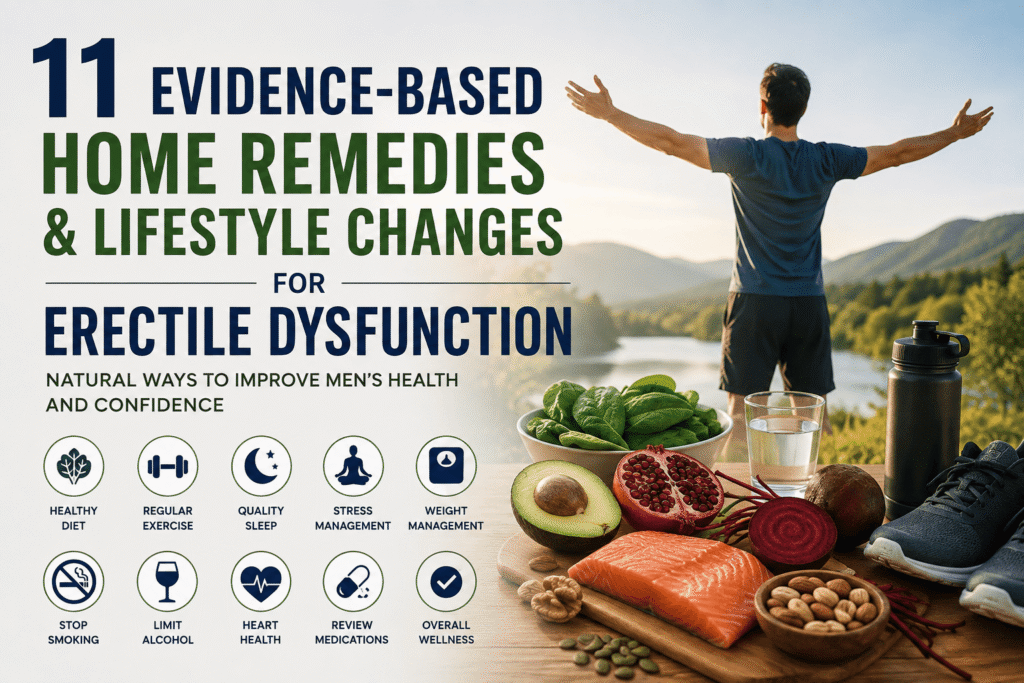
Home Remedies for Erectile Dysfunction is one of the most treatable conditions in men’s health — and for many men, particularly those with mild to moderate ED related to lifestyle factors, significant improvement is possible through non-pharmacological means before medication is considered. Prescription ED medication is highly effective and appropriate when needed, but understanding the lifestyle and dietary changes with the strongest evidence base can help many men improve erection quality meaningfully without side effects or ongoing prescription costs. This article covers 11 evidence-supported home remedies and lifestyle changes for ED — with honest evidence grading and realistic timelines for each.
Note: ‘Home remedy’ does not mean unproven. Many of the approaches below — exercise, diet, sleep, weight management, stopping smoking — have stronger clinical evidence than some prescribed treatments. Others (herbal supplements) have more limited evidence and deserve honest assessment rather than marketing claims.
A Harvard study of over 25,000 men found that those with the highest intake of flavonoid-rich foods had a 19% lower risk of Erectile Dysfunction. A separate Harvard analysis found men who walked 30 minutes daily had a 41% lower risk of ED. These are larger effect sizes than most individual supplements, positioning diet and exercise as among the most evidence-supported natural approaches for erectile health.
1. Nitric Oxide-Supporting Diet
Diet directly impacts Nitric Oxide (NO) production — the chemical signal that initiates erections — and endothelial function (the health of blood vessel lining that produces NO). The foods with the strongest evidence for supporting erectile function:
- Nitrate-rich foods (beets, spinach, rocket, leafy greens): Convert to Nitric Oxide via a salivary-bacterial pathway. Beetroot juice measurably increases blood NO within 2 to 3 hours.
- L-citrulline sources (watermelon): Converts to L-arginine and then to Nitric Oxide more efficiently than supplemental arginine.
- Omega-3 fatty acids (salmon, mackerel, walnuts): Support endothelial function and reduce arterial inflammation.
- Antioxidant-rich foods (berries, pomegranate, dark chocolate 70%+): Protect Nitric Oxide from free radical breakdown.
- Zinc and arginine sources (pistachios, oysters, pumpkin seeds): Zinc is essential for testosterone synthesis; L-arginine is a Nitric Oxide precursor.
- Healthy fats (avocado, olive oil, nuts): Dietary fat is the raw material for testosterone synthesis — very low-fat diets can reduce testosterone.
The overall dietary pattern with the strongest evidence is the Mediterranean diet — associated with the lowest ED risk in multiple large observational studies. Focus on whole foods, healthy fats, lean protein, and minimal processed food rather than individual ‘superfoods.’
2. Vitamins and Minerals — Address Deficiencies
Certain nutrient deficiencies can impair erectile function. The key is identifying actual deficiencies through blood tests rather than supplementing indiscriminately:
- Vitamin D: Low Vitamin D is associated with ED in observational studies, likely through effects on endothelial function and testosterone. If a blood test confirms deficiency, supplementation to adequate levels may support erectile health.
- Zinc: Zinc deficiency reduces testosterone. Supplementation in deficient men can restore testosterone and support erectile function. Zinc-rich foods (oysters, pumpkin seeds, red meat) are preferable to supplements for most men.
- Magnesium: Involved in smooth muscle function and Nitric Oxide regulation. Magnesium deficiency is common and can impair vascular health.
- Vitamin B12: B12 deficiency can cause peripheral neuropathy affecting genital nerve sensitivity. Most relevant for older men, vegetarians, or those on metformin (which reduces B12 absorption).
Important: Get blood tests to confirm deficiencies before supplementing. Zinc at doses above the tolerable upper limit can impair copper absorption and cause adverse effects. Vitamin D at very high doses can cause toxicity. Address deficiencies with food first where possible; supplement when blood tests confirm a gap that diet cannot fill.
3. Regular Aerobic and Resistance Exercise
Exercise is the home remedy with the strongest, most consistent clinical evidence for ED improvement. A 2018 meta-analysis in Sexual Medicine Reviews confirmed that aerobic exercise significantly improves erectile function in men with cardiovascular-related ED, with the greatest benefit in moderate to severe ED. The effective dose: 40 minutes of moderate-to-vigorous aerobic exercise four times per week.
- Aerobic exercise (walking, running, cycling, swimming): Improves endothelial function, Nitric Oxide production, and cardiovascular fitness — directly improving penile blood flow. Harvard data: 30 minutes of daily walking reduces ED risk by 41%.
- Resistance training: Acutely increases testosterone; improves insulin sensitivity and reduces abdominal fat (which increases testosterone aromatisation to oestrogen).
- Pelvic floor exercises (Kegels): Strengthen the muscles that trap blood in the penis during erection. A 2005 BJU International study found pelvic floor rehabilitation restored normal erectile function in 40% of men with ED.
Timeline: cardiovascular improvement begins within 2 to 4 weeks; meaningful erection quality improvement typically within 4 to 8 weeks of consistent training.
4. Quality Sleep
Testosterone is produced during deep sleep, with levels peaking in the final REM cycles before waking. Healthy men also experience 3 to 5 nocturnal erections per night — a physiological maintenance function that delivers oxygenated blood to penile tissue and prevents fibrosis. Chronic sleep deprivation disrupts both of these processes.
- Aim for 7 to 9 hours per night with consistent bedtimes
- Keep the bedroom cool, dark, and screen-free
- Avoid caffeine after 2 PM and screens in the hour before bed
- If you snore heavily or wake feeling unrefreshed, ask about screening for Obstructive Sleep Apnoea — OSA significantly suppresses testosterone and is an independent ED risk factor
Studies show that men sleeping fewer than 5 hours per night have measurably lower testosterone than those sleeping 7 to 9 hours — with the difference apparent within one week of sleep restriction.
5. Herbal Supplements — What the Evidence Actually Shows
Several herbal supplements are marketed for ED. The evidence varies considerably. None have the clinical evidence base of prescription PDE5 inhi
bitors, but some have meaningful supporting data worth acknowledging honestly:
- Panax Ginseng (Red ginseng / Korean ginseng): The best-evidenced herbal option for ED. Multiple meta-analyses show modest but consistent improvement in erectile function scores. Proposed mechanism: ginsenosides stimulate Nitric Oxide production. Evidence grade: low-to-moderate.
- Ashwagandha (KSM-66): Several RCTs show improvement in testosterone and sexual function, particularly in stressed or sleep-deprived men where cortisol reduction may indirectly support testosterone. Evidence grade: low-to-moderate.
- L-arginine (3 to 5 g/day): As a Nitric Oxide precursor, L-arginine at clinical doses shows modest improvement in mild ED. More effective when combined with other Nitric Oxide-supporting nutrients (L-citrulline, Pycnogenol). Evidence grade: low.
- Maca root: Some studies show modest improvements in sexual desire (libido) rather than erection quality specifically. Evidence grade: low.
- Icariin (Horny Goat Weed): The proposed mechanism is PDE5 inhibition, similar to Sildenafil. However, clinical trial evidence in humans is very limited — most evidence is from cell and animal studies. Evidence grade: insufficient for recommendation.
Always consult a doctor before taking herbal supplements alongside prescription medicines — interactions exist, particularly with anticoagulants, antihypertensives, and antidepressants.
6. Stress Management and Performance Anxiety
Psychological ED — driven by performance anxiety, stress, or depression — is the most common primary cause of ED in men under 40. Stress activates the sympathetic nervous system, which directly supposes the parasympathetic state required for erection. Cortisol from chronic stress also suppresses testosterone.
- Daily mindfulness meditation (10 to 15 minutes) — reduces baseline physiological arousal and cortisol
- Psychosexual therapy or CBT — highly effective for performance anxiety and psychological ED; often better than medication alone for this cause
- Sensate focus exercises — reducing performance pressure by focusing on connection rather than outcome
- Regular physical exercise — the most evidence-based stress reducer available
- Open partner communication — reducing the performance pressure that perpetuates psychological ED
If morning erections are preserved but ED occurs specifically in partnered contexts, the cause is more likely psychological — and stress/anxiety management is the most direct treatment.
7. Weight Management
Obesity is one of the most powerful modifiable ED risk factors. Excess abdominal fat promotes testosterone conversion to oestrogen through aromatisation, reducing testosterone and libido. A man with a 42-inch waist is 50% more likely to have ED than a man with a 32-inch waist (Harvard research). Obese men are approximately 1.3 times more likely to experience ED than men with healthy BMI.
Weight loss through combined dietary improvement and exercise — even modest reductions of 5 to 10% of body weight — can meaningfully improve testosterone levels, cardiovascular function, and erection quality over 3 to 6 months.
8. Stop Smoking
Smoking is one of the most direct lifestyle causes of ED. It depletes Nitric Oxide bioavailability by generating free radicals that break it down, and accelerates atherosclerosis in the small penile arteries. A meta-analysis found smokers have a 51% higher risk of ED than non-smokers.
Erection quality improvement is measurable within 2 to 4 weeks of stopping smoking as endothelial function begins to recover. This makes smoking cessation one of the fastest-acting natural ED interventions available.
Resources: nicotine replacement therapy (patches, gum, spray), varenicline or bupropion (prescription), NHS Quit Smoking service (UK), CDC’s 1-800-QUIT-NOW and SmokefreeTXT (US).
9. Limit Alcohol
Light to moderate alcohol consumption (under 14 units per week) is not strongly associated with ED risk. Heavy chronic drinking is a significant cause — it lowers testosterone, damages endothelial cells, and acutely suppresses the CNS arousal signal required for erection. Over 70% of alcohol-dependent men in one study experienced sexual dysfunction.
Practical guidance: limit to 1 to 2 standard drinks on evenings when erection quality matters. Avoid heavy drinking on days you want optimal sexual function.
10. Cardiovascular Health Assessment
ED can precede a cardiovascular diagnosis by 3 to 5 years — because the small penile arteries show the effects of atherosclerosis before the larger coronary arteries. A cardiovascular health assessment is both a natural ED intervention in itself (treating the cause rather than the symptom) and a safety measure.
- Monitor blood pressure — hypertension damages endothelial cells and reduces Nitric Oxide production. Ask your doctor about target blood pressure.
- Check cholesterol — high LDL cholesterol accelerates atherosclerosis. A Mediterranean diet and exercise are first-line non-pharmacological approaches.
- Monitor blood glucose — Diabetes affects 35 to 50% of men with ED through simultaneous vascular and nerve damage. Good blood sugar control directly improves erectile function.
- Manage these conditions with a doctor — the treatment of cardiovascular risk factors often improves ED independently of any specific ED treatment.
11. Review ED-Causing Medications with a Doctor
Many prescription medicines cause or contribute to ED as a side effect. This is one of the most treatable causes of ED — and one of the most overlooked, because men often don’t connect their ED to a recently started medication.
Common medication classes associated with ED:
- Antidepressants (SSRIs and SNRIs) — among the most commonly implicated
- Beta-blockers and thiazide diuretics (for blood pressure)
- Opioid pain medicines (suppress testosterone through HPT axis)
- Antihistamines with anticholinergic effects (e.g. diphenhydramine)
- Finasteride (for hair loss or BPH)
- Antipsychotics (elevate prolactin, suppress libido)
Never stop a prescribed medication without medical guidance — but do discuss the side effect with your prescribing doctor. Many people abandon effective medications unnecessarily when a simple dose adjustment or switching to an alternative class could resolve the ED without compromising the treated condition.
When to Seek Medical Help
Home remedies and lifestyle changes are appropriate first steps for mild or moderate ED — but they are not sufficient for all men, and they should not delay proper medical evaluation indefinitely.
- ED persists over most sexual encounters for more than 8 to 12 weeks despite consistent lifestyle changes
- ED has a sudden onset — which can signal a cardiovascular event, medication side effect, or hormonal change
- ED is accompanied by reduced libido, fatigue, or mood changes — possible hormonal cause
- You are under 60 with new-onset ED — cardiovascular screening is clinically appropriate
- ED is significantly affecting your relationship, mental health, or quality of life
Prescription PDE5 inhibitors (Sildenafil, Tadalafil, Vardenafil, Avanafil) are the evidence-based first-line medical treatment for most men with ED and can be used alongside lifestyle changes rather than instead of them. A doctor can also screen for vascular and hormonal causes, recommend pelvic floor physiotherapy, and refer to a sex therapist where appropriate.
Conclusion
The most evidence-supported home remedies for ED are — in order of evidence strength — regular aerobic exercise, quitting smoking, Mediterranean-pattern diet, adequate sleep, weight management, and pelvic floor exercises. These address the underlying vascular and hormonal causes of most ED more effectively than most supplements. They also compound each other’s benefits when combined.
Herbal supplements (particularly Panax ginseng and ashwagandha) have modest supporting evidence and may help some men, but their effects are smaller and less consistent than the lifestyle measures above. They are best viewed as adjuncts to lifestyle change, not alternatives to it. And when lifestyle changes are insufficient, prescription PDE5 inhibitors — prescribed after a proper medical evaluation — are safe, effective, and often work better alongside good lifestyle habits than without them.
Frequently Asked Questions
-
How long do natural ED remedies take to work?
Timeline varies by remedy. Stopping smoking typically improves erection quality within 2 to 4 weeks. Dietary changes show acute Nitric Oxide effects within hours; longer-term vascular improvement builds over 4 to 12 weeks. Aerobic exercise shows first improvements in 4 to 6 weeks of consistency. Pelvic floor exercises (Kegels) show strength gains at 4 to 6 weeks. Weight loss improves testosterone over 3 to 6 months of sustained effort. Herbal supplements, where they work, typically show effects within 4 to 8 weeks of consistent use.
-
Does lemon cure Erectile Dysfunction?
No — there is no clinical evidence that lemon cures or meaningfully treats Erectile Dysfunction. Lemon and citrus fruits contain antioxidants that support general vascular health, and vitamin C from citrus is anti-inflammatory. But the ‘lemon water for ED’ claim that circulates online has no clinical trial evidence behind it. For dietary approaches with actual evidence, foods rich in dietary nitrates (beets, leafy greens), L-citrulline (watermelon), and flavonoids (berries, dark chocolate) have the strongest mechanistic and clinical backing.
-
What herb is equal to Viagra?
No herb produces effects equivalent to prescription Sildenafil (Viagra). Sildenafil works by selectively blocking PDE5 — a specific enzyme — with strong, consistent clinical trial data. The herb with the best evidence for ED is Panax ginseng (Red Korean ginseng), which has shown modest but consistent improvement in erectile function scores across multiple meta-analyses. Icariin (from Horny Goat Weed) has a similar proposed mechanism to Sildenafil (PDE5 inhibition) but human clinical trial evidence is very limited. No herb should be used as a substitute for medical evaluation of ED.
-
What can I drink for Erectile Dysfunction?
Drinks with the best evidence for supporting erectile health: beetroot juice (highest dietary nitrate content — measurably increases Nitric Oxide within 2 to 3 hours); pomegranate juice (antioxidants protect Nitric Oxide from breakdown; one clinical study showed improved IIEF scores); watermelon juice (L-citrulline content); green tea (EGCG antioxidant supports endothelial function). Coffee in moderation may also support ED risk reduction — observational data associates moderate coffee consumption (2 to 3 cups/day) with lower ED prevalence. Drinks to reduce: alcohol above 1 to 2 per occasion; high-sugar sodas; energy drinks.
-
Can ED be prevented?
Yes — and prevention with lifestyle measures is highly effective, particularly before significant vascular or hormonal damage has accumulated. Regular aerobic exercise, a Mediterranean-pattern diet, maintaining a healthy body weight, not smoking, limiting alcohol, managing blood pressure and blood sugar, and adequate sleep all independently reduce ED risk. The Harvard 41% risk reduction from 30 minutes of daily walking illustrates how significant lifestyle-based prevention can be.
-
What can I do if my partner has Erectile Dysfunction?
The most important things a partner can do: avoid expressing frustration or making erection difficulty feel like personal rejection, which amplifies the performance anxiety that often sustains ED. Create lower-pressure sexual environments where intimacy is not solely goal-oriented. Encourage — not pressure — a partner to see a doctor, emphasising that ED is a health condition with effective treatments rather than a reflection on desire or attraction. Consider couples therapy or sex therapy if communication about ED is creating relationship tension. Participate actively in behavioural techniques like sensate focus if your partner’s doctor recommends them. ED is a condition that affects couples, and partner support is one of the most powerful variables in treatment outcomes.
This article is for general informational purposes only and does not constitute medical advice. If you are experiencing Erectile Dysfunction, consult a qualified healthcare provider. Supplements should be discussed with a doctor before use.
