
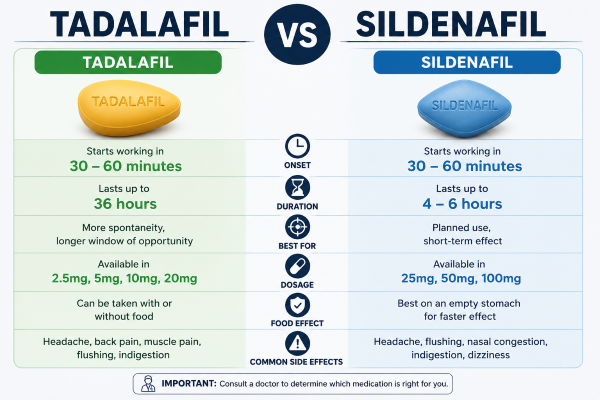
Oral medication is the Tadalafil vs Sildenafil first-line treatment for Erectile Dysfunction (ED) because it’s non-invasive, effective, and easy to use correctly. Tadalafil and Sildenafil are the two most commonly prescribed options, both belonging to the PDE5 inhibitor class. Both improve blood flow to the penis in response to sexual stimulation — but they differ meaningfully in onset, duration, food sensitivity, and how they fit into different routines. This article compares them directly, including approved doses, side effects, cost, and safety.
Important — dosage safety: Both medicines have specific FDA-approved dose ranges that should never be exceeded. Sildenafil’s maximum approved dose for ED is 100 mg per 24 hours. Tadalafil’s maximum approved on-demand dose is 20 mg (or 5 mg for daily use). Products marketed above these limits — including Sildenafil at 120–200 mg or Tadalafil at 40–80 mg — exceed what’s clinically approved. Neither is a legitimate “stronger treatment” option; both increase side-effect risk without a demonstrated benefit.
The discovery of the Nitric Oxide (NO) pathway — the biological process that allows PDE5 inhibitors like Sildenafil and Tadalafil to work — was significant enough that the researchers behind it won the 1998 Nobel Prize in Physiology or Medicine. That was the same year Viagra received FDA approval.
Comparison Overview
| Parameter | Tadalafil | Sildenafil |
| Original manufacturer | Eli Lilly | Pfizer |
| FDA approval | 2003 | 1998 |
| Brand name | Cialis | Viagra |
| Generic versions | Vidalista, Tadagra, Tadarise | Cenforce, Suhagra, Kamagra |
| Onset of action | 30–60 minutes (up to 2 hrs) | 30–60 minutes |
| Duration of effectiveness | Up to 36 hours | 4–6 hours |
| FDA-approved doses | 2.5, 5 mg (daily); 10, 20 mg (on-demand) | 25, 50, 100 mg |
| Common side effects | Headache, nasal congestion, flushing, muscle ache | Headache, flushing, vision changes, nasal congestion |
| Formulations | Tablet; some generics offer jelly/sublingual | Tablet; some generics offer jelly/chewable |
| Food interaction | Minimal | High-fat meals delay onset, reduce peak effect |
| Other approved uses | Pulmonary Arterial Hypertension; Benign Prostatic Hyperplasia | Pulmonary Arterial Hypertension (as Revatio) |
| Cost (brand) | ~$55–$60/pill | ~$70–$85/pill |
| Cost (FDA-approved generic) | ~$1/pill | Often under $1/pill |
On brand pricing, Tadalafil (Cialis) is generally less expensive than Sildenafil (Viagra); among FDA-approved generics, pricing is often broadly comparable, with generic Sildenafil sometimes the lower-cost option.
Onset of Action and Duration
Both medicines typically start working within 30 to 60 minutes, though their effective duration differs substantially:
- Tadalafil: Effects can last up to 36 hours — which is why it’s sometimes called “the weekend pill.” This is a direct result of its half-life of approximately 17.5 hours, more than three times longer than Sildenafil’s. The longer window reduces the need to time a dose closely around planned activity.
- Sildenafil: Effects typically last 4 to 6 hours, with the half-life of approximately 3 to 5 hours. This makes it better suited to planned, on-demand use rather than spontaneous flexibility.
Tadalafil offers a longer duration and more flexibility; Sildenafil is better suited to shorter, planned use.
FDA-Approved Strengths
The right dose depends on health condition, ED severity, treatment response, and a doctor’s guidance — always within the approved range for each medicine:
- Tadalafil:5 mg and 5 mg for daily use; 10 mg and 20 mg for on-demand use before sexual activity. 20 mg is the FDA-approved on-demand maximum.
- Sildenafil: 25 mg, 50 mg, and 100 mg, with 50 mg the usual starting dose. 100 mg is the FDA-approved maximum.
On higher-numbered products: Some generic products — for either medicine — are marketed above these approved ranges (Sildenafil at 120–200 mg; Tadalafil at 40–80 mg). These aren’t a legitimate option for “stronger treatment” or non-responders — no clinical guideline supports exceeding either drug’s approved maximum for ED, and doing so increases side-effect risk without a demonstrated efficacy benefit. If a standard dose isn’t giving you the results you need, that’s a conversation for your doctor about the underlying cause or an alternative medication — not a higher, unapproved dose.
Formulations
Both are primarily available as standard oral tablets, though formulation options vary by brand and generic manufacturer:
- Tadalafil: Standard tablets (as in Cialis); some generic versions also offer oral jelly or sublingual (dissolve-under-the-tongue) formats.
- Sildenafil: Standard tablets; some generic versions also offer oral jelly or chewable formats.
Format choice comes down to convenience, swallowing comfort, and availability — discuss with your doctor if a non-standard format interests you.
Cost Comparison
Both medicines are available as brand-name and FDA-approved generic options, with cost varying by strength, quantity, and pharmacy:
- Brand-name Cialis (Tadalafil): Typically the less expensive brand option relative to Viagra, though a 30-day daily supply without insurance can still run several hundred dollars.
- Brand-name Viagra (Sildenafil): Generally the more expensive brand option per pill.
- FDA-approved generics (either): Both are widely available at low cost through licensed US pharmacies — often around $1 per pill or less, particularly for generic Sildenafil with discount programmes. This is the recommended path for US readers, since it carries the most straightforward regulatory oversight.
Overall, generic pricing for both medicines is broadly comparable and dramatically lower than brand pricing — cost shouldn’t be the deciding factor between them; duration, food sensitivity, and how each fits your routine matter more.
How to Take Each Medicine
- Tadalafil: Can be taken once daily or as needed before sexual activity, depending on the prescribed regimen. Can be taken with or without food — meals don’t meaningfully affect how it works. Never take more than one dose per day.
- Sildenafil: Typically taken as needed, about 45 to 60 minutes before sexual activity. Can be taken with or without food, but a heavy or high-fat meal delays onset and reduces peak effectiveness. Never take more than one dose in 24 hours.
If food-timing flexibility matters to you, Tadalafil is generally the easier option to plan around, since meals don’t significantly affect it.
Caution: Clearance slows in older adults, meaning either medicine can remain active in the body longer than usual — raising the risk of side effects such as low blood pressure, particularly if taken incorrectly or combined with other medications without medical guidance.
Side Effects
Both medicines share common side effects, typically mild and often improving as the body adjusts: headache, facial flushing, indigestion, and nasal congestion. Some effects are more specifically associated with one or the other:
- Tadalafil: More commonly linked with muscle aches, body pain, and lower back pain. Because it remains active for up to 36 hours, side effects can also last longer for some men.
- Sildenafil: More likely to cause temporary visual changes — blurred vision, increased light sensitivity, or a blue tint to vision. Because its effect lasts 4 to 6 hours, these side effects tend to be shorter-lived.
Men particularly sensitive to visual side effects may find Tadalafil more comfortable; those prone to muscle or back discomfort may prefer Sildenafil.
Precautions and Contraindications
As both are PDE5 inhibitors, the same key precautions apply to each:
- Never combine with nitrate medicines (for chest pain) or Riociguat (for Pulmonary Hypertension) — this can cause a severe, potentially fatal blood pressure drop
- Avoid if you’re allergic to Tadalafil, Sildenafil, or other PDE5 inhibitors
- Avoid alcohol and grapefruit (or pomelo) — both can increase dizziness, affect blood pressure, or raise side-effect risk
- Seek emergency medical help immediately for chest pain, fainting, sudden vision or hearing loss, or an erection lasting more than 4 hours (Priapism)
- Tell your doctor about liver or kidney problems, Retinitis Pigmentosa, low or uncontrolled high blood pressure, or a history of heart disease, stroke, or heart attack
- Never combine Tadalafil and Sildenafil together — both belong to the same drug class, and combining them significantly increases side-effect risk without improving results
Men’s Health Guide
Understanding sexual health involves more than treating a single concern. Factors such as lifestyle, sexual performance, erectile function, premature ejaculation, exercise, and medication safety can all play a role. Below are useful resources covering common men’s sexual health questions.
1.Viagra and Alcohol: What You Should Know
Learn how alcohol may affect the effectiveness and safety of Viagra and why moderation is important.
Explore the potential connection between cranberry juice, urinary health, and aspects of sexual wellness.
Understand how dapoxetine is used for premature ejaculation and the key considerations before using it.
4.Can I Take Cialis Without Erectile Dysfunction?
Find out whether Cialis is appropriate for people who do not have erectile dysfunction and what risks to consider.
Discover exercises and fitness approaches that may help improve endurance, pelvic control, and overall sexual performance.
Learn about common causes of weak erections and the lifestyle changes and treatment options that may help.
Conclusion
Both Tadalafil and Sildenafil are effective, well-studied ED treatments that differ mainly in duration, food sensitivity, and cost structure. Sildenafil suits shorter, planned use with lower generic cost; Tadalafil offers a much longer window and a daily-dosing option for men who prefer not to time doses around activity. Side effects differ somewhat — Sildenafil leans toward visual changes, Tadalafil toward muscle and back discomfort. Whichever you choose, staying within the FDA-approved dose range for that specific medicine, and getting a proper prescription, matters far more for your safety than the specific brand or how many milligrams a product is marketed at.
Frequently Asked Questions
-
Is 20 mg Tadalafil equal to 100 mg Viagra?
No. They contain different active ingredients and can’t be compared by milligram strength alone — their potency, half-life, duration, and processing time all differ, so doses don’t convert directly between the two medicines. Always follow your doctor’s prescribed dose for whichever medicine you’re using.
-
Can I take two tablets of Tadalafil 20 mg?
No, not unless your doctor specifically prescribes it — and 20 mg is already the FDA-approved maximum on-demand dose, so two tablets would exceed it. Changing your dose without medical supervision increases the risk of side effects, including headache, dizziness, and a more significant blood pressure drop.
-
Can Tadalafil and Sildenafil be taken together?
No, not unless a doctor specifically advises it in an unusual clinical circumstance. Both belong to the same drug class, and combining them raises the risk of side effects including dizziness, low blood pressure, headache, fainting, and prolonged erection. Use only one PDE5 inhibitor at a time.
-
Which is better for daily use, Tadalafil or Viagra?
Tadalafil is the option actually designed and FDA-approved for daily use, available in low daily doses (2.5 mg and 5 mg) that maintain a steady effect. Sildenafil (Viagra) is approved and typically used on an as-needed basis before sexual activity, not as a daily medication.
This article is for general informational purposes only and does not constitute medical advice. Both medicines are prescription-only. Always consult a qualified healthcare provider and stay within the FDA-approved dose range for whichever medicine you’re prescribed
