
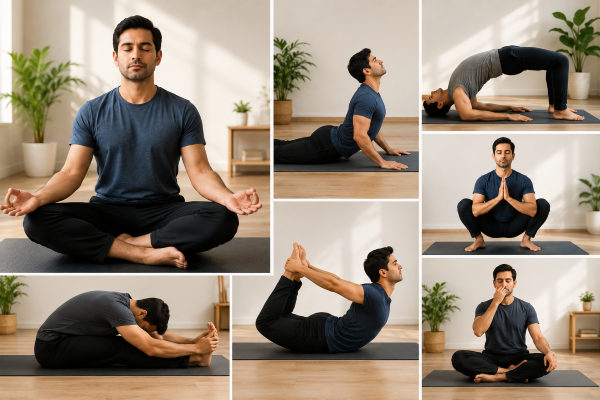
Medication like Sildenafil is the evidence-based first-line treatment for Erectile Dysfunction (ED), but it’s not the only tool worth considering — lifestyle approaches, including regular exercise, yoga for erectile dysfunction matter too. Yoga is one such approach that’s gained genuine research interest. This article covers what the actual evidence shows about yoga and ED, the specific poses most often recommended, and how to practise them safely.
Note: Yoga is a supportive lifestyle practice, not a replacement for medical evaluation or treatment. If you’re experiencing persistent ED, it’s worth discussing with a doctor — who can identify any underlying cause and advise on evidence-based treatment, alongside which yoga can be a reasonable complementary practice.
A 2010 pilot study published in the Journal of Sexual Medicine followed 65 men aged 24 to 60 through a 12-week yoga programme. Using a validated questionnaire (the Male Sexual Quotient), researchers found an overall 11.81% improvement in sexual function scores, with specific gains in intercourse satisfaction, ejaculation control, and erection quality. It’s a small, non-comparative study — promising, but not the same as a large randomised controlled trial.
What Does the Evidence Actually Show?
Research specifically on yoga and Erectile Dysfunction is limited, but what exists is genuinely encouraging. Beyond the 2010 pilot study noted above, a 2024 systematic review and meta-analysis of randomised controlled trials found that yoga was associated with a small but real improvement in sexual function across the studies analysed — while also noting that larger, higher-quality trials are still needed to draw firmer conclusions.
It’s worth being honest about what this evidence does and doesn’t support: yoga shows a real, modest, research-backed association with improved sexual function, particularly through indirect pathways like stress reduction and cardiovascular fitness — not a dramatic, medication-like effect, and not yet confirmed by the kind of large, rigorous trials that exist for PDE5 inhibitors.
Why Might Yoga Help With ED?
Researchers aren’t entirely certain of the mechanism, but a few plausible pathways are consistently proposed:
- Improved cardiovascular fitness and blood flow: A healthy cardiovascular system is essential for erections, since the penile arteries are small and sensitive to blood flow changes. Yoga’s physical activity component supports circulation generally.
- Stress reduction and mindfulness: Chronic stress and anxiety are significant contributors to psychological ED. Yoga’s well-documented stress-reducing and mindfulness benefits may help with this component specifically.
- Pelvic floor engagement: Several yoga poses engage the pelvic floor muscles, which play a direct role in erection firmness and ejaculatory control.
- Improved body image and confidence: Regular practice may support a more positive body image and self-assurance, both of which can reduce performance-anxiety-driven ED.
One specific claim worth addressing directly: you may see individual poses described as directly “raising testosterone levels.” This isn’t well-supported by evidence — no single yoga posture has been shown to meaningfully raise testosterone on its own. What’s more plausible is the indirect route: consistent yoga practice reduces cortisol (a stress hormone that, when chronically elevated, can suppress testosterone), which may support healthier hormonal balance over time — a meaningfully different claim from any one pose directly boosting hormone levels.
Best Yoga Poses for Erectile Dysfunction
These are the poses most commonly recommended for supporting pelvic circulation, pelvic floor engagement, and stress reduction:
Setu Bandhasana (Bridge Pose)
Strengthens the pelvic floor and opens the chest and upper back, supporting circulation and breathing.
- Lie on your back with your arms at your sides
- Bend your knees, feet hip-width apart, palms facing up
- Engage your core and glutes to lift your hips off the floor
- Hold for a few breaths, then lower slowly
Paschimottanasana (Seated Forward Bend)
A gentle stretch that engages the pelvic and perineal muscles.
- Sit with legs extended straight in front of you
- Inhale and lengthen your spine
- Exhale and hinge forward from the hips, reaching toward your feet
- Hold for one to three minutes, breathing steadily — never force the stretch
Uttanasana (Standing Forward Bend)
Supports hip flexibility and gentle inversion, which some practitioners find calming.
- Stand with feet hip-width apart
- Hinge forward from the hips, letting your torso fold down
- Let your arms and head hang naturally — knees can stay softly bent if hamstrings are tight
- Hold for several breaths, then roll up slowly
Janu Sirsasana (Head-to-Knee Pose)
A seated twist and forward fold that engages the pelvic floor and supports flexibility.
- Sit with one leg extended, the other bent with the heel pressed toward the inner thigh
- Turn your torso gently toward the extended leg
- Fold forward, reaching for your foot or shin — use a strap if you can’t comfortably reach
- Hold for five slow breaths, then repeat on the other side
Naukasana (Boat Pose)
Strengthens the core and pelvic muscles, and is sometimes associated with stress-reduction benefits that may indirectly support hormonal balance.
- Lie on your back with arms at your sides
- Inhale, then exhale as you lift your chest and legs off the ground, reaching your arms toward your feet
- Keep your gaze forward and your spine long
- Hold for a few breaths, then release slowly
Practising Safely
- Start gently, particularly if you’re new to yoga — you don’t need to force a pose to get its benefit
- Warm up before attempting deeper stretches or core-engaging poses
- Stop if you feel sharp pain (distinct from a normal stretching sensation)
- Consider a beginner class or instructor guidance if you’re unfamiliar with these poses
- Be consistent — the research showing benefit involved 12 weeks of regular practice, not a single session
Who Should Be Cautious
If you have a heart condition, more intensive yoga practice isn’t automatically appropriate — some poses can raise heart rate and blood pressure. Speak with your doctor before beginning any new yoga practice, particularly if you have cardiovascular disease, uncontrolled hypertension, or any condition where increased physical exertion needs medical clearance first.
Men’s Health Guide
Understanding sexual health involves more than treating a single concern. Factors such as lifestyle, sexual performance, erectile function, premature ejaculation, exercise, and medication safety can all play a role. Below are useful resources covering common men’s sexual health questions.
1.Viagra and Alcohol: What You Should Know
Learn how alcohol may affect the effectiveness and safety of Viagra and why moderation is important.
Explore the potential connection between cranberry juice, urinary health, and aspects of sexual wellness.
Understand how dapoxetine is used for premature ejaculation and the key considerations before using it.
4.Can I Take Cialis Without Erectile Dysfunction?
Find out whether Cialis is appropriate for people who do not have erectile dysfunction and what risks to consider.
Discover exercises and fitness approaches that may help improve endurance, pelvic control, and overall sexual performance.
Learn about common causes of weak erections and the lifestyle changes and treatment options that may help.
Conclusion
The research on yoga and Erectile Dysfunction is still limited but genuinely encouraging — a small pilot study found meaningful improvement in sexual function after 12 weeks of regular practice, and a broader 2024 review confirmed a small, real association between yoga and improved sexual function generally. The likely mechanisms are cardiovascular, hormonal (via stress reduction rather than any single pose directly raising testosterone), and psychological. Yoga isn’t a substitute for medical evaluation or evidence-based ED treatment, but as a consistent, low-risk complementary practice — done safely and with medical clearance if you have a heart condition — it’s a reasonable addition to a broader approach to sexual health.
Frequently Asked Questions
-
Who shouldn’t try yoga for Erectile Dysfunction?
Men with heart conditions should be cautious with more intensive yoga practice, since certain poses can raise heart rate and blood pressure. Speaking with your doctor before beginning any yoga practice is important if you have cardiovascular disease, uncontrolled hypertension, or another condition that affects how much physical exertion is safe for you.
-
How long does it take to see results from yoga for ED?
The research showing benefit involved 12 weeks of consistent practice, not a single session or a few weeks. Yoga works gradually, through cardiovascular, hormonal, and psychological pathways — it’s a complementary practice best approached with realistic expectations and sustained over time, alongside any other treatment your doctor recommends.
-
Can yoga replace medication for Erectile Dysfunction?
No. Yoga has shown a small, genuine benefit for sexual function in research, but it isn’t a replacement for evidence-based medical treatment, particularly for moderate to severe ED or ED with an identifiable underlying cause (vascular, hormonal, or neurological). It’s best considered a complementary practice alongside proper medical evaluation, not a substitute for it.
-
Does yoga help with Premature Ejaculation as well as ED?
Some of the same research suggests yes — the 2010 pilot study found improvements in ejaculation control alongside erection quality, and yoga’s pelvic floor engagement and stress-reduction benefits are relevant to both conditions. As with ED, the evidence is encouraging but still limited, and yoga should be considered a complementary approach rather than a standalone treatment.
This article is for general informational purposes only and does not constitute medical advice. If you are experiencing Erectile Dysfunction, consult a qualified healthcare provider for a proper diagnosis and treatment plan. Speak with a doctor before beginning any new exercise practice, particularly if you have a heart condition
