
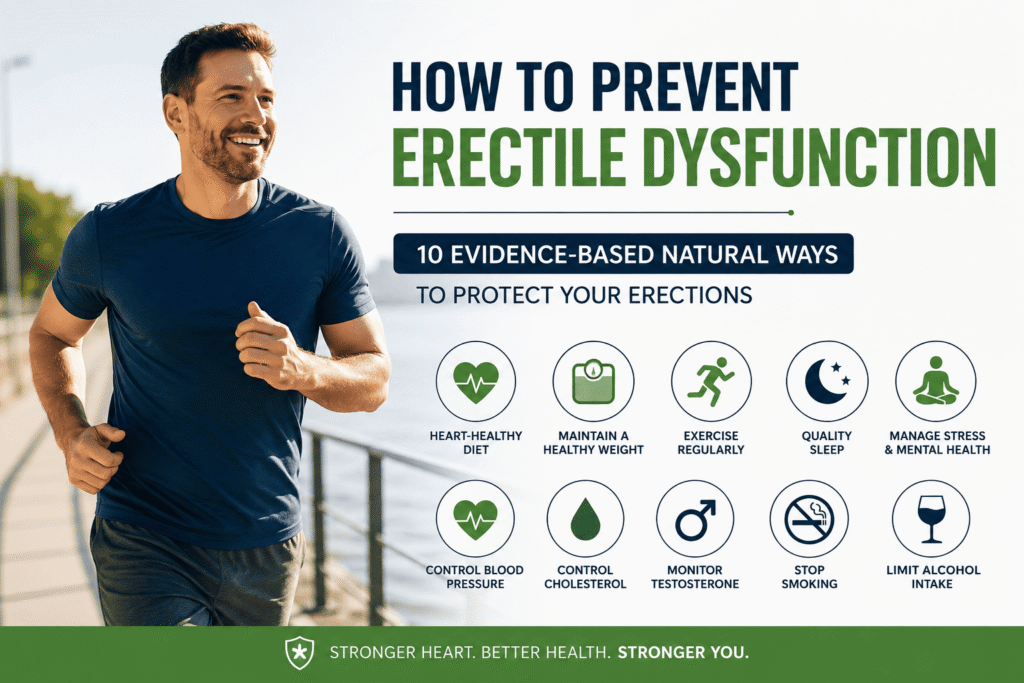
Erectile Dysfunction becomes more common with age — but it is not an inevitable consequence of ageing. For most men, ED is caused by modifiable, preventable conditions: cardiovascular disease, Obesity, Diabetes, smoking, inactivity, poor diet, and chronic stress. This means that how to prevent Erectile Dysfunction is genuinely answerable — not with supplements or quick fixes, but with the same evidence-based lifestyle habits that protect your heart. The connection is not coincidental. The penile arteries are smaller than the coronary arteries and show vascular damage earlier, meaning erection problems in a man under 60 can precede a cardiovascular diagnosis by three to five years. Protecting your erections is, in many ways, the same project as protecting your heart. This article covers 10 natural, evidence-based strategies for ED prevention — with the specific statistics, mechanisms, and practical steps that make each one actionable.
A Harvard University study found that men who walked just 30 minutes a day had a 41% lower risk of developing Erectile Dysfunction. And waist size is one of the most powerful predictors — a man with a 42-inch waist is 50% more likely to have ED than a man with a 32-inch waist. These two statistics underline how directly cardiovascular and metabolic health determines erectile health.
Why ED Is Mostly Preventable — Not Inevitable
Erectile Dysfunction affects an estimated 30 to 50 million men in the United States, and its prevalence increases with age. But research consistently shows that age itself is not the cause — it is the accumulation of modifiable risk factors over time that drives most ED.
In a landmark study from Harvard Medical School, researchers found that in up to 30% of men who saw a doctor for ED, the condition was the first sign of previously undiagnosed cardiovascular disease. The mechanism is straightforward: ED and heart disease share the same vascular pathology — damaged, inflexible blood vessels that cannot dilate adequately. The penile arteries show it first because they are smaller.
This means that the strategies that prevent ED are also the strategies that protect the heart, reduce Diabetes risk, support testosterone, and extend healthy years. Preventing Erectile Dysfunction is not a narrow sexual health goal — it is a comprehensive investment in metabolic and cardiovascular health.
1. Eat a Heart-Healthy Diet
The same dietary habits that restrict blood flow to the coronary arteries and cause heart attacks also restrict blood flow to the penis. And conversely, the same dietary patterns that protect the heart protect erections.
The Mediterranean diet has the strongest evidence base for preventing ED. A 2016 Harvard study following over 25,000 men for 10 years found that men with the highest intake of flavonoid-rich foods — including berries, citrus fruit, and vegetables — had a 19% lower risk of ED. A separate large study found that men following a Mediterranean dietary pattern had significantly lower rates of ED than those following a Western diet.
The DASH (Dietary Approaches to Stop Hypertension) diet is another well-evidenced option, particularly for men with high blood pressure — which is itself a major ED risk factor.
What to prioritise
- Fruits and vegetables — particularly berries, citrus, dark leafy greens, and beetroot (Nitric Oxide precursors)
- Whole grains over refined carbohydrates
- Healthy fats: olive oil, avocado, nuts, and fatty fish (omega-3s)
- Lean protein: fish, poultry, legumes
- Moderate red wine (1 to 2 glasses, not more) — associated with flavonoid intake in the Harvard study
What to reduce or avoid
- Processed and fried foods — promote arterial inflammation
- Refined sugar and refined carbohydrates — drive insulin resistance and reduce Nitric Oxide production
- Excessive saturated fat — damages endothelial function
- Excess salt — raises blood pressure over time
Blood sugar management is particularly important. Diabetes is one of the most significant risk factors for ED, both through nerve damage and vascular disease. A diet that prevents insulin resistance directly reduces ED risk.
2. Maintain a Healthy Weight
Obesity is one of the most powerful and modifiable predictors of Erectile Dysfunction. Men with a 42-inch waist are 50% more likely to have ED than men with a 32-inch waist, according to Harvard research. Obesity raises ED risk through multiple overlapping mechanisms:
- Vascular damage: Excess abdominal fat promotes systemic inflammation and atherosclerosis — narrowing and stiffening the arteries, including those supplying the penis.
- Hormonal disruption: Adipose (fat) tissue converts testosterone to oestrogen through a process called aromatisation. Higher body fat means lower testosterone and reduced sexual drive and response.
- Insulin resistance: Obesity promotes insulin resistance, which impairs endothelial function — the inner lining of blood vessels’ ability to produce Nitric Oxide, the chemical signal required for erections.
- Type 2 Diabetes: Obesity is the primary driver of Type 2 Diabetes, which damages both the nerves and blood vessels required for erectile function.
The good news is that weight loss directly improves erectile function. Multiple studies have shown that men who lose significant weight through diet and exercise see measurable improvements in erection quality — in some cases sufficient to resolve ED without medication.
3. Exercise Regularly — Including Pelvic Floor Exercises
The Harvard walking study is one of the most cited findings in erectile health: 30 minutes of walking daily was associated with a 41% lower risk of ED. This is a striking effect size for a lifestyle measure — comparable to many pharmaceutical interventions. Exercise improves endothelial function, Nitric Oxide availability, testosterone levels, and body composition — all directly relevant to erection quality.
A 2018 meta-analysis in Sexual Medicine Reviews confirmed that aerobic exercise significantly improved erectile function in men with ED related to cardiovascular risk factors, with the greatest effect in moderate to severe ED. The recommended dose was 40 minutes of moderate-to-vigorous aerobic exercise four times per week.
Aerobic exercise
Brisk walking, jogging, cycling, swimming, and rowing all qualify. Aim for at least 150 minutes of moderate-intensity aerobic activity per week as a minimum. Consistent, sustained aerobic exercise over months produces the most meaningful improvements in vascular health and erectile function.
Pelvic floor exercises (Kegels) — a critical correction from the original article
The original version of this article stated that Kegel exercises have ‘no confirmation’ of helping erectile dysfunction. This is factually incorrect and should be disregarded.
Multiple well-designed clinical studies have demonstrated that pelvic floor exercises directly improve erectile function:
- A 2005 study published in BJU International found that pelvic floor rehabilitation (including Kegel exercises) restored normal erectile function in 40% of men with ED and significantly improved function in a further 35% — outperforming lifestyle changes alone.
- Harvard Medical School explicitly recommends pelvic floor exercises for ED, noting that ‘a strong pelvic floor enhances rigidity during erections and helps keep blood from leaving the penis by pressing on a key vein.’
The mechanism is direct: the bulbocavernosus and ischiocavernosus muscles of the pelvic floor are responsible for compressing the veins that drain the penis, helping maintain rigidity. Strengthening these muscles improves both erection quality and control.
How to do Kegel exercises
- Identify the muscles: tighten the muscles used to stop urination midstream
- Contract and hold for 3 to 5 seconds
- Relax completely for 3 to 5 seconds
- Repeat 10 to 15 times per set, 3 sets daily
- Progress to 10-second holds as strength improves over 4 to 6 weeks
4. Get Quality Sleep
Testosterone is primarily produced during deep, slow-wave sleep, with levels peaking during the final cycles of the night. Insufficient or poor-quality sleep directly reduces testosterone and raises cortisol — both of which impair sexual function and erection quality.
Research has found that men who sleep fewer than 5 hours per night have significantly lower testosterone levels than those who sleep 7 to 9 hours. The relationship is dose-dependent — each additional hour of sleep within the healthy range is associated with higher morning testosterone.
Obstructive Sleep Apnoea (OSA) is particularly closely linked to ED — the repeated oxygen desaturations and sleep fragmentation impair both testosterone production and vascular health. Men with untreated OSA have a significantly higher rate of ED than those without. If you snore heavily or feel unrefreshed despite adequate hours of sleep, discuss a sleep study with your doctor.
- Target: 7 to 9 hours of quality sleep per night, in a cool, dark, screen-free environment.
- Reduce blue light exposure: Screens suppress melatonin, delaying sleep onset and reducing sleep depth.
- Keep consistent sleep and wake times: Even at weekends — circadian consistency supports hormonal regulation.
5. Manage Stress and Mental Health
Stress is both a direct and indirect cause of Erectile Dysfunction. Directly: elevated cortisol from chronic stress suppresses testosterone and impairs the parasympathetic nervous system activation required for erections. Indirectly: chronic stress contributes to poor sleep, unhealthy eating, reduced exercise, and mood disorders — all of which independently raise ED risk.
Performance anxiety deserves particular mention as a self-reinforcing cycle. A man who loses an erection once may develop anxiety about it happening again — the worry itself then triggers the very sympathetic nervous system activation (fight-or-flight) that prevents erections. Breaking this cycle often requires both stress management and, in some cases, psychosexual counselling.
- Mindfulness and meditation: Reduce cortisol, activate the parasympathetic nervous system, and improve psychological presence during intimacy. Several studies support mindfulness-based interventions for psychogenic ED.
- Regular aerobic exercise: One of the most powerful evidence-based stress reducers — exercise lowers cortisol and raises endorphins.
- Treat Depression and Anxiety: Both are significant causes of ED. Therapy — particularly CBT — and appropriate medication can help. Note that some antidepressants themselves affect erectile function; if this is a concern, discuss options with your prescriber before stopping any medication.
6. Control Blood Pressure and Cholesterol
High blood pressure (Hypertension) and high LDL cholesterol damage the endothelial lining of blood vessels — the layer responsible for Nitric Oxide production and arterial flexibility. Damaged endothelium cannot produce adequate Nitric Oxide, and stiffened arteries cannot dilate properly. Both impair the blood flow required for erections.
ED is so closely tied to cardiovascular risk factors that urologists and cardiologists now recognise it as an early cardiovascular warning sign. Men with ED are more likely to have a cardiovascular event in the following 5 to 10 years — which is why a new ED diagnosis, particularly in a younger man, should prompt a full cardiovascular risk assessment.
- Get regular checks: Blood pressure and cholesterol should be checked at least every 2 to 5 years for healthy adults, and annually for those with known risk factors.
- Target blood pressure: Below 120/80 mmHg is optimal; 130/80 mmHg or below is the current clinical threshold.
- Medication note: Some blood pressure medicines — particularly older beta-blockers and thiazide diuretics — can contribute to ED as a side effect. However, doctors note that much of the ED attributed to blood pressure medication is actually caused by the arterial damage from untreated hypertension itself. If you suspect your blood pressure medicine is affecting erection quality, discuss alternatives with your doctor — but do not stop medication without medical advice.
7. Monitor Testosterone Levels
Testosterone supports libido, arousal, and the neurological pathways that initiate erections. It does not directly produce erections — the physical mechanism requires Nitric Oxide and blood flow — but it supports the psychological and hormonal conditions in which erections occur.
Testosterone declines gradually from the 30s onwards — approximately 1 to 2% per year after age 40. This is normal and does not typically cause ED on its own. However, testosterone deficiency (hypogonadism) — when levels fall below the clinical threshold alongside symptoms — does impair sexual function and warrants medical evaluation.
Symptoms that may indicate low testosterone alongside ED include: reduced libido (more than reduced erection quality alone), persistent fatigue and low mood, reduced muscle mass and strength, and increased abdominal fat. A morning serum testosterone blood test is the appropriate diagnostic step.
Natural testosterone support includes adequate sleep, resistance training, maintaining a healthy weight, and managing chronic stress — all of which are independently recommended in this article for their direct effects on erectile function.
8. Stop Smoking
Smoking is one of the most directly damaging modifiable risk factors for Erectile Dysfunction. A meta-analysis in the American Journal of Epidemiology found that current smokers had a 51% higher risk of ED compared with non-smokers. The mechanism is direct: smoking damages endothelial cells, depletes Nitric Oxide bioavailability, and promotes arterial stiffening — impairing the vascular mechanism of erection at every step.
The encouraging finding is that the damage is partially reversible. Research shows measurable improvements in endothelial function within weeks of stopping smoking, with men reporting improvements in erection quality within 1 to 3 months of cessation. The earlier a man stops, the more completely the vascular damage can recover.
- Nicotine alone: Nicotine from patches, gum, and vaping also causes blood vessel constriction and is not a safe alternative for erectile health. The goal is to eliminate nicotine exposure in all forms.
- Seek support: Cessation success rates are significantly higher with combined pharmacotherapy (varenicline, bupropion, or nicotine replacement) and behavioural support than with willpower alone.
9. Drink Alcohol in Moderation or Not at All
The relationship between alcohol and erectile function is dose-dependent. Light to moderate alcohol consumption — up to 2 standard drinks per day for men — does not appear to significantly increase ED risk and, as noted in the diet section, moderate red wine consumption is associated with flavonoid intake and lower ED risk in the Harvard flavonoid study.
Chronic heavy drinking, however, is a significant ED risk factor through multiple mechanisms: liver damage, nerve damage, reduced testosterone production (the liver clears oestrogen, and a damaged liver allows oestrogen to accumulate), and direct depression of the nervous system. The acute effect of heavy drinking on erections is well known — more than 2 to 3 standard drinks on any occasion significantly impairs both the arousal signal and erection quality.
- Recommended limit for men: No more than 14 units per week, with at least 2 to 3 alcohol-free days (UK NHS guidance), or up to 2 standard drinks per day (US guidelines). For men with existing ED, reducing further or eliminating alcohol is a practical preventive step.
10. Avoid Anabolic Steroids and Performance-Enhancing Drugs
Anabolic steroids — synthetic testosterone derivatives used to build muscle mass — suppress the body’s own testosterone production by shutting down the hypothalamic-pituitary-testicular (HPT) axis. The testes, receiving no stimulating signal, atrophy and cease production of both testosterone and sperm.
The paradox is that men who use anabolic steroids to improve physical performance and appearance can end up with lower natural testosterone than men who have never used them — including after cessation, where HPT axis recovery can take months to years and sometimes remains incomplete.
Other performance-enhancing drugs — including SARMs (selective androgen receptor modulators), prohormones, and some peptides — carry similar risks of HPT axis suppression. Some recreational drugs, including opioids, marijuana (at high doses), and cocaine, also have documented negative effects on erectile function and testosterone.
How to Prevent Erectile Dysfunction: A Quick-Reference Summary
- Diet: Mediterranean or DASH pattern — high in fruits, vegetables, whole grains, healthy fats, lean protein.
- Weight: BMI under 25 significantly reduces ED risk; a 42-inch waist doubles it.
- Exercise: 150+ minutes moderate aerobic activity weekly; daily Kegel exercises.
- Sleep: 7 to 9 hours per night; screen-free bedroom; assess for sleep apnoea if symptomatic.
- Stress: Mindfulness, therapy, and exercise. Treat Depression and Anxiety.
- Blood pressure and cholesterol: Monitor regularly; treat if elevated; do not stop BP medication without medical advice.
- Testosterone: Monitor if symptomatic; support naturally through sleep, exercise, and weight management.
- Smoking: Stop completely — 51% higher ED risk for current smokers.
- Alcohol: No more than 2 drinks daily; avoid heavy single-occasion drinking.
- Steroids: Avoid anabolic steroids and other HPT-axis-suppressing drugs.
When Prevention Is Not Enough
Even with an excellent lifestyle, some men develop Erectile Dysfunction — due to genetic predisposition to vascular disease, age-related changes beyond their control, medication side effects, or nerve damage from surgery or injury. Prevention reduces risk but does not eliminate it.
If ED develops despite good lifestyle habits, or if it occurs suddenly rather than gradually, a medical evaluation is appropriate. Sudden-onset ED is more likely to have a specific cause (medication change, cardiovascular event, hormonal shift) than gradual-onset ED. A doctor can investigate, screen for cardiovascular risk, and discuss treatment options including prescription PDE5 inhibitors, which are effective for most men and can be used alongside continued lifestyle management.
Conclusion
How to prevent Erectile Dysfunction is really a question about how to maintain cardiovascular, hormonal, and psychological health over time. The most powerful preventive measures — a heart-healthy diet, regular exercise (aerobic and pelvic floor), maintaining a healthy weight, adequate sleep, stress management, not smoking, and limiting alcohol — are the same measures that prevent heart disease, Diabetes, and metabolic syndrome. Erection quality is one of the most sensitive early indicators of this overall health.
The two most actionable statistics to remember: 30 minutes of walking daily reduces ED risk by 41%, and a 42-inch waist makes a man 50% more likely to have ED than a 32-inch waist. Both point in the same direction — an active, healthy-weight lifestyle is the most powerful preventive tool available.
Frequently Asked Questions
-
Can Erectile Dysfunction be prevented?
In many cases, yes. For most men, ED is caused by modifiable risk factors — cardiovascular disease, Obesity, Diabetes, smoking, inactivity, and chronic stress — rather than age itself. Addressing these factors through consistent lifestyle changes significantly reduces ED risk. Even men who develop ED can often reverse or improve it by addressing the underlying cause. ED that occurs despite a healthy lifestyle warrants medical evaluation to identify any treatable contributing factor.
-
What exercises prevent Erectile Dysfunction?
Both aerobic exercise and pelvic floor exercises (Kegels) have strong evidence for preventing and improving ED. A Harvard study found that 30 minutes of walking daily reduced ED risk by 41%. A 2005 BJU International study found pelvic floor rehabilitation restored normal erectile function in 40% of men with ED. For prevention, aim for 150 minutes of moderate aerobic activity weekly combined with daily Kegel exercises targeting the bulbocavernosus and ischiocavernosus muscles.
-
Does smoking cause Erectile Dysfunction?
Yes — significantly. Smokers have a 51% higher risk of ED than non-smokers, according to a meta-analysis in the American Journal of Epidemiology. Smoking damages endothelial cells and depletes Nitric Oxide — the chemical signal that produces erections. The damage is partially reversible: erection quality improves measurably within 1 to 3 months of stopping smoking.
-
At what age should I start thinking about preventing ED?
The lifestyle habits that protect erectile function — diet, exercise, weight management, not smoking — are most effective when established early and sustained consistently. The vascular damage that underlies most ED accumulates over decades. Men in their 20s and 30s who build these habits are protecting their erection quality in their 50s and 60s. However, it is never too late — men who improve their lifestyle in their 50s and 60s still see meaningful improvements in erectile function.
-
Do Kegel exercises really help with Erectile Dysfunction?
Yes — and the original article’s claim that ‘there is no confirmation they counter erectile dysfunction’ is incorrect. A 2005 study published in BJU International found that pelvic floor rehabilitation, which includes Kegel exercises, restored normal erectile function in 40% of men with ED and significantly improved function in a further 35%. Harvard Medical School also recommends pelvic floor exercises for ED, noting they enhance rigidity and help maintain erections by strengthening the muscles that compress draining veins.
More Related Blog –Experiencing Different Libidos ?? Read these tips
Citations
- Harvard Health Publishing. 5 natural ways to overcome erectile dysfunction. https://www.health.harvard.edu/mens-health/5-natural-ways-to-overcome-erectile-dysfunction
- Cassidy A, et al. Dietary flavonoid intake and incidence of erectile dysfunction. American Journal of Clinical Nutrition, 2016. https://pubmed.ncbi.nlm.nih.gov/26762373/
- Dorey G, et al. Pelvic floor exercises for erectile dysfunction. BJU International, 2005. https://pubmed.ncbi.nlm.nih.gov/15888852/
- Gerbild H, et al. Physical activity to improve erectile function. Sexual Medicine Reviews, 2018. https://pubmed.ncbi.nlm.nih.gov/29759813/
- Pourmand G, et al. Do cigarettes cause erectile dysfunction? A meta-analysis. International Journal of Impotence Research, 2004. https://pubmed.ncbi.nlm.nih.gov/14963417/
- National Institute of Diabetes and Digestive and Kidney Diseases. Erectile Dysfunction. https://www.niddk.nih.gov/health-information/urologic-diseases/erectile-dysfunction
- Bastion Health. 5 Natural Ways to Improve Erectile Dysfunction Without Medication. https://www.getbastion.com/health-insights/5-natural-ways-to-overcome-erectile-dysfunction
This article is for general informational purposes only and does not constitute medical advice. If you are experiencing Erectile Dysfunction or have cardiovascular risk factors, consult a qualified healthcare provider. Do not stop or change any prescription medication without medical guidance.
