
If your doctor has recently prescribed Sildenafil Citrate — the generic form of Viagra — to manage Erectile Dysfunction (ED), you likely have a straightforward question: how do you take it correctly to get the best results?
Sildenafil is one of the most prescribed medications in the world, with more than 30 million men treated globally since its FDA approval in 1998. Yet a surprisingly large number of men do not use it optimally — taking it too early, too close to a heavy meal, or without understanding the role of sexual stimulation — and then conclude the medication is not working for them.
This guide covers everything you need to know about how to take Sildenafil correctly: dosage, timing, food and alcohol rules, what to avoid, how to maximize effectiveness, and what to do when results are not what you expected.
What Is Sildenafil and How Does It Work?
Sildenafil Citrate is a PDE5 inhibitor — a class of drugs that blocks the Phosphodiesterase Type 5 (PDE5) enzyme. By inhibiting this enzyme, Sildenafil allows cGMP (cyclic guanosine monophosphate) to accumulate in the smooth muscle cells of the penile arteries. This causes relaxation of those muscles, resulting in increased blood flow into the erectile tissue and a sustained erection.
Sildenafil is FDA-approved to treat two separate conditions:
- Erectile Dysfunction (ED) — sold under the brand name Viagra in doses of 25 mg, 50 mg, and 100 mg.
- Pulmonary Arterial Hypertension (PAH) — sold under the brand name Revatio in a 20 mg dose, taken three times daily.
This article focuses specifically on Sildenafil taken for Erectile Dysfunction. If you have been prescribed Sildenafil for PAH, the dosing schedule and instructions are different — follow your doctor’s specific guidance.
Key Reminder Before You Start
- Sildenafil does not increase your libido or cause automatic erections.
- Sexual stimulation is always required for Sildenafil to produce an effect.
- It works by improving the body’s natural erectile response — not by bypassing it.
Sildenafil Dosage Guide
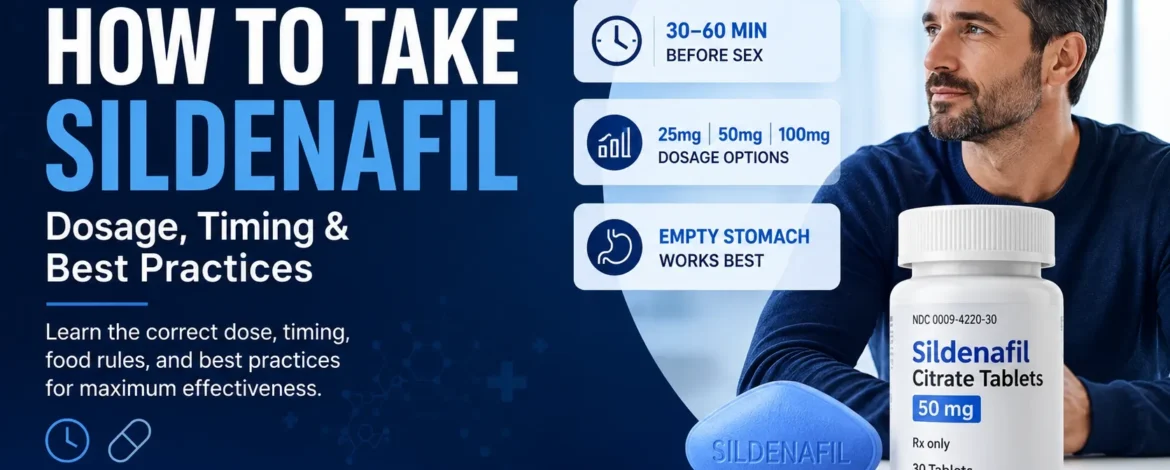
Sildenafil for ED is available in three standard doses. Your doctor will prescribe the dose that is most appropriate for your age, health profile, and severity of ED:
| Dose | Who It Is Typically Prescribed For |
|---|---|
| 25 mg | Older men (65+), men with mild ED, or those with liver/kidney conditions where lower drug exposure is preferred. Also a step-down dose if 50 mg causes unwanted side effects. |
| 50 mg | The standard starting dose for most men. Effective for mild-to-moderate ED and well tolerated by the majority of first-time users. |
| 100 mg | Prescribed when 50 mg has not produced adequate results. The maximum approved dose for Viagra branded Sildenafil. Should only be used under doctor guidance. |
Your doctor may also prescribe Sildenafil in 20 mg increments (a dose associated with the Revatio brand) for off-label ED use. In these cases, multiple tablets are taken together to reach an equivalent therapeutic dose — always follow the instructions provided.
Important Dosing Rules
- Never take more than 100 mg of Sildenafil in a 24-hour period.
- Do not self-adjust your dose without consulting your doctor.
- If 50 mg is effective but causing side effects, a reduction to 25 mg may improve tolerability.
- If 50 mg produces no results after 8 separate attempts, speak to your doctor about titrating up to 100 mg — not about taking two doses.
When to Take Sildenafil: The Timing Window
Sildenafil is an as-needed medication — you take it only when you plan to be sexually active, not on a daily schedule (unless specifically instructed by your doctor).
The optimal timing window is:
- Ideal: 60 minutes before sexual activity — this is when peak blood concentration is typically reached.
- Acceptable: Anywhere from 30 minutes to 4 hours before sexual activity.
- Too early: Taking Sildenafil more than 4–5 hours before activity may result in reduced effectiveness as plasma levels decline.
- Never: More than once within a 24-hour period.
Most men find that taking Sildenafil 45 to 60 minutes before planned activity strikes the best balance between onset time and effect duration. The medication remains active in the bloodstream for approximately 4 to 6 hours, though the strongest effects are in the first 2 to 3 hours after ingestion.
Step-by-Step: How to Take Sildenafil for the First Time
If you are new to Sildenafil, this step-by-step guide will help you use it correctly from day one:
- Step 1 — Start with the prescribed dose. Do not take more than your doctor has recommended, even if you feel the lower dose may not be strong enough. Give it a fair trial first.
- Step 2 — Take it on an empty stomach or after a light, low-fat meal. A heavy or high-fat meal consumed within an hour can delay onset significantly — by up to 60 minutes — and reduce the medication’s peak concentration in the blood.
- Step 3 — Swallow the tablet whole with a full glass of water. Do not crush or chew the tablet. Do not take it with grapefruit juice.
- Step 4 — Wait at least 30 to 60 minutes before attempting sexual activity. Use this window for foreplay or intimacy — sexual stimulation is what activates the drug’s effect.
- Step 5 — Ensure you are relaxed. Anxiety, stress, and performance pressure can all counteract Sildenafil’s effect even at the correct dose. A calm mental state significantly improves outcomes.
- Step 6 — If the first attempt does not produce the desired result, do not immediately double the dose. Guidelines recommend trying the same dose on at least 8 separate occasions before concluding it is ineffective.
Food Rules: What to Eat (and Avoid) Before Taking Sildenafil
High-fat meals
A high-fat meal eaten within an hour before taking Sildenafil can significantly reduce how quickly the drug is absorbed. Clinical data shows that a high-fat meal lowers the peak plasma concentration of Sildenafil and delays the time to peak effect. In practical terms, you may experience a longer wait for the medication to take effect, or find it less effective than expected.
For best results, take Sildenafil on an empty stomach or following a light, low-fat snack — such as fruit, toast, or a salad — rather than after a full meal.
Grapefruit and grapefruit juice
Grapefruit and grapefruit juice contain compounds (furanocoumarins) that inhibit the CYP3A4 enzyme — the enzyme responsible for metabolizing Sildenafil in the liver. When this enzyme is blocked, Sildenafil stays in the bloodstream longer and at higher concentrations than intended, increasing the risk of side effects such as flushing, headache, and low blood pressure.
Avoid grapefruit and grapefruit juice for at least 24 hours before taking Sildenafil. If you regularly consume grapefruit, mention this to your prescribing doctor.
Alcohol
Moderate alcohol intake — one to two standard drinks — is generally considered unlikely to cause serious harm when combined with Sildenafil. However, alcohol is a vasodilator (it lowers blood pressure), and so is Sildenafil. Combining the two can amplify blood pressure reduction, increase dizziness, and reduce your ability to achieve and maintain an erection.
Heavy drinking significantly impairs erectile function independent of any medication. It is strongly advisable to keep alcohol intake minimal when taking Sildenafil.
| Substance | Effect on Sildenafil | Recommendation |
|---|---|---|
| High-fat meal | Delays absorption by up to 60 min, reduces peak levels | Avoid within 1 hour of dosing |
| Grapefruit juice | Raises drug concentration, increases side effects | Avoid for 24 hours before dosing |
| Light meal / snack | Minimal impact on absorption | Safe to take with |
| 1–2 units of alcohol | Mild additive blood pressure reduction | Acceptable with caution |
| Heavy alcohol (3+ units) | Reduces efficacy, worsens dizziness and flushing | Avoid |
Drug Interactions: What Not to Take With Sildenafil
Sildenafil interacts with several medication classes. Always disclose your full medication list to your doctor before starting Sildenafil:
| Medication / Substance | Interaction & Risk |
|---|---|
| Nitrates (e.g. nitroglycerin, isosorbide) | ABSOLUTE CONTRAINDICATION. Combined use causes severe, potentially fatal drop in blood pressure. |
| Alpha-blockers (e.g. tamsulosin, doxazosin) | Can cause significant blood pressure drop. Use with caution; dose separation may be required |
| Other PDE5 inhibitors (tadalafil, vardenafil) | Never combine. Risk of additive cardiovascular effects and hypotension. |
| CYP3A4 inhibitors (e.g. ketoconazole, ritonavir) | Increase Sildenafil blood levels — dose reduction may be needed. |
| Certain antibiotics (e.g. erythromycin) | May slow Sildenafil metabolism; monitor for increased side effects. |
| Blood pressure medications (antihypertensives) | Additive blood pressure-lowering effect; discuss adjustment with your doctor. |
How to Maximize Sildenafil’s Effectiveness
Several lifestyle and behavioral factors can significantly affect how well Sildenafil works for you, beyond simply following the dosing instructions:
- Manage stress and performance anxiety — Even at the correct dose, psychological tension can prevent an adequate erectile response. Deep breathing, mindfulness, and open communication with your partner before activity can help.
- Stay physically active — Regular cardiovascular exercise improves baseline erectile function by enhancing vascular health and nitric oxide production — the same pathway Sildenafil works through.
- Maintain a healthy weight — Obesity and metabolic syndrome are leading contributors to vascular ED. Even modest weight loss can improve response to Sildenafil.
- Avoid smoking — Smoking damages vascular endothelium and reduces nitric oxide availability, directly counteracting Sildenafil’s mechanism. Men who smoke are significantly more likely to have reduced Sildenafil efficacy.
- Get adequate sleep — Sleep deprivation lowers testosterone levels and impairs erectile function. Poor sleep quality is an underrecognized contributor to ED treatment resistance.
- Give it enough attempts — Guidelines recommend trialing Sildenafil on at least 8 separate occasions before drawing conclusions about its effectiveness at a given dose.
What to Do If Sildenafil Is Not Working
If you have taken Sildenafil correctly — on an empty stomach, 60 minutes before activity, without alcohol or grapefruit — and are still not seeing results, do not increase the dose on your own. There are several possible explanations worth discussing with your doctor:
- The dose may need adjusting — Moving from 50 mg to 100 mg under medical supervision may improve results.
- Timing may need refining — Some men respond better at 60–90 minutes rather than 30 minutes.
- Psychological factors may be at play — Performance anxiety, depression, and relationship stress can override the pharmacological effect of Sildenafil. A referral to a sex therapist or psychologist may be appropriate.
- An underlying health condition may be contributing — Uncontrolled diabetes, low testosterone, thyroid dysfunction, or cardiovascular disease can all reduce Sildenafil’s effectiveness and need to be addressed directly.
- A different medication may be more appropriate — Tadalafil (Cialis), which has a 36-hour window of activity, may suit men who prefer less time-sensitive dosing.
Side Effects to Be Aware Of
Common side effects (usually mild and temporary)
- Headache — the most frequently reported side effect, caused by vasodilation
- Facial flushing and warmth
- Nasal congestion
- Indigestion or stomach upset
- Dizziness or lightheadedness
- Temporary visual changes — a slight blue tint, increased light sensitivity, or blurred vision
Serious side effects (seek immediate medical attention)
Seek Emergency Care Immediately If You Experience:
- Sudden loss of vision in one or both eyes — may indicate non-arteritic anterior ischemic optic neuropathy (NAION).
- Sudden decrease in hearing or complete hearing loss.
- Chest pain, irregular heartbeat, or difficulty breathing during or after sexual activity.
- Priapism — a painful erection lasting more than 4 hours that does not subside. This is a medical emergency requiring urgent treatment.
- Severe allergic reaction: rash, swelling of the face, throat, or tongue, difficulty breathing.
Storage and Handling
- Store Sildenafil tablets at room temperature — between 15°C and 30°C (59°F to 86°F).
- Keep tablets away from moisture and direct sunlight. Do not store in the bathroom.
- Keep out of reach of children and pets.
- Do not take expired tablets. Check the expiry date on the packaging before use. Expired Sildenafil may be less effective and could have altered chemical composition.
- Do not remove tablets from their blister packaging until you are ready to take them.
Frequently Asked Questions
Q: How long before sex should I take Sildenafil?
The ideal time to take Sildenafil is 60 minutes before planned sexual activity. However, the medication can be effective anywhere from 30 minutes to 4 hours after ingestion. Most men find the 45-to-60-minute window produces the most consistent results. Taking it earlier than 4 hours may result in reduced effectiveness as the drug’s plasma concentration begins to decline.
Q: Can I take Sildenafil every day?
Sildenafil for ED is typically prescribed as an as-needed medication — taken only when sexual activity is anticipated, not on a daily schedule. However, low-dose daily Sildenafil is sometimes prescribed off-label for certain conditions. Do not take Sildenafil more than once in any 24-hour period. If you are considering daily use, discuss this explicitly with your doctor.
Q: Does it matter if I take Sildenafil with food?
You can take Sildenafil with or without food, but the type of meal matters. A high-fat meal taken within an hour of your dose can delay the drug’s onset by up to 60 minutes and lower its peak blood concentration, reducing effectiveness. For fastest, most reliable results, take Sildenafil on an empty stomach or after a light, low-fat snack.
Q: What happens if Sildenafil 50 mg doesn’t work?
First, ensure you have given the medication a genuine trial — at least 8 attempts at the same dose, taken correctly (empty stomach, 60 minutes before activity, without alcohol or grapefruit). If results are still inadequate, consult your doctor about titrating up to 100 mg. Do not take two 50 mg tablets on your own initiative. Your doctor may also want to investigate underlying health factors contributing to reduced response.
Q: Can I drink alcohol before taking Sildenafil?
Light alcohol consumption — one to two units — is generally considered unlikely to cause serious harm. However, both Sildenafil and alcohol lower blood pressure, and combining them can amplify this effect, causing dizziness and reducing erectile quality. Heavy drinking significantly impairs erectile function independently of any medication and should be avoided. For the best outcome, keep alcohol to a minimum on the day you plan to take Sildenafil.
Q: Why is sexual stimulation necessary for Sildenafil to work?
Sildenafil does not produce an automatic erection. It works by enhancing the body’s natural erectile response to sexual arousal — specifically by preserving cGMP levels that are triggered by nitric oxide release during stimulation. Without sexual arousal, nitric oxide is not released in sufficient quantities, cGMP does not accumulate, and Sildenafil cannot produce its effect. This is one of the most common reasons first-time users report disappointment with the medication.
Conclusion
Taking Sildenafil correctly is not complicated — but the details matter. Timing, food choices, alcohol intake, mental state, and dose all influence how well the medication works. The most common reason men feel Sildenafil has failed them is not the drug itself, but how it was used.
Follow these core principles: take it 60 minutes before activity, on a light stomach, without grapefruit or heavy alcohol, and ensure sexual stimulation is present. If results are still unsatisfactory after multiple correct attempts, speak with your doctor about dose adjustment or alternative ED treatments rather than self-medicating.
Sildenafil is one of the most well-studied medications in men’s health, with a proven safety record spanning more than 25 years. Used correctly, it is a reliable and effective treatment for the majority of men with ED.